
Strategy & Transformation
How to Calculate ROI for AI and Software Modernization
A practical, finance-ready framework for comparing AI and modernization investment with the current-state cost, realistic benefits, delivery risk and time to value.
operationalwrocław--:-- cet
∕ insights / best-agentic-ai.md
Best Agentic Ai
Compare the best agentic AI partners of 2026: strengths, trade-offs, pricing models, and how to pick the right one for engineering teams.
>_article.meta
Why compare platforms when your real problem is shipping reliable software faster with the same engineering headcount? Agentic AI promises more capacity, but the wrong delivery partner leaves your team maintaining demos, repairing integrations, and explaining why an ambitious program hasn't reached production.
The best agentic AI choice is a partner who owns the production result, not just the prototype. In McKinsey's 2025 global survey, 23% of organizations were scaling an agentic AI system in at least one business function, while another 39% were experimenting. Adoption is real. Enterprise-wide autonomy isn't the default.
For SaaS founders, CTOs, and modernization leaders, the buying decision should center on time to market, cost predictability, risk control, and production accountability. A reusable agent framework can help, but it won't resolve unclear requirements, inaccessible data, or missing operational ownership.
This ranking prioritizes delivery fit over platform popularity. Choose a focused engineering partner for a bounded release, an enterprise consultancy for cross-functional transformation, or a specialist for a controlled pilot. Your shortlist should match the work you need delivered and the risks you need someone to own.
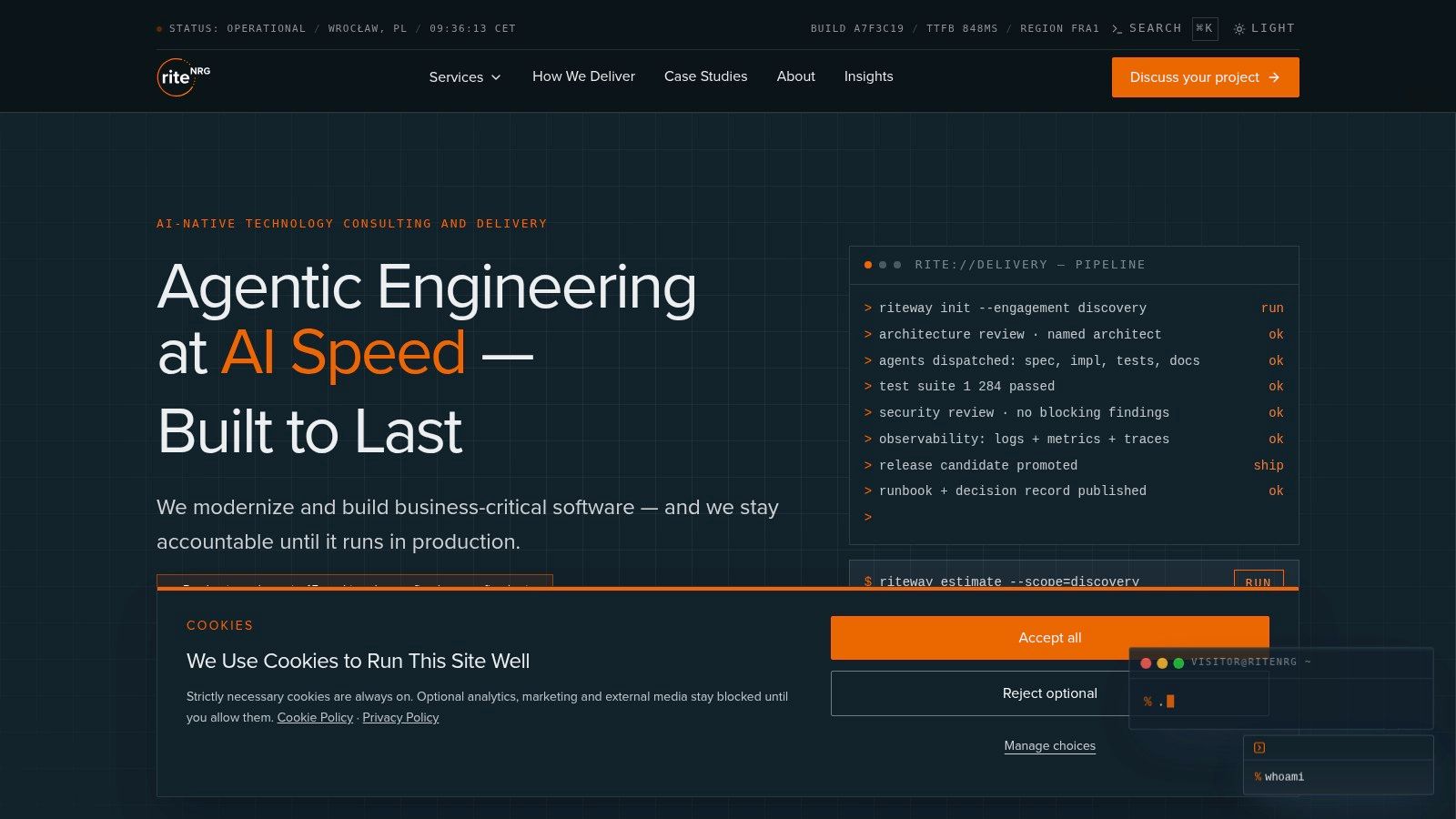
Best for startups, scale-ups, and enterprises that need AI-native engineering with senior production ownership. We're a Poland-based technology consultancy combining software development, modernization, AI consulting, dedicated teams, and managed operations.
Our agents support discovery, specifications, implementation, testing, documentation, and release. Our architects and engineers remain accountable for architecture, data, integrations, security, testing, and production quality. AI changes delivery economics, not engineering standards.
The #riteway methodology turns Extreme Ownership into delivery practices. We identify data and integration risks early, communicate uncertainty and trade-offs transparently, move blocked decisions forward, and take responsibility for the complete result rather than handing off generated code.
For a fast-growing fintech, we built an AI assistant whose financial advisors save around 75% of the time spent on ongoing advice administration and 80% on meeting notes. Those are outcomes from that implementation, not a blanket promise for every agent project.
The trade-off is scope discipline. The release commitment isn't suitable for an undefined transformation with unresolved dependencies, and there's no general published price list. An AI opportunity assessment, readiness review, or roadmap is available for a fixed fee priced by complexity.
Choose this approach when you want a strategic engineering partner who'll challenge an unnecessary AI investment, use conventional software where it's simpler, and remain responsible for what reaches production.
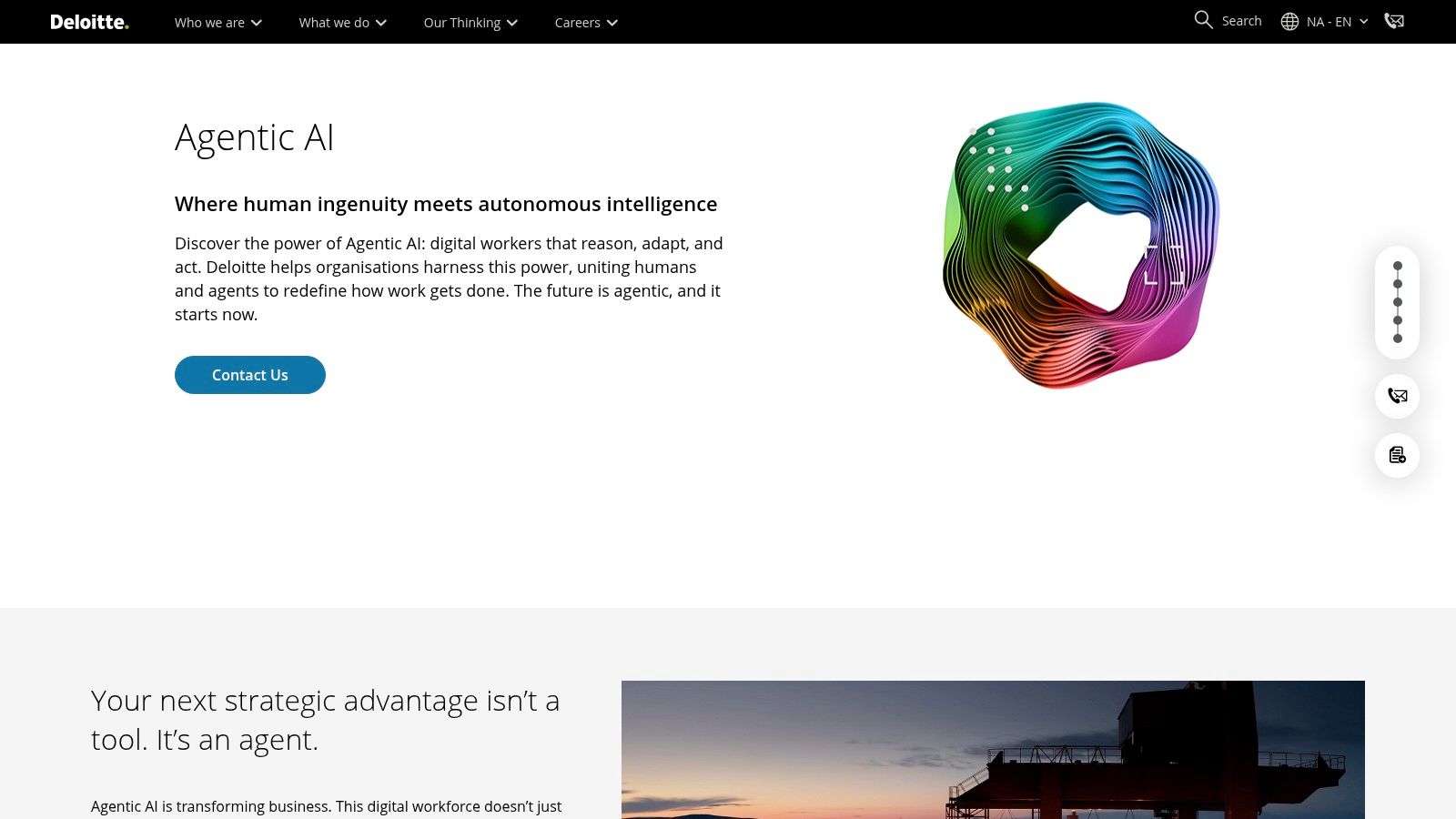
Choose Deloitte for enterprise-wide transformation that requires coordinated strategy, governance, engineering, and operations. It's a stronger fit for a complex organization connecting multiple functions than for a founder commissioning a compact MVP.
Deloitte's agentic AI services span strategy, design, development, deployment, and ongoing optimization. Its offering includes custom agents, multi-agent systems, reusable frameworks, governance, trust monitoring, and managed services.
That breadth matters when technology is only part of the constraint. A customer-operations program, for example, may require process redesign, permissions across business systems, employee training, and an operating model that survives the initial launch.
Practical rule: Buy enterprise transformation when you need coordinated organizational change. Don't buy it merely because your workflow uses an AI agent.
Deloitte's strongest fit is a program where reducing advisory-to-engineering handoffs matters as much as building the agent. Evaluate its proposal against business-function ownership, integration milestones, post-launch monitoring, and measurable service improvements.
Use a practical AI governance framework for growing companies to make approval rights, incident ownership, and escalation paths concrete before procurement.
Recommendation: Shortlist Deloitte when organizational coordination and governance are major delivery risks. Define a bounded initial workflow so the broader program still has a clear route to measurable value.
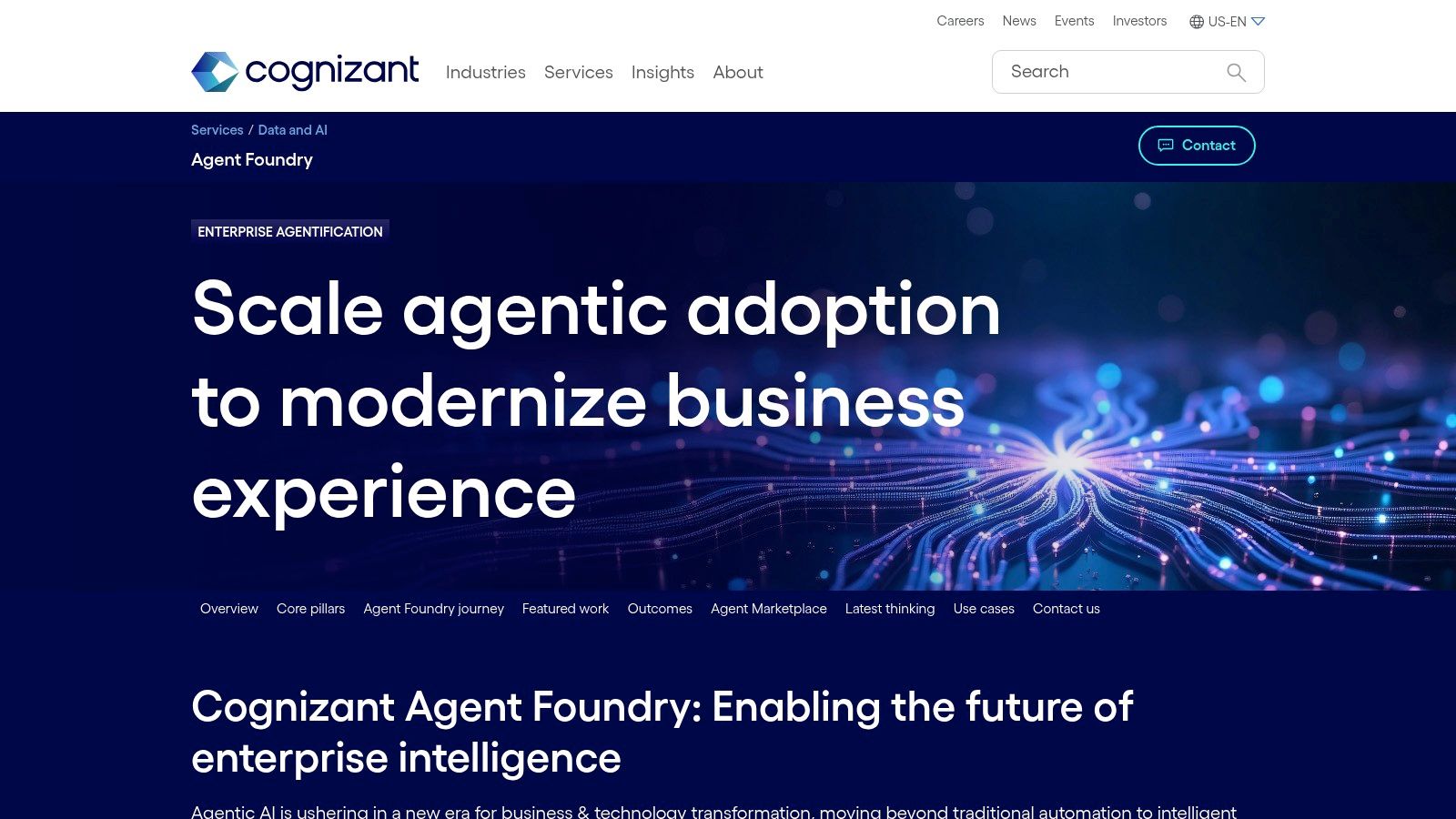
An enterprise planning agents across several business processes shouldn't rebuild its operational foundations for every deployment. Cognizant Agent Foundry is the strongest fit here for buyers seeking reusable assets alongside consulting and implementation.
Cognizant's enterprise agent development offering combines use-case selection and process design with agent engineering and scaling. Agent Foundry Composer supports grounding, building, and deployment, while Agent Foundry Ops covers observability, governance, financial operations, and lifecycle management.
Its prebuilt agent catalogue, templates, and connectors can reduce the amount of foundational work a team must commission from scratch. The buying question is whether those assets fit your actual systems, access rules, and business exceptions.
A procurement workflow and a support workflow might share monitoring infrastructure. They still need different authorization boundaries, acceptance tests, and escalation logic.
Use this guide to building an agentic AI system for production to structure the acceptance discussion around integrations, evaluations, and operational controls.
Recommendation: Choose Cognizant when you expect repeat deployments and want shared enterprise foundations. Measure the benefit through deployment effort, cost per completed workflow, and operational consistency, not the number of agents available in a catalogue.
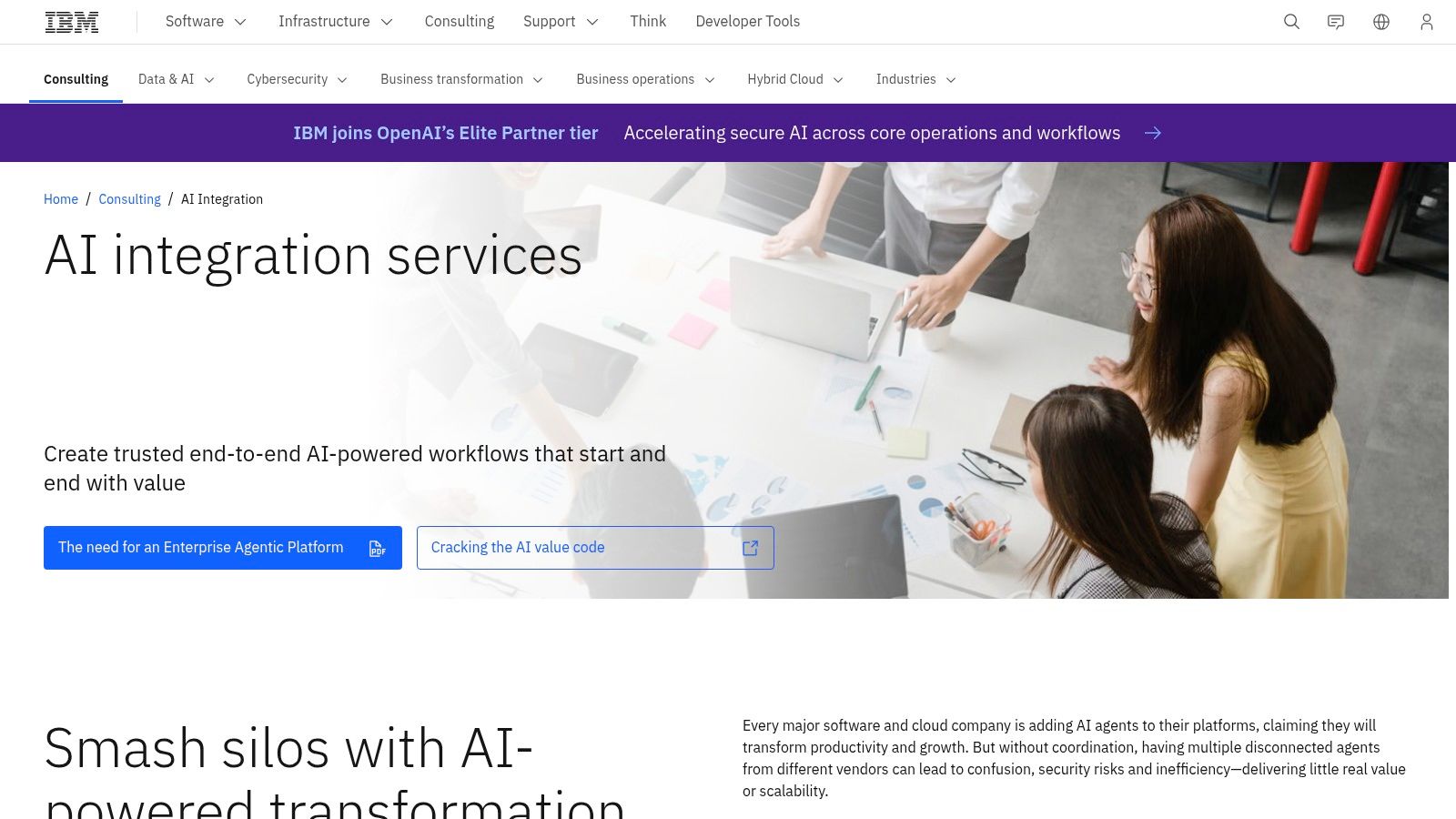
Keep your established cloud environment central to the decision. IBM Consulting Enterprise Advantage deserves a place on the shortlist when an enterprise wants governed agent adoption without engineering an entire AI platform itself.
IBM Consulting's AI integration services combine consulting expertise with platform assets and implementation support. Enterprise Advantage pairs IBM Consulting Advantage assets with a marketplace of agentic applications, with an announced focus that includes organizations using Microsoft Azure.
For an Azure-heavy enterprise, that alignment is a reason to investigate fit, not proof that every integration will be straightforward. Map identity, data access, deployment, and monitoring requirements against the proposed architecture before committing.
An existing cloud investment is useful only when the proposed agent architecture respects your security boundaries and operating model.
IBM's approach fits buyers who need strategy, industry context, and implementation support within an established technology estate. The opportunity is to reuse suitable assets while retaining control over how agents interact with business systems.
The advantages are consulting depth, platform assets, and an emphasis on governed scaling. The limitations are potential complexity for smaller teams and the need to clarify exactly which assets, applications, services, and operational responsibilities the engagement includes.
Pricing is quote-based and isn't publicly listed. Because Enterprise Advantage is a relatively new service, make relevant production references and an explicit responsibility matrix part of technical diligence.
Recommendation: Shortlist IBM for enterprise integration, especially where Microsoft alignment matters. Tie acceptance to a functioning, monitored business workflow, not platform configuration or access to an application marketplace.
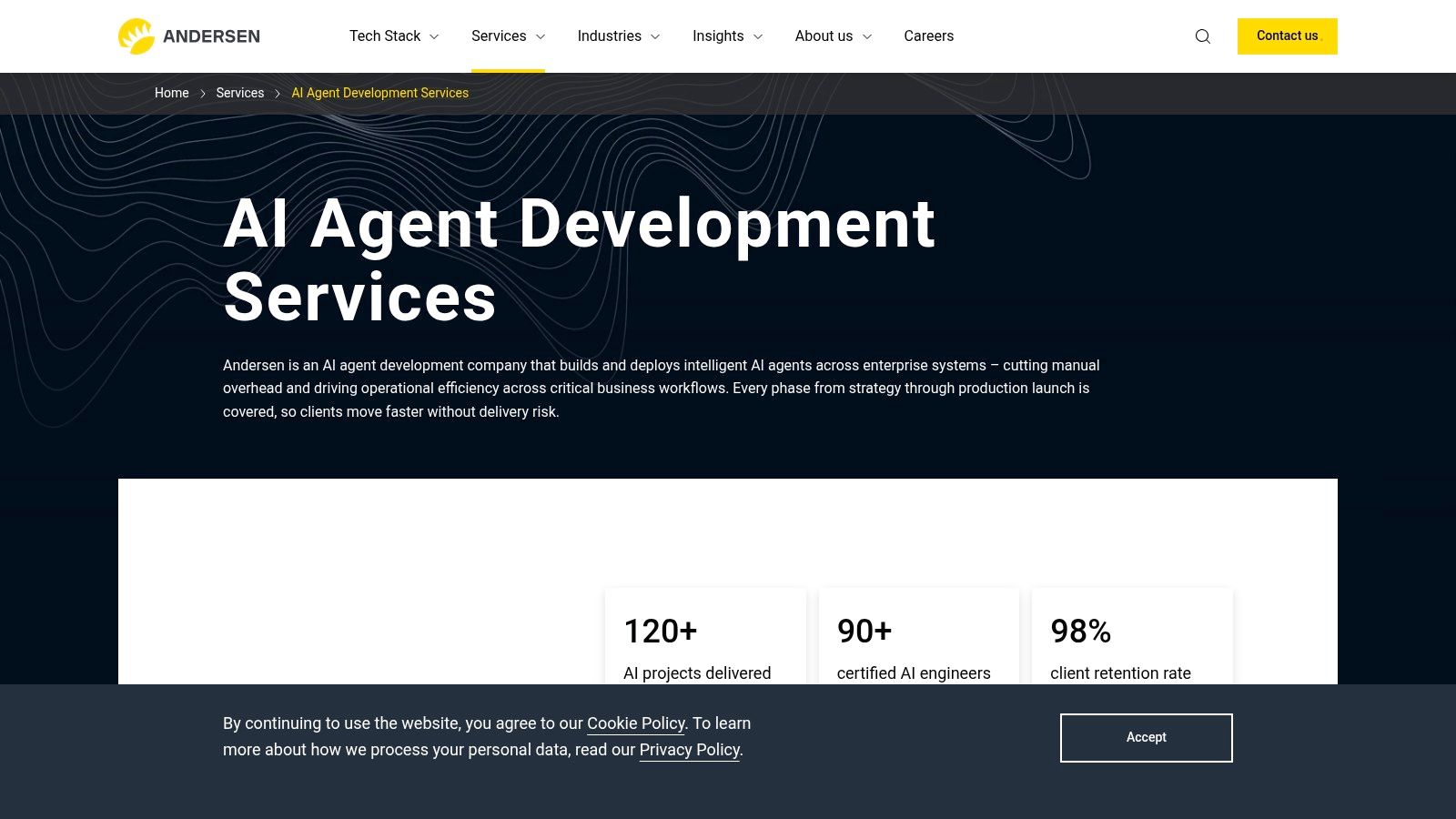
Say your support agent must retrieve customer history, check an ERP order, update a helpdesk ticket, and escalate a disputed refund. The difficult purchase isn't conversational AI. It's dependable integration engineering.
Andersen's AI agent development services cover discovery, architecture, custom single-agent and multi-agent systems, testing, deployment, and maintenance. Its stated capabilities include retrieval-augmented knowledge agents, workflow orchestration, and integrations with CRM, ERP, helpdesk, and legacy systems.
Andersen offers fixed-scope and time-and-materials engagements, with custom estimates. Use fixed scope when interfaces, permissions, acceptance criteria, and business rules are understood; use time and materials when discovery must resolve material technical unknowns.
Neither model replaces delivery governance. A fixed-scope contract needs clear exclusions and change control, while time and materials needs prioritized milestones, budget visibility, and regular demonstrations against acceptance tests.
The principles in choosing a modern software development partner apply directly: assess architecture ownership, delivery transparency, and maintainability alongside technical skills.
Recommendation: Choose Andersen when the agent is part of a broader integration project. Define success as a correctly completed business transaction, with safe exception handling, rather than a convincing response in a chat window.
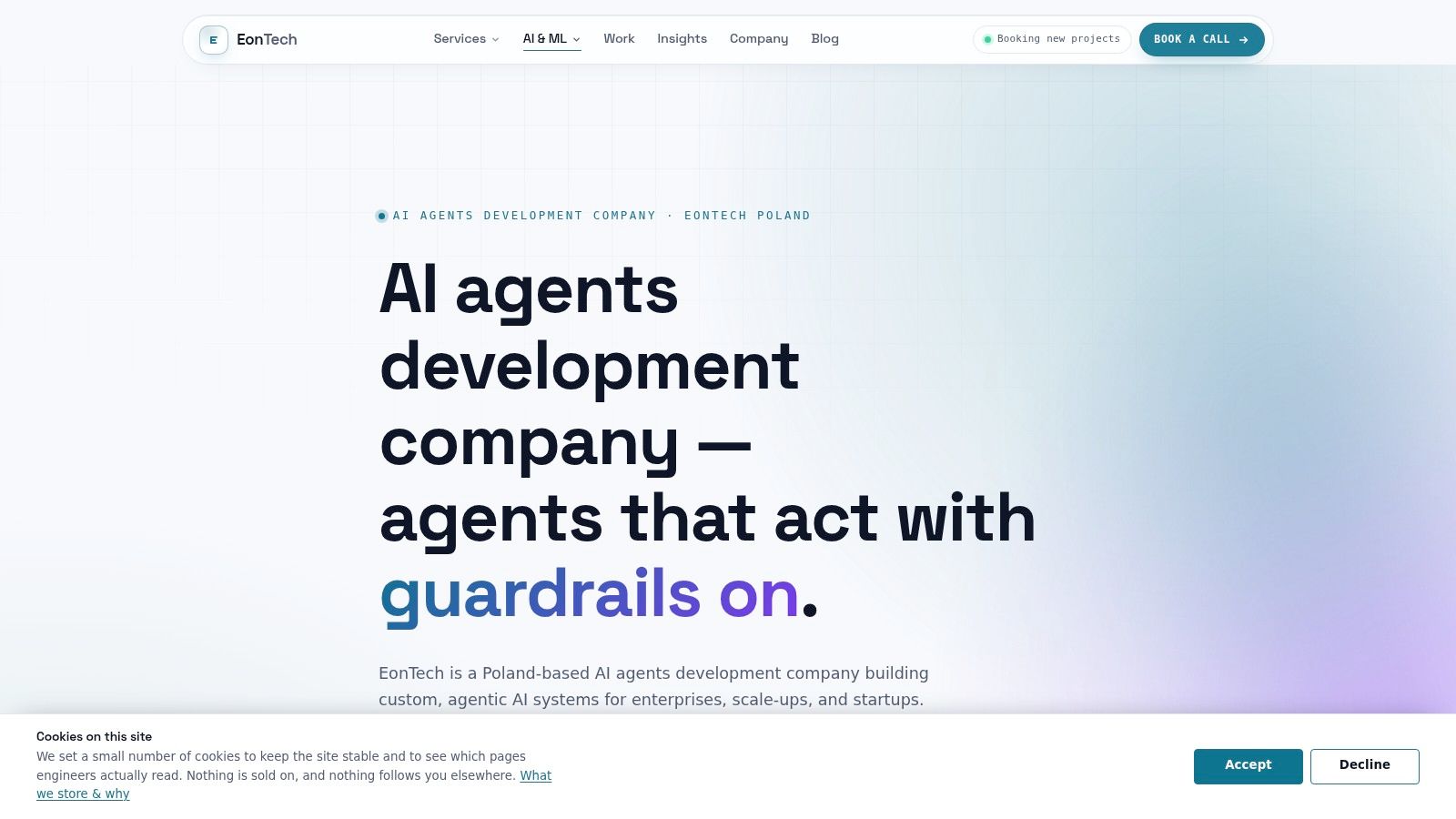
EonTech is a focused option for teams that want custom agents with explicit operational controls. The Poland-based provider emphasizes permissioned tool use, multi-step orchestration, evaluations, observability, and rollback.
EonTech's agent development offering includes deployment in the client's cloud environment, proprietary and open-weight model options, and enterprise features such as single sign-on and role-based access control. Its stated commercial formats include monthly rolling engagements and a fixed-scope discovery-and-prototype option.
A specialist engagement is useful when your internal team already owns product strategy and needs concentrated agent engineering. Keep the pilot narrow, but test it against incomplete inputs, unavailable tools, duplicate requests, and unauthorized actions.
In ReliabilityBench, agents with a 96.9% pass rate under unchanged conditions fell to 88.1% under moderately perturbed tasks. That finding makes repeatability under changing conditions a better buying criterion than a polished demonstration.
Acceptance test: Interrupt a tool call, change an input, and remove a permission. Evaluate whether the agent recovers safely or escalates clearly.
Advantages include operational-control emphasis, flexible model choices, and engagement formats that support testing before expansion. Limitations include unpublished pricing and less breadth than a large consultancy for organization-wide change.
Verify the proposed security architecture, evaluation artifacts, and rollback behavior during technical diligence. Client-cloud deployment alone doesn't establish that access controls or recovery procedures are adequate.
Recommendation: Shortlist EonTech for a bounded production-engineering engagement when you have internal leadership ready to own process adoption and business outcomes.
Choose Mobile Reality when agent development must sit alongside broader SaaS or product engineering. Its offering combines custom software development with agents for sales, document processing, customer support, and internal operations.
That combination matters when the work includes an application interface, backend services, integrations, and human approval screens. An agent specialist alone may not cover the whole product backlog.
Mobile Reality lists indicative development rates of $45–$65 per hour, UX/UI and QA rates of $40–$50 per hour, and states that project starts are often possible within two weeks. Those rates aren't a fixed price for an agent implementation, and the start window isn't a release commitment.
Build the budget around discovery, engineering, design, QA, integrations, evaluation, infrastructure, and ongoing support. Include human-review effort and model usage when comparing the proposed operating cost with your current workflow.
For a SaaS founder, the strongest reason to shortlist Mobile Reality is combined product and agent execution. For a heavily regulated enterprise transformation, prioritize evidence of the specific governance and operational capabilities your program requires.
Recommendation: Use it for product-centered automation where interface design, application engineering, and agent behavior need coordinated delivery. Compare the full team estimate and production responsibilities, not hourly rates alone.
| Best for | Engagement Model | Pricing Transparency | Standout Strength |
|---|---|---|---|
| Rite NRG: AI-assisted software delivery and modernization | Consulting, specialists, dedicated teams, managed services; fixed-scope offer for qualifying projects | Fixed price for eligible scoped projects; other pricing not published | AI-assisted engineering with senior human ownership and a 45-working-day production-release offer |
| Deloitte: Enterprise-wide agentic AI transformation | Strategy, design, development, deployment, and ongoing operations | Quote-based; pricing and project minimums not published | Broad enterprise services with governance and monitoring |
| Cognizant Agent Foundry: Enterprise agent design and scaling | Consulting and implementation using reusable tools, templates, and platform capabilities | Quote-based; public pricing not listed | Reusable agent assets paired with observability and governance |
| IBM Consulting Enterprise Advantage: Governed agentic AI scaling, especially for Azure-heavy organizations | Consulting and implementation with platform assets and an agentic application marketplace | Quote-based; public pricing not listed | Combines consulting and platform assets for governed scaling |
| Andersen: Custom agents integrated with business systems | Fixed-scope or time-and-materials engagements | Custom estimates; no standard rates listed | End-to-end development, integration, testing, and support |
| EonTech: Production-focused custom agents and workflows | Monthly rolling engagements or fixed-scope discovery and prototype | Prices not published | Emphasis on evaluation, observability, guardrails, and private deployment |
| Mobile Reality: Agent workflows alongside broader product engineering | Custom development with ongoing optimization and human oversight | Indicative hourly rates published; total project costs depend on scope | Combines agent development with full-stack product engineering |
Start with process economics, not a preferred model. Define the workflow, current handling effort, delay, rework, and failure cost, then specify the outcome you're buying: faster release cycles, lower cost per resolved request, greater capacity, or reduced operational risk.
For engineering delivery, the DORA metrics guide provides measures covering change lead time, deployment frequency, failed deployment recovery time, and change failure rate. Track speed and stability together so increased code output doesn't conceal more incidents or recovery work.
The NIST AI Risk Management Framework calls for documented roles, responsibilities, and communication lines. Translate that into named decision-makers and explicit approval boundaries, not a vague promise of human oversight.
The best agentic AI partner is the one whose delivery model fits your next production outcome. Give shortlisted partners the same workflow, constraints, baseline, and acceptance criteria so their proposals are comparable.
Teams wanting a structured, fixed-scope route can explore our AI opportunity assessment and agentic delivery approach. We assess the business process, data readiness, risk, and operating ownership before choosing models or architecture.
Rite NRG combines AI opportunity assessment, senior-led engineering, and ongoing operations to turn agentic workflows into controlled production outcomes. Visit Rite NRG to discuss a priority workflow and define the scope, acceptance criteria, and accountable delivery team for your next release.
/ about the author
Written by the RITE NRG editorial team — the architects, engineers and delivery leads who build and operate AI-era software for our clients.
Strategy & Transformation
A practical, finance-ready framework for comparing AI and modernization investment with the current-state cost, realistic benefits, delivery risk and time to value.
Technology Talent & Teams
A decision-maker's guide to IT partnership models: what each model actually transfers to the partner, what it costs beyond the rate card, and how to match the model to your situation.
AI Consulting & Automation
A practical framework for choosing and deploying transport or logistics AI agents around real exceptions, reliable data and controlled operational authority.
More guidance: all insights articles
Tell us about the system or idea behind this article. We tell you honestly if it is a fit — and what a fixed-scope delivery could look like.