
Strategy & Transformation
How to Calculate ROI for AI and Software Modernization
A practical, finance-ready framework for comparing AI and modernization investment with the current-state cost, realistic benefits, delivery risk and time to value.
operationalwrocław--:-- cet
∕ insights / ai-readiness-assessment.md
AI Readiness Assessment
An AI readiness assessment scores data, technology, people and governance against a real business outcome, then shows what to fix first.
>_article.meta
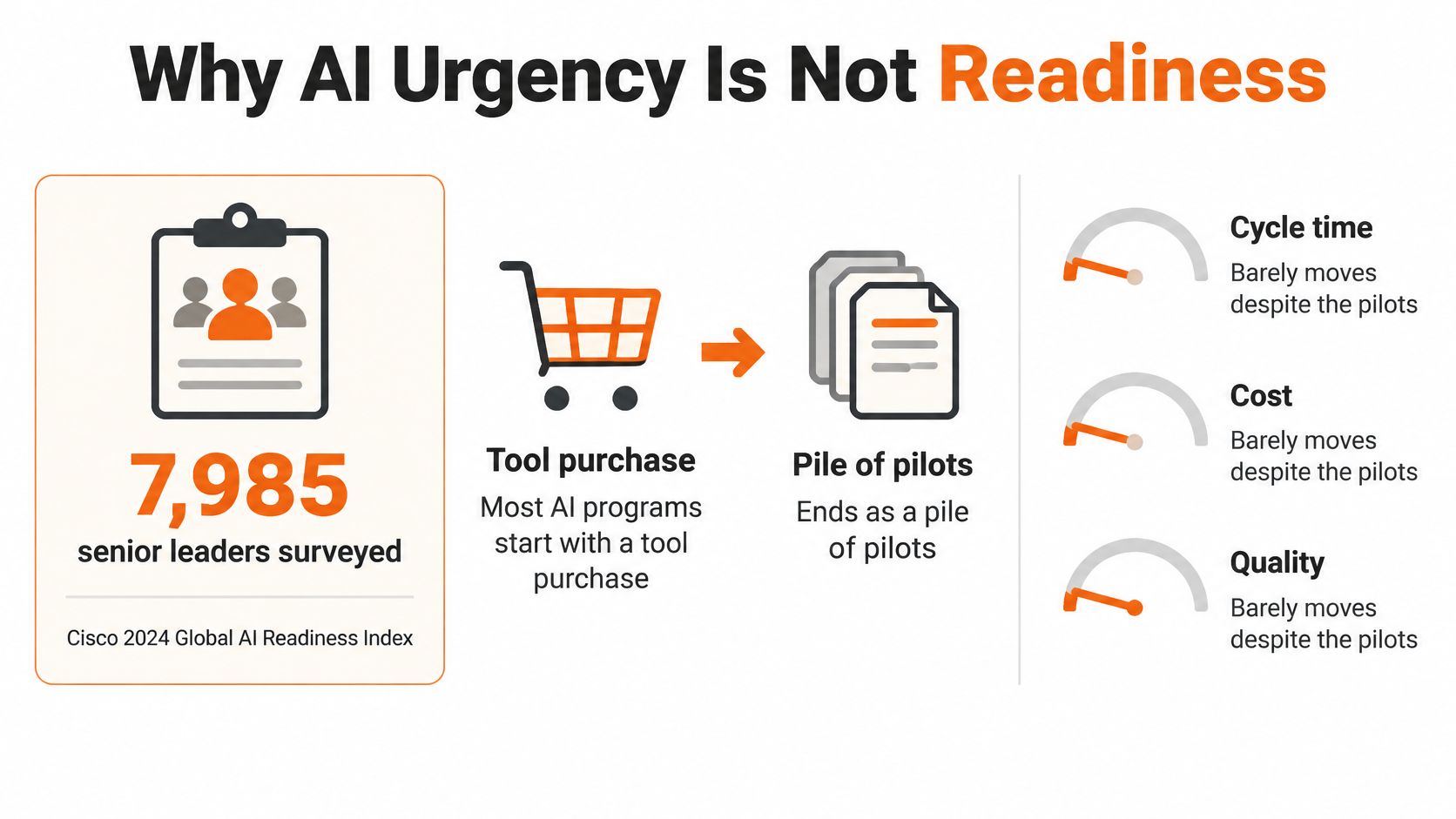
Support costs keep rising while the team launches another AI pilot. That's the problem an assessment should solve. In Cisco's 2024 AI Readiness Index, 98% of companies reported greater urgency to deploy AI during the previous year. Urgency, though, doesn't tell a product leader whether customer replies will get faster, costs will fall, or production will remain safe.
Buying an AI tool is easy. Making it improve a business-critical workflow takes accountable decisions about data, integrations, operating costs, and the people who'll handle mistakes.
Cisco's 2024 Global AI Readiness Index surveyed 7,985 senior business leaders responsible for AI integration at organizations with at least 500 employees across 30 markets, with only 13% of organizations classified as fully ready, according to the index findings summarized in the OECD's artificial intelligence policy context. That's the useful tension: executive pressure can be high while operational preparedness remains low.
Don't interpret that gap as a reason to postpone every initiative. Interpret it as a reason to stop approving technology purchases without a named business result.
An AI readiness assessment is a structured review of whether one named workflow can deliver a measurable outcome in secure daily use. That outcome might be lower cost per support case, faster product delivery, greater processing capacity, fewer defects, or reduced operational risk.
The assessment should examine business outcome, data, technology, people, and governance. Its output is a decision to proceed, narrow the scope, or stop, not a maturity badge for a presentation.
The distinction between buying tools and improving operations is worth making visible.
A product owner should define the business change. A senior engineer should own technical feasibility and production quality. The operating owner should confirm who handles exceptions after launch. If those responsibilities are scattered across teams without a decision-maker, resolve that before adding automation.
For software workflows, DevArmor's guardrails for AI-generated code provide useful context for discussing code review and delivery controls. Treat those controls as part of readiness, not cleanup work after an agent has generated an implementation.
Practical rule: Approve the next piece of evidence, not the next tool purchase.
That's the #riteway methodology in action: Extreme Ownership, proactive problem-solving, transparent communication, and senior engineering accountability. We identify risks early, make trade-offs explicit, and move decisions forward. Completing assigned tasks isn't enough if the workflow still can't operate safely or deliver the intended result.
AI readiness scorecard by lens
| Lens | What to examine | Evidence of ready | Red flag |
|---|---|---|---|
| Business outcome | Baseline, owner, target metric and stop rule | Named KPI with a before-and-after measure | No owner or no decision rule |
| Data | Quality, access, lineage and interoperability | Records the workflow needs are available and governed | Critical fields missing or trapped in one system |
| Technology | Integrations, security, observability and rollback | System of record connected, logs and a tested rollback | Demo-only model with no production path |
| People | Skills, process owner and change capacity | Owner plus people who can run the workflow daily | Enthusiasm without an operating owner |
| Governance | Risk, human approval, audit and incident ownership | Approval steps, logs and a named incident owner | Autonomous action with no exception path |
Complete this scorecard for a workflow such as drafting support replies from approved product documentation. Don't complete it for an entire SaaS company. The narrower scope makes evidence inspectable and disagreements actionable.
For the business-outcome lens, attach a baseline report and the owner's acceptance criteria. Define the target as a change in processing time, cost per case, quality, or another operational measure, not the number of employees using an AI tool.
For data, inspect actual records. Ask the data owner to show whether the required fields exist, whether their meaning is consistent across systems, and whether access permissions survive retrieval. A document inventory doesn't prove that a support agent can safely retrieve the right customer's information.
Technology evidence should include an integration test, traceable logs, and a demonstrated recovery path. The engineering lead should explain what happens when the model times out, a dependency changes, or an external service returns incomplete information.
People readiness means someone can operate the changed process. If hiring is part of closing that gap, MyCulture.ai's AI readiness screening for hiring can inform the skills discussion. It doesn't replace testing whether candidates can evaluate outputs and handle exceptions in your intended workflow.
The OECD's digital economy analysis reports that, in its 2025 D4SME survey, 25% of businesses with basic or developing digital-tool usage employed AI, compared with 61% of businesses with advanced digital technology use. That adoption difference doesn't prove deployment success, but it supports examining digital foundations before funding a broad use-case portfolio.
A startup might need permissioned product data and observability. An enterprise might need legacy integration and a clear operating model. Neither should inherit the other's remediation backlog.
Use this working procedure:
The governance owner should also document who can approve actions, who receives incident alerts, and who can suspend the workflow. Those are operating responsibilities, not policy-document checkboxes.
How to act on an AI readiness score
| Band | Working range | What it means | Next move |
|---|---|---|---|
| Not ready | 0–40 | Foundations or the business metric are missing | Fix data access, ownership and a baseline before any pilot |
| Emerging | 41–60 | One narrow workflow may be viable | Pilot with human review and an explicit stop rule |
| Capable | 61–80 | A production path exists with named gaps | Close those gaps, then scale that workflow only |
| Ready for this use | 81–100 | Performance, failures, owners and monitoring are evidenced | Operate it and review the metric on a set cadence |
These are proposed working bands, not survey findings or validated predictions. Use them to organize a decision conversation, not to claim scientific precision. Keep the evidence and rationale beside every score so another reviewer can challenge it.
The calculation needs a visible warning: missing evidence isn't partial approval.
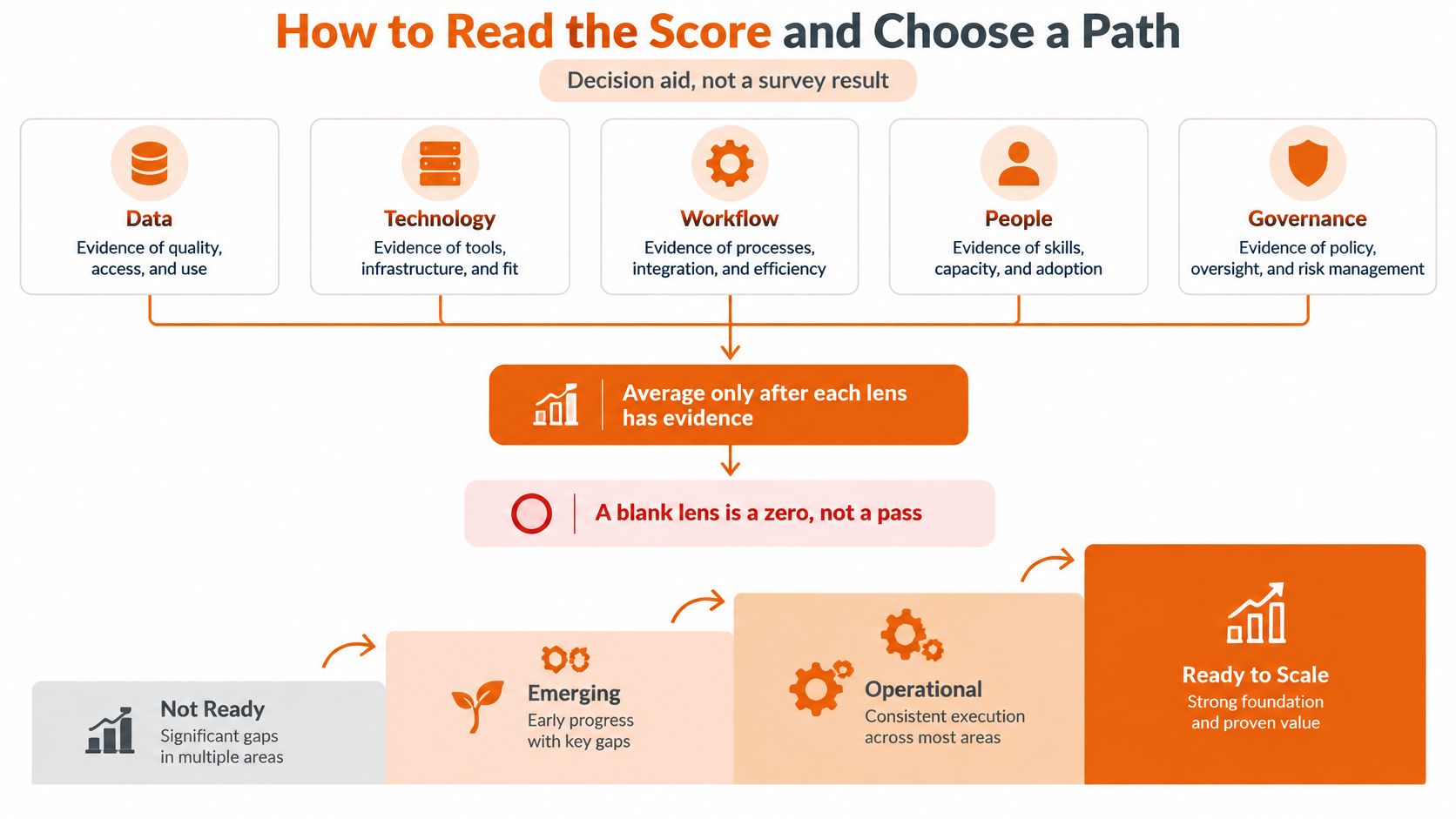
Apply the most restrictive unresolved condition before accepting the band's suggested next move.
Amber doesn't mean ignore the gap. It means the owner has defined a containment measure, a remediation task, and evidence that will close it.
An average describes the scorecard. The weakest critical lens determines what you're allowed to do.
Consider a hypothetical workflow with data 70, technology 75, people 60, governance 40, and business outcome 80. Its average is 65, placing it in the proposed capable band. Those numbers are illustrative, not observed results.
If governance is red because the agent can send customer commitments without approval, the workflow stays in a human-reviewed pilot. The score doesn't authorize autonomous sending.
The governance owner must define approval boundaries and exception handling. The engineering lead must demonstrate that the application enforces them. Only then should the decision-maker reconsider the operating scope.
Record the decision in plain language: fix the foundation, pilot with limits, or prepare a bounded production release. Add the accountable owner, the evidence still required, and the condition that would reverse the decision. That record is more useful than a score without consequences.
Reject the idea that a company is AI-ready. A business may be prepared for permissioned internal search while being unprepared for automated customer decisions. The consequences, evidence requirements, and operating responsibilities aren't interchangeable.
UK government AI adoption research found that 71% of businesses cited a lack of an identified AI use case as a barrier, while 60% cited limited AI skills or expertise. Start by identifying a problem worth removing, then assess the capabilities needed to remove it.
Readiness differs by workflow
| Workflow | Data you need first | Human oversight | Risk if wrong | Result to measure |
|---|---|---|---|---|
| Internal knowledge search | Indexed, permissioned documents | Review when citations fail | Low to moderate | Time to find an answer |
| Assisted customer replies | Representative transcripts and policy | Approve before send | Customer and brand harm | Handle time and reopen rate |
| Predictive maintenance | Reliable sensor and failure history | Planner confirms the work order | Missed failure or wasted visit | Downtime and maintenance cost |
| Autonomous process or code change | Evaluation set, logs and rollback | Human gate on high-impact actions | Operational, financial or compliance loss | Defects escaped and recovery time |
The risk labels are starting assumptions, not universal classifications. Internal search involving sensitive employee records needs stricter controls than search over approved public documentation. The risk owner should classify the intended use, not rely on the workflow's friendly name.
Compare candidates against data availability, integration effort, human oversight, regulatory exposure, expected value, and change capacity. Ask the process owner to describe what staff will do differently when the system launches.
For internal search, the information owner must resolve permissions and stale documents. For maintenance, the plant team must establish whether sensor readings can be connected to actual failure events. For autonomous changes, the engineering lead must bound the agent's authority before evaluating its speed.
Use AI use-case discovery focused on business value to challenge whether AI is the right intervention. Sometimes a better search index, a conventional rules engine, or a repaired integration removes the bottleneck with less operating risk.
Classify the shortlist decisively:
A lower company-wide maturity rating shouldn't block a well-contained opportunity. A higher rating shouldn't authorize unrelated automation.
Can the team demonstrate the workflow's behavior under realistic operating conditions? A completed questionnaire can't answer that. Require an operating test with explicit acceptance criteria.
The difference between self-reported readiness and demonstrated operation should be visible to everyone approving the release.
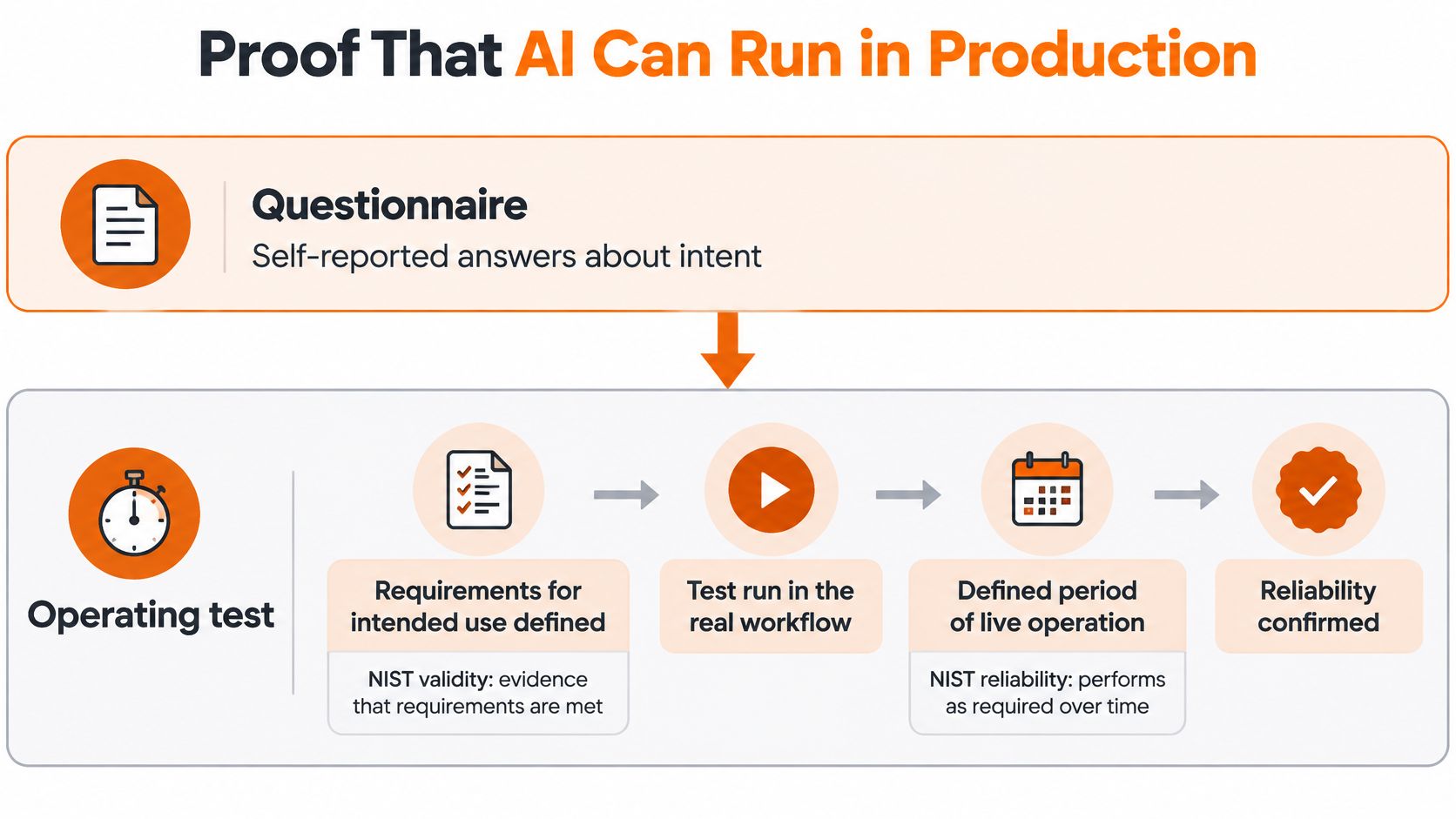
The NIST AI Risk Management Framework distinguishes validity, evidence that intended-use requirements are fulfilled, from reliability, performance over defined conditions and time. Translate that distinction into testable release requirements.
For generative outputs, NIST's Generative AI Profile recommends comparison with known ground truth and a combination of automated evaluation and human oversight. Document where the system must not be trusted, not just its average performance.
Choose measures that match the work. For document automation, Matil's error rate formulas for invoice processing offer a concrete starting point for defining mistakes consistently.
Under the European Commission's AI regulatory framework, high-risk systems require controls covering risk management, data quality, logging, documentation, human oversight, accuracy, reliability, and cybersecurity. Don't assume every workflow falls into that category.
The AI Act implementation FAQ gives entry into force as 1 August 2024, general-purpose model obligations from 2 August 2025, and transparency requirements from 2 August 2026, with high-risk obligations scheduled for 2 December 2027 for Annex III systems and 2 August 2028 for Annex I product-embedded systems. Have the regulatory owner verify the applicable classification and schedule before release.
The production discussion also needs a shared reference point.
Our technical and operational assessment reviews architecture, dependencies, security position, observability, and operational risk, then agrees what must be corrected first. To bridge the gap between an AI proof of concept and a production system, we assess architecture, data, security, evaluation, monitoring, and ownership, then deliver the gap as a bounded release with acceptance criteria.
AI changes delivery economics, not engineering standards. Agentic AI accelerates analysis, implementation, testing, migration, and documentation. Our senior architects and engineers remain accountable for the complete production result.
The following composite scenarios are illustrations, not client results. They show why similar headline scores can require very different investment decisions.
The useful comparison is what each team can prove and safely operate.

A product team wants AI to draft support replies. The product owner has a handle-time baseline and a target, but transcript permissions remain unclear. The helpdesk integration works, yet nobody has assembled an evaluation set for factual accuracy.
Support staff can review drafts, but governance is red if the application sends replies itself. Interpret the evidence as emerging readiness for assisted drafting, not readiness for autonomous customer communication.
The release should require human approval before sending and exclude records without confirmed permission. The support owner measures handle time and reopen rate over an agreed evaluation period. Stop the pilot if reopen rate rises beyond the agreed acceptance boundary, even if agents finish cases faster.
A manufacturer wants predictive maintenance for aging equipment. The maintenance director can describe downtime costs, but sensor history is incomplete and the maintenance platform requires a legacy integration.
Planners can interpret work orders, but nobody owns model performance. The operating policy also fails to identify who accepts or rejects a generated maintenance recommendation. A technically impressive prediction demo won't resolve those gaps.
The decision is not ready for prediction. Fund a data-and-integration release that connects equipment records, failure history, and maintenance events, with named ownership for coverage and reconciliation. Stop that release if it can't establish the agreed usable history needed to evaluate predictions.
Investment test: A faster workflow isn't a better workflow if another team must absorb its errors.
McKinsey's 2025 State of AI report found that more than 80% of respondents reported no tangible enterprise-level EBIT impact from generative AI, and identified tracking well-defined KPIs among the practices most associated with bottom-line impact.
Before funding either scenario, have the business owner write the baseline, accountable owner, target, and stop rule. Those commitments make the next funding decision testable rather than political.
Leave the assessment with a one-page decision, not another presentation about potential. The decision should identify the workflow, its business metric and baseline, the red lens blocking scale, the human approval rule, and the next release that could prove or disprove the case.
Give each unresolved dependency an accountable person. If nobody can accept ownership, don't disguise that as a technical backlog item.
Match the release to the evidence:
Keep the broader AI transformation roadmap subordinate to those release decisions. A roadmap should sequence dependencies and value, not preserve every idea an executive has suggested.
We'll challenge whether the workflow should be modernized, automated, integrated, or left alone. That includes saying when a conventional solution is enough and when we aren't the right fit.
RITE NRG offers a free 30-minute scoping call for that judgment. An AI opportunity assessment, readiness review, or roadmap is then delivered for a fixed fee priced by complexity. After qualifying an inquiry, we propose a path naming the scope, accountable people, and first valuable release.
Bring the scorecard, the blocking lens, and the business metric. The useful outcome is a clear decision about what to build, what to fix, and what not to fund.
Visit Rite NRG to arrange a scoping call around one named workflow and its measurable business outcome. Bring your current evidence and biggest blocker so we can define whether your next step is a foundation fix, a controlled pilot, or a bounded production release.
/ about the author
Written by the RITE NRG editorial team — the architects, engineers and delivery leads who build and operate AI-era software for our clients.
Strategy & Transformation
A practical, finance-ready framework for comparing AI and modernization investment with the current-state cost, realistic benefits, delivery risk and time to value.
Technology Talent & Teams
A decision-maker's guide to IT partnership models: what each model actually transfers to the partner, what it costs beyond the rate card, and how to match the model to your situation.
AI Consulting & Automation
A practical framework for choosing and deploying transport or logistics AI agents around real exceptions, reliable data and controlled operational authority.
More guidance: all insights articles
Tell us about the system or idea behind this article. We tell you honestly if it is a fit — and what a fixed-scope delivery could look like.