
Strategy & Transformation
How to Calculate ROI for AI and Software Modernization
A practical, finance-ready framework for comparing AI and modernization investment with the current-state cost, realistic benefits, delivery risk and time to value.
operationalwrocław--:-- cet
∕ insights / ai-product-development.md
AI Product Development
Learn how AI product development works, from business discovery and model choice to deployment and monitoring, with a clear roadmap to production.
>_article.meta
Stanford HAI reported that 78% of organizations used AI in 2024, compared with 55% in 2023, a jump of 23 percentage points in one year, and McKinsey's 2024 global survey found that 72% of respondents said their organizations regularly used AI. That's the reframe for AI product development. Your competitors aren't experimenting in a corner anymore. They're embedding AI in products customers use daily, and the winners will be the teams that ship reliable systems, not impressive demos.
AI is now expected inside customer products, internal workflows, analytics, and software delivery. It's no longer a research lab activity or an innovation team side project. When your support queue, your onboarding flow, and your reporting all gain an AI layer, customers judge you on whether that layer works on a bad Tuesday, not on whether it wowed anyone in a boardroom.
That creates the trap I see most often in this work. A team builds a convincing demo in two weeks, shows it internally, gets applause, and then stalls for six months. The demo never met messy data, never faced a permission rule, never had to explain a wrong answer to an angry customer. A demo proves a model can respond. A product proves a business can rely on the response.
Think of a model as an engine. An engine on a test bench is interesting, but nobody drives it to work. A car needs brakes, a dashboard, a fuel gauge, a service schedule, and someone accountable when a warning light comes on. AI product development is building that car around the engine, so people can use it every day without thinking about the machinery.
That means the cost rarely sits in picking a model. It sits in evaluation, monitoring, data quality, integration, security, and clear ownership. Those are the parts most product guides skip, and they're the parts that decide whether you keep the feature or switch it off.
Practical rule: if nobody can tell you who owns a wrong answer in production, you don't have a product yet. You have an experiment with users attached.
Every initiative should name its payoff before anyone writes a prompt.
Speed matters. We build at AI speed because the economics now allow it. But speed only counts when the result is production grade, measurable, and owned by a named person after launch.
The AI route to production has four stages: Discover, Design, Build and prove, and Operate. Here's the whole route at a glance, so you can see where your current project sits.
| Stage | Key question | Output | Go/no-go gate |
|---|---|---|---|
| Discover | Which process creates measurable value, and what is the baseline? | Problem statement, baseline metric, value hypothesis | Baseline agreed and a clear business outcome named |
| Design | What architecture, data and risks does the product need? | Architecture sketch, risk map, versioned evaluation set | Evaluation thresholds and data access confirmed before build |
| Build and prove | Does a thin production-relevant slice work on real inputs? | Working slice, continuous test results, review record | Slice meets thresholds for quality, safety and cost |
| Operate | Who owns the product after launch, and how is it watched? | Monitoring, incident process, cost view, named owner | Owner accountable and rollback path tested |
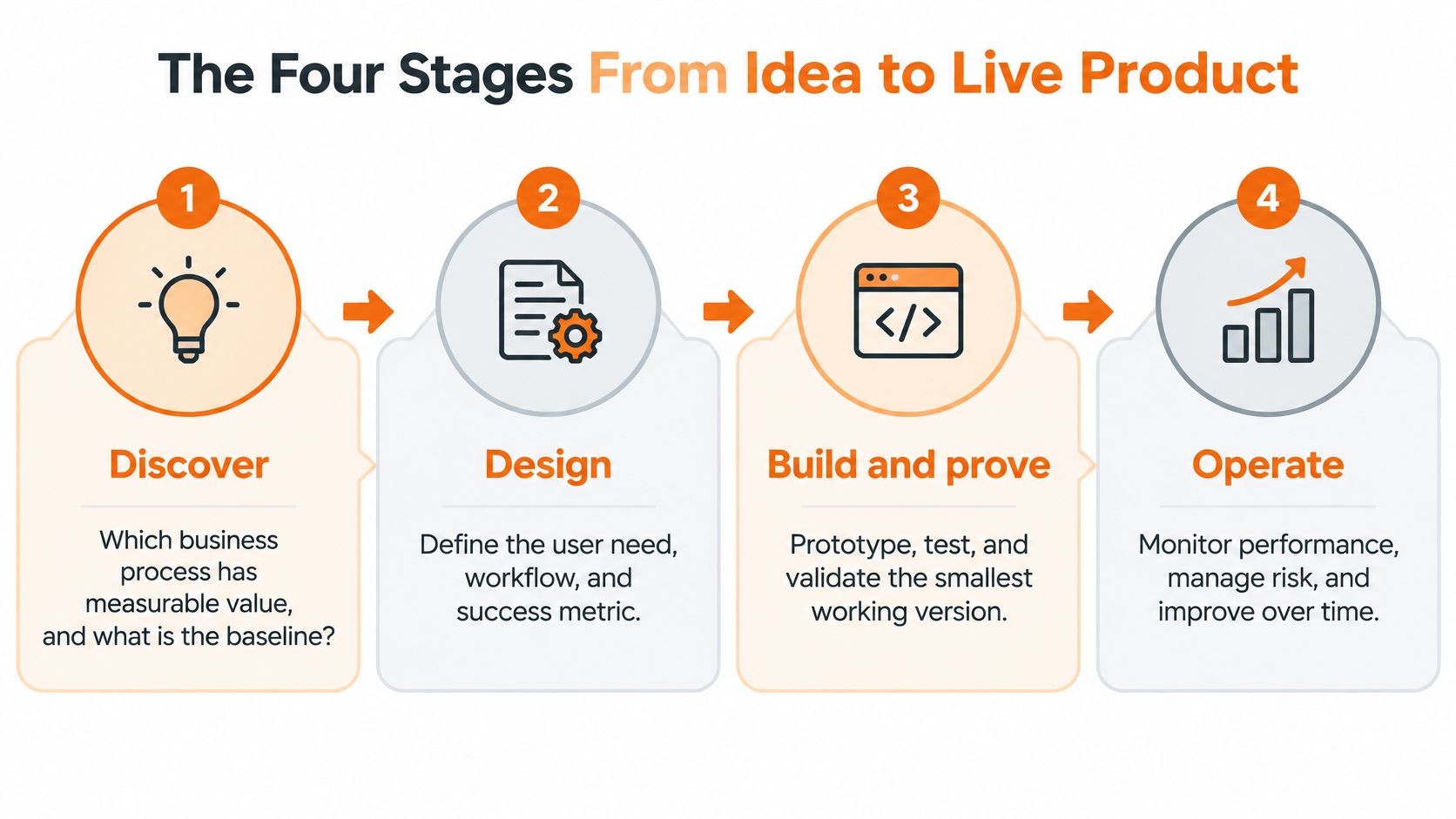
Each gate is a cheap decision that prevents an expensive one. In Discover, you're not allowed to proceed on enthusiasm alone. You need a baseline number, today's cost, time, or error rate, and a named outcome. Without that, you'll never know if the product worked.
Design is where many teams underinvest. Writing the evaluation set before the build feels slow, but it's the opposite. It forces agreement on what good looks like while changing your mind is still free. It also surfaces data access problems early, when legal or engineering can still fix them.
In Build and prove, work in thin production-relevant slices with continuous testing and review. One narrow flow, wired to real systems, tested against real inputs, beats a broad prototype wired to nothing. If the slice misses its quality, safety, or cost threshold, that's useful information, not failure. You stop or reshape before the expensive build.
Operate isn't a phase you reach. It's a test you pass before launch. Monitoring, an incident process, a cost view, and a rollback path must exist before real users depend on the feature. Teams embedding AI into an existing app will find useful detail in this production AI guidance for SaaS teams, which covers the practical mechanics of putting AI inside a live product.
Treat any missing output in the table as a reason to pause. Skipping a gate doesn't remove the work. It moves the work to production, where it's slower and public.
Architecture and model decisions come last, after the business case and data are clear. That's not caution. That's sequencing.
Adoption isn't value. McKinsey's 2025 global survey reports that only 39% of respondents attribute any level of enterprise-wide EBIT impact to AI, and among those reporting impact, most say less than 5% of organizational EBIT is attributable to AI. Read that twice before your next steering meeting. Most companies have AI. Few can point to money.
The gap isn't model quality. It's that teams start with a capability and go hunting for a problem. We start the other way. AI work starts with the business process, opportunity, and process economics before any technology selection, with model and architecture decisions made last, on evidence.
Run these before you fund anything. They're simple, and they kill weak ideas fast, which is the point.
Our deeper thinking on this sits in our guide to AI consulting use case discovery and business value, and it's worth working through before you shortlist vendors or tools.
Be honest about these. The idea starts with "we need AI." There's no baseline. The data exists somewhere but nobody has permission to use it. Nobody owns the process you'd change. The demo has never met a real user. Any two of those together means pause.
"By [date], [process] will move [metric] from [baseline] to [target] for [user group], without raising [risk metric] above [limit]."
That's your value hypothesis. One sentence, one target number, one deadline. If a team can't write it, they don't have a product idea yet. They have a technology preference looking for a home.
Killing or reshaping a weak use case in week two is progress, not failure. I'd rather tell a client their idea won't pay back than bill them for six months of building. That's the consulting mindset. Challenge the assumption early, explain the trade-off clearly, and put the budget where the return is real.
Start with the simplest approach that can clear your threshold. Complexity is a cost you pay every month, in latency, maintenance, and debugging. Here's how the five common options compare.

| Approach | Best when | Data you need | Cost to change | Main risk |
|---|---|---|---|---|
| Prompting a hosted model | Fast validation of a narrow task | Few examples and clear instructions | Low | Inconsistent answers at scale |
| Retrieval-augmented generation | Answers must come from your own documents | Clean, permissioned, regularly updated content | Medium | Poor retrieval quality |
| Fine-tuning | Consistent style or format is critical | Large, well-labelled examples | Medium to high | Stale behaviour as data changes |
| Custom model | Unique data and strict control or privacy needs | Substantial, governed training data | High | Long build and maintenance burden |
| Agentic workflow with tools | Multi-step tasks that touch business systems | Tool access, permissions and workflow rules | Medium to high | Unsafe actions without clear limits |
Where the model runs matters too, especially with sensitive data or tight latency needs. Our comparison of local LLMs vs cloud AI and how to choose walks through that trade-off in practical terms.
This short video is a useful companion while you weigh those options against your own constraints.
Don't pick a model because it won a public leaderboard. Benchmark labels and task mix usually differ from your production traffic, your document types, and your users' language. Build a domain evaluation set from representative, permissioned inputs, and document where the labels came from and where the blind spots are. A smaller model that wins on your data beats a famous model that wins on someone else's.
NIST's Generative AI Profile recommends incorporating trustworthiness considerations across design, development, deployment, use, and evaluation, including validity and reliability, safety, security, resilience, accountability, transparency, explainability, privacy, and bias management. In practice, define a versioned evaluation set before implementation, separate capability tests from safety and abuse tests, and set thresholds for task success, unsupported-claim rates, latency, cost per request, privacy leakage, and subgroup performance.
The cause and effect matters. If you optimize only average answer quality, you can improve your headline score while increasing unsafe outputs or failure rates for less-represented users. Tie every prompt, model, index, tool, or policy change to a regression run against the frozen test set plus newly collected failure cases. That's how the choice stays honest after launch day.
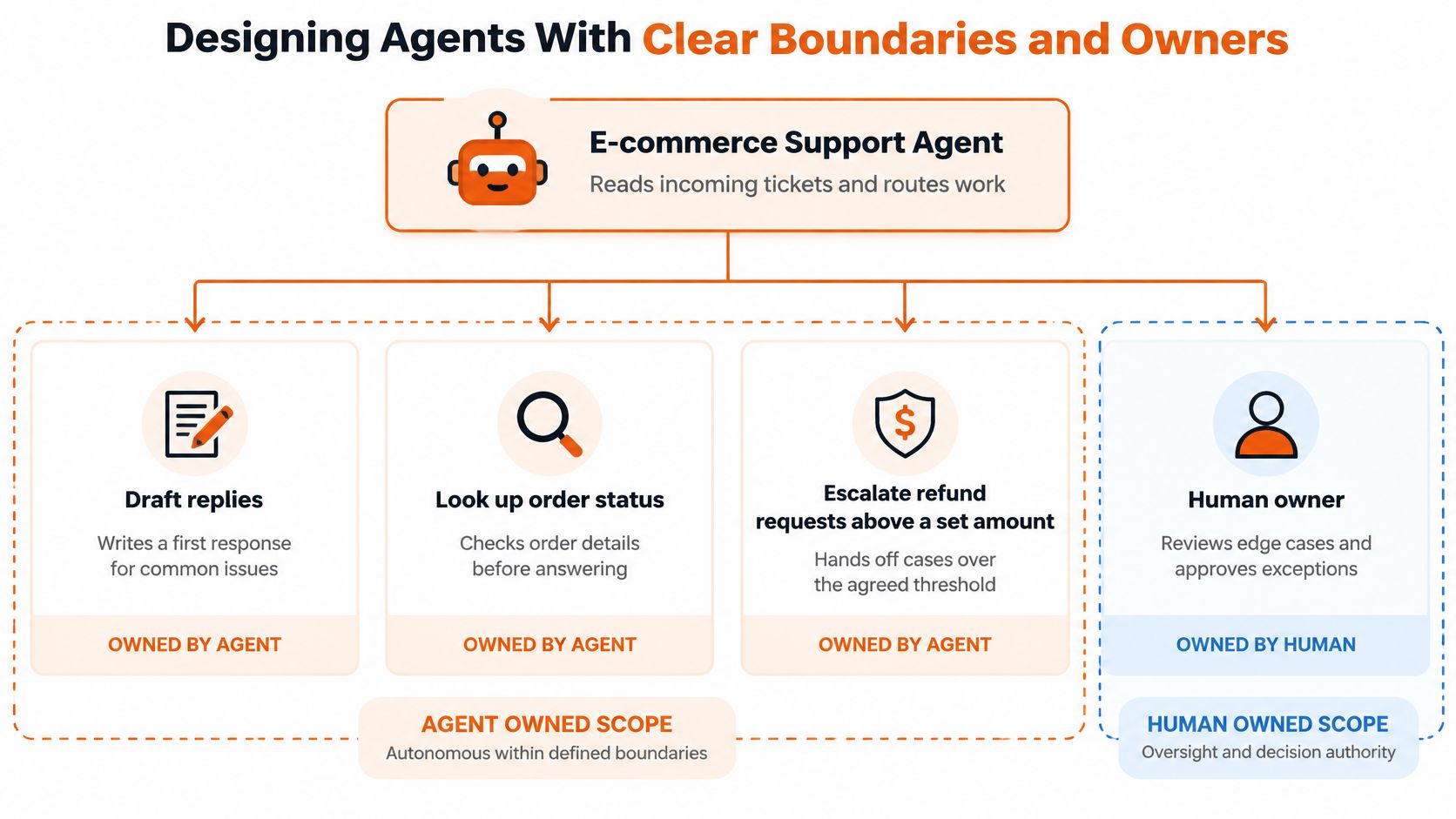
Say an e-commerce support team wants relief from a growing ticket queue. The agent should read incoming tickets, draft replies, look up order status, and escalate refund requests above a set amount agreed during discovery. Good use case. Now design it so it can't hurt anyone.
The model gets chosen for accuracy on the support evaluation set and for cost per ticket, not for reputation. The product owner signs off on both numbers.
The retrieval and data layer pulls policy text and order records only from permissioned sources. If the returns policy changes on Friday, the agent answers from the new policy on Saturday, because retrieval reads the live source. A data owner keeps that content clean and current.
The tools are where boundaries get real. Sort every action into three lists.
The orchestration decides the next step, tracks where each ticket is in the flow, and hands off to a person when confidence drops. Every tool call writes a log entry, so a failure traces back to the exact step that caused it. Each requirement links to its tests, so you can prove the boundary works instead of hoping.
Senior architects stay accountable for architecture, data, security, and testing. Agents speed up ticket analysis, drafting, and test generation inside those guardrails. That's AI-native engineering. The economics change, the standards don't.
Speed with structure is how the Metapro project went from strategy workshop to a functional MVP launched at the Poznan Game Arena in six months. Clear ownership at each layer is what made that pace safe.
Before you ship any agent, run three checks. Are the action limits explicit and enforced in code, not just in a prompt? Does the agent fall back to a human queue when it's unsure? Is there a named owner for each layer? Three yeses, or you wait.
Governance works when it is part of delivery, with clear decision rights and named owners. The NIST AI Risk Management Framework Playbook sets out four functions teams can apply as routine product work:
Controls should match the system's potential impact. A drafting assistant calls for different oversight than a system that influences hiring decisions. A practical AI governance framework for growing companies can help teams set controls that fit their risks and capacity.
For systems that may fall into high-risk categories, the European Commission's AI regulatory framework describes phased obligations and controls. These include risk assessment and mitigation, data governance, activity logging, technical documentation, information for deployers, human oversight, accuracy, reliability, and cybersecurity.
Turn applicable controls into product requirements. Assign an owner to each one and define what evidence will demonstrate it is met. Documentation and logging take effort to maintain, but they also help teams trace failures and explain system behaviour.
Platform review creates a similar need for evidence. The guide to AI-built React Native apps facing review examines how undocumented or untested code can stall an app review. Reviewers, regulators, and enterprise buyers each need to understand how a system behaves and how its risks are managed. Build that evidence into delivery, and keep it current as the product changes.
Here's the uncomfortable number. A 2025 survey covered in Temporal's guide to shippable AI systems found that only 13% felt very confident observing and debugging AI workflows at scale, while 62% reported measurable annual time or revenue losses from reliability problems. Teams can generate the feature. They can't see what it's doing. That's the production gap, and it's where AI products bleed money.
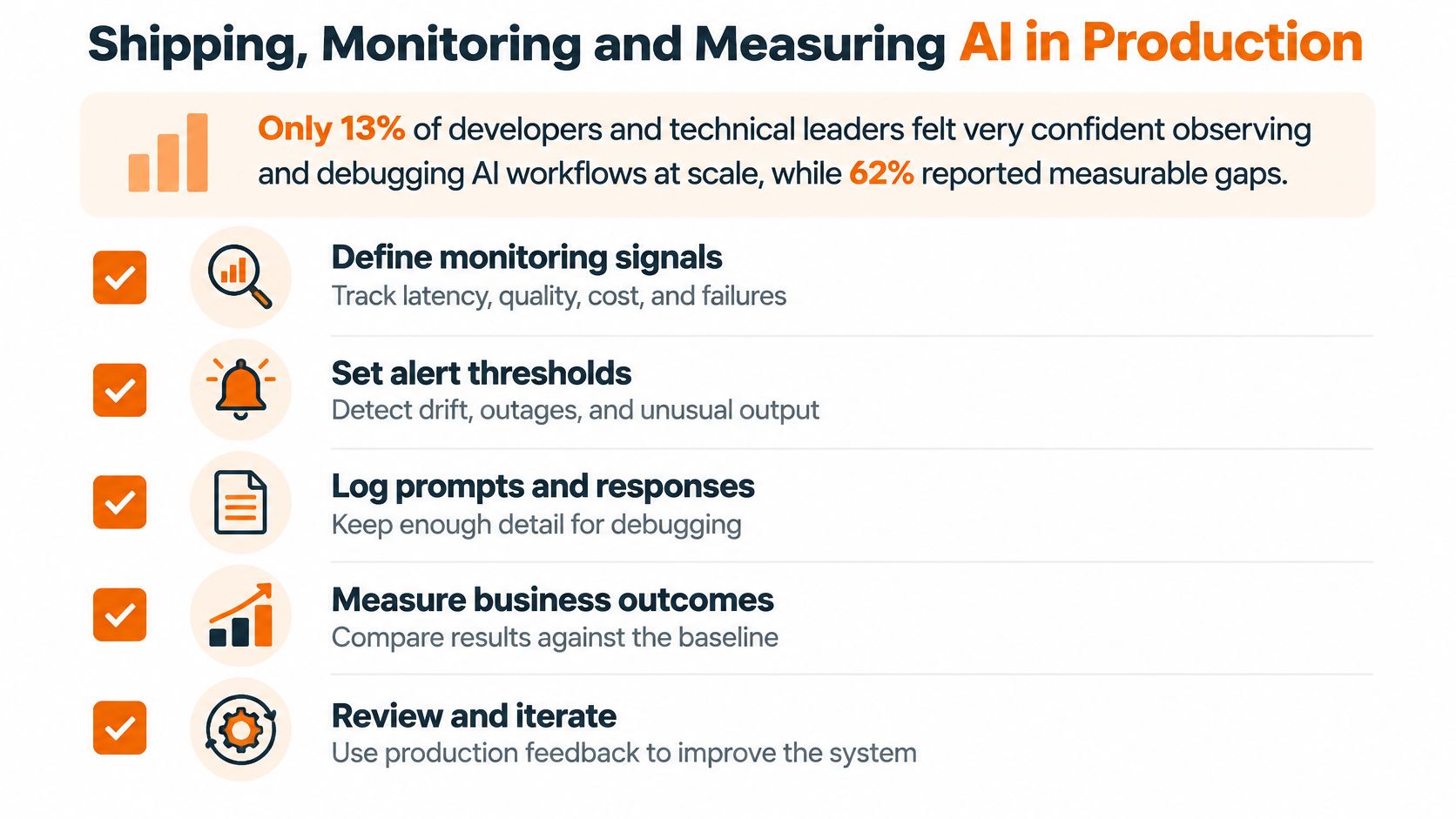
Ship in this order, every time.
A pilot earns production status, it doesn't drift into it. To move a pilot into production, we assess it against architecture, data, security, evaluation, monitoring, and ownership requirements, then deliver the gap as a bounded release with acceptance criteria.
| Signal | Target | Action when breached |
|---|---|---|
| Task success rate | Threshold agreed from the evaluation set | Pause the release and run a regression review |
| Unsupported-claim rate | Threshold agreed from the evaluation set | Tighten retrieval or add human review |
| p95 latency | Target set in the service-level objective | Check model choice, caching and tool calls |
| Cost per request | Budget set during discovery | Adjust routing or model size and review usage |
| Tool-call failure rate | Target set during design | Inspect integrations and fallback paths |
| Escalation rate to humans | Target set with the support or operations owner | Review failing cases and update prompts, tools or rules |
Then measure delivery itself. DORA's guide to its four delivery metrics defines deployment frequency, lead time for changes, change failure rate, and failed deployment recovery time. Baseline them before you add AI to the workflow. If lead time improves but change failure rate climbs, AI isn't making you faster. It's making you busier.
Finally, assign owners by failure type. Model, data, orchestration, and infrastructure failures overlap, and incidents stall in the gaps between teams. Name who takes the first call for each, and put it in the runbook. That's Extreme Ownership in practice. Somebody's name is on the outcome, not just the task list.
Go-to-market readiness is part of the product, not a marketing task bolted on at the end. Pick one use case with a measurable outcome, one target customer group, and one launch metric. Three of each means none of them get your full attention, and a scattered launch teaches you nothing.
You don't need a quarter to know whether an idea deserves a build. You need a month of disciplined work.
If week four ends without a decision, the project doesn't have a sponsor. It has an audience.
Get these in writing, in a shared document, with names next to them.
The #riteway test: if a decision has no name and no date attached, it hasn't been made. Move it forward or kill it, but don't let it float.
Capacity is often the constraint behind these decisions. In a managed engineering team, the partner handles daily delivery leadership, hiring and replacement, and the quality system, while the client keeps product priorities and business acceptance. You stay in control of what gets built and why. We own the how, the pace, and the production evidence, and we're transparent about risks the moment we spot them, not at the status meeting after they've grown teeth.
So here's your move, this week, not next quarter. Write the one-sentence value hypothesis for your strongest use case. Measure the baseline, even roughly. Name the owner. If you want a senior partner to pressure-test that thinking, describe your system, your constraint, or your capability gap, and we'll explain what should change, what should remain, and what a responsible path forward looks like. No hype, no obligation to build anything. Just a clear-eyed answer you can act on. The companies winning with AI aren't the ones with the flashiest demos. They're the ones who started with a real problem, built the controls in from day one, and shipped something their customers can trust.
If you're ready to turn an AI idea or a stalled pilot into a production product with a baseline, an evaluation gate, and a named owner after launch, talk to Rite NRG about your system, constraint, or capability gap. We'll tell you plainly what should change, what should stay, and the fastest responsible route from idea to a live, measurable result.
/ about the author
Written by the RITE NRG editorial team — the architects, engineers and delivery leads who build and operate AI-era software for our clients.
Strategy & Transformation
A practical, finance-ready framework for comparing AI and modernization investment with the current-state cost, realistic benefits, delivery risk and time to value.
Technology Talent & Teams
A decision-maker's guide to IT partnership models: what each model actually transfers to the partner, what it costs beyond the rate card, and how to match the model to your situation.
AI Consulting & Automation
A practical framework for choosing and deploying transport or logistics AI agents around real exceptions, reliable data and controlled operational authority.
More guidance: all insights articles
Tell us about the system or idea behind this article. We tell you honestly if it is a fit — and what a fixed-scope delivery could look like.