Your product is gaining traction. Sales is closing bigger accounts. Onboarding is getting messy because every new customer seems to need its own environment, its own deployment quirks, and its own support path. Your engineers are moving fast, but the platform underneath them is starting to fight back.
That's the moment where founders and CTOs usually ask the wrong question. They ask, “Should we refactor the infrastructure?” The better question is, “What operating model will support our business without crushing delivery speed?”
That's why multi tenancy in cloud computing matters. It isn't an infrastructure fashion. It's the architecture decision that determines whether you can scale customer acquisition, keep delivery predictable, and avoid building a bespoke platform for every logo you win.
Why Your Next Growth Move Is an Architectural One
A familiar pattern shows up in growing SaaS companies.
You launched with a practical setup. One customer got one environment. That made early sales easier because the team could promise flexibility. Then product adoption improved, more accounts arrived, and the “temporary” architecture turned into a drag on margin, release speed, and engineering focus.
Every new tenant now means more configuration, more maintenance, more chances to misconfigure something, and more friction every time you ship. Your roadmap slows down because your team is managing copies of the same thing instead of strengthening one product.
Growth breaks the wrong architecture first
Leaders need to stop treating architecture as a back-office concern. Your tenancy model shapes your cost structure and your go-to-market model. If you want a product business, you need a platform that behaves like one.
The UK market makes this even more relevant. The UK cloud computing market was valued at about USD 31.2 billion in 2023 and is projected to reach USD 61.2 billion by 2030, while the Office for National Statistics reports that more than half of UK businesses used cloud computing services in recent years, according to CloudToggle's overview of multi-tenancy in cloud computing. That's not a niche environment. That's a market where scalable shared delivery is table stakes.
If you're serving that market with customer-by-customer stacks, you're making life harder than it needs to be.
Practical rule: If onboarding a new customer feels like launching a new product instance, your architecture is working against your business model.
The business outcome comes first
Multi-tenancy is the move from duplicated delivery to shared delivery with controlled isolation. That shift changes what your team can do every week:
- Ship once, serve many: One change can reach the full customer base without repeating the same deployment work.
- Control cost growth: Shared infrastructure reduces waste from idle environments and duplicate operational effort.
- Support faster product learning: One platform gives you a clearer path to standardise features, support, and release management.
A lot of teams need a sharper architecture lens before they touch implementation. That's why it helps to look at the broader discipline of software architecture and how to design it well before choosing a tenancy pattern. The decision isn't just technical. It's commercial.
The best SaaS companies don't stumble into multi-tenancy. They decide on it because they want scale without chaos.
Understanding the Apartment Building Analogy in Cloud
The cleanest way to explain multi tenancy in cloud computing is to stop talking like an infrastructure manual and use a model people understand.
Think of your platform as an apartment building.
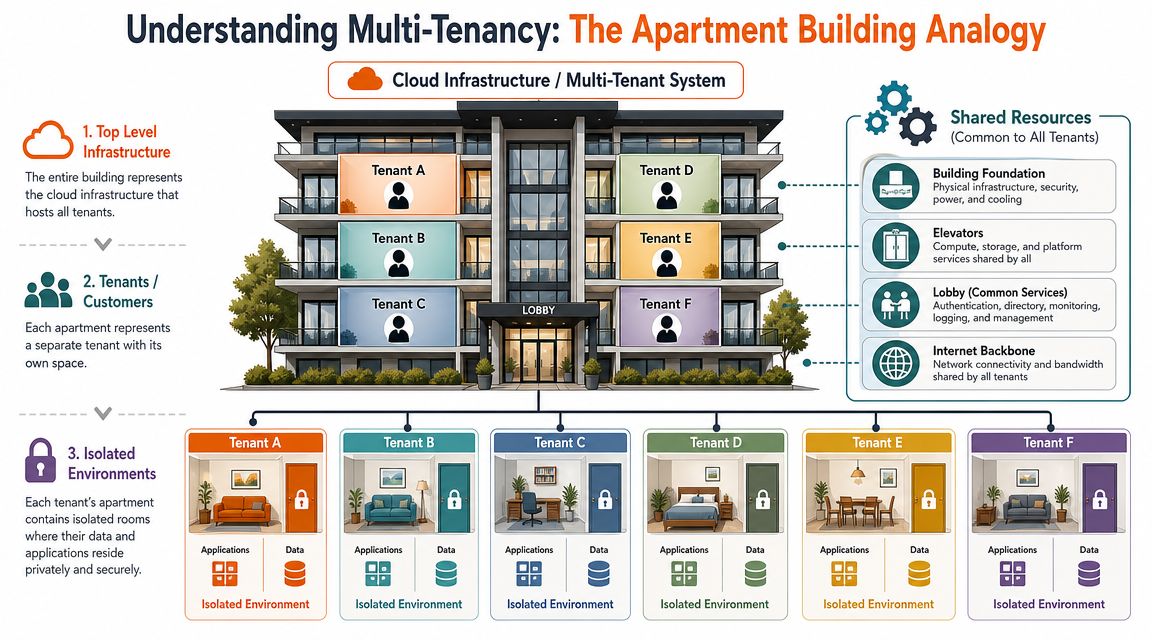
One building, many residents
The building is your single software instance. The residents are your tenants, meaning your customers. They all live in the same building, but each resident has their own flat, their own key, and their own private space.
That's the essence of multi-tenancy. Customers share the underlying structure, but they don't share each other's data.
The shared parts are easy to visualise:
- Foundation and utilities: Compute, storage, and network capacity
- Lift, lobby, and maintenance systems: Core platform services, monitoring, deployment pipelines
- Building management: Operational controls, updates, security processes
The private parts matter just as much:
- Each flat: Tenant-specific data
- Each lock: Access control and permission boundaries
- Each resident record: Tenant identity and configuration
Shared doesn't mean exposed
A lot of teams hear “shared” and immediately worry about security. That's the wrong reaction. Shared infrastructure isn't the problem. Weak isolation is the problem.
In practice, providers implement separation through mechanisms like tenant IDs in application logic, schema partitioning, or database-level separation. The exact boundary varies, but the principle stays the same. One platform serves many customers while keeping their data logically separated.
According to Northflank's explanation of multitenancy, shared-schema tenancy has the lowest overhead, while separate schemas or separate databases provide stronger isolation at the cost of higher operational complexity. That trade-off starts at the data model, not at the marketing layer.
If your application can't identify the tenant on every meaningful request path, you do not have a multi-tenant platform. You have shared risk.
Where the analogy helps leaders
The apartment building analogy matters because it clarifies what executives should expect from engineering.
You are not paying the team to build hundreds of detached houses. You're asking them to build one well-run property with strong boundaries, efficient operations, and room for more residents.
That business logic is why multi-tenancy is attractive:
- You reduce duplication because you maintain one core system.
- You accelerate rollout because updates happen centrally.
- You improve consistency because customers use the same product foundation.
The analogy also exposes the failure mode. If one resident can wander into another resident's flat, the building design is broken. If one resident hogs all the water pressure, the building operations are broken. Multi-tenancy succeeds only when both the architecture and the operational discipline are deliberate.
That's why smart SaaS teams don't stop at “shared platform”. They define exactly what is shared, exactly what is isolated, and exactly where the enforcement happens.
Choosing Your Tenancy Model and Its Business Trade-Offs
There isn't one correct tenancy model. There is only the model that matches your product, buyer expectations, and delivery strategy.
That's the decision leaders need to make clearly. Too many teams default to the cheapest thing to build first, then wonder why enterprise deals become painful later.
The model you choose shapes the company you become
As Frontegg's guide to multi-tenant architecture notes, 73% of UK businesses used cloud services in 2024, and expectations for reliability and governance are rising. The core decision isn't “multi-tenant versus single-tenant”. It's which model supports regulated buyers, incident containment, and premium pricing.
That's the right framing.
If you sell to startups with standardised needs, you can optimise aggressively for efficiency. If you sell to enterprise or public-sector buyers, isolation, auditability, and operational control start carrying more weight. Your architecture should reflect that reality early.
Multi-Tenancy Model Comparison
| Model | Cost Efficiency | Data Isolation | Development Complexity | Best For |
|---|---|---|---|---|
| Shared Database, Shared Schema | Highest efficiency. Lowest infrastructure overhead | Lowest isolation of the three. Requires disciplined query scoping | Lowest initial complexity, but mistakes in tenant scoping are dangerous | Early-stage SaaS with standardised workflows and price-sensitive growth |
| Shared Database, Separate Schemas | Balanced. More overhead than shared schema, still operationally manageable | Stronger isolation than shared schema | Moderate complexity in migrations, schema management, and tooling | Growing SaaS platforms that need stronger separation without full database sprawl |
| Separate Databases | Lowest efficiency of the three | Strongest isolation and clearer containment boundaries | Highest complexity in provisioning, operations, and support | Enterprise-focused SaaS, regulated workloads, premium tiers, sensitive customer data |
My recommendation by business model
If you're building a horizontal SaaS product and speed matters most, start with shared database, separate schemas unless there's a compelling reason not to. It gives you a healthier balance between efficiency and isolation than shared schema, without the operational burden of a database per tenant.
Use shared schema only if you're disciplined enough to enforce tenant scoping everywhere. That means no exceptions, no shortcuts, and no “we'll clean it up later”. This model is efficient, but it punishes sloppy engineering.
Choose separate databases when your revenue strategy depends on enterprise confidence. If buyers ask detailed questions about containment, auditability, custom controls, or stricter separation, stronger isolation can support bigger deals and calmer security conversations.
Architect's view: The cheapest model to launch is not always the cheapest model to sell.
Don't choose one model for every customer forever
A mature SaaS business often needs more than one tenancy pattern across pricing tiers.
You can standardise the product on a shared platform while reserving stronger isolation options for premium accounts. That gives commercial teams room to close demanding customers without forcing the whole platform into the most expensive operating model.
That's the business trade-off. Tenancy architecture isn't just about infrastructure efficiency. It defines how flexibly you can price, how confidently you can sell, and how cleanly you can scale operations.
Mastering Security and Data Isolation in a Shared World
Security is where weak multi-tenant thinking gets exposed.
A lot of teams treat isolation like a data-layer checkbox. Add a tenant ID, write a few guards, and move on. That's not serious architecture. In a shared environment, isolation has to be designed into data access, application behaviour, operations, support tooling, and audit controls.
Isolation is a business-risk control
In the UK, 50% of businesses and 32% of charities experienced some form of cyber security breach or attack in the latest reporting year, according to the research referenced in this University of Portsmouth portal document on multi-tenancy in cloud native architecture. That makes tenant-isolation design a business issue, not a backend preference.
The same source also highlights a point many teams miss. Cloud customers still retain responsibilities for configuration, access control, and data protection. So no, “we run a multi-tenant cloud platform” does not equal “we are compliant”.
If you handle UK customer data, your architecture needs to stand up to UK GDPR expectations, the Data Protection Act 2018, and sector-specific scrutiny. Shared infrastructure is fine. Weak segregation is not.
What strong isolation actually looks like
Security in multi tenancy in cloud computing needs multiple enforcement points working together:
- Tenant-aware access paths: Every request must resolve the tenant context before touching business data.
- Authorisation boundaries: Roles and permissions must be scoped by tenant, not just by user type.
- Operational separation: Support access, admin tooling, and background jobs must respect tenant boundaries too.
- Auditable controls: You need logs that show who accessed what, under which tenant context, and why.
Then there's the risk many product teams underestimate. Performance isolation.
A noisy neighbour problem can become a security conversation very quickly if one customer's workload degrades another customer's service. Buyers may describe it as reliability, but the root issue is still weak isolation design.
Compliance starts in architecture, not in policy docs
Teams often try to document their way out of architectural weaknesses. That never works for long.
If you want a useful benchmark for building safer systems earlier, this guide to security in the software development life cycle is worth reviewing. The important part is the mindset. Security controls should show up in design reviews, backlog decisions, code review rules, test strategies, and incident playbooks.
Tenancy design is where compliance becomes real. Policies only describe what the architecture must enforce.
A strong multi-tenant platform should answer these questions cleanly:
- Can one tenant ever access another tenant's records through a bug, a job runner, or an admin tool?
- Can one tenant degrade the experience of others through unbounded resource usage?
- Can you prove access history and containment when something goes wrong?
If the answer to any of those is vague, the design isn't ready.
The Operational Reality of Multi-Tenant Architectures
Here, multi-tenancy either becomes a force multiplier or an operational headache.
On paper, the value is obvious. One application instance serves many tenants, which reduces duplicated infrastructure and centralises updates. Cloudvara's explanation of multi-tenancy makes that point directly. It lowers cost and speeds release management, but only when strict logical segregation and reliable operational processes are in place.
That last part matters most. Shared architecture without strong operations becomes shared instability.
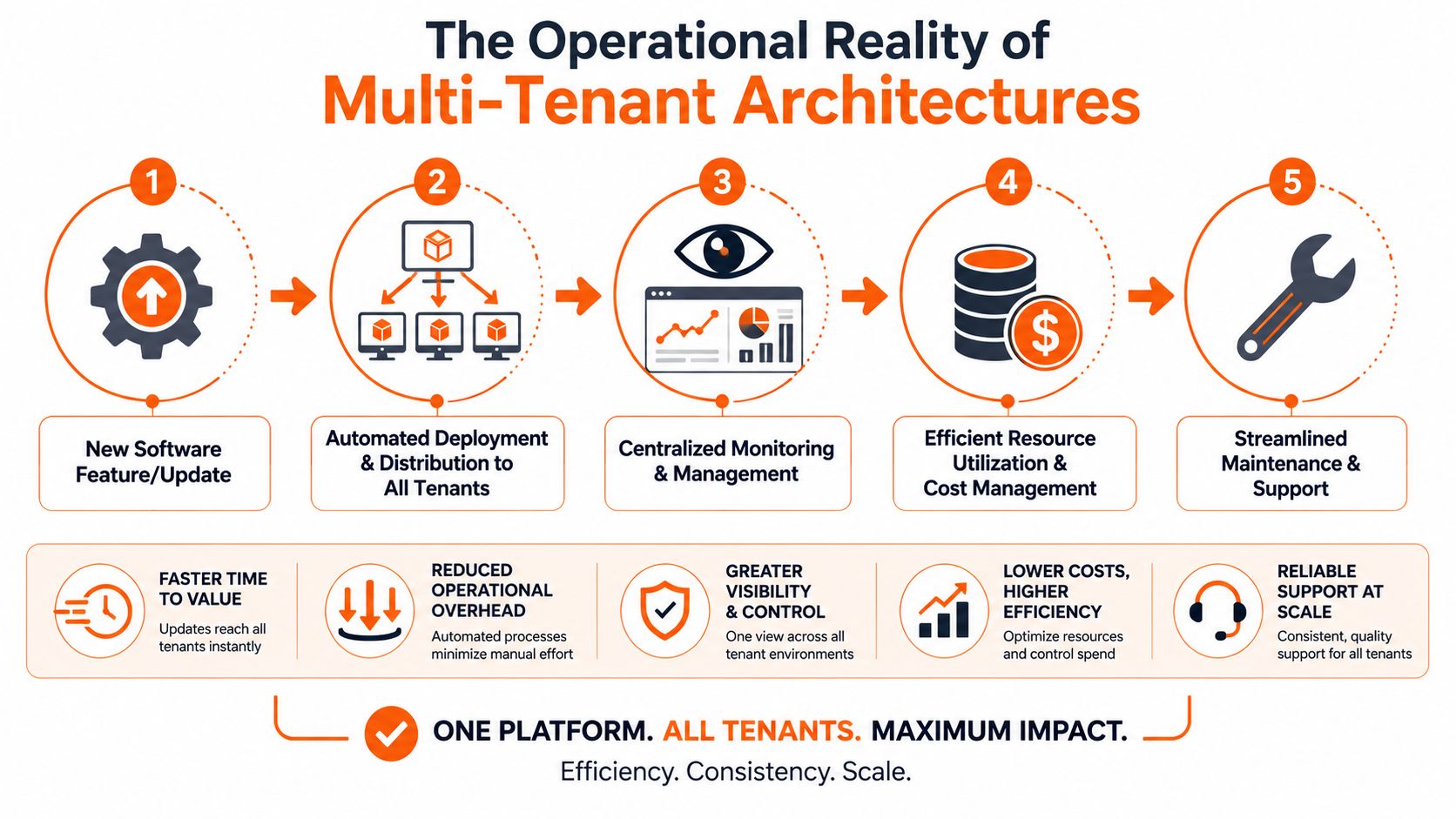
What gets easier
A well-run multi-tenant platform improves the daily mechanics of product delivery.
You update one core application. You monitor one core platform. You harden one set of deployment pipelines. That gives product and engineering teams a cleaner route to ship improvements, fix defects, and standardise support.
The practical gains usually show up in a few places:
- Release management: One deployment motion is easier to rehearse, automate, and audit.
- Platform visibility: Centralised observability makes it easier to spot systemic issues.
- Support consistency: Teams troubleshoot one product, not a patchwork of customer-specific variants.
If you care about sustainable growth, platform scalability belongs in the same conversation. This is why engineering leaders should stay close to the broader discipline of cloud computing scalability, not just tenancy in isolation.
What gets harder
Operations don't become simpler everywhere. They become simpler in some places and sharper in others.
Tenant-aware operations require discipline around things like:
- Backups and recovery: Can you restore one tenant cleanly without disturbing others?
- Monitoring and alerting: Can you distinguish a tenant-specific problem from a platform-wide issue?
- Resource fairness: Can you stop one customer's traffic pattern from overwhelming shared capacity?
- Support workflows: Can internal teams diagnose issues without exposing unrelated tenant data?
Operational rule: If your monitoring cannot answer “which tenant is affected?” within minutes, support will burn time and customers will feel it.
Build the operating model with the architecture
A lot of architecture diagrams stop at the database boundary. That's not enough. The platform also needs tenant-aware observability, runbooks, deployment controls, and support permissions.
A strong operational design usually includes three habits.
First, teams instrument the platform around tenant context. Logs, traces, metrics, and audit events need to carry enough detail to support incident handling.
Second, teams define fair-use controls early. Rate limits, queue controls, and workload isolation policies protect the wider customer base.
Third, teams rehearse failure scenarios. Not abstractly. Specifically. What happens if one tenant's data import causes pressure on shared services? What happens if a background worker fails only for a specific account? What happens if support needs temporary access to diagnose a premium tenant issue?
The operational reality is simple. Multi-tenancy pays off when you run it like a platform, not like a collection of exceptions.
Migrating from Single-Tenant to Multi-Tenant Architectures
If you started with single-tenant deployments, that wasn't a mistake. It was probably the fastest way to get early customers live. The mistake is staying there after the architecture has clearly become a tax on growth.
Migration doesn't need to become a reckless rewrite. It should become a staged programme with business control points.
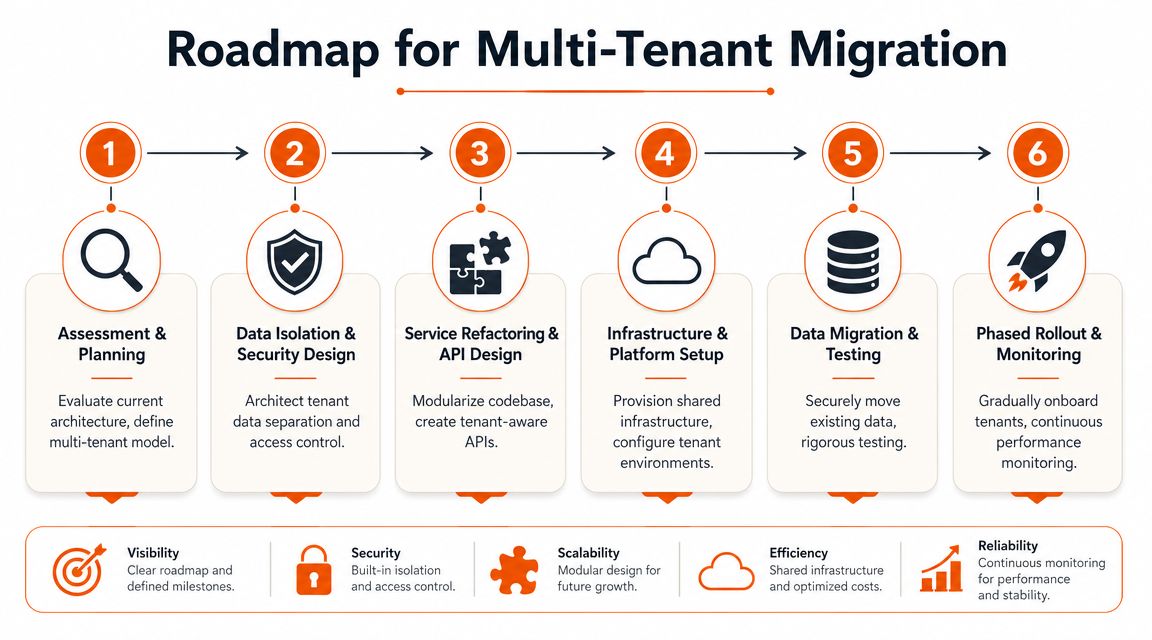
A practical migration path
Start by deciding which tenancy model supports the company you want to become, not just the code you have today. That means aligning architecture with target customers, compliance needs, onboarding volume, and commercial plans.
Then move in phases:
Assess the current platform
Identify where tenant assumptions already exist in code, data, and infrastructure. Most systems have partial building blocks already. They're just inconsistent.Design isolation properly
Choose the tenant boundary, define access rules, and redesign schemas or database allocation. Don't let this become an afterthought.Refactor services to become tenant-aware
APIs, background jobs, admin tools, billing logic, and reporting flows all need explicit tenant context.Plan migration sequencing
Move lower-risk tenants first, validate behaviour, then roll out gradually. A phased cutover is safer than a big-bang event.
After the roadmap is clear, this walkthrough gives a useful visual anchor for the transition:
What teams usually underestimate
The hard part is rarely the database migration alone. The harder part is cleaning up hidden single-tenant assumptions across the application.
Watch for these pressure points:
- Admin workflows: Internal tooling often bypasses normal access controls.
- Data exports and imports: Batch processes can leak assumptions about one-customer-per-environment.
- Configuration sprawl: Customer-specific settings may have grown informally over time.
- Testing gaps: Tenant isolation bugs often hide in edge cases, not happy paths.
Migrations fail when teams treat them as infrastructure work. They succeed when product, engineering, security, and operations all own the target model.
A strong migration plan protects current revenue while building future advantage. The goal isn't to make the system more clever. The goal is to make growth easier to sustain.
The Rite Way Your Multi-Tenancy Decision Checklist
Organizations don't need more theory. They need a clean decision tool.
The right tenancy model should support your growth plan, your sales motion, and your operational maturity. If it doesn't, it will surface later as margin pressure, delayed releases, ugly enterprise negotiations, or painful incident handling.
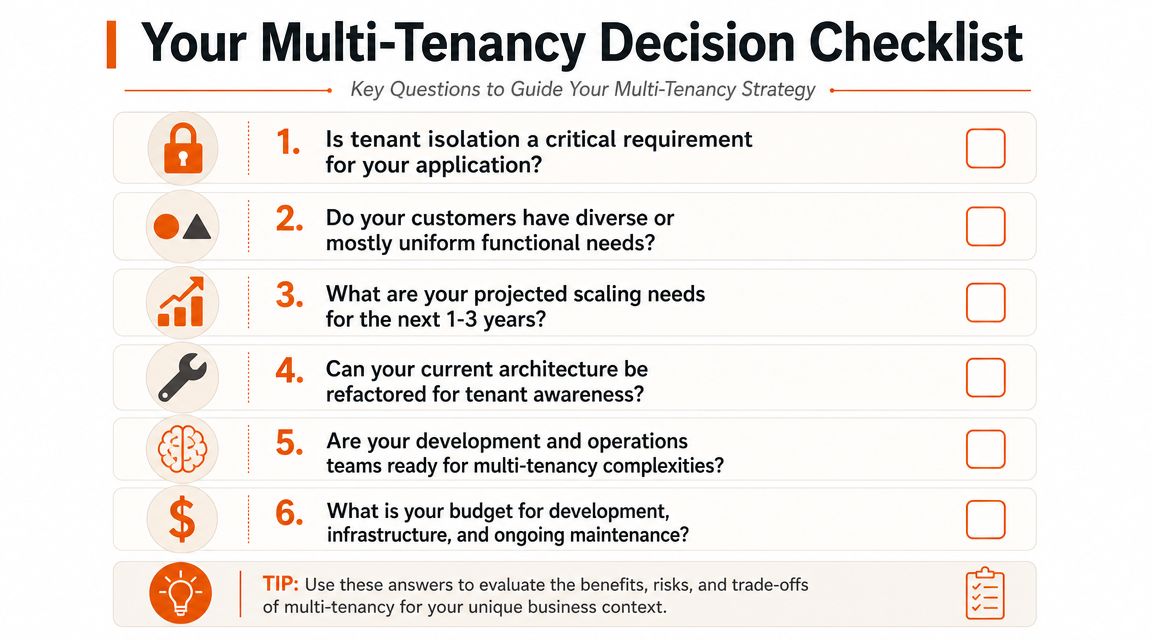
Ask these questions before you commit
Use this checklist in your next product and architecture discussion.
What are we selling?
A standardised product business wants shared delivery. A service-heavy model may tolerate more isolation and more custom overhead.Which customers are we targeting next?
If enterprise, public sector, or regulated buyers are on the roadmap, isolation and auditability need to be stronger from the start.How much platform complexity can we own well?
Separate databases can support stronger isolation, but they also demand more operational discipline.Where will we make our margin?
Shared infrastructure improves efficiency. Premium isolation can support higher-value deals. Decide deliberately instead of drifting into both badly.
The shortlist that clarifies the decision
If you want a blunt decision frame, use this:
| If this sounds like you | Favour this model |
|---|---|
| We need speed, standardisation, and efficient onboarding | Shared schema or separate schemas |
| We need a balance of scale and stronger separation | Separate schemas |
| We need stronger containment, premium positioning, or enterprise confidence | Separate databases |
The standard I'd hold the team to
Before any implementation starts, leadership should be able to answer these six questions in plain English:
- What business model does this tenancy design support?
- What customer segment is it optimised for?
- Where is tenant isolation enforced?
- How will support, monitoring, and recovery work per tenant?
- Which future deals would this design make easier to close?
- Which future risks would this design make harder to control?
If those answers are fuzzy, the architecture decision isn't finished.
The #riteway mindset is simple. Own the outcome, not just the code. Choose the tenancy model that creates advantage for the business, then build the controls and operating discipline to make it reliable.
If you're making a high-stakes architecture decision and want senior people who think in business outcomes, not just tickets, talk to Rite NRG. We help SaaS teams design, build, and scale platforms that support faster delivery, cleaner operations, and stronger commercial momentum.