The most popular cloud migration advice is also the most dangerous: move everything first, optimise later. That approach treats the cloud as a new location for existing infrastructure, not as a way to improve how the organisation serves customers, employees, citizens, or patients.
A credible cloud migration strategy starts with harder questions. Which services must become more resilient? Which products need a shorter path from idea to release? Which legacy dependencies create unacceptable operational or compliance risk? And which workloads should stay where they are until the business case changes?
That distinction matters in the UK. Public sector organisations have operated under the Government Cloud First policy, which says they should default to Public Cloud for new or existing services and use other solutions only where Public Cloud isn't possible. The same policy promotes “services not servers”, placing business value, resilience, security, and recoverability above infrastructure location. The UK Cloud First policy gives migration a strategic benchmark that extends beyond government procurement.
Why Most Cloud Migrations Fail to Deliver Business Value
Cloud migration programmes fail when delivery is measured by infrastructure movement instead of business performance. A server can move successfully in a project report while customers still experience slow services, product teams wait for releases, and finance cannot explain the ongoing cost.
Set the outcome before selecting the target environment. The result might be faster time to market, a better customer experience, improved resilience, lower capital expenditure, or stronger support for revenue growth. If the team cannot define that result before migration begins, it has no credible way to prove value after go-live.
PwC UK's cloud survey associates cloud adoption with measurable outcomes including faster time to market, increased innovation, improved customer experience, cost savings, and continued revenue growth of 15% or greater. It also reports that organisations fully committed to cloud expect measurable returns on investment within the next 12 months, including gains in agility and resilience. The PwC UK cloud survey summary supports a commercial test for migration. Cloud earns its place when it improves business performance.
The UK market has moved beyond experimentation
Investment trends reinforce that position. One industry estimate puts the UK cloud migration services market at $789.4 million in 2023, projecting $2,009.6 million by 2028 and a 20.5% compound annual growth rate over that period. UK cloud migration market analysis shows why migration belongs in board-level transformation planning, not only infrastructure budgets.
A separate forecast estimates the UK cloud migration market at USD 566.77 million in 2024, reaching USD 4,975.56 million by 2033, with an implied 25.20% CAGR from 2025 to 2033. These forecasts use different definitions and methodologies, so treat them as directional rather than combining them into one precise market size. Their common message is clear: cloud migration has become a substantial strategic category.
The UK Government's policy language also provides a useful operating principle for private organisations. Prioritise services, customers, and outcomes, then decide where each workload should run. That decision must account for compliance and legacy dependency. A hybrid model may be the right answer where regulated data, specialist systems, or tightly coupled legacy platforms cannot move safely. Multi-cloud can make sense where service requirements, resilience objectives, or supplier concentration justify the added operating complexity. Choose the architecture because the constraints require it, not because a provider preference makes it convenient.
The delivery team owns the result across disciplines. Engineers, product leaders, security specialists, finance partners, and business owners must agree on the outcome, the trade-offs, and the evidence that will demonstrate success.
Practical rule: Do not approve a migration wave until its owner can explain the business outcome, the operational risk, and the evidence that will prove success.
The #riteway Methodology applies that discipline through Extreme Ownership, high energy, and proactivity. The team identifies blockers before they become incidents, escalates decisions while they remain inexpensive to resolve, and stays accountable for value after go-live. Cloud expertise alone is insufficient. Successful delivery combines technical capability, commercial judgement, and the energy to keep decisions moving.
Discovery and Workload Assessment Before You Move Anything
Start with discovery, not a provider contract or a migration tool. You need a dependable view of the application estate, its business importance, and the relationships that keep services running.
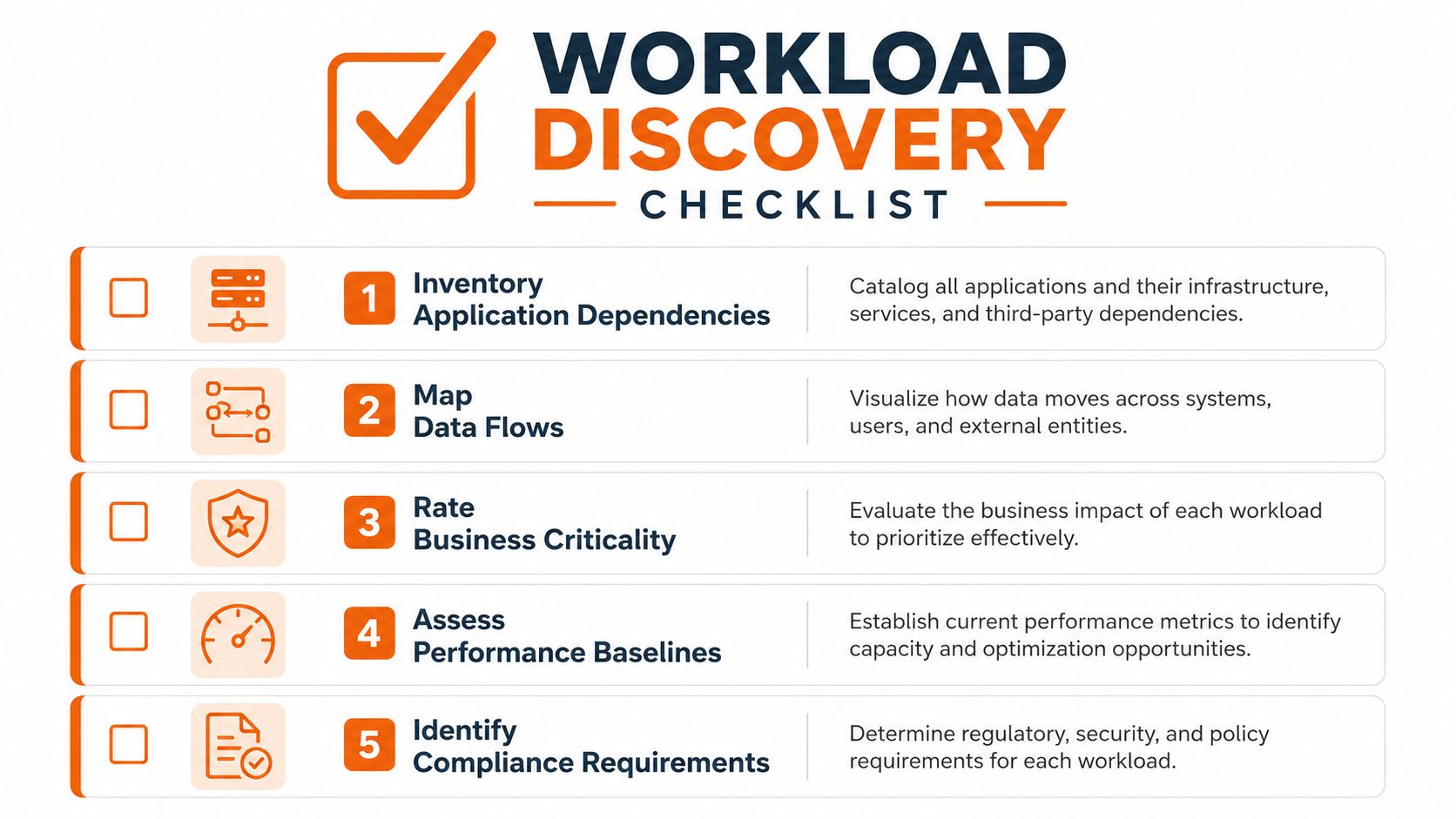
For each workload, assign a business owner and record five evidence categories:
- Inventory application dependencies. Document applications, databases, scheduled jobs, identity services, third-party integrations, network connections, and operational contacts.
- Map data flows. Show where data enters, where it is transformed, where it is stored, and which services consume it. Pay particular attention to authentication, reporting, payment, and customer-facing paths.
- Rate business criticality. Classify the effect of downtime, degraded performance, data loss, or delayed recovery. Criticality should reflect business and mission impact, not the age of the technology.
- Assess performance baselines. Capture current response behaviour, throughput, batch windows, failure patterns, and peak demand. Without a baseline, the team can't prove that the target environment performs better.
- Identify compliance requirements. Record data handling obligations, retention rules, access controls, audit needs, residency expectations, and supplier constraints before selecting a target architecture.
Use business criticality to set migration priority
A practical decision rule comes from UK public-sector cloud management guidance. Decide which applications and workloads should move first based on whether they're critical to operating costs or important to the organisation's mission. Defer lower-priority workloads rather than allowing them to consume attention needed for higher-value services. UK public-sector workload prioritisation guidance provides a useful basis for that distinction.
This produces four useful groups:
- High criticality and strong cloud fit: Prepare carefully and prioritise when the controls, dependencies, and rollback plan are credible.
- High criticality and weak cloud fit: Retain or modernise selectively. These systems need deeper dependency and compliance analysis before movement.
- Lower criticality and strong cloud fit: Use them to validate delivery practices, observability, security controls, and operational ownership.
- Lower criticality and weak cloud fit: Consider retirement, replacement, or deferral. Migration isn't a reason to preserve unnecessary complexity.
The assessment must include people, not only systems. Interview business owners, service managers, security, finance, support teams, and suppliers separately, then reconcile conflicting assumptions. A technical team may believe an application is standalone while operations knows it feeds a daily process or depends on an undocumented manual intervention.
Legacy systems deserve explicit treatment. Document interfaces, data formats, batch schedules, licensing conditions, recovery procedures, and the individuals who understand the system. A focused legacy system migration approach can help teams expose these dependencies before they become cutover surprises.
UK-focused guidance identifies unanticipated complexity, particularly integration work, as a major source of migration trouble. One cited industry statistic says 60% of cloud migrations exceed budget and schedule because teams underestimate that complexity. UK cloud migration market guidance makes the practical lesson clear: discovery is not administrative overhead. It's budget protection and service protection.
Choosing the Right Migration Pattern for Each Workload
Don't impose one migration pattern across the portfolio. A stable internal application with limited differentiation may justify rehosting, while a customer-facing platform with growth ambitions may warrant replatforming or refactoring. A regulated legacy workload may need to remain in a controlled environment until its dependencies or compliance position changes.
Compare the three core patterns
Lift-and-shift, or rehost, moves a workload with limited application change. It's useful when speed matters, the application already behaves reliably, or the organisation needs to exit a data-centre constraint without redesigning the service. The trade-off is clear. Rehosting can reduce migration effort, but it doesn't automatically improve operating efficiency, release speed, resilience, or cloud economics.
Replatforming changes the execution environment while preserving the application's core architecture. Examples include moving a database to a managed service, adopting containers, or replacing manually maintained infrastructure with a managed platform. This approach often suits teams that want a controlled improvement in operational overhead without funding a complete redesign.
Refactoring changes the architecture to access cloud-native capabilities. It can make sense for a strategically important product where scalability, resilience, delivery speed, or product experimentation creates material business value. It demands stronger engineering capability, clearer product ownership, and tighter scope control. Don't refactor a low-value application because the architecture looks old.
| Migration Pattern | Best For | Timeline | Risk Level | Long-term Value |
|---|---|---|---|---|
| Lift-and-shift | Stable workloads, urgent infrastructure exit, limited near-term change | Faster | Lower application change risk, but operating inefficiency may remain | Immediate relocation value, limited modernisation |
| Replatform | Workloads that benefit from managed services or modest platform improvement | Moderate | Managed change risk | Better operational efficiency and maintainability |
| Refactor | Strategic products where cloud-native capabilities support business growth | Longer and more involved | Higher delivery and scope risk | Greatest potential for resilience, scalability, and delivery agility |
Hybrid or multi-cloud is a workload decision
The hybrid versus multi-cloud debate is usually framed incorrectly. It shouldn't begin with a vendor preference. It should begin with compliance boundaries, legacy dependency, resilience requirements, data movement, internal capability, and service ownership.
Hybrid cloud keeps some workloads in private or on-premises environments while others run in public cloud. That can be the right answer when a legacy system has tight local dependencies, when data handling controls require a specific environment, or when a staged transition reduces operational risk.
Multi-cloud places workloads or capabilities across multiple public-cloud providers. It can support specific service requirements, procurement decisions, resilience objectives, or portability goals. It also creates more governance, identity, monitoring, skills, integration, and cost-management complexity. Choose it deliberately, not as a badge of architectural sophistication.
Recent independent reporting on government cloud decision-makers found that 80% use hybrid cloud, 71% use multiple public clouds, and 27% identified migrating existing workloads as their most likely initiative in the next 12 months. UK cloud migration cost and architecture reporting points to the decision facing UK organisations. They need to decide which workloads should move, stay, or split across environments.
Use a hybrid cloud strategy when coexistence reduces risk. Use multi-cloud only where the benefits justify the additional operating model. In both cases, define portability requirements at workload level, not as a vague aspiration for the whole estate.
Cost Modelling and Risk Assessment That Delivers Results
A business case fails when it compares current server spend with a cloud estimate and labels the difference as savings. That approach hides transition work, dual running, control requirements, and the operating conditions created after migration.
Build two connected models. The first covers the cost of moving each workload. The second tests whether the expected business outcome justifies that investment. Keep hybrid and multi-cloud scenarios separate where compliance, legacy dependencies, or portability requirements change the cost base.
Include the costs between environments
Your model should account for:
- Integration work: Interfaces, identity, networking, data transformation, testing, and supplier changes can require more effort than the application move itself.
- Parallel running: During a hybrid transition, old and new environments may need to operate together while users and data move safely.
- Data movement: Record transfer and egress assumptions, particularly where applications, analytics platforms, or backups cross environment boundaries.
- Operational readiness: Budget for observability, security controls, incident response, service management, training, and documentation.
- Optimisation after cutover: Right-sizing, architecture changes, automation, and governance belong in the value plan, not in a later wish list.
Assign an owner to every material uncertainty. Application owners validate service dependencies. Security confirms control coverage. Finance challenges consumption assumptions. Operations tests recovery and support readiness. This turns a risk register into a set of decisions with accountable owners.
The UK market is moving towards coexistence rather than one final-state environment. One forecast says hybrid multi-cloud adoption is expected to rise from 19% in 2024 to 26% within three years. UK cloud migration market analysis reinforces the need to model ongoing portability, duplicated controls, cross-environment connectivity, and governance. Do not treat migration as a one-time lift-and-shift if compliance or legacy dependency requires services to remain distributed.
Build the business case around measurable change
Tie each major cost to an outcome and an owner. If the goal is faster product delivery, track release steps and decision bottlenecks. If the goal is resilience, define recovery expectations and test them. If the goal is lower operating cost, separate one-off migration spend from recurring run-rate costs, then assign responsibility for optimisation.
Use scenarios to expose weak assumptions. A workload can move successfully while integration redesign remains incomplete, leaving support effort and failure points unchanged. An undocumented dependency can also force a replatforming plan to pause. Show the financial and operational effect of both conditions before approving the workload.
Use the model as a decision tool, not spreadsheet ceremony. A workload is not ready for migration if compliance risk, vendor lock-in, or performance uncertainty has no owner and no mitigation.
Planning Migration Waves and Executing Cutover
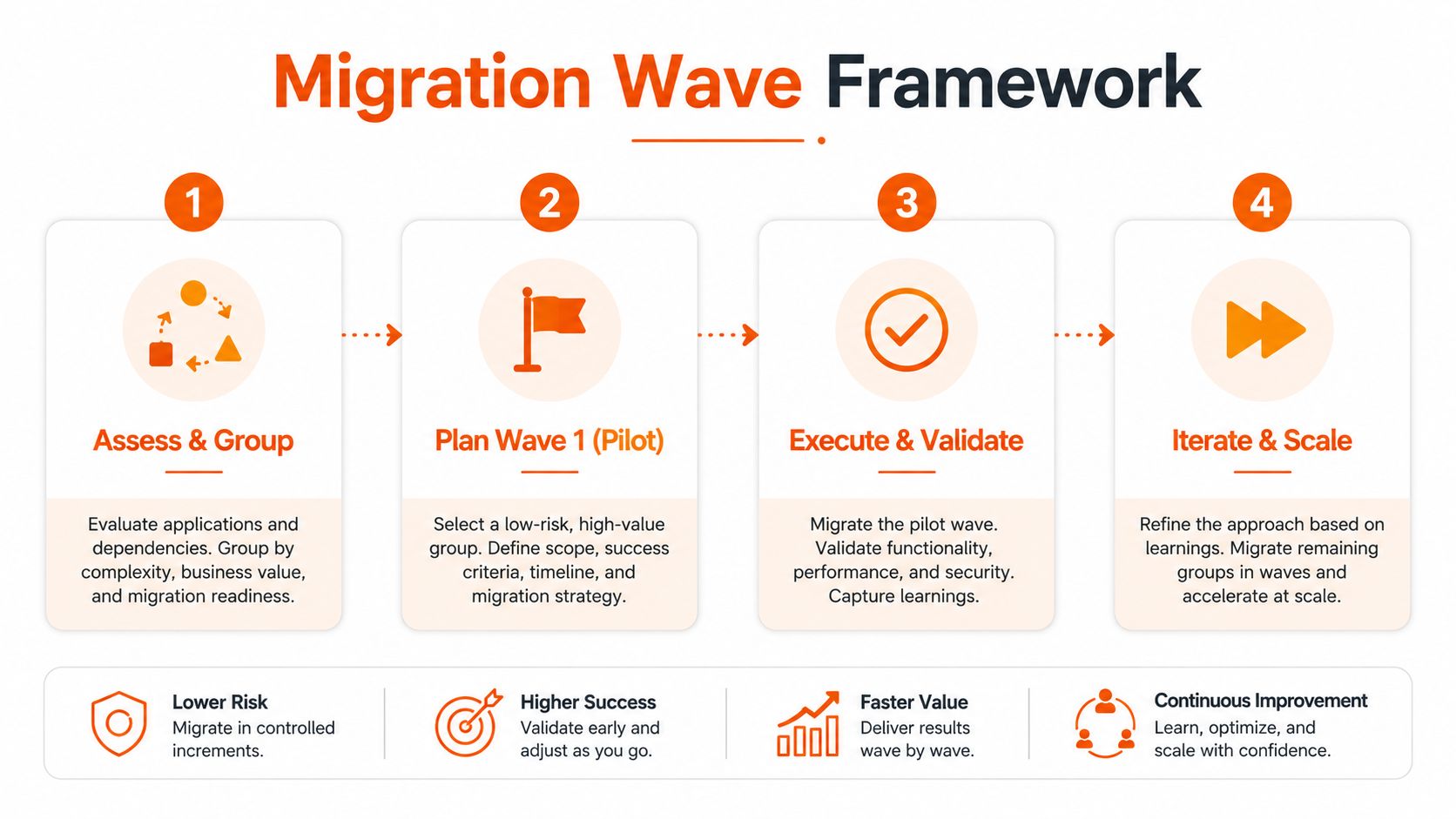
A migration wave should be small enough to control and meaningful enough to teach the team something. Group workloads by dependency, business service, data relationship, and operational ownership. Don't group them solely by technology stack, because the business experiences services rather than isolated components.
Build each wave around a controlled sequence
- Confirm scope and ownership. Name the business owner, technical lead, security approver, service manager, and decision-maker for rollback.
- Validate dependencies. Recheck integrations, identity paths, scheduled processes, data synchronisation, supplier contacts, and user access.
- Define the target state. Document the landing zone, network path, security controls, monitoring, backup, support model, and cost allocation.
- Test before production. Run functional, integration, performance, security, data integrity, and recovery tests against agreed acceptance criteria.
- Write the runbook. Include preconditions, task owners, timings, validation commands or checks, communication points, escalation routes, and rollback triggers.
- Execute a rehearsed cutover. Confirm data consistency, switch traffic or users, monitor the service, and keep the rollback path available until the business owner accepts the result.
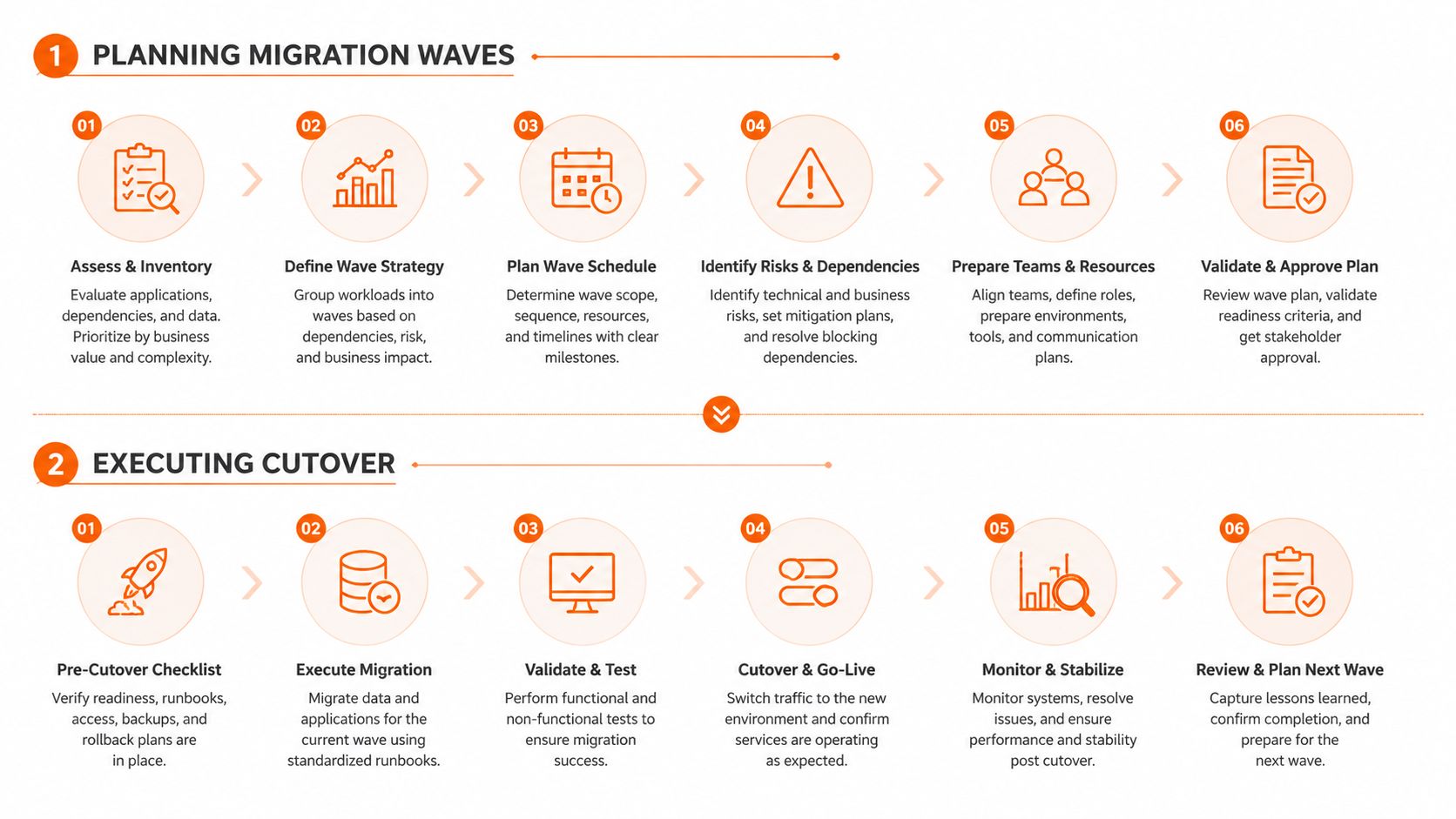
Treat rollback as a decision, not a hope
A rollback plan needs more than a backup. Define the exact condition that triggers it, who has authority to call it, how new data is handled, how users are informed, and how the team restores service in the previous environment. Test the procedure before production cutover.
Infrastructure should be reproducible, reviewed, and version-controlled. Teams adopting Infrastructure as Code practices can make environment changes visible and repeatable, which improves recovery and reduces dependence on one person's memory.
Pause the wave when the evidence changes. An unexpected dependency, failed recovery test, unclear data ownership, or unexplained performance result is a delivery decision point, not an inconvenience to hide. #riteway's Extreme Ownership means the team surfaces that information early and acts on it with energy, rather than protecting a date at the expense of service continuity.
Post-Migration Operations and Continuous Optimisation
Go-live is where the business case becomes testable. Keep the original outcome measures visible alongside technical telemetry. A dashboard that shows uptime and resource consumption is useful, but it doesn't prove that customers receive a better service or that product teams release with less friction.
Create an operating scorecard with three layers:
- Service health: Availability, latency, error patterns, recovery performance, security events, and capacity.
- Business performance: Customer journey completion, support demand, transaction success, product usage, or other measures tied to the service.
- Financial control: Cost by product or service, unexpected consumption, shared-platform allocation, and the progress of optimisation actions.
Optimisation needs named owners and a regular review cadence. Check whether resources match observed demand, whether storage and data transfer patterns remain sensible, whether managed services reduce operational work, and whether the architecture still fits the product roadmap. Avoid cost cutting that damages resilience or slows delivery.
The same principle applies to engineering flow. Teams that remove manual deployment friction and establish reliable operational feedback can ship apps faster without treating speed as a substitute for control. The target is a healthier delivery system, where releases are safer, evidence arrives sooner, and the business can make decisions with confidence.
Cloud migration is therefore a continuing management responsibility. Revisit retained workloads when dependencies change, reassess hybrid and multi-cloud boundaries when compliance or resilience needs evolve, and compare actual value against the assumptions approved at the start.
Rite NRG provides advisory on technology and delivery, senior engineering teams, cloud platform development, and structured support for legacy modernisation and migration programmes. If you need a partner to assess workloads, plan controlled migration waves, or build the operating capability that turns cloud investment into business value, visit Rite NRG and start a focused conversation.