Twenty-eight per cent of UK central government technology was still classed as legacy in 2024, rising from 26% in 2023, while 22% of assessed legacy systems were rated red for both likelihood and impact of failure, according to the State of Digital Government review. That reframes legacy system migration immediately. This isn't a tidy infrastructure upgrade. It's a governance decision about which services, revenues, customers, and regulatory obligations your business is willing to expose while the estate changes.
SaaS leaders should treat migration as a value-delivery programme. The right sequence reduces operational risk, lowers total cost of ownership, protects service continuity, and creates room for product teams to ship. The wrong sequence only moves brittle architecture to a different hosting environment and calls the work complete.
This playbook applies the #riteway Methodology, built around Extreme Ownership, high energy, and proactive delivery. A migration team shouldn't wait for dependencies to become incidents. It should find them early, assign ownership, measure outcomes, and keep the business in control from discovery through decommissioning.
Why Legacy System Migration Is a Business Risk Problem
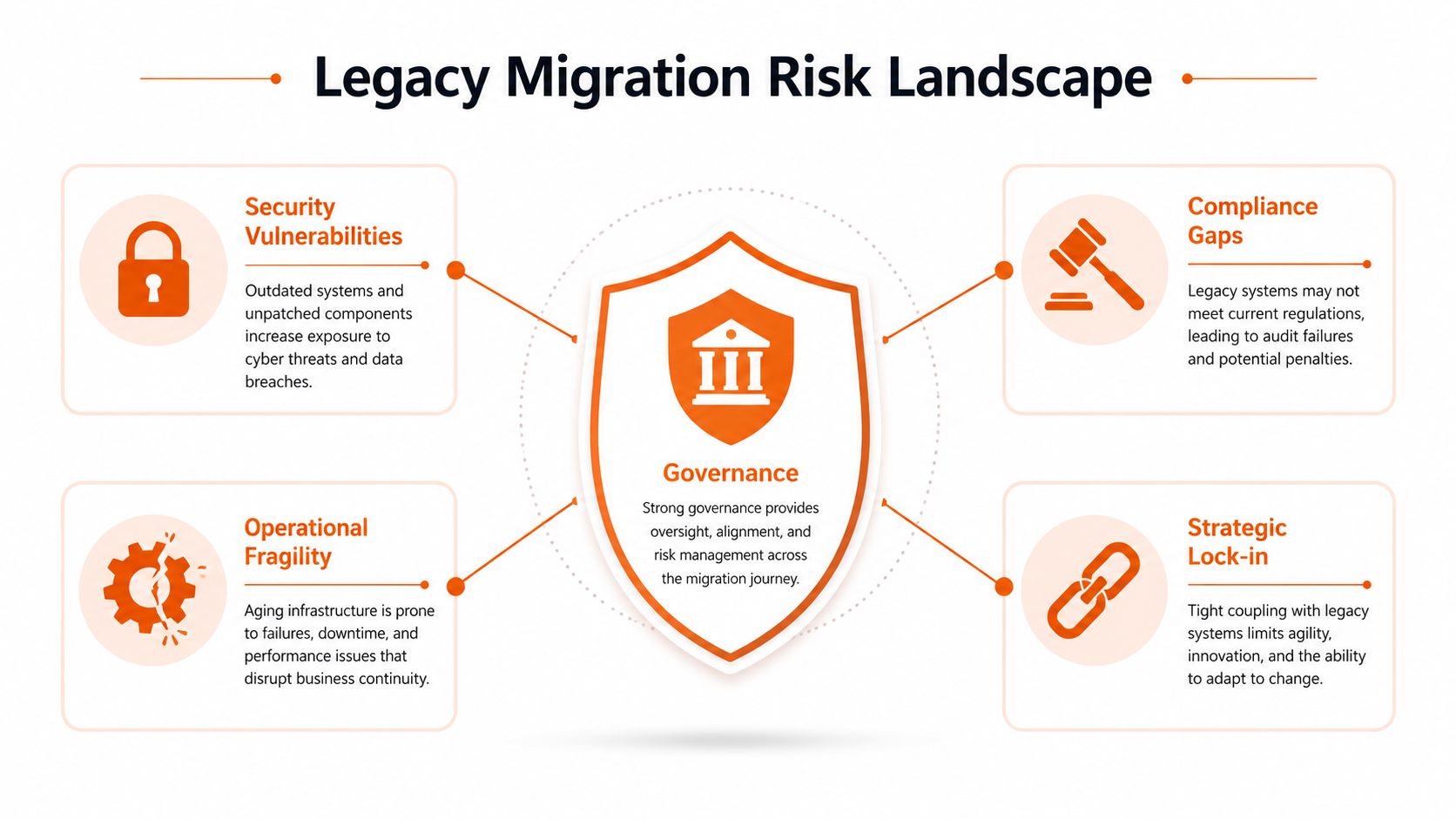
Legacy technology creates risk through more than old code. It can hide unsupported components, undocumented integrations, fragile operational procedures, compliance gaps, and strategic lock-in. Each weakness becomes a business exposure when a customer-facing service fails, a release slows down, or a small change requires scarce specialist knowledge.
UK public administration offers a useful illustration. Between July 2022 and the end of March 2026, the Department for Work and Pensions sent Universal Credit migration notices to 2,353,319 individuals in 1,822,374 households. By the same point, 1,992,161 individuals in 1,580,239 households had claimed Universal Credit, 814,703 households had received transitional protection, and 360,030 individuals hadn't claimed, with their legacy benefit claims closed. The official dataset reports that 87% of households sent a notice had made a claim, while 13% hadn't and had their legacy benefit ended. These figures are available in the official Universal Credit migration statistics.
The lesson isn't that every SaaS migration resembles a benefits programme. The lesson is that policy, communication, eligibility, transition controls, and service continuity determine migration outcomes alongside technology. A technically elegant cutover can still fail if customers don't understand the change, business owners haven't approved the operating model, or support teams can't handle exceptions.
Treat migration as a board-level control
Start with outcomes, not platforms. Define the service reliability you must preserve, the cost base you need to change, the product capabilities migration should enable, and the risks the board expects you to retire. Then translate those outcomes into delivery gates.
The #riteway Methodology makes Extreme Ownership practical. One accountable leader owns the migration result, not just a workstream. Engineering owns technical evidence. Product owns customer impact. Operations owns readiness. Compliance owns control validation. Nobody can hide behind a completed ticket if the business outcome hasn't improved.
Practical rule: A migration is complete only when the new service is demonstrably safe to operate and the old service can be retired without reopening the same risk.
Use a structured legacy system modernization playbook to challenge assumptions, but keep your own decision log authoritative. Record why each system is being retained, retired, re-hosted, repurchased, or re-platformed, who accepted the residual risk, and what evidence will trigger the next decision.
Business continuity belongs in the delivery design, not in a final checklist. Teams should connect migration sequencing to tested business continuity strategies so that incident response, customer communications, recovery procedures, and ownership remain usable during transition.
Assessing Your Legacy Estate and Scoring Risk
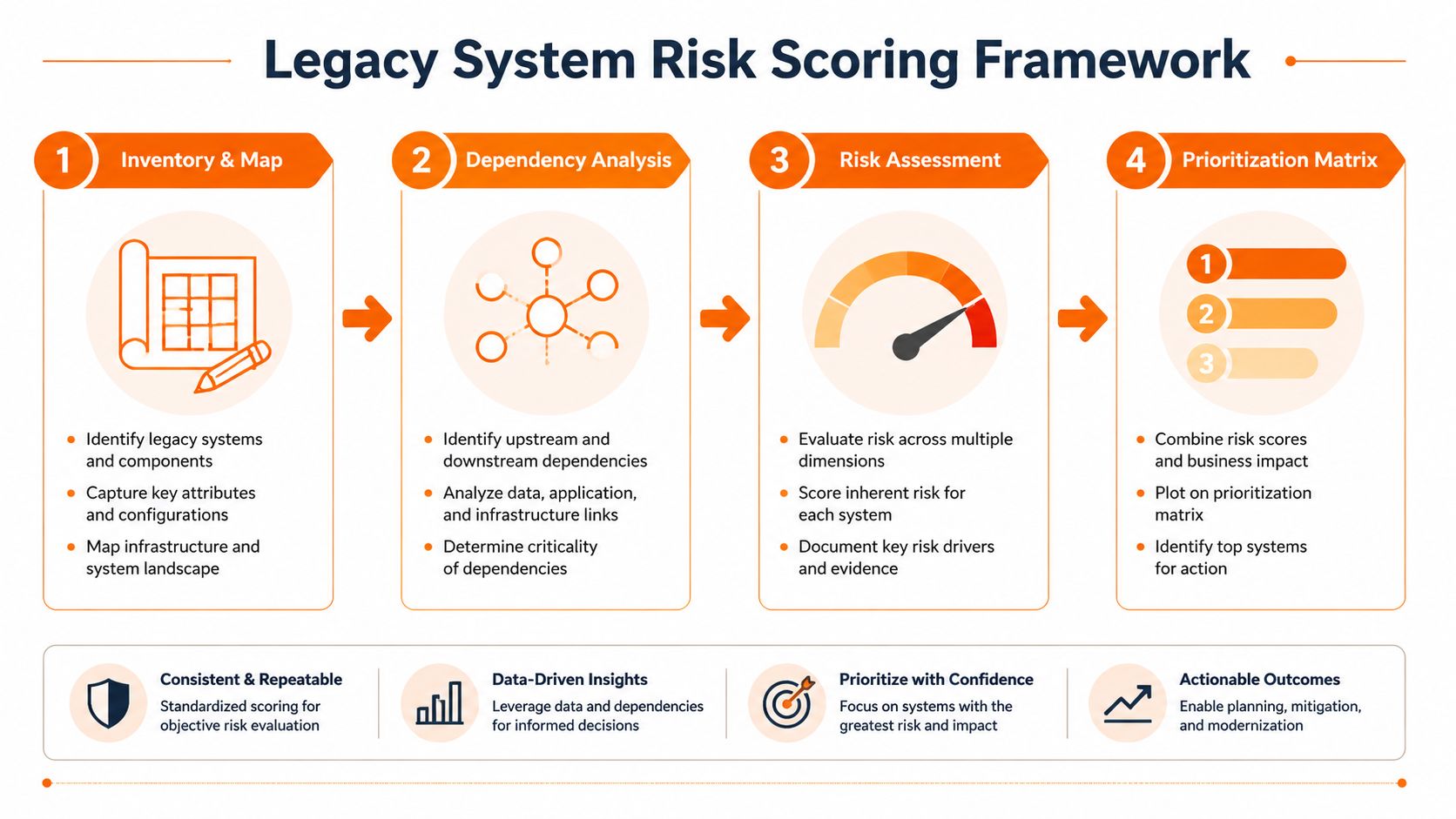
Before moving data or rewriting services, build a reliable map of the estate. You need to know what each application does, which customers or internal teams depend on it, where its data lives, how it communicates, and what fails if it becomes unavailable.
UK government has started formalising this discipline. A government roadmap reported that 26 organisations had registered and scored assets using the common Legacy IT Framework, with HM Courts and Tribunals Service applying risk scores to every IT system to prioritise decommissioning and migration decisions. The same reporting found that central government legacy technology ranged from 10% to 60% by department, which shows why portfolio-level assumptions are dangerous. The figures and framework context are covered in UK public-sector legacy technology reporting.
Build an evidence-based inventory
Create one portfolio record per system. Capture business owner, technical owner, users, data domains, interfaces, runtime environment, authentication model, release process, support dependency, contractual constraints, and known incidents. Pull evidence from repositories, observability platforms, service desks, deployment pipelines, database catalogues, and finance records.
Automated discovery gives you breadth, but it won't reveal every dependency. Interview the people who approve releases, reconcile data, answer production alerts, and handle customer exceptions. Those conversations surface manual workarounds that diagrams often miss.
Score likelihood and impact separately
Use a simple risk model with two axes:
- Failure likelihood: Consider obsolescence, unsupported components, weak test coverage, operational fragility, change frequency, and concentration of knowledge.
- Business impact: Consider revenue, customer access, safety, regulatory obligations, data sensitivity, contractual commitments, and recovery difficulty.
- Dependency depth: Record upstream and downstream systems, batch jobs, reports, third-party integrations, and human processes.
- Modernisation value: Identify whether changing the system improves reliability, lowers cost, accelerates product delivery, or removes a strategic constraint.
Don't let engineering convenience decide priority. A difficult system with major customer impact may deserve earlier discovery than an easy internal tool. Conversely, a low-risk service can become a valuable pilot if it proves the migration controls without threatening the core business.
Cabinet Office guidance presents legacy remediation as a structured choice between retain, retire, re-host, repurchase, and re-platform, rather than a universal rewrite. Follow that logic. A system may be stable enough to retain while another should be retired immediately because it duplicates a supported capability.
Risk scores create alignment. They don't replace judgement. Use them to expose disagreement, then make the business owner accept or reject the consequence.
The output should be a sequenced roadmap with explicit decision owners, dependencies, evidence requirements, and exit criteria. If your team can't explain why a system appears in the first migration wave, the assessment isn't finished.
Choosing the Right Migration Pattern for Each System
No single migration pattern works across a mixed estate. A low-risk reporting service, a revenue-critical monolith, and a regulated data store carry different constraints, so applying the same approach to all three is poor governance.
| Pattern | Best For | Risk Profile | Typical Time-to-Value |
|---|---|---|---|
| Lift-and-shift | Services where infrastructure is the immediate constraint and behaviour must remain stable | Fast movement, but technical debt and weak controls may remain | Early infrastructure value, with limited business change |
| Strangler fig | Large monoliths that need gradual replacement around stable customer journeys | Controlled transition, but routing, data ownership, and coexistence add complexity | Incremental value as each capability moves |
| Replatforming | Systems whose core business logic remains valid but whose runtime, database, or interfaces restrict delivery | Moderate change risk, with compatibility and performance validation required | Faster than a rewrite when boundaries are understood |
| Full rewrite | Systems that no longer fit the business, regulatory, or product model | Highest delivery and parity risk, especially with undocumented behaviour | Delayed value, but potentially greater long-term flexibility |
Make the decision against business constraints
Choose lift-and-shift when the priority is to remove a hosting constraint without changing application behaviour. Don't mistake relocation for modernisation. If observability, patching, access controls, and deployment discipline remain weak, the risk has travelled with the workload.
Choose replatforming when the application logic still supports the business but the supporting layers block reliability or scale. A database, operating system, API layer, or deployment model may need to change while the domain behaviour stays stable.
The strangler fig pattern fits a tightly coupled SaaS platform where the business can't tolerate a big-bang replacement. Put a stable interface around the existing service, move one capability at a time, redirect traffic deliberately, and retire old paths only after usage and data parity are proven. This pattern creates learning early, but it demands disciplined ownership of duplicated logic and transitional data flows.
A full rewrite belongs at the end of the decision list, not the top. Use it when the current system's behaviour, architecture, or operating model prevents the business from meeting its obligations. Otherwise, incremental replacement usually gives leaders more control over risk and time-to-value.
For infrastructure-heavy programmes, the Beyond Surplus data center migration guidance provides useful context on planning, dependencies, and continuity. For application portfolios, apply the same discipline through legacy system modernization strategies, then tie each choice to an outcome the business can inspect.
Executing Data Migration, Testing, Cutover and Rollback
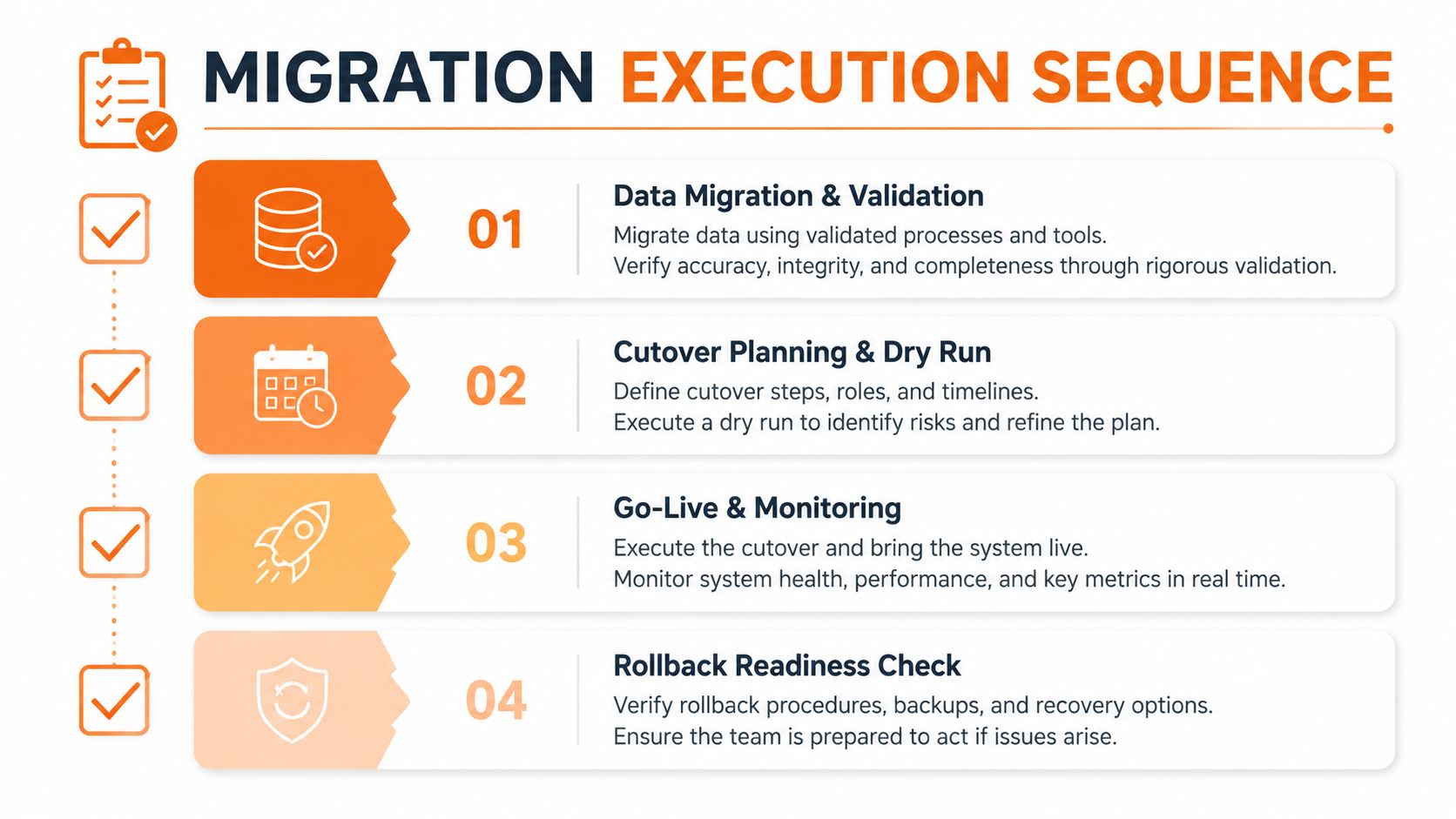
Migration execution should run as one controlled sequence. Data work, testing, cutover, monitoring, and rollback aren't separate projects that happen to share a date. Each stage produces evidence for the next decision.
Start with data truth
Define ownership for every data domain before extraction begins. Document source fields, target fields, transformations, validation rules, retention obligations, reconciliation methods, and exception handling. Preserve lineage so an operator can explain where a customer record came from and why its target value differs.
Run migration rehearsals using representative data and production-like workloads. Reconcile record counts, totals, relationships, timestamps, permissions, and business rules. A successful load isn't proof of a successful migration. The target must support the same business decisions, reports, workflows, and customer outcomes that matter.
Testing needs multiple gates:
- Functional parity: Confirm that critical journeys produce the expected result.
- Data integrity: Reconcile transformed records and investigate every material exception.
- Performance and resilience: Test expected load, failure recovery, dependencies, and operational alerts.
- Security and compliance: Validate access, audit trails, encryption controls, retention, and segregation requirements.
- Operational readiness: Confirm runbooks, support ownership, dashboards, escalation routes, and customer communications.
Design the cutover backwards
Choose a cutover window based on business tolerance, not team convenience. Decide whether to run old and new services in parallel, migrate by data domain, or release by customer or service tranche. Each approach needs explicit rules for writes, reconciliation, support, and traffic routing.
A dry run should measure elapsed time, operator actions, failure points, and recovery steps. Improve the runbook after every rehearsal. Go-live begins only when product, engineering, operations, security, and business owners agree that the evidence meets the exit criteria.
Rollback deserves equal design attention. Define the trigger, decision authority, data reversal or forward-repair method, customer communication, and maximum safe time in the new environment. If rollback can't preserve consistency, use a controlled forward-recovery plan instead, but document that choice before cutover.
A rollback plan isn't paperwork. It's the mechanism that lets leaders make a fast decision without improvising under customer pressure.
Monitor business signals after go-live, including transaction completion, support contacts, reconciliation exceptions, processing queues, and customer-facing errors. Decommission only after service parity is proven and the organisation can operate the replacement without relying on the legacy team.
Structuring Teams and Nearshore Delivery for Predictable Outcomes
Migration fails when leaders treat it as spare-time work for an already stretched product team. Establish dedicated ownership around clear workstreams, then connect those workstreams through one delivery cadence.
A practical structure includes a migration lead, domain owners, application engineers, data specialists, QA and automation engineers, platform support, security, compliance, and service operations. Product leadership should own customer sequencing and value decisions. The technical lead should own architecture and evidence. The programme lead should expose blockers early rather than report optimistic status.

A nearshore partner can add capacity without separating delivery from the people who understand the business. The partner should work inside your repositories, ceremonies, quality gates, incident process, and decision records. You keep product and risk accountability. The partner contributes senior delivery capability, structured discovery, automation, and predictable execution.
Rite NRG is one option for this model. It provides dedicated teams, platform development, technology and delivery consulting, and Build-Operate-Transfer support for R&D centres in Poland. Its published service model also describes AI-powered processes across recruitment, delivery, and operations, with senior teams able to scale within 1–2 weeks, as stated in the company information provided for this article.
Govern the partner through outcomes
Don't measure a partner by tickets closed or engineers supplied. Track indicators that expose whether the programme is becoming safer and faster:
- Cutover success rate: Did planned releases complete without an unplanned rollback?
- Defect escape rate: Which migration defects reached production or customers?
- Reconciliation completion: Were data exceptions resolved within the agreed gate?
- Migration cycle time: How long does each domain or service tranche take?
- Decision latency: How quickly do owners resolve dependency and risk questions?
- Knowledge transfer: Can the receiving team operate the service without the original specialists?
Use transparent dashboards and short decision cycles. AI can help analyse repositories, tickets, dependencies, and test gaps, but it doesn't replace accountable judgement. The team must still decide what risk the business accepts and who will act on it.
Knowledge transfer should be designed from day one. Document architecture decisions, operational procedures, data lineage, and failure modes through knowledge transfer best practices, rather than attempting a rushed handover at the end.
This LATAM nearshore hiring guide offers broader context for evaluating distributed delivery models, including how location, talent access, and operating practices affect team design. The relevant test is simple: can the combined team make decisions quickly, preserve context, and own the result?
A short visual explanation can help stakeholders understand how team design supports delivery control:
Common Migration Pitfalls and How to Avoid Them
Cloud hosting doesn't erase legacy risk. It can improve the environment, but a lifted application may still have obsolete dependencies, weak observability, manual recovery, poor governance, and brittle data flows.
UK government guidance explicitly treats legacy remediation as a structured effort to understand systems and infrastructure, plan continuous improvement, and reduce technical debt. The government guidance on managing legacy technology also makes risk reduction part of the advisory responsibility, not an optional technical enhancement.
The expensive anti-patterns
The big bang cutover concentrates uncertainty into one event. Replace it with service tranches, parallel validation, rehearsed runbooks, and a rollback decision that has named authority.
The cloud-only definition of success rewards movement instead of improvement. Require evidence of stronger monitoring, safer change, better recovery, or lower operating effort before calling a workload modernised.
The incomplete dependency map leaves hidden batch jobs, reports, integrations, and manual processes outside the plan. Make dependency discovery an ongoing activity, not a workshop that ends when the first roadmap is approved.
The savings-first backlog cuts maintenance without funding the work that removes the underlying risk. Sequence short-term stabilisation alongside modernisation so that budget pressure doesn't push the hardest systems indefinitely into the future.
The knowledge bottleneck leaves one specialist as the only person who can validate behaviour. Pair that specialist with the receiving team, record decisions, and turn operational knowledge into tests and runbooks.
Defra demonstrates why scale must be treated carefully. The department estimated £726 million of legacy modernisation spend between 2021 and 2025, while later reporting described plans spanning roughly 10 years and 1,962 applications. More than 1,500 applications remained after 180 critical applications had been refreshed, as reported in the UK government roadmap for upgrading outdated legacy systems.
The practical response is staged governance. Stabilise first, map dependencies, migrate by domain or service tranche, validate quality at every gate, and decommission only when the replacement proves safe to operate.
Measuring Success and Proving Post-Migration Value
A green deployment dashboard doesn't prove business value. Your post-migration scorecard should show whether customers, operators, finance teams, and product leaders are better off.
Track service reliability, completed journeys, processing speed, support demand, reconciliation exceptions, incident severity, recovery performance, release friction, and total cost of ownership. Establish the baseline before migration, then assign an owner to each measure. Without a baseline, teams can claim improvement from anecdote.
The Office for National Statistics provides a useful example. In December 2025, ONS migrated three critical surveys from legacy systems to a new platform. The organisation reported that Monthly Business Survey clearance rates improved by 15%, error resolution became faster, and operational risk fell in its quarterly economic statistics and surveys improvement update.
Report value across the operating horizon
Some benefits appear immediately, such as fewer manual interventions or faster processing. Others emerge as teams ship product changes more safely, retire support contracts, reduce specialist dependency, and avoid interim fixes.
The financial case also deserves discipline. UK reporting citing the State of Digital Government review estimated that maintaining legacy systems costs three to four times as much as modern alternatives, while public-sector technology spending was roughly £26 billion in 2023. Those figures appear in UK legacy modernisation cost analysis.
Use a benefits register with an accountable owner, baseline, target direction, evidence source, review cadence, and decision if performance doesn't improve. For longer programmes, keep projected benefits visible across the full investment horizon. The Unity shared-services programme was reported at £366 million in cost, with around £90 million in savings compared with separate departmental upgrades and projected benefits of £585 million over 15 years, according to coverage of the UK government's core-systems cloud migration.
That is the #riteway standard. Extreme Ownership continues after go-live. The team stays accountable until the new platform delivers measurable resilience, speed, cost, and product value.
Rite NRG helps SaaS teams plan and deliver legacy system migration through technology and delivery consulting, dedicated senior nearshore teams, platform development, and Build-Operate-Transfer R&D centres in Poland. Visit Rite NRG to discuss your estate, risk priorities, and the delivery model that can turn migration into predictable business value.