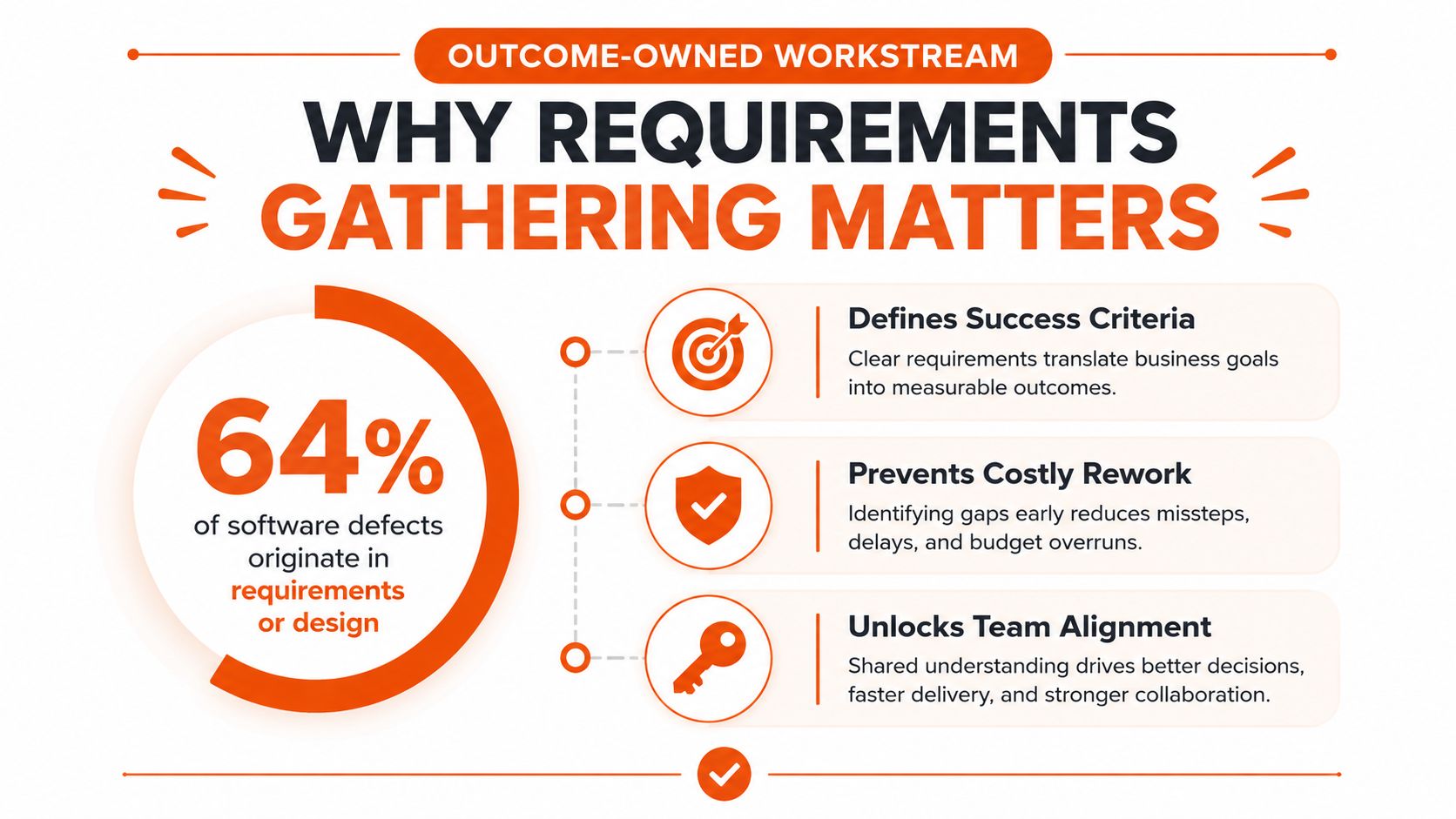
Roughly 64% of software defects originate in the requirements or design phase, and about 41.5% of project effort can be spent on unnecessary or poorly specified requirements. A disciplined requirements gathering process turns that exposure into a controlled, outcome-focused workstream before build begins.
For SaaS teams, discovery isn't a paperwork exercise before the “real” work starts. It determines whether the release improves activation, reduces operational friction, protects retention, or produces another technically impressive feature that users don't need. The #riteway approach combines Extreme Ownership, high energy, and proactive delivery discipline, so every requirement has an owner, every decision has evidence, and every handover gives the team enough context to move without guesswork.
Why the Requirements Gathering Process Matters for SaaS Delivery
The cost of weak requirements isn't confined to a late clarification in Jira. Industry analysis referenced in UK software-requirements literature links approximately 64% of software defects to the requirements or design phases, while poor requirements practices can add roughly 60% to project time and budget. The same evidence associates around 41.5% of new project development resources with unnecessary or poorly specified requirements. The UK-relevant requirements benchmark makes the commercial point clearly: unclear discovery creates rework long before anyone labels it rework.
A SaaS company feels that failure quickly. A misunderstood onboarding flow can delay time-to-first-value, increase support demand, and leave new customers questioning whether the product fits their operation. A billing change can create reconciliation work for finance and trust issues for customers. Under MRR pressure, a feature that misses the intended behaviour isn't merely late. It can affect retention and make the next release harder to plan.
Practical rule: Treat discovery as a deliverable with an owner, a timebox, approval gates, and measurable exit criteria.
UK government guidance reinforces this outcome-led view. Requirements should be prioritised and agreed against expected outputs, outcomes, and benefits, with a shared vision of success that remains realistic and understandable. The guidance also connects early requirements work to business-case development and warns that late changes are costly. Government requirements guidance is useful here because it moves the conversation away from “which features can we fit?” and towards “which result are we funding?”
Start with the outcome, not the backlog
Write one sentence naming the user segment, the change you want, and the business result. Then attach three to five success measures. For a B2B SaaS onboarding redesign, the canvas might look like this:
- User segment: New operations teams joining the platform.
- Outcome: New customers reach their first useful workflow with less assisted setup.
- Measures: Activation rate, time-to-first-value, support ticket volume, and a churn-risk indicator.
- In scope: Workspace setup, role assignment, data import, and the first guided workflow.
- Out of scope: A full navigation redesign, mobile parity, and advanced reporting.
For a usage-based billing rollout, name the customer segment, the billing event that must be captured, and the commercial result. Measures could include invoice accuracy, finance reconciliation effort, payment dispute signals, and customer visibility into usage. The point isn't to predict every result perfectly. It's to give the team a test for every later trade-off.
A single workshop can produce this outcome canvas:
| Canvas field | Decision to record |
|---|---|
| Problem | What operational or customer problem exists now? |
| Named users | Who experiences it, and who approves the change? |
| Business outcome | What must change after release? |
| Success measures | Which observable signals indicate value? |
| Scope boundary | Which workflows, integrations, and segments are included? |
| Non-goals | What won't this release solve? |
| Decision owner | Who can resolve disagreement and approve scope? |
The backlog comes after this canvas. If a story can't trace back to a stated metric, user need, risk reduction, or delivery constraint, cut it or move it to an explicitly separate decision. Extreme Ownership matters here. The discovery lead doesn't collect contradictory requests and pass the conflict to engineering. They expose the conflict, bring the right people together, and force a decision while the cost of changing direction is still low.
For teams working with a nearshore partner, the payoff is practical. A clear outcome canvas shortens the design-to-build cycle, gives the delivery pod a reliable handover, and turns lower rework into an intended result of discovery. Teams can also use a structured, evidence-led science-backed evaluation approach when assessing user or organisational signals that inform the product decision.
Mapping Stakeholders, Decision Rights and the Nearshore Interface
A Series A SaaS company is rebuilding billing. The founders care about investor confidence and revenue visibility. The Head of Operations cares about accurate invoices and fewer manual adjustments. Two engineers understand the legacy data model. A nearshore delivery pod in Colombia will design, build, and validate the replacement.
Without a stakeholder map, each person can be “helpful” in a way that damages delivery. A founder adds a reporting request in a workshop. Operations changes the priority after the session. An engineer explains a technical constraint directly to the nearshore pod, while the Product Owner has already promised a different scope. The pod isn't blocked by Colombia's time zone. It's blocked because nobody knows whose answer counts.
Use a power-interest grid, but adapt it for SaaS delivery:
- Decision makers: Product Owner and founder or sponsor. The Product Owner holds final scope authority.
- Consulted experts: Operations Lead, Engineering Lead, finance, compliance, and customer-facing specialists.
- Informed contributors: People affected by rollout who don't own a decision.
- Delivery counterparts: Named nearshore Product, Engineering, and QA contacts who consolidate questions before escalation.
The Product Owner must own scope cuts, prioritisation trade-offs, and acceptance sign-off. The founder can set the commercial direction, but shouldn't issue parallel delivery instructions. The nearshore pod needs one clear route for clarification, with decisions recorded where the whole team works.
For teams assessing the operating model itself, this nearshoring guide provides useful context. The delivery mechanics still depend on explicit ownership.
Stakeholder RACI for SaaS Discovery with a Nearshore Pod
| Activity | Product Owner | Founder/Sponsor | Ops Lead | Engineering Lead | Nearshore Pod |
|---|---|---|---|---|---|
| Discovery workshops | A | C | C | C | R |
| Artefact sign-off | A | C | C | C | R |
| Daily clarification | A | I | C | C | R |
| Validation sprints | A | I | C | C | R |
R means responsible for doing the work, A means accountable for the decision, C means consulted, and I means informed. Every open question also needs a named owner and a response SLA. Ambiguous ownership harms asynchronous nearshore delivery more than time zones do, because a delayed answer is manageable, while three contradictory answers create invisible rework.
Running Discovery Workshops That Surface the Real Process
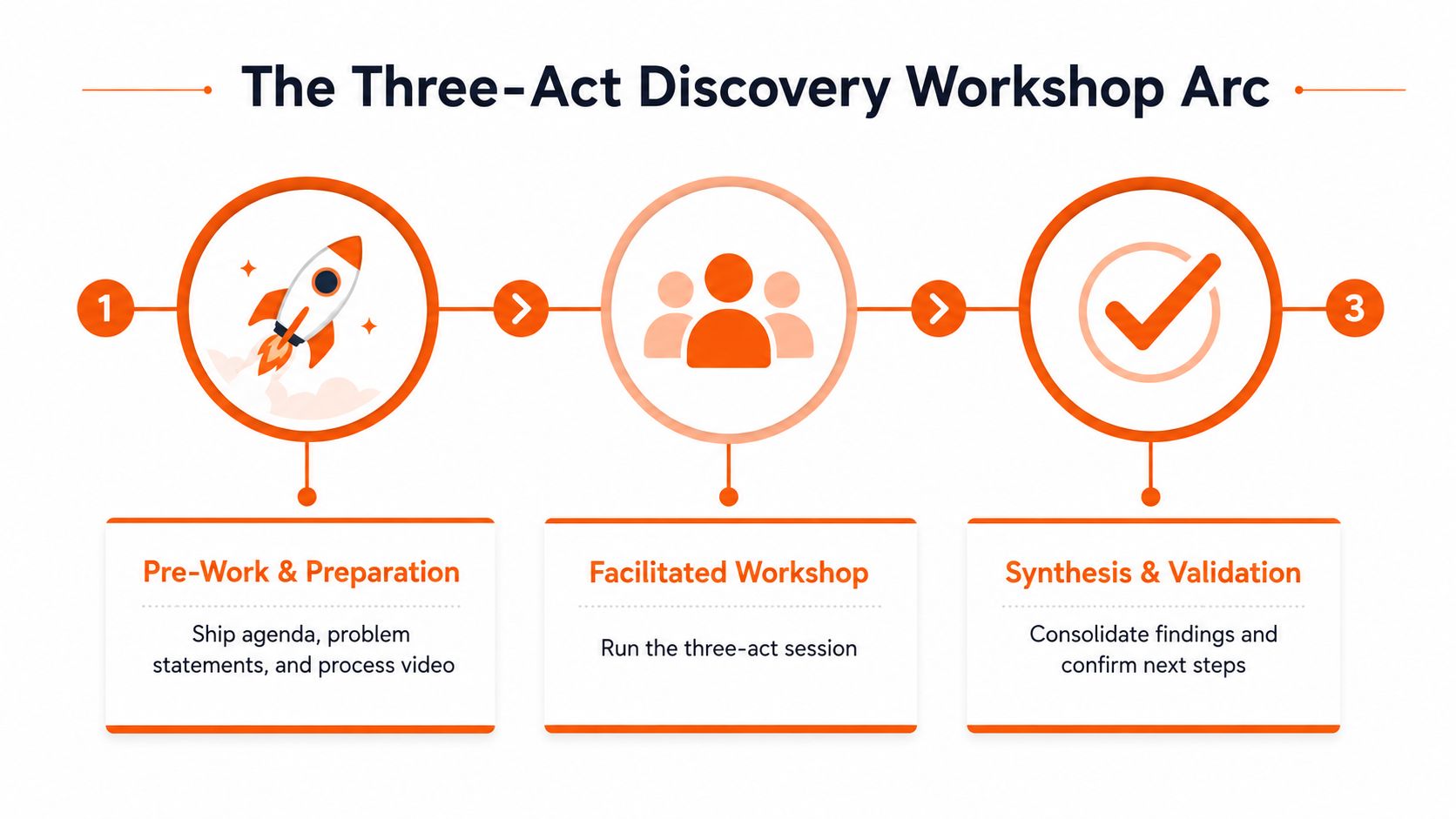
A productive workshop has three acts. Don't invite stakeholders to an unstructured brainstorm and hope the workflow appears.
Act one prepares evidence
Send a one-page agenda, three problem statements, and a process walkthrough video to every participant at least 48 hours before the session. Ask attendees to mark where the current process differs from the written description. This shifts the meeting from opinion-sharing to evidence review.
Act two reconstructs the current state
Start with business context, then map the current process using swim lanes for each role, system, and handoff. Vote on pain points before sketching the future state. Capture decisions and unresolved questions in a shared log as the conversation happens.
The strongest technique is process archaeology. Ask someone to walk through the legacy tool while recording the screen. Prompt with, “Show me the last time this broke,” then ask what they did next, who approved the exception, and which data they copied manually. People often can't describe undocumented practice in the abstract. They can demonstrate it when the old screen, spreadsheet, or email thread is in front of them.
For a deeper treatment of user observation and interview design, teams can consult these user research methods. The practical principle is simple: watch the work, don't rely only on what participants believe the work should be.
For a nearshore team, appoint a shadow facilitator to capture notes and decisions in the shared board in real time. Use a 30-minute overlap window the next morning for the pod to challenge assumptions while the discussion is still fresh. Don't treat notes as complete until the team has confirmed the process map, exceptions, and decision log.
Act three closes the loop
Within 24 hours, send the workshop summary, decisions, action items, and open questions. Finish with a binary decision: is the scope ready for prioritisation, yes or no? If no, name the missing evidence and the person responsible for producing it. High energy isn't rushing past uncertainty. It's moving uncertainty into a visible queue and resolving it proactively.
Prioritisation and Acceptance Criteria That Survive Build
Prioritisation and acceptance criteria are one gate, not two disconnected ceremonies. First use MoSCoW in the workshop to protect a fixed release window. Must-Haves define the minimum outcome; Should-Haves matter but can move; Could-Haves add value if capacity remains; Won't-Haves make the boundary explicit.
Then use RICE to sequence the Must-Haves. Reach, impact, confidence, and effort expose a weak bet that survived because its sponsor spoke most forcefully. MoSCoW answers, “Does this belong in the release?” RICE answers, “Which included bet deserves attention first?” Neither replaces product judgement. Both make the trade-off visible.
Acceptance criteria belong on every story. Write them in Given-When-Then form so QA can reuse the statements as test skeletons:
- Given a workspace administrator has imported valid usage data,
- When they review the billing preview,
- Then the system displays the calculated charge and identifies any rejected records.
Make each criterion binary and testable. State the user role, action, and observable result. Cover empty states, permission denials, failed integrations, and data shapes that can break legacy imports. Avoid “the page should be intuitive” because nobody can accept or reject it consistently.
For a nearshore handover, run an offsite pair-writing session with the onshore Product Owner and nearshore QA authoring criteria together. The QA partner will challenge vague verbs and missing exceptions that a solo author may overlook.
When to Use MoSCoW, RICE and Given-When-Then
| Technique | Best Used For | Owner | Output |
|---|---|---|---|
| MoSCoW | Locking release scope | Product Owner with stakeholders | Must, Should, Could, and Won't decisions |
| RICE | Sequencing approved bets | Product and delivery leads | Comparable prioritisation rationale |
| Given-When-Then | Making behaviour testable | Product Owner and QA | Reusable acceptance tests |
Define Done at story, feature, and release level. A story may need accepted criteria and passing tests. A feature may need updated documentation, observability, and stakeholder validation. A release may need a decision log, runbook, migration sign-off, and benefit measure. HMRC engineering guidance illustrates this operational standard by requiring product documentation to cover purpose, architecture views, decisions, runbooks, and observability. HMRC engineering standards show why “complete” must include how a product is operated, not only how it is coded.
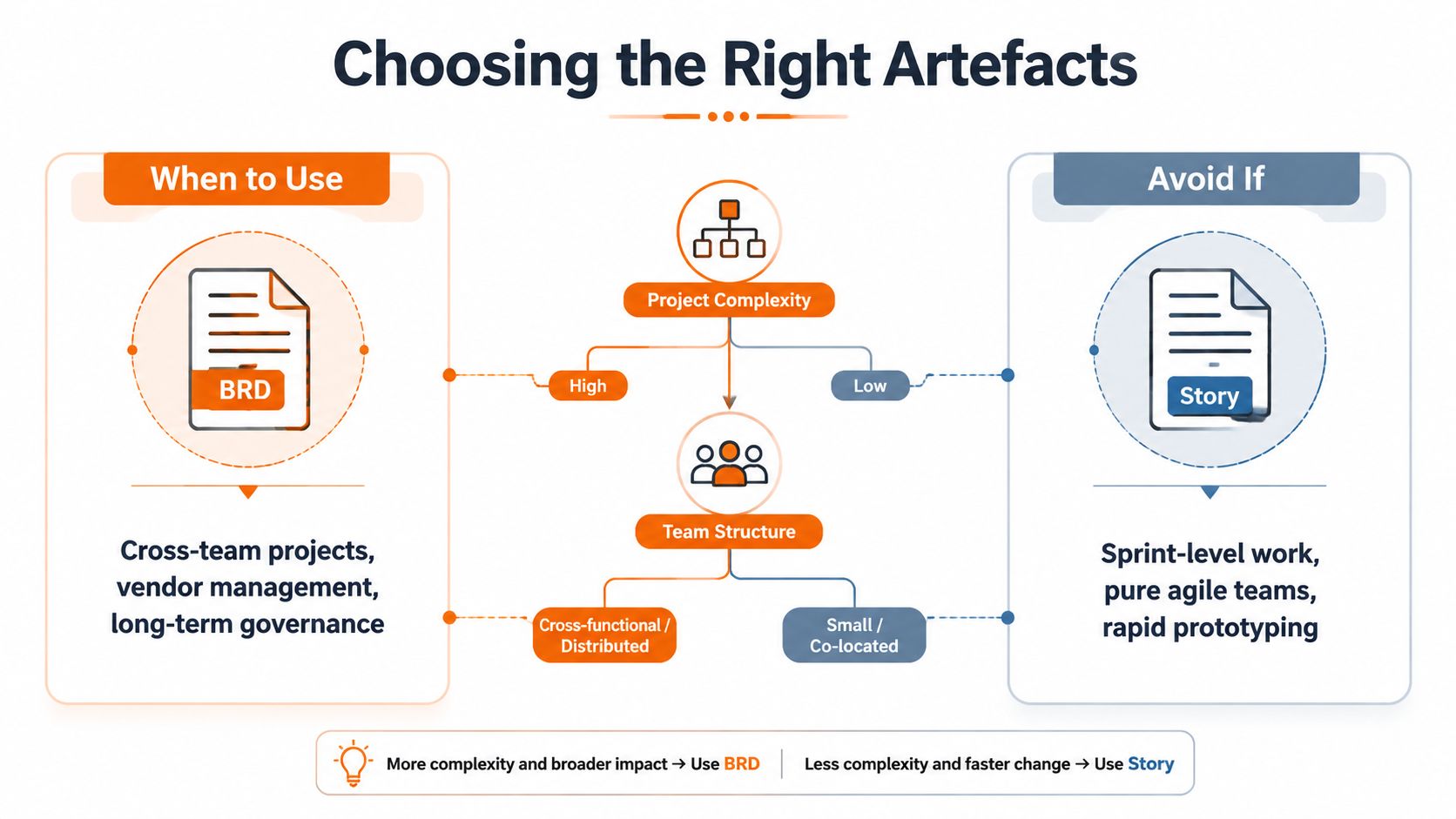
Choosing the Right Artefacts Across BRD, PRD, Stories and Wireframes
SaaS teams usually fail in one of two ways. They create a large document nobody opens, or they scatter decisions across tickets, Figma comments, chat threads, and meeting notes. Choose artefacts according to the decision they support, then retire anything that no longer helps the team decide or deliver.
| Artefact | What it owns | Primary owner | Adds value when |
|---|---|---|---|
| BRD | Business problem, outcome, scope, and non-goals | Sponsor or Product Owner | Multiple business units or executive approval are involved |
| PRD | Product rationale, behaviour, constraints, and links | Product Owner | The delivery team needs a shared explanation of what and why |
| User stories | Granular delivery scope and acceptance criteria | Product Owner with QA | The team is planning and validating buildable slices |
| Wireframes | Interaction concepts and workflow discussion | Product and design | The team needs to expose misunderstandings before detailed design |
A BRD should stay lean. For a cross-business billing programme, one page covering the problem, desired outcome, scope, non-goals, and decision owner may be enough. A PRD should carry the “what” and “why” without duplicating every story. Store it in the same version-controlled workspace the nearshore team reads daily.
Wireframes belong in the conversation, not after it. A rough sketch drawn during a workshop often creates more useful disagreement than polished Figma screens designed in isolation. The sketch makes a workflow visible while stakeholders can still change it cheaply.
For teams building a consistent specification set, a practical software spec template guide can help establish a starting structure. Don't copy a template blindly. Remove fields that create maintenance work without improving a decision.
Use one source of truth, tag items by sprint and owner, and link stories to decisions, designs, tests, and operational notes. If the nearshore pod has to ask which version is current, the workspace has already failed. If nobody reads an artefact after discovery, delete it.
Integrating AI Assistance and Nearshore Handover into Discovery
AI-assisted discovery works when it accelerates synthesis without becoming the authority. Use it to cluster interview notes, identify repeated pain points, draft user-story skeletons from transcripts, and stress-test acceptance criteria for ambiguous language. A delivery lead still checks every output against the source conversation and the agreed outcome.
The failure mode is treating generated text as discovered truth. AI can't replace a domain expert, invent process knowledge a stakeholder never shared, or substitute for a signed-off artefact. UK guidance on uncertainty is a useful reminder that discovery must handle ambiguity explicitly, while broader requirements-engineering research is increasingly examining generative AI support in fast-changing projects. The NIHR guide to gathering uncertainties provides a helpful lens for separating known needs from unresolved questions.
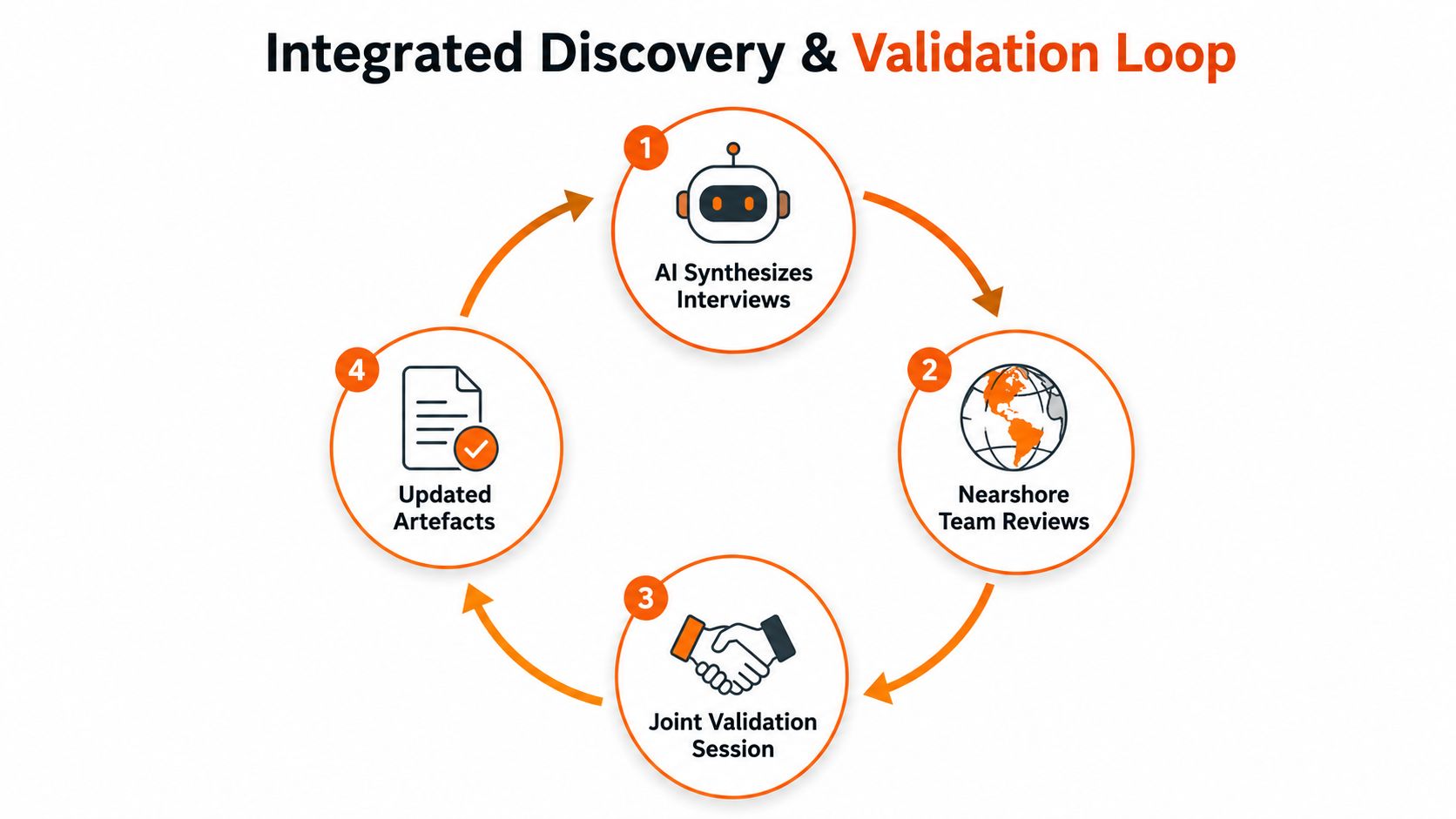
The operating model should be one continuous loop:
- AI synthesises interviews: The analyst reviews the generated clusters and links each finding to its source note.
- The nearshore team reviews: Engineers and QA challenge feasibility, dependencies, edge cases, and missing operational context.
- A joint validation session: The Product Owner, domain experts, and delivery pod resolve disagreements.
- Updated artefacts: The team revises the backlog, decision log, acceptance criteria, and traceability links.
The handover pack should contain personas, outcome measures, scope boundaries, process maps, decision history, assumptions, prioritised backlog, acceptance tests, integration notes, and runbooks. A shared repository and agreed overlap windows matter, but the primary control is traceability.
End with a validation handshake. Ask the nearshore team to replay the discovery story in their own words, from the user problem through the release outcome and the reasons behind each Must-Have. The client team should listen for missing assumptions rather than defending its original documents. AI can speed synthesis, a nearshore pod can accelerate execution, and both stay aligned only when the same evidence-backed artefacts govern the work.
Common Pitfalls and How to Validate Before Build Starts
A signed-off PRD doesn't prove that a team is ready to build. It proves only that someone approved a document. The final gate must test whether the delivery team can interpret, implement, and validate the intended outcome without relying on hidden context.
Five failure modes appear repeatedly:
- Solution-shaped requirements: “Build a dashboard” hides the user problem. Rewrite it as an outcome, then identify the smallest workflow that can produce it.
- Deferred edge cases: “We'll decide during build” transfers product decisions into the most expensive delivery moment. Add empty states, permission failures, integration errors, and migration rules to the acceptance set.
- Untestable criteria: Replace subjective words such as “easy” or “fast” with an observable role, action, and result. If QA can't create a pass or fail test, the criterion isn't ready.
- Unrecorded data assumptions: Create an assumption log covering field mappings, invalid records, duplicate handling, historical data, and external integration ownership.
- Context-free handover: Give the nearshore pod the problem statement, process map, decision log, scope boundaries, and outcome measures, not just a stack of tickets. A proof-of-concept documentation guide can help teams make early technical evidence easier to review and transfer.
Use a pre-build checklist with a deliberate cooling period. Send the artefact set for review, wait 24 hours, then run a developer-readability review in which engineering rewrites two user stories back into the underlying requirements. Differences reveal ambiguity faster than another passive approval meeting.
Finish with a readback session. The delivery lead walks the backlog aloud, records every clarification, updates the decision log, and checks each item against the outcome canvas. GOV.UK's Functional Standard GovS 002 requires outputs to meet the identified need and be validated by stakeholders, while business justification should continue throughout delivery so unjustified work can be stopped. GovS 002 project delivery guidance supports treating validation as an active control, not a signature.
The IPA's Principles for Project Success similarly connects outcomes to tangible deliverables and measurable benefits, with decisions guided by scope, time, cost, risk, and design priorities. Stop the gate when evidence is missing. The cost of one uncomfortable pause is lower than carrying a misunderstood requirement through every sprint that follows.
Rite NRG helps SaaS teams turn ambiguous product goals into outcome-led discovery, testable requirements, and structured nearshore handovers through technology and delivery consulting. Visit Rite NRG to discuss your next discovery sprint, delivery pod, or modernisation programme with a partner that takes ownership from decision through release.