
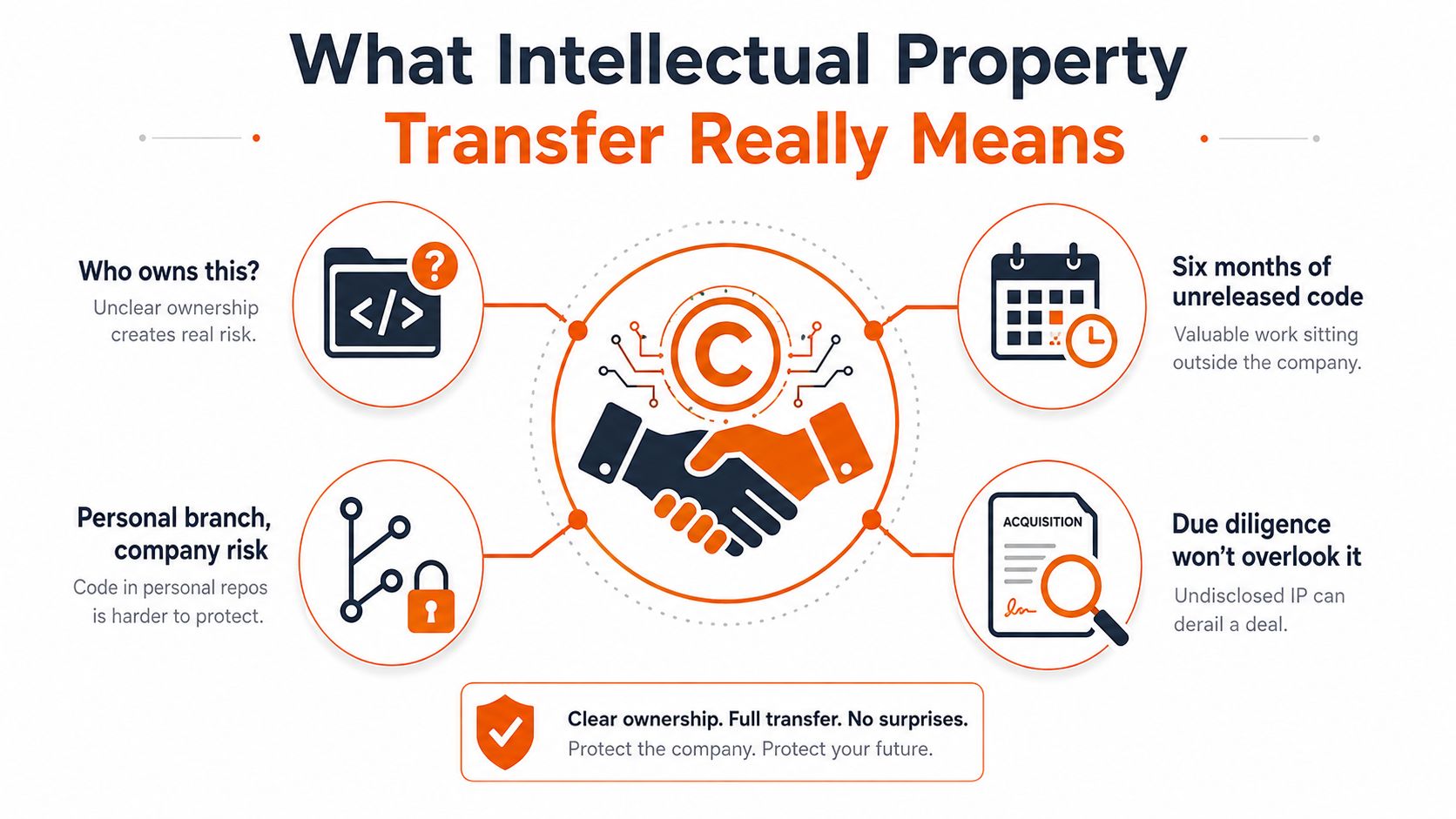
The term sheet is nearly signed. Your buyer has reviewed the product, the repository is full of valuable code, and the nearshore team is ready to hand over its documentation. Then one question stops the deal: who owns the software? The lead engineer resigned with six months of unreleased work on a personal GitHub branch, a contractor's agreement covers services but says little about copyright, and nobody can reconcile the code in production with the assignment records in the data room.
That situation is common in SaaS acquisitions, founder exits, and Build-Operate-Transfer arrangements. Intellectual property transfer isn't a paperwork exercise that follows delivery. Clean, enforceable ownership is itself a delivery outcome. The #riteway method puts that outcome under active management through Extreme Ownership, high energy, and proactive risk removal, rather than leaving title defects for a buyer's lawyer to discover.
What Intellectual Property Transfer Really Means
Intellectual property transfer is the movement of legal rights from one party to another. Those rights can include patents, software copyright, source code, designs, trade marks, know-how, database rights, domain names, and related documentation. The transfer may happen through a sale, merger, corporate restructure, asset purchase, or contractual handover between a client and a delivery organisation.
The important distinction is between ownership and access. A developer may have access to a repository, deployment environment, design system, or database without owning any of the rights embodied in those assets. Conversely, a company may claim ownership in a contract while lacking a signed assignment from the person who created the code.
The repository isn't the title
A repository proves that code exists and shows who committed it. It doesn't, by itself, prove who owns the copyright in that code. A founder, employee, freelancer, agency, and nearshore centre may all have contributed to the same product under different legal arrangements.
The UK framework treats formal transfer seriously. The Copyright, Designs and Patents Act 1988 provides that copyright is transmissible by assignment, but an assignment isn't effective unless it is in writing and signed by or on behalf of the assignor. That requirement is central to chain-of-title integrity. A verbal understanding, repository permission, or invoice won't substitute for the required transfer document where the statute applies.
The volume of rights in the UK also makes this a recurring commercial issue, not an unusual legal edge case. The UK Intellectual Property Office recorded 22,701 patent applications and 5,522 patent grants in 2025, compared with 18,956 applications and 8,228 grants in 2024, according to its 2025 facts and figures release. The same release records 203,194 trade mark applications in 2025, compared with 173,180 in 2024. Those filings create a substantial pool of rights that may later be assigned, licensed, or reorganised.
Practical rule: Treat every asset in the product as an ownership question, not just a technical artefact.
The right approach is to define the IP perimeter, identify the creator of each material asset, trace the signed rights path, and then deliver control in a way the buyer can operate. That's how you engineer an outcome instead of inserting a clause and hoping it works.
Assignment, Licence, and Transfer-on-Exit Compared
An assignment transfers ownership. A licence grants permission to use the IP while the owner retains title. A transfer-on-exit provision creates a contractual obligation to transfer rights when a defined event occurs, such as termination, change of control, or insolvency.
These mechanisms aren't interchangeable. UK guidance distinguishes assignment from licensing, and explains that a patent assignment can be effective without UK Intellectual Property Office recordal. However, failing to register an assignment within six months can affect litigation cost recovery, and a later assignment may gain priority over an earlier unregistered one, as outlined in this UK IP transfer guide.
| Mechanism | Ownership Outcome | Reversibility | Typical Use Case | Diligence Risk |
|---|---|---|---|---|
| Assignment | Title moves to the recipient | Usually difficult to reverse without a new transaction | Acquisition, asset sale, founder exit, completed BOT handover | Highest scrutiny because the buyer needs a complete chain of title |
| Licence | Owner keeps title, recipient receives defined use rights | Often reversible or time-limited under the contract | SaaS delivery, SDKs, white-label products, public-sector reuse | Risk that the licence is too narrow for resale, modification, sublicensing, or support |
| Transfer-on-exit | Ownership moves only after a trigger and required process | Depends on the trigger and drafting | Employment, shareholder, investor, and supplier arrangements | Trigger ambiguity, missing signatures, and uncertainty over timing can delay closing |
A licence can be the correct commercial choice. UK central-government guidance explains that existing IP is usually owned by its creator, while new IP may belong to the supplier or the Crown depending on the arrangement. It also uses a model structure granting a UK-wide, irrevocable, royalty-free, non-exclusive licence to use new IP and necessary existing IP. That layered approach can protect reuse and deployment without forcing a complete assignment.
But a licence doesn't satisfy a buyer that needs title. If the product will be resold, pledged, merged, or transferred again, an assignment usually creates the cleaner outcome. For a deeper look at licensing software brand or data, review the rights, restrictions, sublicensing terms, and termination mechanics before choosing the instrument.
The worst structure is an unsequenced mixture. A supplier may assign source code, license a core framework, and promise a transfer on termination without specifying which document controls. Decide the ownership outcome first, then align the assignment, licence, employment terms, and exit triggers around it.
A Step-by-Step Transfer Workflow That Actually Works
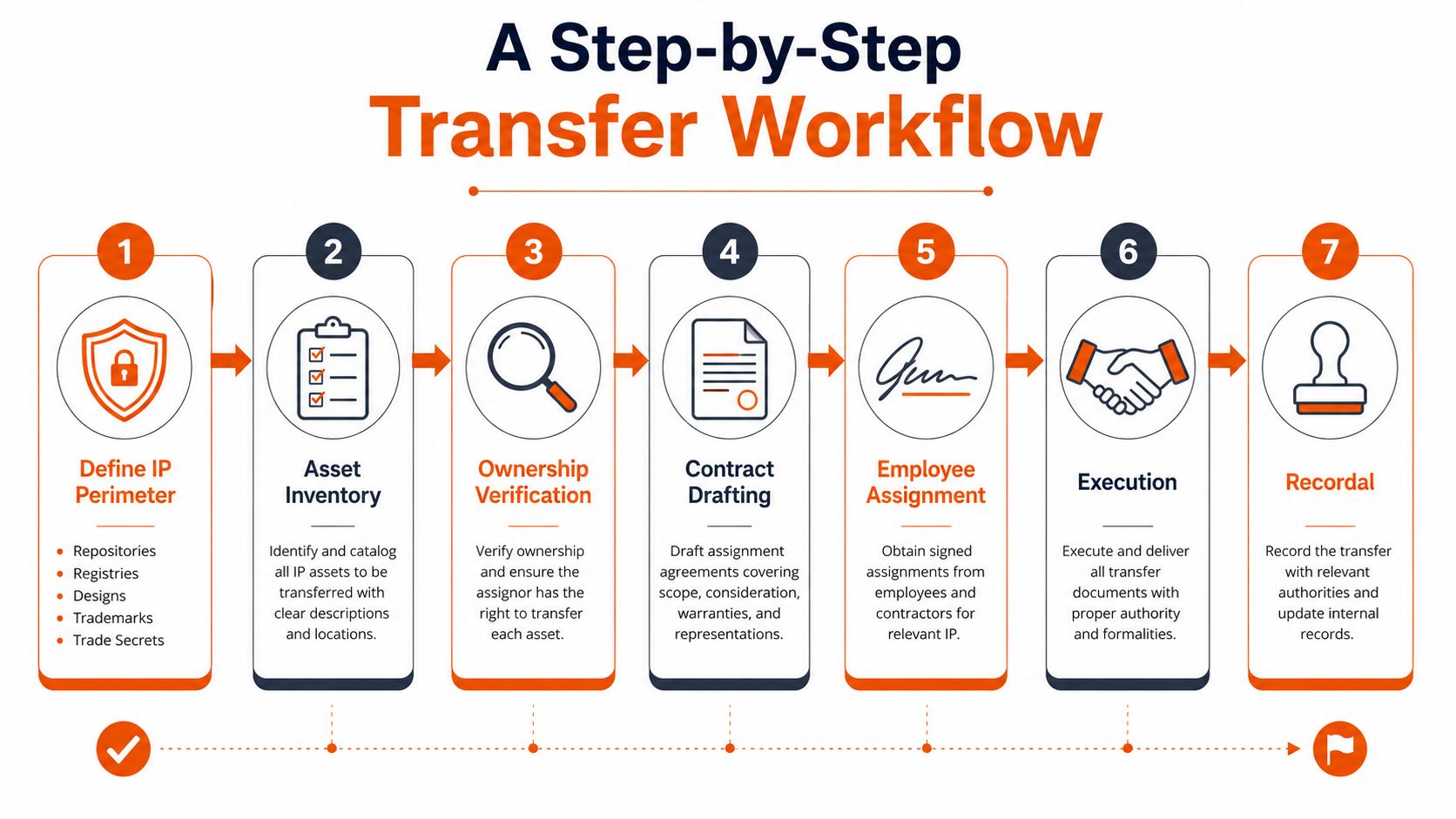
A reliable transfer workflow gives each task an owner and produces an evidence trail. Legal shouldn't be left to infer the asset perimeter from engineering tickets, and engineering shouldn't be expected to interpret a deed without knowing what must be delivered.
Start with the asset perimeter
Define the perimeter. The engineering lead lists repositories, branches, packages, deployment scripts, designs, documentation, data models, domains, registries, trade marks, patents, trade secrets, and third-party dependencies. Legal converts that list into an asset register with identifiers and ownership status.
Map the ownership chain. HR and legal identify every employee, contractor, freelancer, agency, former employee, and founder who touched the work. Don't stop at the current team. A former architect's missing assignment can matter more than a hundred current repository permissions.
Cure title defects. Obtain retroactive assignments, invention confirmations, contractor assignments, and any required consents. Finance helps locate invoices and statements of work, while HR checks onboarding and exit files.
Draft for the real transaction
Choose the mechanism. Legal drafts an assignment or licence that defines the rights, territory, duration, consideration, warranties, retained rights, and obligations to sign further documents. UK guidance on IP in agreements emphasises precise scope, effective date, permanence, and any retained research or publication rights.
Execute properly. Confirm signatory authority, collect signatures, and obtain notarisation or corporate evidence where required. A transaction isn't complete because the commercial team has agreed the wording.
Deliver operational control. Engineering transfers repositories, credentials, build instructions, architecture records, runbooks, test suites, deployment knowledge, and escrow materials where appropriate. The buyer should be able to operate and maintain the asset, not merely possess a signed deed.
Complete recordal and housekeeping. Legal files registry documents, sends third-party notices, updates the asset register, and records post-completion obligations. Engineering revokes old access, and HR closes outstanding assignment actions.
A clean SaaS codebase can move through this process in two to eight weeks, depending on the complexity of the ownership chain and the parties involved. That timeline is a planning guide, not a guaranteed result. A specialist virtual legal assistant can help organise the evidence room and chase missing documents, but legal counsel still needs to make the substantive decisions.
Due Diligence for Buyers and Sellers
Buyers and sellers should run different checklists. Buyers test whether the rights exist and can support the intended transaction. Sellers prove what they own, disclose what they don't, and remove avoidable friction before the buyer turns a missing document into a closing condition.
Buyer responsibilities
The buyer should confirm chain of title through incorporation records, employment agreements, contractor contracts, invention assignments, and founder documents. Review registered marks, patents, designs, domain names, database rights, and unregistered software rights as separate asset classes.
Open-source review deserves its own workstream. Map dependencies against licence compatibility, patent grants, attribution duties, disclosure requirements, and commercial restrictions. An acquisition can inherit operational obligations even when the source code itself is properly assigned.
The buyer should also check:
- Jurisdictional gaps: Compare employee and contractor assignment language across every location where work was created.
- Financial burdens: Identify royalties, revenue shares, government funding conditions, and third-party restrictions.
- Prior grants: Review exclusive licences, distribution rights, security interests, and customer-specific ownership promises.
- Disputes: Search for infringement claims, threatened claims, takedown notices, and former worker complaints.
Use the IP due diligence checklist to structure the review, then make each request traceable to a document and an accountable owner.
Seller responsibilities
The seller should produce an IP schedule containing registration identifiers, renewal dates, repositories, material components, creators, licences, encumbrances, and disputes. Include assignment deeds, consent letters, contractor records, open-source reports, and evidence that escrow material is current and usable.
A redline-ready data room is essential. Organise it by asset class, mark missing documents visibly, and assign deadlines for every signature page. Sellers often lose negotiating power because they discover a defect only after the buyer has drafted an indemnity around it.
The objective isn't to create a perfect folder. It's to give both sides a defensible answer to the same question: can the intended owner prove, use, enforce, and transfer these rights after closing?
Contract Clauses and Employee Assignment That Hold Up
A strong IP agreement starts before the first commit. The clause should capture past work, future work, inventions, documentation, designs, improvements, and materials created in the scope of the relationship. It should also require disclosure of inventions and cooperation with later registrations or enforcement.
The core package typically includes:
- Present assignment: Transfer identified past work and future work as it is created, rather than relying only on a promise to assign later.
- Moral-rights treatment: Include a waiver or consent where enforceable, while recognising that local law may limit the effect of that wording.
- Further-assurance duty: Require the creator to sign documents and provide evidence needed for registration, enforcement, or a later sale.
- Exit protection: Add a clear assignment-on-exit obligation and handover duty if the relationship ends.
Contractor agreements need sharper drafting than many founders expect. Adapt work-made-for-hire language to the relevant copyright doctrine, then include an unconditional assignment fallback. Add an indemnity for unauthorised third-party code and identify permitted tools, repositories, and side-project boundaries.
The missing onboarding file
The most dangerous defect is often mundane. A beautifully drafted employee clause is worthless if the company can't produce the signed onboarding paperwork for the lead architect hired eighteen months earlier. The same problem appears when an invoice describes “development services” but the underlying statement of work never assigns the resulting code.
For inventors outside the core team, agree compensation and recognition terms early. A later claim may not defeat the transfer, but it can create delay or an unexpected payment obligation.
Check restrictive covenants, non-compete enforceability, confidentiality obligations, and post-termination licences alongside the IP assignment. Use a structured contract negotiation approach so commercial concessions don't subtly undermine ownership or operational control.
The document that matters is the signed one in the evidence room, not the clause everyone remembers approving.
Open Source, Trade Secrets, and Escrow Decisions
These three areas determine whether transferred IP has practical value after signing. A buyer may receive a valid assignment and still inherit code it can't distribute, secrets it can't protect, or a product it can't maintain if the seller stops supporting it.
Open-source exposure
Begin with a software composition inventory. Record each dependency, version, licence, modification, copyright notice, patent grant, and distribution obligation. Grade the result by copyleft strength, compatibility with the target product, and commercial viability.
An incompatible licence needs a remediation decision before closing. Remove the dependency, isolate it, replace it, obtain a commercial permission, or accept a clearly documented obligation. An assignment deed can't cure licence contamination, because the issue concerns the terms under which the software may be used and distributed.
A practical SCA guide for product security teams can help security and engineering teams organise this inventory, but legal must decide whether each licence fits the intended product and transaction.
Trade secrets
A trade secret isn't valuable merely because the team calls it confidential. Identify the information, restrict access, maintain confidentiality agreements, record disclosure paths, and obtain exit acknowledgements. Include architecture decisions, pricing logic, customer data models, deployment methods, and operational know-how where they meet the applicable legal test.
Missing protection measures turn valuable knowledge into disputed folklore. The buyer should ask who could access each secret, how access was controlled, and what evidence demonstrates ongoing protection.
Escrow
Escrow terms should define release triggers, verification rights, refresh duties, materials covered, and the neutral agent. Triggers may include insolvency, material breach, or failure to provide contracted support. Decide whether escrow contains source code, build environments, documentation, credentials, data restoration material, or only selected components.
Make the escrow decision before signing. It changes buyer power, seller exposure, support obligations, and the value of the transfer long after completion.
Nearshore and Build-Operate-Transfer Implications in Poland
Poland adds operational depth to an IP handover because the delivery model and the legal ownership chain develop together. In a nearshore or Build-Operate-Transfer arrangement, the client isn't only receiving software. It may later receive a local team, employment records, operating processes, supplier relationships, and a corporate entity.
Polish employment invention rules require careful analysis. Employee-created IP doesn't automatically belong to the employer in every situation. The relevant question includes whether the work arose from the employee's assigned duties, so the transfer deed should contain specific representations about Polish employee inventions and the duties under which they were created.
Moral rights also need attention. Don't assume a broad UK-style waiver will produce the same result in Poland. Capture consents and cooperation obligations in a form that respects applicable Polish law, then identify each engineer whose work forms part of the transferred product.
BOT risks that surface late
The recurring traps are practical:
- Repository co-mingling: The centre's work sits in a parent company's repositories beside reusable frameworks and unrelated client code. Separate the transfer perimeter before delivery.
- Contractor classification gaps: Invoices may describe services without creating a reliable rights assignment. Trace each contractor to a signed agreement and fallback assignment.
- Cross-border administration: VAT treatment, translation, corporate authority, and registry filings can delay completion even when the commercial deal is agreed.
- Recordal ownership: Name the party responsible for filings with the Polish Patent Office, commonly referred to as UP RP, and specify who pays, prepares, translates, and confirms acceptance.
For a broader operating model, review the Build-Operate-Transfer model alongside the IP schedule. The deed should identify the legal entity, employees, repositories, documentation, and post-transfer support obligations rather than treating the handover as a single signature event.
Secure a Polish sworn translator for the assignment schedule before signing, not after. A translated schedule prepared at the end can create discrepancies between the operative language, asset identifiers, and registry submission.
Treating IP Transfer as a Delivery Outcome
Founders should stop treating the assignment deed as the deliverable. The deliverable is clean ownership that the new owner can prove, operate, enforce, and transfer again.
The Rite NRG playbook is straightforward:
- Choose assignment over licence when the business intends to resell or fully control the product.
- Run buyer-side and seller-side diligence early, with one evidence register.
- Lock employee and contractor assignments before code reaches the production repository.
- Decide the open-source and escrow posture before signing.
- Schedule post-transfer governance for at least twelve months, including recordal, access reviews, renewal tracking, and unresolved signature actions.
The trade-off is real. A clean transfer consumes more legal and operational time and can slow the first sprint. A sloppy transfer costs more through escrow holds, indemnity claims, enforcement problems, and broken exits. High-energy delivery doesn't mean skipping control. It means taking Extreme Ownership of the risks that determine whether delivered technology creates business value.
Book a forty-five-minute diligence session before the term sheet is drafted, not after. Bring the repository map, contractor list, employment records, licence inventory, and intended ownership outcome. That meeting will tell you whether the deal is ready to accelerate or whether the delivery plan is carrying a title defect.
Rite NRG provides strategic technology and delivery consulting, nearshore engineering teams, and Build-Operate-Transfer support for SaaS companies managing complex software handovers and Polish R&D centre transfers. Visit Rite NRG to discuss your IP perimeter, ownership workflow, and operational transfer plan before negotiations begin.