A lean UK MVP typically costs £15,000–£35,000 for a simple build, while feature-rich business apps rise to £25,000–£120,000 depending on integrations and backend complexity. More demanding products can move beyond those ranges quickly when they add compliance, artificial intelligence, real-time behaviour, or multiple platforms.
You've probably seen the problem already. One agency quotes £18,000, a freelancer suggests £9,000, and another delivery partner presents a six-figure proposal. All three may call the work an “MVP”, yet they're pricing very different products, risk levels, and launch expectations.
The right question isn't how much does it cost to build an MVP. It's what must be built to test your commercial hypothesis, what quality level users need to trust it, and how much cash you'll need after the first release to learn from the market. A cheap demo that can't support real users is a false economy. A carefully scoped product that reaches meaningful validation can be a powerful investment.
The Real Cost of Building an MVP
A SaaS founder recently described the familiar situation to us: a spreadsheet full of agency quotes, each with different assumptions hidden behind the same phrase, “MVP development”. One proposal covered a single web workflow. Another included mobile apps, an administration portal, payment processing, analytics, and a custom backend. The prices looked contradictory because the scopes were contradictory.
For a simple UK build, a realistic starting point is £15,000–£35,000, with delivery commonly taking 8–14 weeks, according to UK MVP pricing guidance for 2025 and 2026. Feature-rich business applications sit around £25,000–£120,000, depending on integrations, backend complexity, and design scope. Those figures are useful anchors, but they don't define your product.
The label MVP tells you almost nothing about the price. A focused product with one platform, a small set of screens, and one integration can remain relatively lean. Add separate user roles, complex permissions, payments, reporting, real-time updates, or an operational dashboard, and the team must design, build, test, secure, and release many connected workflows.
Practical rule: Price the workflows that prove the business, not the feature list that makes the product sound complete.
An MVP is a strategic learning system, not a smaller version of the finished platform. It should help you answer a specific commercial question: will a defined user group complete a valuable action, return to the product, and create evidence for the next investment? Every pound should support that learning loop.
That changes how you assess proposals. Ask what user behaviour the build will validate, which risks the team is accepting, and what has been deliberately excluded. A partner with a consulting mindset won't just estimate coding tasks. They'll challenge assumptions, expose dependencies, and connect delivery decisions to business outcomes.
At Rite NRG, the #riteway Methodology centres on Extreme Ownership, high energy, and proactivity. That means the delivery team takes responsibility for surfacing risks early, making decisions visible, and keeping the product aligned with the outcome. The right team isn't merely a list of technical skills. It combines product judgement, engineering discipline, and the drive to move a commercially useful release forward.
What Actually Drives MVP Development Costs
MVP budgets rise when decisions multiply delivery effort. The most expensive choices usually affect several parts of the system at once, so founders should evaluate them as connected trade-offs rather than isolated features.
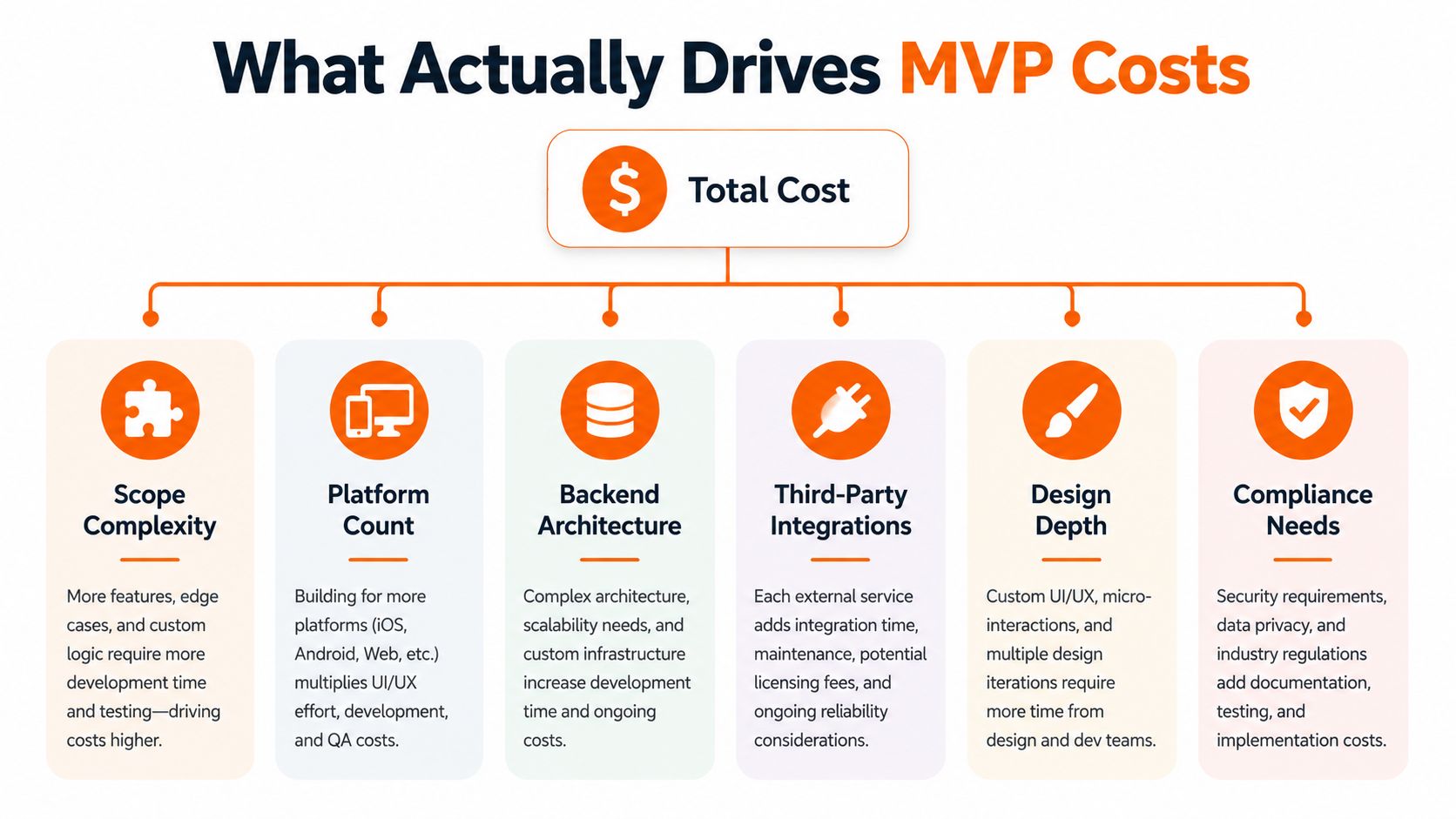
Scope complexity
Start with the critical user journey. A product that lets one customer create an account, complete a core action, and see a useful result has a very different delivery profile from a platform serving customers, administrators, partners, and internal operators.
Each additional workflow creates design decisions, validation rules, error states, permissions, documentation, and QA scenarios. Secondary features often look small in isolation, but they compete for the same discovery, engineering, testing, and release capacity as the core experience.
Platform count
A web application, a native mobile app, and a cross-platform product each create different testing and release obligations. Supporting multiple platforms does not duplicate the interface. The team must account for device behaviour, operating-system changes, responsive states, app-store processes, and platform-specific defects.
For an early product, one platform is usually the strongest financial decision unless the business hypothesis depends on another form factor. Validate the behaviour where your target users already spend time, then expand when evidence justifies it.
Backend architecture
A straightforward backend can support a narrow workflow with carefully selected data structures. A multi-tenant backend must isolate organisations, manage permissions, handle account hierarchies, and protect data across customers. Real-time synchronisation adds event handling, connection management, conflict resolution, and more demanding testing.
AI features can introduce model selection, prompt design, data pipelines, evaluation, monitoring, and failure handling. They aren't just another screen on the roadmap. They create a new operational surface that must behave predictably enough for users to trust the result.
Integrations and design
Payments, identity providers, CRMs, accounting tools, and external APIs add coordination work. The team must handle authentication, rate limits, failures, data mapping, version changes, and test environments. A single integration may be manageable. Several interdependent integrations can create a release-management problem.
Design depth matters too. A focused interface can use a small design system and prioritise task completion. A highly branded, heavily animated experience demands more exploration, refinement, accessibility review, and visual QA.
Compliance needs
Authentication, data protection, auditability, retention, and administrative controls become central when your product handles sensitive or regulated information. These requirements affect architecture, workflows, testing, documentation, and launch readiness. Treat them as part of the product definition, not a late legal review.
Realistic MVP Budget Ranges by Complexity
UK pricing guidance points to clear complexity tiers, although the boundaries depend on the product's workflows and operational demands. A simple utility MVP isn't automatically low risk, and a standard business application can become complex quickly when it handles payments, multiple roles, or sensitive data.
| Complexity Tier | Budget Range | Timeline | Typical Features |
|---|---|---|---|
| Simple utility or focused MVP | £8,000–£30,000 | Focused delivery window, often 8–14 weeks | One platform, core screens, straightforward data handling, limited integrations |
| Standard business MVP | £25,000–£80,000 | Around 10–20 weeks | Secure login, several user roles, third-party APIs, payments, admin tooling |
| Complex or regulated MVP | £60,000–£200,000+ | 3–6 months or more | Regulated data, AI-enabled features, multi-tenant backend, real-time synchronisation, enterprise-style controls |
The simple tier works when your validation question is narrow. A single-platform product with a handful of core screens and one integration is commonly benchmarked at £15,000–£30,000, as outlined in UK MVP cost guidance from Bluka. The lower end may suit a tightly defined utility. The upper end gives the team more room for handling, design, and release preparation.
A standard business MVP usually earns its higher budget through operational complexity. Secure login, payments, administration, external services, and multiple user roles create dependencies that need coordinated QA. Tulip Tech's UK market guidance places standard business MVPs around £30,000–£80,000, while regulated or enterprise-style builds reach £70,000–£150,000+.
The complex tier is where founders most often under-budget. AI, real-time behaviour, compliance, and multi-tenant architecture each introduce substantial engineering overhead. Money Donut's UK pricing guide notes that products with these characteristics can exceed £120,000, reaching £200,000+ or £500,000+ for large platforms.
Timeline matters because a hurried launch can require a larger team, more coordination, and more rework. A small, senior team with clear product decisions can often deliver more predictably than a larger group working from an unstable scope. If a proposal promises a complex platform on a utility budget and an aggressive schedule, challenge the assumptions before signing.
A Repeatable Method to Estimate Your MVP Cost
Reliable estimates begin with product behaviour, not technical labels. “Build an AI SaaS platform” is too vague to price responsibly. “A finance manager uploads a file, receives a categorised result, reviews exceptions, and exports an approved report” gives a delivery team something they can analyse.
Start with the critical workflow
Write the main user journey from trigger to outcome. Include the customer, the action, the system response, and the evidence that tells you whether the workflow worked. Remove features that don't help you test that journey.
Then define the smallest acceptable version of each step. Decide whether users need a native app, whether self-service onboarding is essential, and whether an integration can initially be handled through an import or manual operation. Product-first scoping protects the budget without weakening the learning objective.
Map the dependencies
List every service the workflow touches:
- Identity: Decide whether you need custom authentication or can use a trusted provider.
- Payments: Define the transaction, refund, subscription, and failure paths.
- Data: Identify what the product stores, who can access it, and how administrators correct errors.
- External APIs: Record the data exchanged, authentication method, fallback behaviour, and test access.
- Operations: Specify the dashboards, alerts, support tools, and manual interventions needed after launch.
Map dependencies before asking for a fixed price. A team can't estimate integration effort accurately if it doesn't know whether the external service has stable documentation, suitable test data, or restrictive usage rules.
Estimate components, then test the estimate
Break the workflow into discovery, design, frontend, backend, integration, QA, deployment, and launch support. Ask the delivery partner to explain assumptions for each component, rather than presenting one unexplained total. A credible estimate should show what drives effort and what would change the price.
Use Rite NRG's software cost estimation guidance to structure the conversation around feature-level scope, dependencies, and budget alignment. Then compare the proposal with the relevant UK benchmark. If your product resembles a focused single-platform build but the estimate sits in the complex range, ask which requirements create that difference.
Before you appoint a partner, ask:
- Which workflow will this MVP validate?
- What have you excluded from the estimate?
- Which risks could change the budget?
- How will you test integrations and edge cases?
- Who owns product decisions and delivery communication?
- What does launch-ready mean in this proposal?
- What happens when users request changes after launch?
Watch for red flags. A quote with no assumptions, no dependency map, no QA description, and no explanation of post-launch support isn't predictable. A low price may move work into change requests, technical debt, or founder-led coordination.
Proven Strategies to Reduce MVP Costs Without Cutting Corners
The best cost reduction doesn't come from asking engineers to work faster. It comes from removing waste before the team builds it. Product-first thinking, senior nearshore delivery, and transparent collaboration reduce the expensive gaps between a business idea and a usable release.

Start with the hypothesis. If your SaaS product must prove that users will complete one valuable workflow, don't spend the first release on extensive configuration, complex reporting, or every planned integration. Use a clickable prototype, user interviews, and short validation cycles to challenge the experience before the team commits to production code.
Nearshore delivery is another practical lever. A senior team working in compatible time zones can participate in discovery, review decisions quickly, and resolve ambiguity while it still costs little to fix. The benefit isn't just a lower rate. It's reduced coordination overhead, fewer handoff failures, and stronger ownership of the commercial result.
A dedicated team should fit into your operating rhythm rather than behave like a remote ticket factory. Give the team access to the right stakeholders, establish clear decision rights, and make risks visible through regular demonstrations. Rite NRG offers nearshore software delivery, dedicated teams, platform development, technology and delivery consulting, and Build-Operate-Transfer support for custom R&D centres in Poland.
AI-powered processes can accelerate repetitive work such as scaffolding, documentation, test generation, and workflow analysis. Use them under senior human review. Generated code still needs architectural judgement, security checks, integration testing, and careful handling of edge cases. Speed only creates value when the team preserves reliability.
Delivery principle: Automate repetition, not accountability.
Use rapid prototyping to settle product decisions before engineering expands the surface area. Rapid prototyping techniques for MVP teams can help expose weak assumptions early, when changing a screen or workflow is cheaper than changing a built system.
One further option is a focused MVP sprint. Rite NRG's published MVP sprint package starts from €9,950, according to its product information, and is positioned around a functional, launch-ready product rather than an isolated technical prototype. Treat any starting price as a scope conversation, not a promise that every product fits the same package.
The commercial objective is to compress the path from assumption to evidence. Rite NRG states that its teams help clients ship up to 50% faster without sacrificing quality or control, as described in its publisher information. That outcome depends on disciplined scope, senior ownership, proactive communication, and a team that makes decisions instead of waiting for perfect instructions.
The Hidden Costs Most MVP Guides Ignore
The initial build quote is only the first financial decision. Founders need enough cash to move from a working release to a reliable validation cycle, where real users can complete the core workflow, report friction, and receive fixes without the product team losing momentum.
Start with VAT and tax treatment. The amount shown in a proposal may not represent the final cash requirement for your company, depending on how the supplier invoices and how your business handles VAT. Ask for a clear commercial breakdown before comparing providers.
Then reserve contingency. UK-focused startup guidance recommends adding around 25% contingency because scope creep is common, as explained in this UK startup development cost breakdown. That reserve isn't permission for loose scope. It protects the launch when an external API behaves differently than expected, a security requirement surfaces, or users reveal a missing step in the core journey.
Budget for the product after release
Post-launch changes are part of MVP delivery because validation produces new information. You may need to simplify onboarding, alter permissions, improve an error state, or change the workflow users consistently abandon. Reserve capacity for these decisions rather than treating them as unexpected failure.
Operational overhead also arrives immediately. Hosting, monitoring, security updates, support processes, analytics, and third-party service charges all affect whether the product remains usable. A launch-ready MVP needs environments, deployment controls, backups, incident response, and a person responsible for acting when something breaks.
Compliance and integration-heavy products deserve a larger buffer because the team has more external constraints to satisfy. Non-functional requirements such as security, availability, performance, and auditability can change architecture even when they don't appear as visible features.
The figure you need isn't the build quote. It's the total cash required to reach reliable learning. Add the initial build, VAT implications, contingency, launch operations, user support, and the first round of evidence-led changes. If you can fund only the demo, you haven't budgeted for validation.
Your Next Steps to Build a Predictable MVP
Choose your complexity tier first. A focused UK MVP may sit around £8,000–£30,000, a standard business product around £25,000–£80,000, and a complex or regulated build around £60,000–£200,000+, based on the UK benchmarks cited above. Your scope, integrations, platforms, compliance needs, and operational expectations determine where you belong.
Write the critical workflow, map its dependencies, and separate essential validation from future ambition. Ask delivery partners for assumptions, exclusions, QA responsibilities, launch support, and a clear process for managing change. Reject proposals that offer a confident total without showing what creates the effort.
Finally, choose the team as carefully as the technology. Cultural fit, Extreme Ownership, proactive communication, and product judgement make delivery more predictable than a spreadsheet of skills. Nearshore collaboration can give SaaS founders senior capability and close working rhythms without the friction of distant handoffs.
Rite NRG helps SaaS founders turn focused product hypotheses into launch-ready MVPs through senior nearshore teams, product-first consulting, transparent estimation, and AI-powered delivery processes. Visit Rite NRG to discuss your workflow, budget, and path to a predictable release.