
Your Series A roadmap is slipping. Three senior backend roles have sat open for months, the product manager keeps rewriting launch dates, and your existing engineers are spending sprint capacity covering gaps instead of building the next revenue feature. Every week without those seats carries a cost, even before recruiter fees, equity, onboarding time and the damage to your next investor conversation.
That's why SaaS leaders are looking beyond domestic hiring. Nearshore outsourcing benefits aren't really about finding cheaper coders. They're about increasing senior delivery capacity, protecting predictable burn and reducing the coordination friction that turns a low rate into an expensive product delay.
The right nearshore team behaves like an extension of your business. It works against outcomes, owns decisions, communicates in your working hours and raises risks before they become missed commitments. That's the standard we use at Rite NRG, built around Extreme Ownership, high energy and proactive delivery, not a list of skills attached to a timesheet.
The Real Reason SaaS Teams Are Looking Beyond Their Borders
At 9:15 on Monday morning, the founder opens Linear and sees the same red markers she saw last Friday. The multi-tenant billing release is blocked on backend capacity. The platform lead is handling production incidents. The CTO is interviewing candidates instead of reviewing architecture. The Series A plan promised momentum, but the roadmap is now negotiating with the hiring funnel.
This pressure is structural, not personal. One UK IT outsourcing analysis estimates the UK market at $39.99 billion in 2024, forecasting $44.50 billion by 2025 and annual growth of 9.53% through 2029. The same analysis reports that 63% of UK organisations planned to maintain or increase outsourcing in 2025, while 81% of UK businesses were affected by critical talent shortages and Brexit contributed to the loss of 300,000 EU workers. Those conditions create persistent demand for external engineering capacity, particularly when a SaaS company needs experienced people without adding domestic headcount. The UK outsourcing market analysis provides that context.
The founder still has two obvious choices. Burn more cash competing for scarce local talent, or accept a slower roadmap and explain the miss to the board. Nearshore delivery adds a third option: bring in a senior-led product pod that can work inside the existing operating rhythm while finance retains a clearer view of committed spend.
The useful question isn't “How much cheaper is this developer?” It's “What will this team help us ship, and what will that shipment change on the P&L?”
That shift matters. A nearshore partner can reduce the time between a product decision, an engineering decision and a working release. It can also keep the founder out of day-to-day recruitment administration, provided the engagement has clear ownership, measurable milestones and a quality bar that matches the internal team.
The outcome is not more tickets closed. It's a roadmap that regains credibility, a burn profile leadership can defend and a stronger narrative for the next fundraise.
What Nearshore Outsourcing Actually Means for a SaaS Team
Nearshore outsourcing means placing a dedicated product team in a nearby region with meaningful working-hour overlap. The team works in your Jira or Linear workspace, contributes through GitHub, communicates in Slack, reviews flows in Figma and follows your roadmap, release process and engineering standards.
Distance alone doesn't define the model. A remote supplier can still behave like a disconnected vendor if it delivers a handoff at the end of each sprint. A proper nearshore setup embeds people into the decisions that shape the work. Engineers understand the customer problem, product managers can resolve ambiguity in real time and technical leads remain accountable for the quality of the system they're extending.
The working model
Onshore means the team operates in the same country. You usually get the strongest domestic context and the simplest legal arrangement, but the model carries premium hiring costs and often takes longer to scale.
Offshore means the team operates in a distant region, usually with a substantial working-hour gap. It can work well for repeatable, high-volume tasks where the lowest raw rate matters more than live collaboration. It becomes harder when product questions, incident response and design iteration need same-day decisions.
Nearshore sits between those models. UK-focused coverage highlights closer time zones, lower travel costs, easier face-to-face meetings and more similar financial, legal and data-protection frameworks as practical advantages for British firms. The UK outsourcing comparison supports that operating view.
| Dimension | Onshore | Nearshore | Offshore |
|---|---|---|---|
| Location | Same country | Nearby country or region | Distant country or region |
| Working hours | Full overlap | Material overlap | Limited or delayed overlap |
| Cost profile | Highest | Balanced | Lowest raw rate |
| Scaling | Often slower | Faster access to external capacity | Can scale heavily with mature coordination |
| Collaboration | Direct | Real-time and accessible | More dependent on documentation and handoffs |
| Best fit | Sensitive domestic work | Product delivery and senior capacity | Volume work with stable requirements |
Three signals separate a functioning nearshore team from a remote staffing arrangement:
- Shared working hours. People can join planning, pairing, incident reviews and customer-driven prioritisation without forcing one side into a permanent night shift.
- Senior-led pods. A tech lead or senior engineer owns the technical context, spots delivery risk and prevents a growing team from becoming a queue of disconnected contributors.
- Clean IP ownership. The contract must assign work product and intellectual property to the client in a form that fits the client's legal and compliance requirements.
If you're also exploring Latin American delivery capacity, Hire LATAM talent is a useful resource for understanding that regional option. The principle remains the same wherever you source: proximity only creates value when the partner operates inside your product system.
The Core Benefits That Move the Needle for SaaS Delivery
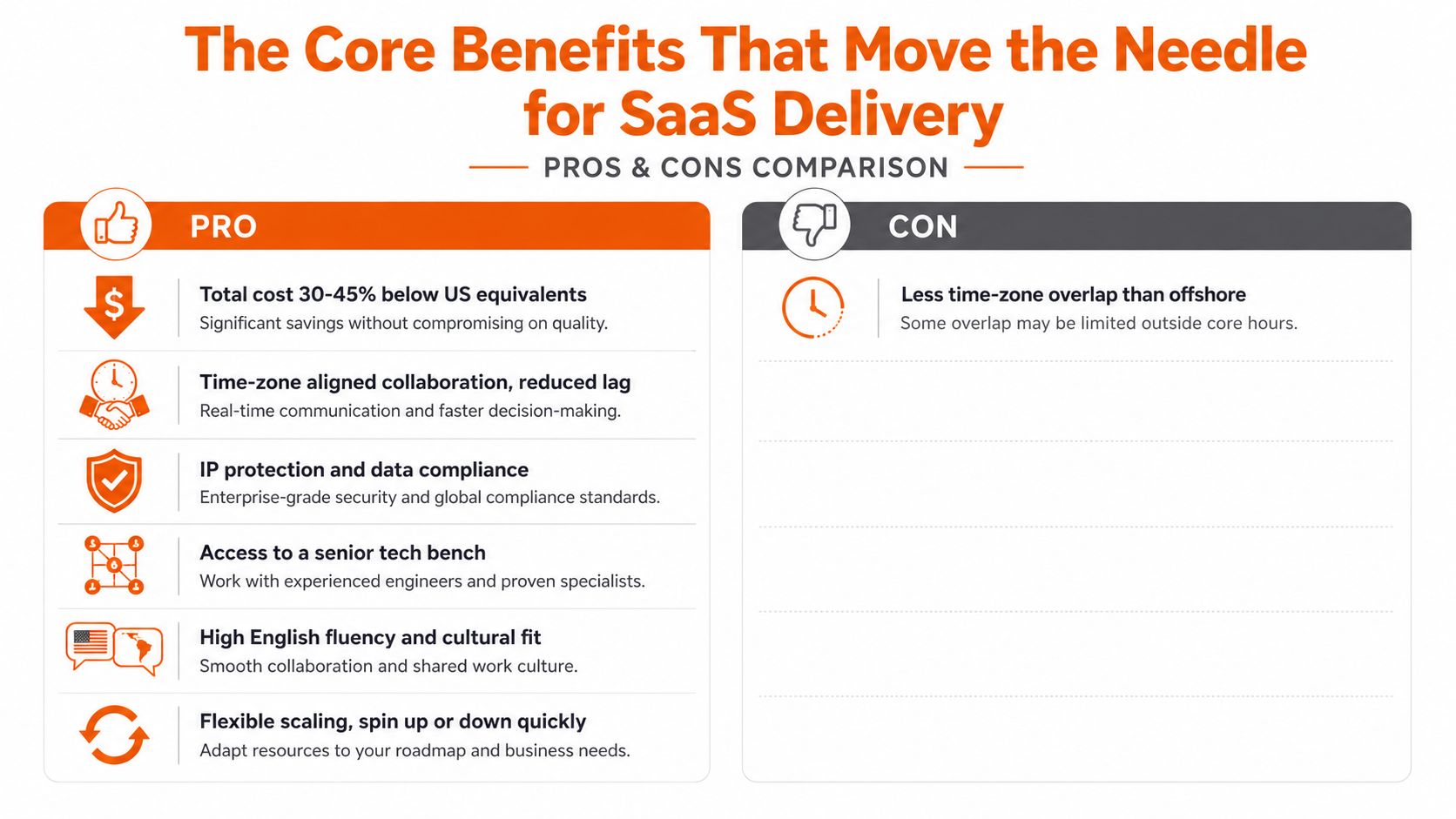
The strongest nearshore outsourcing benefits show up in business outcomes, not headcount reports. A team is valuable when it shortens the path from a validated product decision to revenue, retention or operational control.
Cost that survives finance review
UK-focused nearshore coverage reports labour-cost savings of about 30–50% versus domestic hiring, while another UK analysis places typical savings for Eastern European developers at 30–50%, with Eastern Europe averaging about 40% annual savings and reaching up to 70% per employee in some cases. The UK nearshore trends analysis gives the latter figures.
That saving only matters if seniority holds. Replacing one expensive senior with several inexperienced developers can increase review load, rework and architecture risk. Use nearshore capacity to buy more dependable delivery per pound, not merely a lower hourly rate.
Working-hour overlap
A UK-focused source describes Eastern European teams as typically one hour ahead of the UK, enabling daily stand-ups, immediate issue resolution and easier on-site visits. Its nearshore delivery analysis connects that overlap with lower feedback latency and less rework.
For a SaaS team, the practical result is simple. A product manager can clarify acceptance criteria while the engineer is still working on the story. A security concern can be discussed before the pull request becomes a release blocker.
Cultural and language fit
Fluent communication matters most during ambiguity, not during a status update. Product reviews expose assumptions about customer behaviour, edge cases and acceptable trade-offs. A team that can challenge those assumptions constructively helps prevent the expensive version of “I thought you meant something else”.
Senior talent without a prolonged search
Nearshore gives a CTO access to product engineers, designers, DevOps specialists and quality engineers through a delivery partner rather than requiring every role to pass through the local hiring funnel. UK outsourcing research reports that 67% of respondents saw access to skilled teams as the main benefit, while 40% outsourced to save recruitment time. The UK development outsourcing coverage supports a consulting-led rather than purely staffing-led model.
Elastic capacity
A dedicated pod can expand for a migration, platform rebuild or new product line, then reduce capacity after the release without creating the same severance and fixed-headcount drag. The value is not unlimited scaling. It's the ability to match engineering capacity to the shape of the roadmap.
Lower coordination risk
The best providers combine senior ownership, documented decisions, contractual service expectations and appropriate security controls. Use a practical outcome framework, such as The OKR Hub's guide to closing the execution gap, to connect engineering milestones with business results.
A nearshore team should help you release a compliant feature, complete a multi-tenant migration or pass an enterprise security review. If it only produces more code, your operating model is too weak.
Nearshore vs Onshore vs Offshore Compared Honestly
There's no universally superior sourcing model. Each one optimises for a different constraint, and SaaS leaders get into trouble when they pretend cost, speed, context and risk can all be maximised at once.
| Dimension | Onshore | Nearshore | Offshore |
|---|---|---|---|
| Fully loaded cost | Highest, with domestic employment overhead | Lower than domestic hiring, with partner costs to manage | Lowest raw rate in many markets |
| Time-zone overlap | Complete | Strong overlap for nearby regions | Often limited |
| Cultural context | Deepest local product context | Generally close, especially with a disciplined operating model | Requires more explicit documentation |
| Seniority ceiling | Strong access, but competitive and expensive | Strong access when the partner vets for seniority | Broad capacity, quality varies by provider |
| Travel | Simplest | More accessible than distant delivery | More expensive and time-consuming |
| Risk profile | Strongest domestic control | Balanced control, proximity and contractual governance | Greater coordination and jurisdictional complexity |
Onshore wins when a fintech product needs deep domestic regulatory context, sensitive data must remain in-country or the work depends on constant proximity to internal executives. It also makes sense for a small founding team where the first hires define the company's product culture.
Nearshore wins when the product requires daily collaboration and senior execution but domestic hiring is too slow or costly. A UK SaaS team modernising its billing platform can hold the same planning sessions, resolve acceptance questions during the day and bring the partner into an on-site workshop without treating travel as a major programme event. UK analysis specifically cites easier travel, overlapping time zones and aligned financial and legal frameworks as reasons the model works for British firms. The relevant UK outsourcing study covers those factors.
Offshore wins when the work is repeatable, the requirements are stable and volume matters more than live product discussion. Large test execution, data labelling or well-specified migration tasks can suit that model. Offshore loses its advantage when managers spend heavily on handoffs, overnight delays, rework and compliance clarification.
Use this comparison of nearshore and offshore delivery when building a sourcing portfolio, not a binary verdict. Venture-backed SaaS rarely wins by minimising the rate card alone. It wins by placing each type of work in the model that protects the most valuable outcome.
Beyond the Rate Card Calculating True Delivery Economics
A rate card is an input, not a business case. Finance should model coordination overhead, rework, late handoffs, travel, security review and the opportunity cost of a feature that reaches customers after the commercial window has moved.
The supplied delivery-economics visual shows how a headline $50 per hour service rate can become a $68 per hour true effective rate after coordination overhead, rework, context-switching cost and quarterly travel. Those figures are an illustrative cost breakdown represented by the asset, not a universal benchmark.
A finance-friendly formula
Use:
Cost per shipped feature = total delivery cost ÷ accepted features released
Total delivery cost should include partner fees or salaries, internal product and engineering management time, coordination, rework, travel, compliance work and the cost of delays that affect revenue or retention. “Accepted” matters. A ticket merged into GitHub but rejected by product review isn't a shipped feature.
Consider a worked comparison. A senior nearshore team charges $95 per hour, while an offshore team charges $55 per hour. The nearshore team delivers 100 accepted features at an assumed 1,000 hours, producing a delivery cost of $95,000, or $950 per accepted feature. The offshore team completes 100 accepted features at 1,700 hours after additional coordination and rework, producing $93,500, or $935 per accepted feature.
The offshore option is still cheaper in this example. That's the honest answer. But the gap is narrow, and it ignores the commercial value of earlier release timing, internal leadership capacity and the possibility that the product required deeper senior judgement. Replace the assumptions with your own data, especially sprint acceptance, rework and delay cost.
Practical rule: Track accepted outcomes and elapsed time together. A cheaper team that ships later can be the wrong investment even when its invoice is smaller.
Offshore remains compelling for volume work. Onshore remains sensible for regulated workloads where domestic counsel and data controls dominate. Nearshore becomes strongest when coordination, senior product velocity and governance are bottlenecks.
Before negotiating, take this guide to technology contract negotiation into the operating committee. Ask for a one-page view covering committed spend, internal oversight, expected milestones, rework assumptions, security obligations, travel and exit terms. That document gives finance something better than a vendor promise.
Scaling and Resilience Through Senior Nearshore Teams
Mature SaaS companies use nearshore delivery as a structural scaling layer. They don't bring in external engineers only after a hiring plan fails. They design a capacity model that can add expertise for a strategic release, preserve architecture ownership during the change and reduce capacity when the commercial objective is complete.
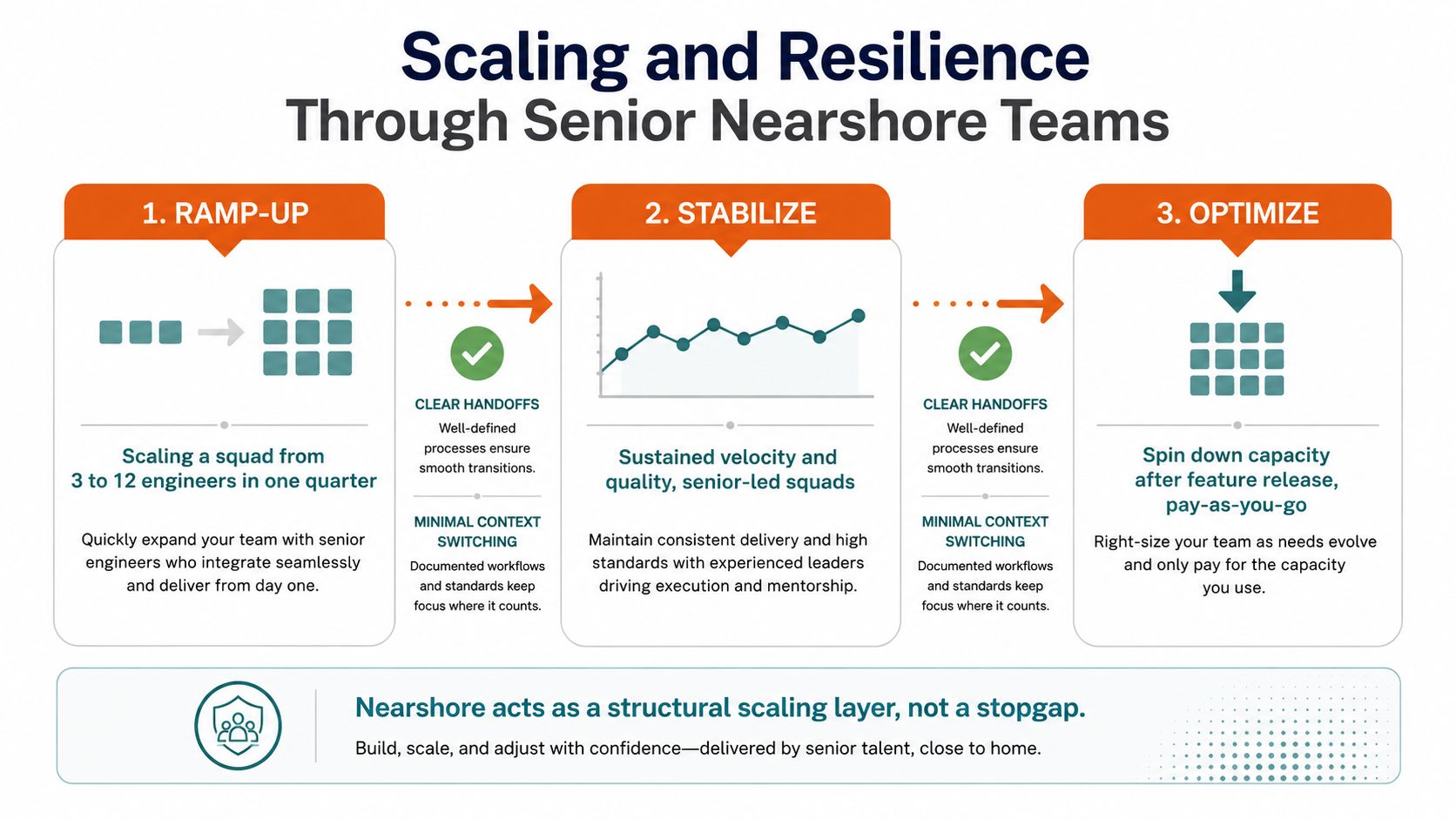
A Series B SaaS company launching a new product line might create a senior-led squad around discovery, platform boundaries and the first production release. The internal team retains product authority, while the nearshore pod owns an outcome such as tenant provisioning, billing integration or a new workflow. That separation prevents the new initiative from consuming every existing platform specialist.
A public SaaS business preparing for an enterprise sales push has a different concern. It needs auditability, predictable release quality and resilient support for integrations that buyers will scrutinise. A nearshore team can add DevOps, security and test automation capacity, but only if ownership is explicit and evidence is produced as part of delivery.
A SaaS platform entering Latin America may add bilingual engineering coverage for localisation, payments and regional workflows. The value comes from product context and feedback speed, not from labelling the team “international”.
Capacity without permanent drag
UK-focused delivery coverage reports that nearshore arrangements can avoid recruiter fees, redundancy liability and much of the management overhead associated with local hiring. The same source describes labour spend reductions of about 30–50% and teams scaling up or down in weeks rather than months. The nearshore economics analysis provides those observations.
Resilience also means avoiding a single point of failure in your talent plan. A nearby delivery partner can help you maintain progress during a local hiring freeze, a difficult recruitment cycle or a period when senior engineers are unavailable. That doesn't remove vendor risk. It gives leadership another operating node to manage.
Senior-led teams matter during these transitions. Junior-heavy capacity can increase output briefly while weakening architecture consistency, testing discipline and code ownership. Experienced leads keep design decisions visible, coach the wider team and make the eventual scale-down less disruptive.
Nearshore is delivery insurance when it preserves knowledge, not when it supplies temporary hands.
Myths That Stop Good SaaS Teams from Considering It
Nearshore fails when leaders buy a vague promise and skip governance. The model itself doesn't cause most cost, communication or quality problems. Weak contracts, unclear ownership and careless team design do.
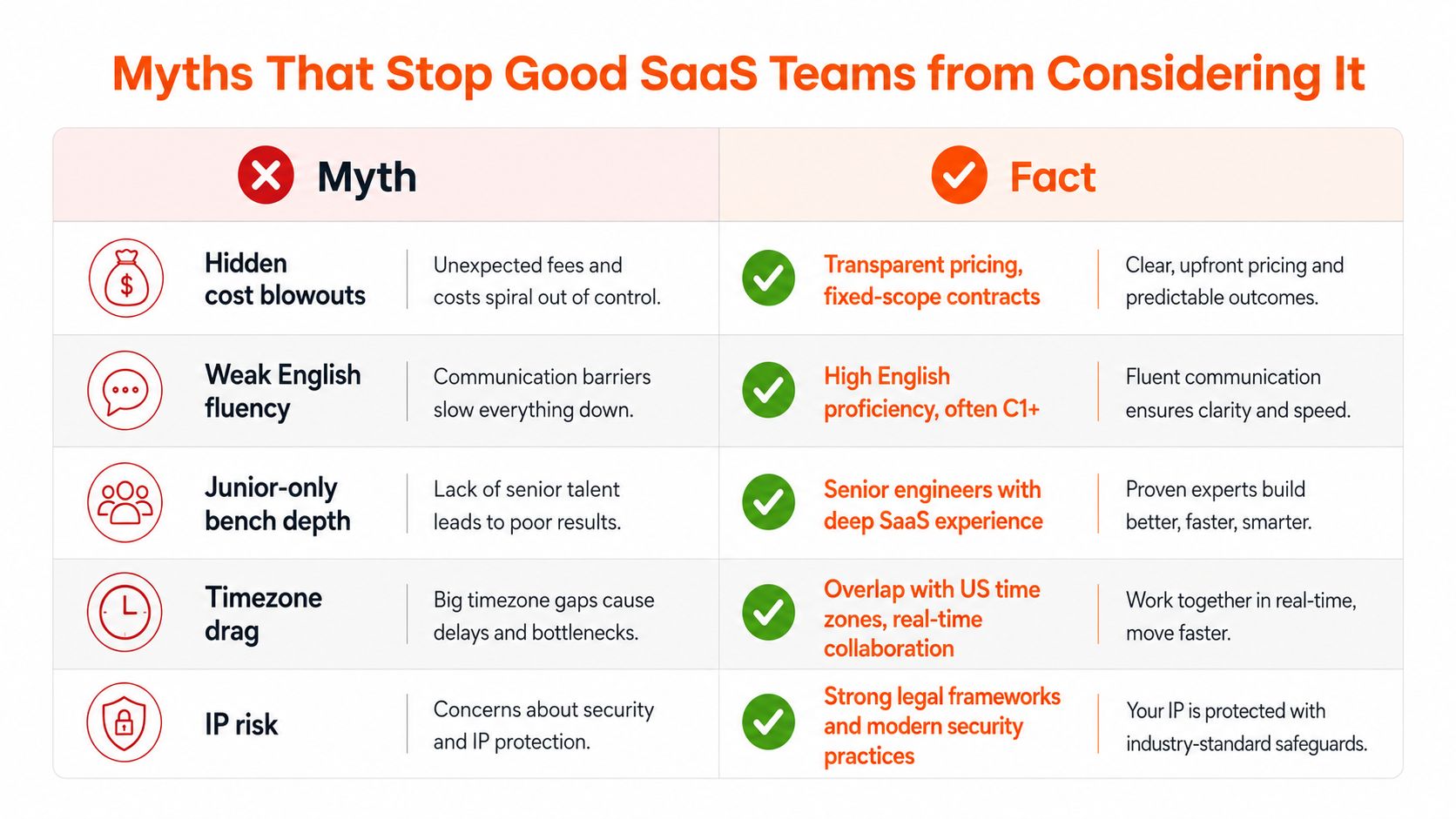
Myth one, the invoice will hide the real cost
The failure mode is an unclear statement of work, open-ended change requests and no acceptance criteria. Prevent it with outcome-based milestones, capped change orders, visible assumptions and a monthly review of committed versus delivered value.
For a payments startup, the contract should connect work to a release or control outcome, such as a payment flow, reconciliation process or audit evidence. Hours alone don't tell the board whether the investment worked.
Myth two, communication will be weak
A CV can claim fluency while a technical review still produces confusion. Use bilingual interview loops, written design exercises and live product discussions before assigning ownership. Teams need to explain trade-offs, challenge requirements and document decisions clearly.
A B2B analytics product benefits when engineers can question an inconsistent metric definition before it reaches customers. That requires conversational confidence, not just vocabulary.
Myth three, the bench is mostly junior
This happens when the provider optimises for availability rather than delivery responsibility. Set a mandatory mid-level and senior mix, require a senior technical lead and review the person who will own architecture, not only the people who will implement tickets.
Myth four, time zones create drag
Nearshore removes much of the overnight delay, but it doesn't create automatic collaboration. Define a structured overlap window, shared ceremonies and an escalation path. A healthcare SaaS team still needs disciplined access controls and documented handoffs even when everyone is working during the same day.
Myth five, IP is too risky
IP risk comes from vague assignment language, uncontrolled access and poor offboarding. Put IP ownership, confidentiality, repository access, security obligations and exit procedures into the MSA and statement of work. Validate the partner's legal and compliance process before exposing sensitive product assets.
Nearshore is a governance decision, not a geography decision. The region influences collaboration and access. Your operating model determines whether those advantages reach the product.
Deciding Whether Nearshore Is Right for Your SaaS Product
Nearshore is the strongest fit when your roadmap is stuck behind hiring, you need several senior engineers quickly, your buyer and delivery team can share working hours, and the work can be expressed as outcome-based milestones. It's particularly effective for a product squad, platform migration, DevOps capability or new commercial workflow.
It's the wrong lever for a tiny enhancement that needs only one or two people for a short period, or for heavily regulated work that requires domestic counsel and strict onshore control. It's also a poor choice if your internal team can't provide product direction, architecture context or timely acceptance.
Use this readiness check before you speak with providers:
- Capacity: Can an internal product and technical owner support the team?
- Outcome: Can you define the first release in business terms?
- Documentation: Are the core workflows, architecture and acceptance rules accessible?
- Seniority: Do you need experienced ownership rather than additional junior throughput?
- Overlap: Can both teams commit to shared ceremonies and live decisions?
- Economics: Have you modelled coordination, rework, governance and delay?
- Exit: Do the contract and access controls support a clean transition?
A UK outsourcing study found 72% of companies planned to continue outsourcing at the same rate, while 60% named cost reduction as a main reason. The UK outsourcing research shows that cost remains relevant, but it shouldn't be the only approval criterion.
For most scaling SaaS teams, nearshore is the right move when senior velocity matters more than the lowest invoice. Use this guide to choosing a nearshore partner to test delivery ownership, technical depth, security, communication and commercial fit before you sign.
Rite NRG provides senior nearshore teams, product and delivery consulting, end-to-end platform development and Build-Operate-Transfer support for R&D centres in Poland. Visit Rite NRG to discuss the delivery bottleneck, map the true economics and build a team around the outcomes your next release has to achieve.