
Multi platform mobile application development is not a technical luxury, it's a commercial decision about how fast you can reach a smartphone-heavy market without duplicating effort. In the UK, 88% of adults had a smartphone in 2024, and ownership was 97% among 16 to 24-year-olds and 96% among 25 to 34-year-olds (Ofcom data cited in the cross-platform mobile app development report). If your SaaS product needs broad reach, the right move is usually a single shared codebase with disciplined platform-specific exceptions, not two separate native teams pretending duplication is efficient.
UK users also live online for long stretches, with adults spending 4 hours 20 minutes per day online on average in 2024 (Ofcom data cited in the same report). That level of engagement means your app is competing for attention inside a mature, always-connected market, not a casual browsing environment. The winners are the teams that ship faster, learn faster, and keep maintenance under control while the product grows.
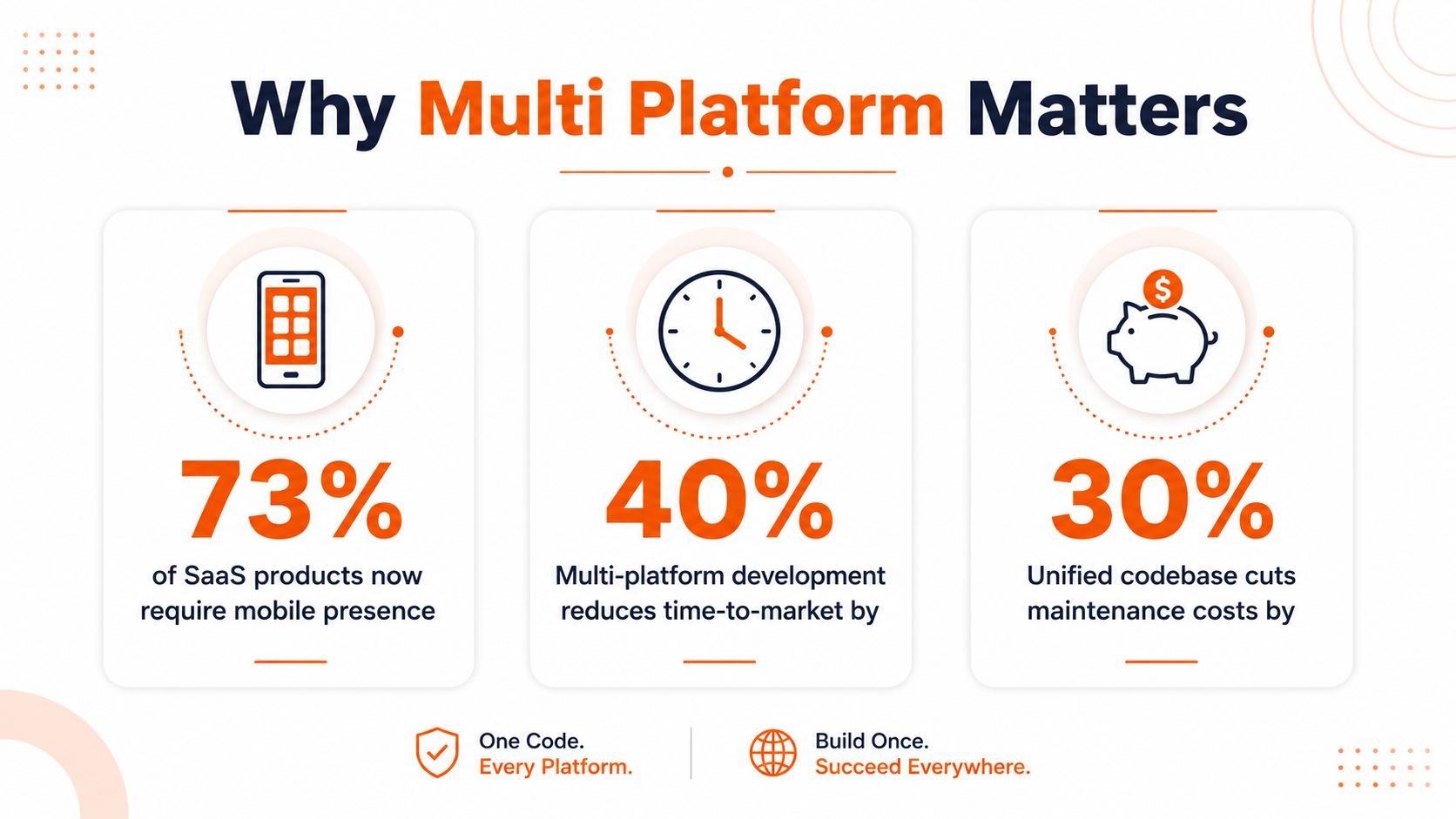
Why Multi Platform Mobile Application Development Matters for SaaS
For SaaS founders, multi platform mobile application development is really about reach, speed, and delivery discipline. The old argument for separate iOS and Android teams sounds neat until you're burning time on duplicated features, duplicated QA, and duplicated release planning. In a market where British users are already split across iOS and Android at scale, the right question isn't whether your app can run on both, it's how quickly you can reach both without wrecking your roadmap.
The UK market makes the case for shared delivery
The UK mobile market is mature enough that cross-platform thinking is no longer an experiment. The App Store launched in 2008 and Google Play followed in 2012, creating the two-store reality product teams still build for today (cross-platform app development statistics). That history matters because it explains why the market stopped rewarding teams that built for a single device family and started rewarding teams that could ship once and adapt sensibly.
The business logic is simple. A single codebase can shorten early delivery, reduce duplicated effort, and make MVP planning cleaner. Kotlin's multiplatform guidance defines this model as building from a single shared codebase instead of maintaining two separate native apps, and ties it directly to lower cost and faster time to market (Kotlin Multiplatform cross-platform mobile development).
Practical rule: if your SaaS needs to validate demand, support both major mobile ecosystems, and stay lean, cross-platform is the default starting point. Go native only when the product's performance or hardware requirements genuinely justify the extra delivery load.
![A infographic note is intentionally omitted here because the section already includes the mandatory image.]
Comparing Native, Cross-Platform, Hybrid, and PWA Approaches
Don't start with ideology. Start with the business outcome you need, then choose the delivery model that supports it without creating avoidable operational drag. Native, cross-platform, hybrid, and PWA approaches each solve a different problem, and the wrong choice usually shows up later as release friction, hard-to-trace bugs, or a team that can't move fast enough.
Where each approach earns its keep
Native is the right answer when the app's feel, performance, or device integration is a core differentiator. It gives you the cleanest access to platform features, but it also gives you the heaviest maintenance load because every feature typically needs parallel work.
Cross-platform is the sensible default for many SaaS products because it balances speed and reach. It's built for teams that want one core product experience, one feature roadmap, and less duplication across iOS and Android.
Hybrid sits in the middle, useful when you need to wrap web assets in a mobile shell or extend an existing web application into mobile quickly. It can be efficient early on, but the trade-off is usually weaker polish and more compromise when the product matures.
PWAs are best when the product is web-first, content-driven, or needs instant access without app-store friction. They're efficient, but they won't suit every app that needs deep device integration or a premium native feel.
| Approach | Time-to-Market | Cost Efficiency | Performance | Maintenance Complexity |
|---|---|---|---|---|
| Native | Slower | Lower | Highest | Higher |
| Cross-Platform | Faster | Strong | Good, with trade-offs | Moderate |
| Hybrid | Fast for simple apps | Strong early | Variable | Moderate to high |
| PWA | Fastest for web-first products | Strong | Good for lighter use cases | Lower, with browser constraints |
The point isn't to crown a universal winner. It's to avoid paying native-grade costs for a product that doesn't need native-grade separation. If your roadmap is still proving demand, cross-platform usually gives you the cleanest balance of speed and control.
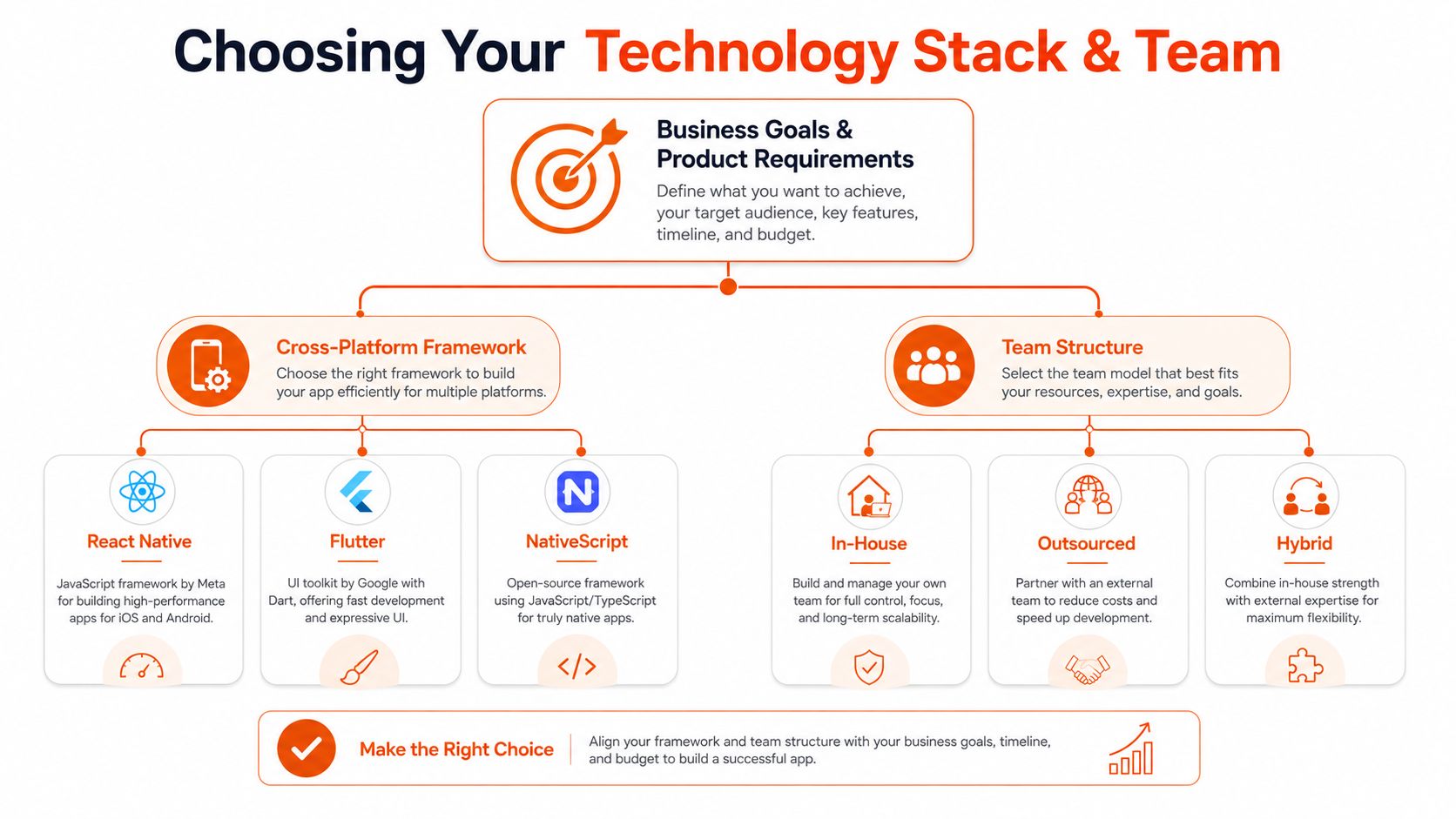
Choosing the Right Technology Stack and Team Structure
Your stack decision should be driven by product reality, not by what a hiring manager hopes to find on LinkedIn. React Native, Flutter, and Kotlin Multiplatform all make sense in different situations, but each one changes how your team ships, tests, and hands work over. If you choose the wrong stack, your delivery bottleneck won't be code, it'll be coordination.
Start with product shape, then match the stack
If your product needs fast UI delivery, a consistent visual layer, and a broad ecosystem, Flutter is often the cleanest fit. If your team already lives in JavaScript and wants to move quickly, React Native can lower the adoption burden. If you already have strong native expertise and want to share logic without forcing a new UI model, Kotlin Multiplatform is the more disciplined choice.
That decision should sit inside a bigger architecture conversation. If you need a refresher on how that thinking connects to broader system design, use this guide to the technology stack as a working reference: what a technology stack covers. Stack choice is never isolated from APIs, release tooling, analytics, and support burden.
Team structure matters as much as framework choice
A great framework won't save a weak delivery model. In-house teams work well when you already have senior mobile leadership and the product justifies deep internal ownership. Nearshore teams make more sense when you need senior delivery capacity quickly, without waiting months to recruit and onboard.
Decision rule: pick the framework that fits your team's current strengths, then choose a team model that removes the biggest delivery constraint. If the constraint is speed, don't add organisational complexity that slows the first release.
For many SaaS founders, the sweet spot is a hybrid model, core product ownership stays internal, and the implementation load sits with a nearshore partner or embedded delivery squad. That lets leadership keep control of the product direction while still increasing throughput. If the team can't explain how they'll handle release ownership, testing, and handover from day one, they're not ready.
Hidden Costs and Lifecycle Risks of Cross-Platform Development
The biggest mistake I see is teams assuming cross-platform always wins on total cost. It often wins early, but the full lifecycle tells a harder story. Once the app is live, platform quirks, performance gaps, and device-specific exceptions can turn a neat shared codebase into a patchwork of exceptions.
Where the savings start to erode
Research on cross-platform development keeps pointing to the same pain points, weaker native performance and UX, harder debugging, and higher maintenance effort. A survey-backed summary of cross-platform challenges says platform quirks are still the top issue, with framework maturity, online resources, debugging tools, and testing suites also ranking highly (cross-platform development challenges study). That's not a minor inconvenience, it's a delivery risk.
For UK SaaS teams building customer-facing or regulated products, the question is whether the codebase stays shared after launch. In many cases, it doesn't. Authentication flows, camera behaviour, push logic, and device-specific UI tweaks can all force platform-specific work anyway. Once that starts, the maintenance model changes, and the clean cost story gets messy.
Use the right lens before you commit
A cross-platform choice is only cheap if the product stays inside the framework's comfort zone. If your app demands polished motion, deep OS integration, or highly specific native behaviour, the shared-code promise shrinks fast. That doesn't make cross-platform wrong, it just means you should budget for the exceptions upfront.
Kotlin also makes this trade-off explicit by allowing platform-specific code when needed while still sharing a common base (Kotlin cross-platform frameworks guidance). That flexibility is useful, but it's also the point where many teams lose the efficiency they thought they were buying.
The discipline here is simple. Treat platform-specific work as part of the plan, not a surprise. If the team talks only about code reuse and never about long-term parity, maintenance, or release friction, they're selling you a partial truth.
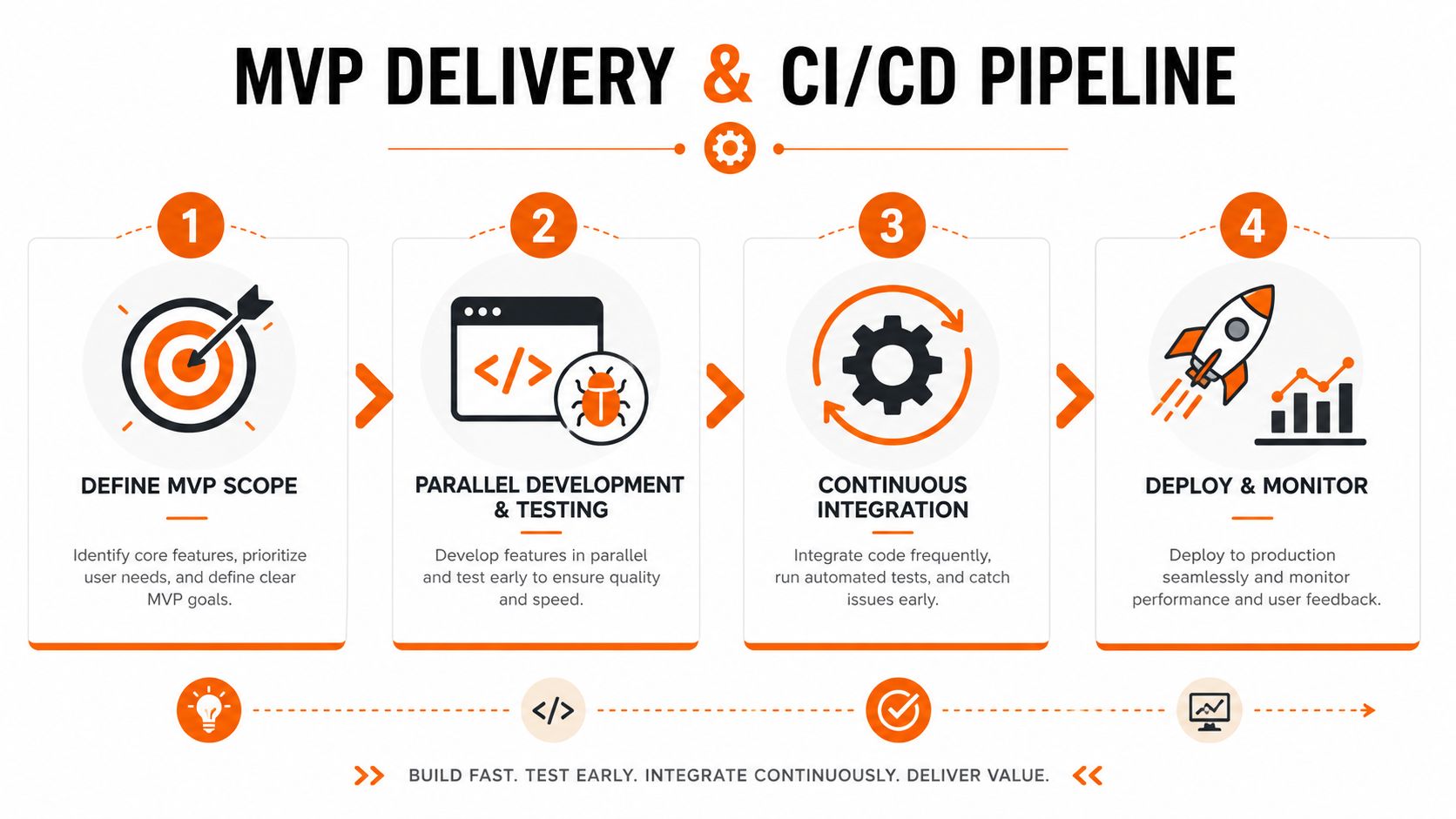
MVP Delivery Timelines, Testing, and CI/CD Best Practices
MVP speed matters, but shipping fast without release discipline just moves the pain downstream. The teams that do this well don't optimise only for first build, they optimise for a stable path from scope to store submission to monitored release. That's where a lot of cross-platform projects slip, because emulator success and real-device behaviour are not the same thing.
Build the delivery pipeline before the feature list grows
A practical MVP process starts with scope control. Define the smallest version of the product that proves value, then lock the testing surface before feature creep multiplies device combinations. If you're comparing tooling approaches, the CI/CD pipeline article from Rite NRG's site is worth reading for the delivery mechanics: CI/CD pipeline guidance.
Emulators help, but they don't finish the job. Research on mobile development challenges notes that limited monitoring, analysis, and testing tools are a real constraint, and that emulators aren't enough to catch everything seen in the wild (mobile development challenges paper). That's why teams need real-device validation, not just happy-path simulator runs.
Keep release friction visible
A sane CI/CD setup should automate build, test, and deployment steps as far as your environment allows. It should also make it obvious when a platform-specific issue is slowing release, because hidden friction becomes calendar drift. If bug triage keeps sitting outside the pipeline, your release process will keep accumulating avoidable delay.
The goal isn't technical elegance for its own sake. The goal is predictable delivery with fewer surprises after launch. Teams that invest in device validation, crash visibility, and a clean build pipeline ship with less drama and fewer late-stage fixes.
Engaging a Nearshore Partner for Multi Platform Mobile Application Development
Nearshore delivery is a commercial decision, not a staffing trend. If you need senior execution, faster team formation, and enough overlap to keep product conversations moving, a nearshore partner often beats a stretched internal hiring plan. That matters most when the app has to ship, learn, and keep pace with the business.
What to expect from the right partner model
A serious nearshore partner should bring more than developers. It should bring delivery ownership, communication habits, and a clear plan for how work moves from discovery to release without handoff chaos. That's where Build-Operate-Transfer becomes useful, because it lets you stand up an R&D centre with a partner, operate it with structure, and transfer it when the business is ready.
For founders comparing partnership models, this write-up from Hire-a.dev is a useful external perspective on the operating model and trade-offs of nearshore delivery: nearshore software development insights from Hire-a.dev. Use it as a lens for evaluating how much control, speed, and management bandwidth you have.
If you're evaluating a partner in Europe, the question isn't just who can code. It's who can create a stable delivery rhythm, support knowledge transfer, and keep the product moving when priorities shift. That's also why the internal fit matters, because cultural alignment and communication discipline reduce the overhead that kills momentum.
Choose a partner that owns outcomes
Rite NRG fits this model as a nearshore software delivery partner that builds and scales SaaS products with senior teams, dedicated delivery squads, and Build-Operate-Transfer support for R&D centres in Poland. It also works across platform development and consulting, which matters when the delivery challenge includes more than implementation.
Use this internal guide if you're evaluating that kind of partnership structure: how to choose a nearshore partner. The right partner should make the product easier to ship, not harder to manage.
Strong delivery partners don't wait for instruction to spot risk. They surface issues early, explain trade-offs plainly, and keep the team aligned on what outcome matters next.
Your Action Plan for Multi Platform Mobile Application Development Success
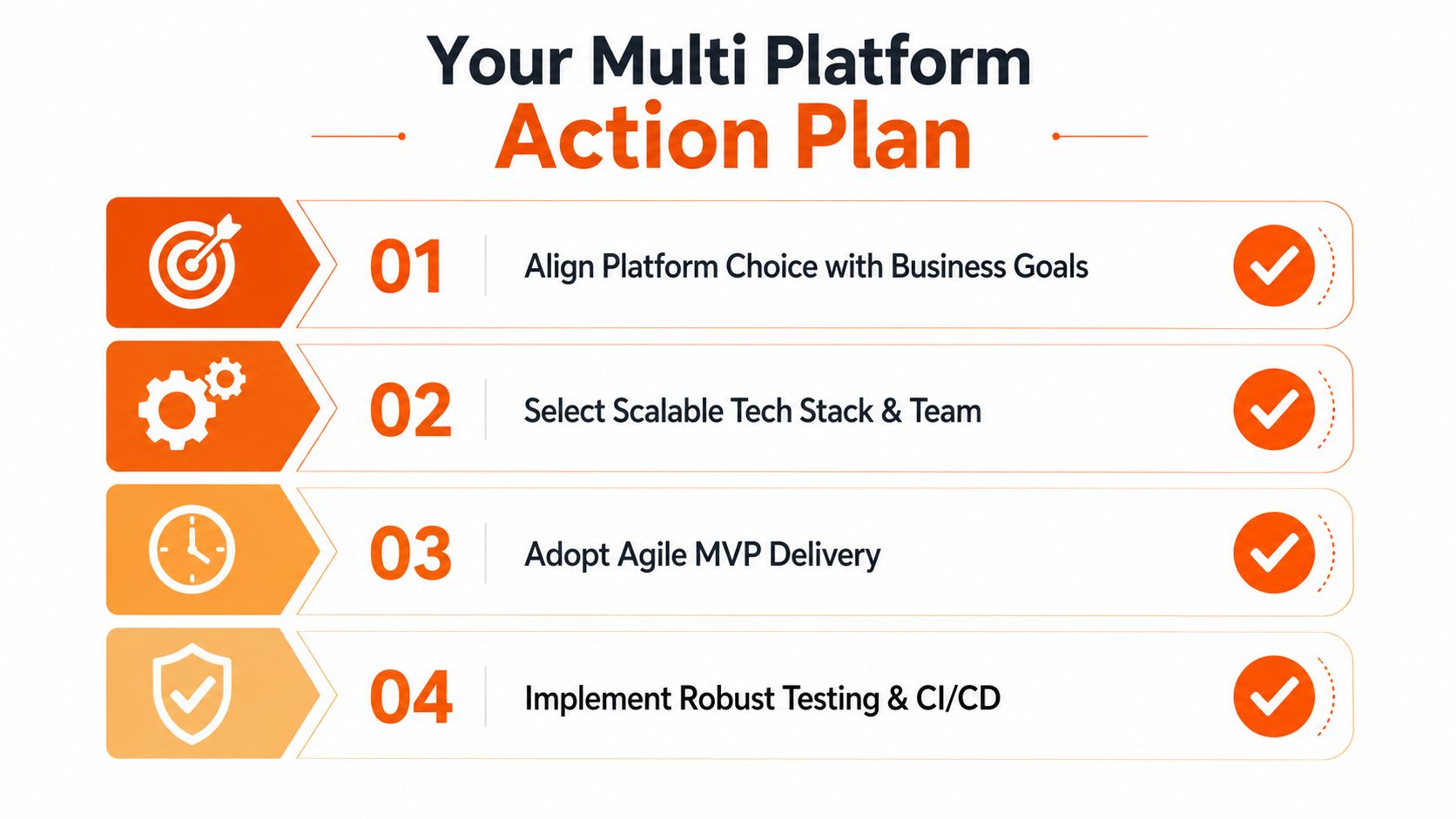
The best multi platform mobile application development plan is boring in the right way. It makes the stack decision early, defines the team model clearly, and removes ambiguity from delivery and testing. That's how you get faster market entry without turning the app into a maintenance headache.
The plan that actually works
First, align the platform choice with the business goal. If the goal is rapid validation, don't overbuild for complexity you haven't earned yet. If the goal is a long-lived customer product, choose a stack that can handle platform-specific exceptions without collapsing under them.
Second, select the team structure with the same seriousness. In-house, nearshore, or hybrid all work, but only if accountability is explicit and release ownership is clear. Extreme Ownership isn't a slogan here, it's the difference between clean delivery and endless finger-pointing.
Third, keep MVP scope tight and test on real devices early. Emulator confidence is useful, but it doesn't replace the last mile of release validation. Fourth, put CI/CD, crash visibility, and monitoring in place before the product becomes hard to change.
Avoid the usual traps
Don't let the team sell you reuse without showing you how they'll handle platform quirks. Don't let release automation become an afterthought. And don't let partner selection come down to headcount alone, because the wrong delivery model will cost more than the wrong framework.
If you want a practical benchmark, use this checklist before you commit:
- Business fit first: confirm the stack supports the product's actual revenue and retention goals.
- Ownership clarity: know who owns architecture, release, and bug triage.
- Device realism: test on real hardware, not just emulators.
- Lifecycle discipline: plan for maintenance before the first launch.
- Partner accountability: choose a team that acts on risk, not one that waits to be asked.
The strongest teams treat the app as a business system, not a coding exercise. That mindset keeps the product moving and the budget honest.
If you're planning a multi platform product and want a delivery partner that can help you choose the right stack, shape the team, and ship with less friction, talk to Rite NRG. We build nearshore teams, delivery processes, and SaaS products with a focus on predictable outcomes, not busywork.