Automation in Software Development is no longer a developer convenience, it's a delivery multiplier. In the UK, 76% of software firms were already using AI in at least one business function, and 15% were using it to automate coding or software development tasks specifically, which tells you this has moved well past experimentation (UK AI uptake analysis). If you're still treating automation as a tooling wishlist, you're already behind the teams that are turning it into faster releases, steadier quality, and cleaner operating margins.
The right automation strategy doesn't just save engineering time. It changes how quickly you can ship, how predictably you can scale, and how much of your senior team is stuck firefighting manual work instead of building product. UK businesses using AI reported reduced time spent on routine tasks at 39%, which is exactly why automation belongs in the delivery conversation, not just the developer experience conversation (same UK analysis).
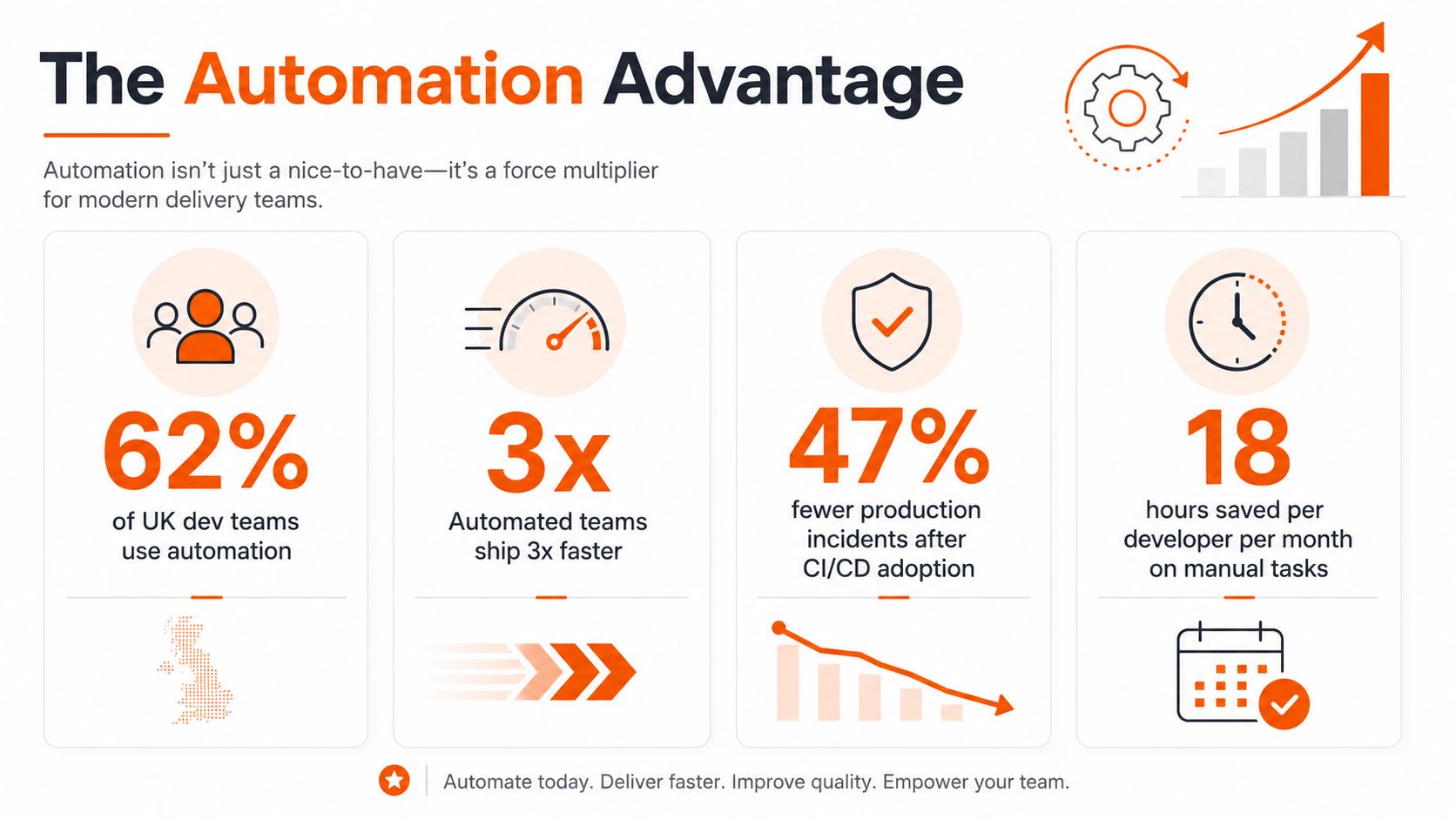
Why Automation Is Now a Delivery Multiplier
Automation in software development has crossed the line from “nice to have” to “core operating model”. The UK data makes that plain, because most software firms are already using AI somewhere in the business, and a meaningful share are applying it directly to coding and development work (UK AI uptake analysis). That means the competitive baseline has shifted. Manual release habits, ad hoc testing, and environment drift are no longer harmless inefficiencies, they're structural drag.
The change is business, not technical. Automation shortens the time between decision and shipment, which improves time-to-market, makes cost planning less erratic, and reduces the release-day panic that kills confidence across product and sales teams. The Government Digital Service and GOV.UK's wider delivery model also normalised automated testing and continuous delivery in public-sector workflows, which matters because institutional adoption tends to set the pattern for the rest of the market (public-sector automation guidance summary).
Why founders should care
If you're running a SaaS company, automation should be judged by how much it improves the flow of value to customers. Not by how many tools you've bought. Not by how many pipelines look impressive in a dashboard.
Practical rule: if a manual step doesn't protect revenue, compliance, or customer trust, automate it or remove it.
The upside is simple. Teams that automate the right parts of delivery can move materially faster without giving up control, because repeatable pipelines reduce the coordination tax that slows releases. Rite NRG frames this kind of delivery as outcome-led work, which is the right lens. Automation only matters when it improves the business result, not when it makes the engineering org feel busy.
The Full Automation Landscape Across the SDLC
Automation in modern delivery isn't one tool, it's a connected system. The strongest teams treat the SDLC as a chain of repeatable controls, where each layer reduces manual handoffs and makes the next layer safer. IBM's definition of SDLC automation captures the breadth of it, from CI/CD and infrastructure automation to automated testing and security checks driven by software, AI, orchestration platforms, and policy-based workflows (IBM on SDLC automation).
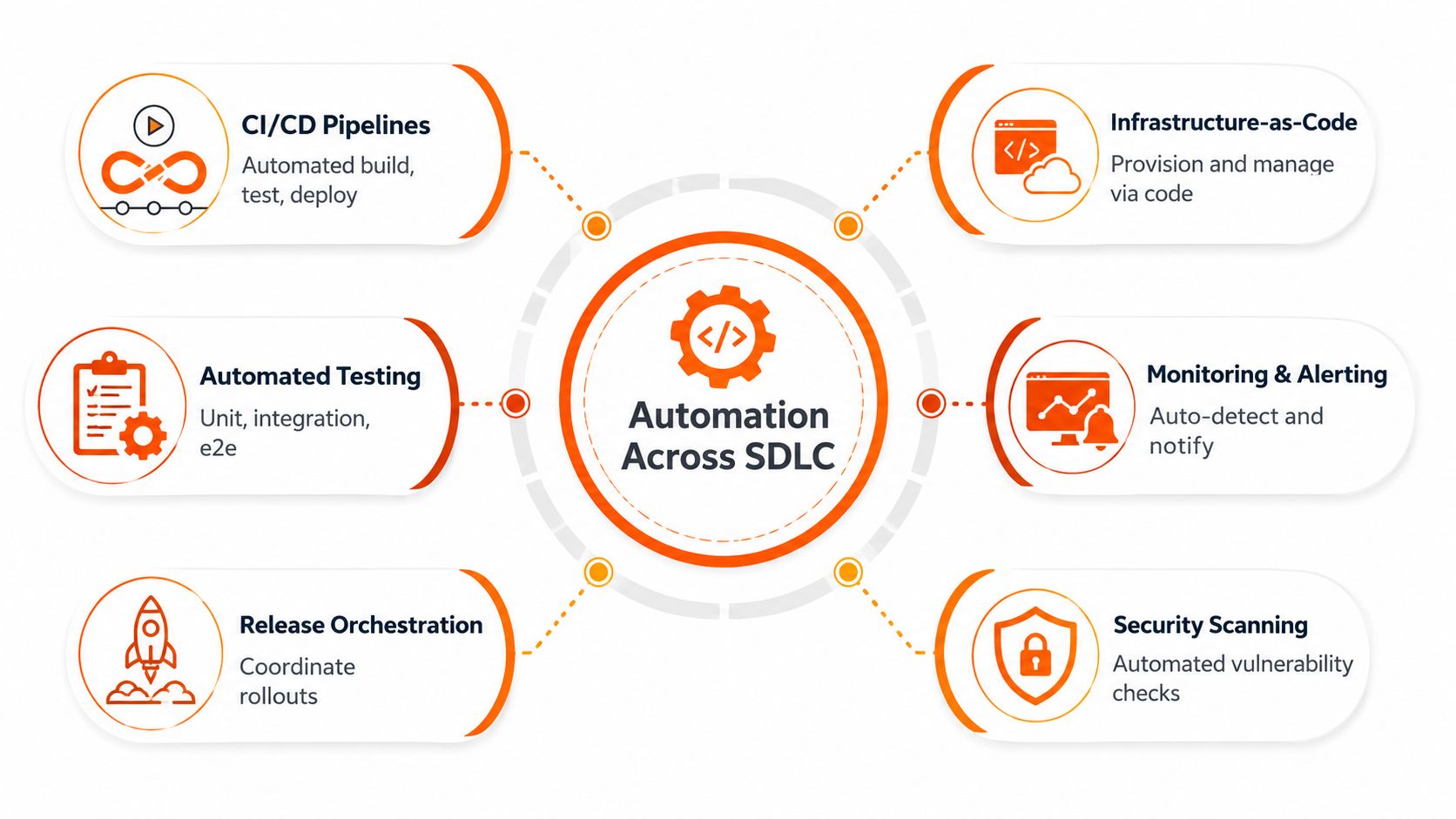
The layers that actually matter
CI/CD pipelines build, test, and deploy code automatically. That's the backbone, because it turns release work from a ceremony into a repeatable path. Infrastructure-as-code makes environments reproducible, which is where SaaS teams stop arguing with “works on my machine” problems and start shipping with confidence. Automated testing covers unit, integration, and end-to-end checks, giving you feedback before humans become the bottleneck.
Then there's release orchestration, which is the layer too many teams ignore until multi-service deployments start breaking on Friday afternoon. It coordinates rollout order, dependencies, and approval gates. Observability pipelines sit slightly later in the chain, surfacing anomalies before users do. AI-assisted workflows now add code generation, bug triage, and documentation drafting, which is useful when you apply them to high-frequency work rather than random experimentation.
For a practical primer on how these delivery disciplines connect, Otter A/B's practical guide on SDLC and Agile is worth a read because it frames process, feedback loops, and delivery flow together rather than treating them as separate problems. If you're already building the deployment side, the corresponding internal view on CI/CD pipeline design helps anchor the engineering shape.
The highest-impact control points for SaaS teams are workflow orchestration and infrastructure-as-code. Those two make deployments repeatable, enforce policy before code reaches production, and cut the hidden friction that creeps in when every release depends on people remembering the right steps.
Automated delivery only works when the pipeline is treated like product infrastructure, not a side project owned by one overworked engineer.
Measuring the Business Impact of Automation
The metrics that matter are boring on purpose. Deployment frequency, lead time for changes, mean time to recovery, change failure rate, and developer cycle time tell you whether automation is making the business healthier or just making Jira look prettier. If those numbers aren't improving, the tooling isn't working hard enough.
Automation moves each metric in a different way. Faster pipelines increase deployment frequency because code spends less time waiting for humans. Automated tests and security checks reduce change failure rate because bad code gets stopped earlier. Infrastructure-as-code lowers lead time by removing environment setup delays. Strong observability and rollback paths reduce mean time to recovery when something does slip through.
| Metric | Manual Delivery | Automated Delivery | Business Impact |
|---|---|---|---|
| Deployment frequency | Slower, gated by human coordination | More consistent, pipeline-driven | Faster access to revenue features |
| Lead time for changes | Longer, with more waiting between steps | Shorter, because handoffs shrink | Quicker learning from production |
| Mean time to recovery | Slower, because diagnosis depends on people | Faster, when telemetry and rollback are built in | Lower outage cost and less churn risk |
| Change failure rate | Higher, because checks are inconsistent | Lower, when tests and policy gates run automatically | Better trust from customers and sales |
| Developer cycle time | More fragmented, with repetitive admin work | Less fragmented, with routine work removed | Senior engineers spend more time on product work |
The UK Defence Academy's automation guidance is useful here because it frames success through coverage, throughput, and decision-quality metrics rather than vanity output (Defence Academy automation guide). That's the right lens for founders and CTOs, because the point isn't to replace engineers. It's to free experienced people from repetitive work so they can solve product and platform problems that change the business.
For a process-level view of the same logic, see the internal discussion on process automation.
The Automation Maturity Model for SaaS Teams
Most SaaS teams don't fail at automation because they lack tools. They stall because they don't know which layer to buy next, or they try to jump straight to “autonomous delivery” without building the foundations. A clean maturity model helps you invest in the right order and stop mistaking activity for progress.
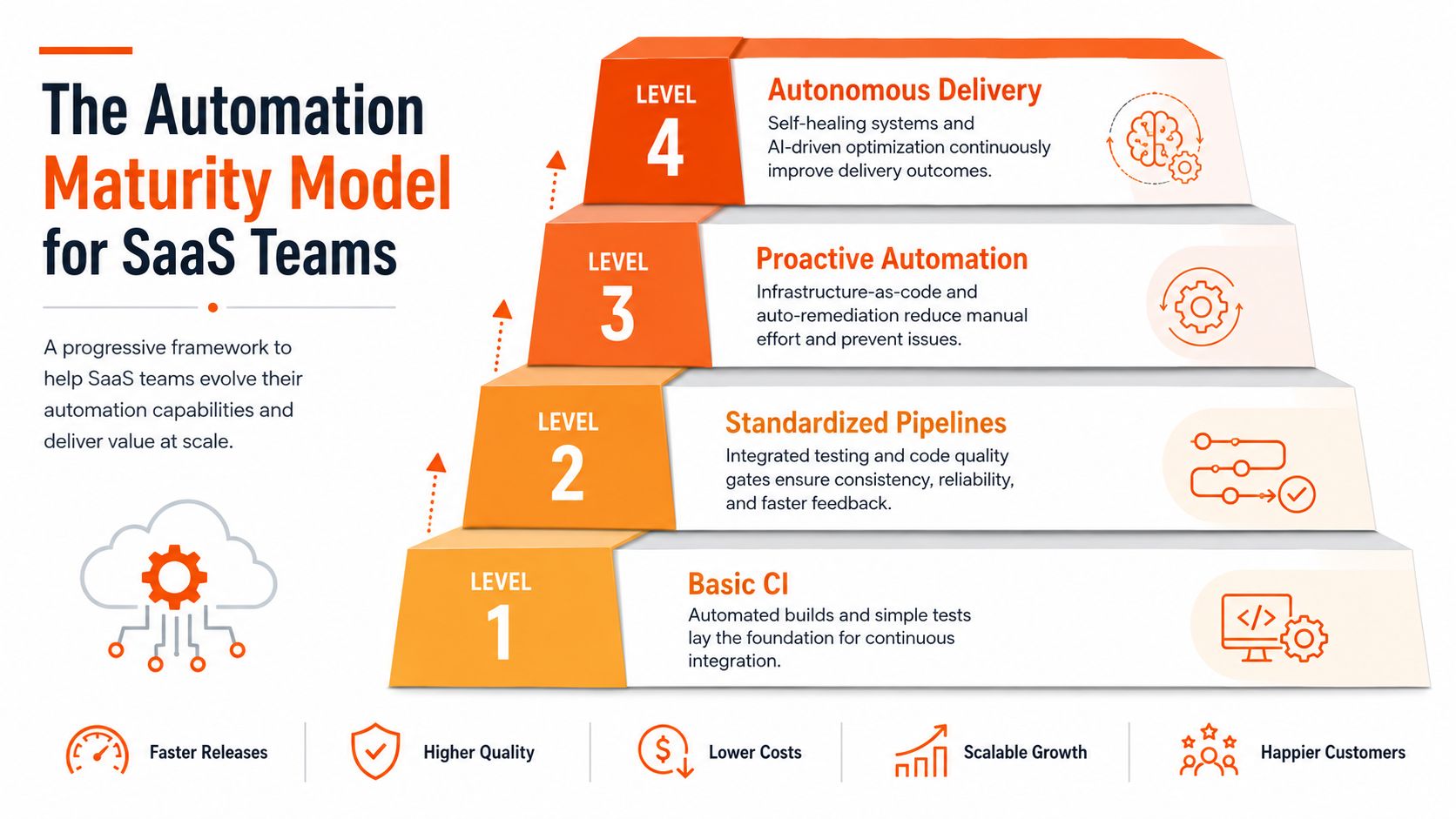
Level 1 Basic CI
Smaller teams usually start with automated builds and a simple test suite. The stack is lightweight, often centred on GitHub Actions, GitLab CI, or Jenkins, plus a few dependable tests that catch obvious regressions. Delivery cadence improves, but the team still spends plenty of time on release coordination and manual environment work.
Level 2 Standardised Pipelines
At this stage, deployments become repeatable and environments start to look the same across staging and production. Infrastructure-as-code enters the picture, along with proper integration tests and code quality gates. Many scale-ups begin to feel the benefit here, but this is also a point where many stall because their culture still depends on heroic manual intervention.
Level 3 Proactive Automation
This is the step change. Release orchestration, automated security scanning, and AI-assisted code review reduce the number of decisions humans have to make during ordinary delivery. The stack is more opinionated, and the team needs stronger engineering discipline, because the pipeline now enforces behaviour instead of merely reflecting it.
Level 4 Autonomous Delivery
This is full platform thinking, with self-service infrastructure, automated observability, and GenAI embedded across the SDLC. The team is smaller in coordination terms, not necessarily smaller in headcount, because more of the routine work is handled by the platform. That's where nearshore partnership models can help, especially when a team needs seasoned engineers who can build the system and transfer the operating model into the client organisation without drama.
Hard truth: most teams don't need more automation ideas. They need more consistency in how they adopt the next layer.
Hidden Risks and Unintended Consequences
More automation isn't automatically better. If you lean too hard on pipelines and runbooks, people stop learning how the system behaves, and that creates a nasty gap when something breaks outside the happy path. Research on unintended consequences in software automation is blunt about this, automation can create new failure modes, make incidents harder to resolve, and degrade human knowledge if teams rely on it too passively (unintended consequences research).
That matters in the UK because breach exposure is expensive, and the IBM 2024 Cost of a Data Breach report put the average UK breach cost at £3.58 million. When your automation hides telemetry, delays intervention, or obscures who owns a failure, the risk is no longer theoretical. It becomes a balance-sheet problem.
Where the governance gap appears
GenAI creates a second problem. It can generate code faster than teams can review it, especially in requirements, coding, and design work where adoption is already becoming normal, while maintenance remains harder to automate and easier to ignore (PwC GenAI report). That's where governance slips. If teams treat generated code as safe, they ship more volume with less scrutiny.
The answer isn't slowing everything down. It's putting guardrails in the right places.
- Keep manual review gates on critical paths, especially authentication, billing, and data handling.
- Run incident response drills without relying on automation, so engineers still know how to recover manually.
- Invest in observability that makes system state legible to humans, not just dashboards that look busy.
- Document rollback paths plainly, because the team will need them at the worst possible moment.
Automation should reduce the amount of routine work, not remove human understanding from the system. If your team can't explain what the platform is doing when a release fails, you've automated too much of the wrong thing.
Implementation Patterns That Actually Work
The teams that ship well don't chase every new tool. They use a few reliable patterns and enforce them consistently. Trunk-based development with feature flags keeps code moving without forcing giant merge windows, and the testing pyramid keeps fast checks close to the code while reserving heavier tests for the few flows that really need them. GitOps gives you a sane way to manage infrastructure changes through version control, which is far easier to audit than one-off console edits.
If you want a solid reference point for infrastructure automation in practice, Fivenines' infrastructure automation for DevOps teams is a useful companion to the internal infrastructure as code discussion because it keeps the focus on repeatable change, not theoretical purity.
How the delivery model changes
AI pair-programming works best when it's used for boilerplate, test scaffolding, documentation drafts, and repetitive refactors. It should not own architecture decisions. Senior engineers still need to shape boundaries, choose trade-offs, and own production risk. That's where an experienced nearshore partner earns its keep, by embedding senior people who bring extreme ownership, proactive communication, and product-first judgement into the client team.
Rite NRG's #riteway approach fits that model because it combines delivery discipline with AI-powered processes without handing control away. In practice, that means the team can accelerate routine engineering work while staying transparent about what is built, why it was built, and where the risks sit. It's not about adding more noise to the process. It's about making delivery more predictable.
The best implementation pattern is the one your team can repeat under pressure on a bad Tuesday, not the one that looks clever in a slide deck.
Your Prioritised Automation Adoption Roadmap
Start with the bottleneck that hurts the business most. If releases are slow and unpredictable, Phase 1 is CI/CD foundations and automated testing. That usually takes weeks, not months, and it gives you immediate value by reducing manual release work and cutting the number of obvious defects that reach staging.
Phase 2 adds infrastructure-as-code and environment automation. Teams start getting reliable deployments and less configuration drift, because the same setup can be recreated every time. The investment is higher, because you're changing how the platform is managed, but the payoff is calmer operations and less release-day friction.
Phase 3 brings in release orchestration, security automation, and AI-assisted workflows. This is the point where quality, policy, and speed start reinforcing one another instead of competing. Phase 4 is for teams ready to build a real platform engineering capability, with self-service infrastructure and automated observability that lets product teams move without waiting on ops.
A simple decision rule helps. If your team still spends too much time on manual release work, start with pipelines and tests. If production problems come from inconsistent environments, invest in infrastructure automation next. If you're shipping fast but losing control, focus on orchestration, security, and observability before adding more AI.
When the team lacks enough senior delivery depth to execute that sequence cleanly, bring in a nearshore partner early. Rite NRG's Build-Operate-Transfer model is designed for that moment, because it helps companies set up custom R&D centres, embed automation expertise into the organisation, and transfer the operating model without leaving a dependency behind.
If you want a delivery partner that treats automation as a business outcome, not a tool stack, talk to Rite NRG. They build senior nearshore teams, automation-aware delivery models, and BOT structures that help SaaS companies ship faster without giving up control.