USD 139.64 billion in 2025, projected to USD 945.53 billion by 2035 at a 21.08% CAGR. That's the scale of the IoT in transportation market, based on Precedence Research's market projection. If you're still treating IoT as a side experiment, you're already behind.
The mistake I see most often isn't weak technology. It's weak delivery. Teams buy sensors, spin up dashboards, connect a few vehicles, and call it strategy. It isn't. The winners build market-ready products that turn operational data into decisions, savings, and defensible SaaS value. That takes ruthless prioritisation, strong architecture, and a delivery team that owns outcomes instead of waiting for instructions.
That's the standard behind the #riteway methodology. Extreme Ownership. High energy. Proactive execution. In IoT in transportation, those traits matter more than another slide deck about edge devices.
Beyond the Hype The Real Business of IoT in Transportation
Analysts are projecting explosive growth in connected transport, but market size is not the part that decides winners. Delivery does. Teams that turn operational data into a product customers rely on will capture the margin. Teams that treat IoT as a hardware experiment will burn budget and stall.
Many technical guides define IoT in transportation by listing parts. Sensors, connectivity, cloud, analytics. That framing is too technical and too late in the process.
The commercial definition is simpler. IoT in transportation is a system for turning moving assets into measurable business performance. If your product does not improve cost control, reliability, utilisation, customer experience, or response times, it is just connected hardware with a monthly bill.
That shift matters because buyers do not purchase telemetry for its own sake. They purchase fewer breakdowns, tighter ETAs, lower fuel spend, faster dispatch decisions, and better asset use. Your roadmap should reflect that from day one.
Why execution decides the outcome
A growing category creates urgency, but urgency alone does not create a viable SaaS product. It creates pressure to move fast without a clear operating target. That is where bad scope decisions start.
Start with one decision the product will improve, then build backward into data capture, processing, alerts, and workflow design. If your team needs a reference point for that stack, use a practical Internet of Things architecture for scalable product delivery instead of improvising integrations sprint by sprint.
This is the gap many companies miss. The hard part is rarely getting devices online. The hard part is shipping a product that fits existing operations, proves value quickly, and gives leadership a reason to expand the rollout.
What smart operators do differently
Strong operators ask sharper commercial questions before they approve scope:
- Where is margin leaking today: fuel waste, idle time, emergency maintenance, missed delivery windows, or poor ETA accuracy?
- Who acts on the insight every day: fleet manager, dispatcher, depot operator, transport planner, or end customer?
- What can ship first and prove value fast: a focused SaaS layer for one painful workflow will outperform a wide platform with weak adoption.
For transport businesses trying to optimize trucking operations, that usually means picking one commercial lever first, proving usage, and expanding from evidence.
Delivery beats explanation
Some IoT programmes lose momentum because ownership is split across too many functions. Leadership approves the budget. Engineering connects devices. Procurement handles hardware. Operations waits for reports. Six months later, nobody can point to a KPI that improved or a user behavior that changed.
Fix that early. Build around a decision loop with clear accountability. Capture the right data. Process it fast enough to matter. Put it inside the workflow where a user can act on it. Assign one team to own the result, not just the release.
That is how connected transport becomes a market-ready SaaS product instead of another pilot that never earns a second phase.
Unlocking Measurable Outcomes with IoT Use Cases
The fastest way to kill momentum is to talk about IoT as a bundle of features. Buyers don't fund features. They fund outcomes.
Cutting transport costs where it hurts
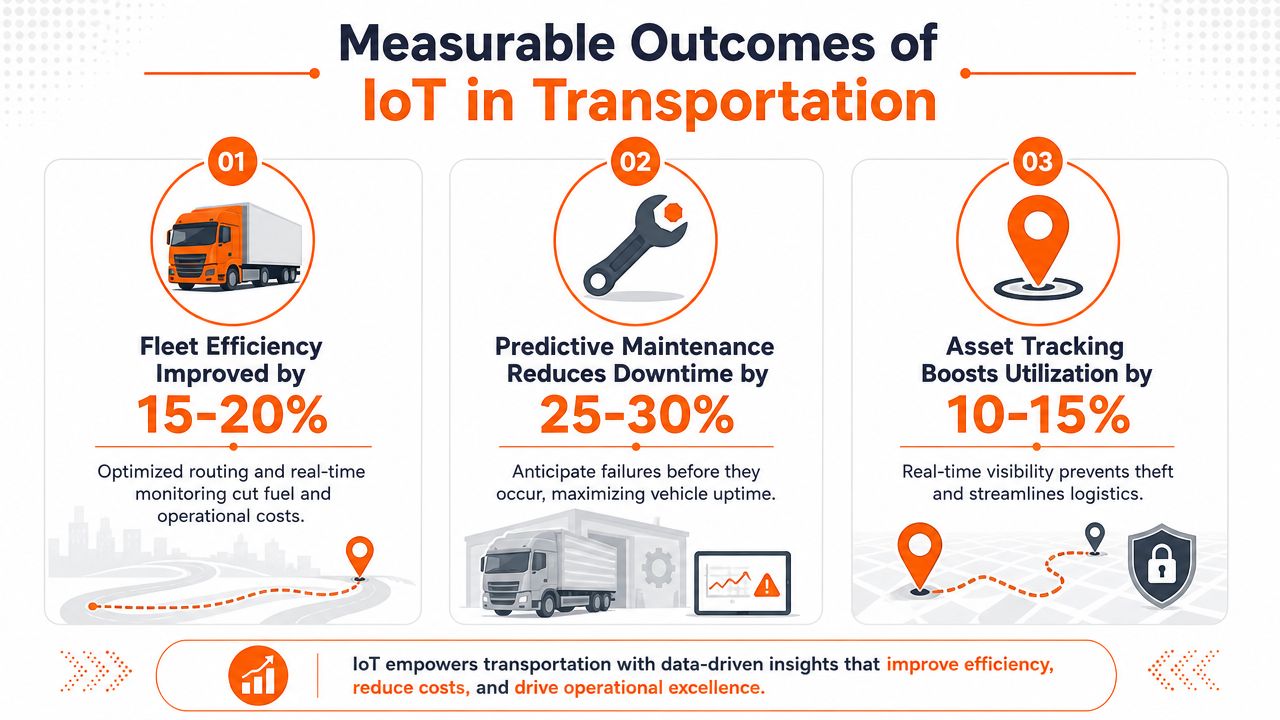
Fuel is one of the cleanest starting points because finance teams understand it immediately. In the UK, fleet management systems powered by IoT telematics deliver 10–15% reductions in fuel consumption, creating direct impact on operating costs and ESG reporting for logistics companies, as described by Synex Logistics.
That's why telematics works as an MVP anchor. It connects route behaviour, idling patterns, vehicle usage, and driver operations to a line item the business already tracks.
A practical product scope often includes:
- Live vehicle visibility: Dispatchers see where vehicles are and act before delays compound.
- Route performance monitoring: Product teams identify repeat inefficiencies instead of reacting trip by trip.
- Fuel trend analysis: Operations leaders can compare assets, routes, and behaviours inside one workflow.
If your team needs a concrete benchmark for product thinking in this space, learn about Fleetalyse's offerings and look at how transport data gets translated into operational decisions rather than passive reporting.
Turning maintenance into a controlled process
Reactive maintenance destroys margins because it creates chaos. Vehicles fail at the wrong time, the wrong place, with the wrong knock-on effects. Predictive maintenance changes that by moving intervention earlier, when the repair is still manageable.
The commercial win isn't “better data”. It's fewer service disruptions, more predictable scheduling, and less emergency spend.
Teams should treat maintenance alerts as an operational product. If the alert doesn't trigger a clear next action, it isn't useful.
Improving visibility across cargo and customers
Asset tracking matters because customers don't buy your internal complexity. They buy confidence. Real-time GPS and RFID tracking enabled by IoT allows UK transport operators to verify cargo location and status within seconds, reducing shipment delays by 25% while improving customer satisfaction through more accurate delivery estimates, according to Vakoms on LinkedIn.
That use case becomes much more valuable when product teams combine tracking with spatial context. A strong primer on this is Rite NRG's guide to geospatial data in product delivery, especially if your SaaS roadmap includes ETA logic, route intelligence, or location-based alerting.
Here's a useful reality check from the market itself:
Passenger experience is still an operations problem
Passenger-facing features often get framed as “nice to have”. That's lazy thinking. Accurate arrival information, occupancy visibility, and service reliability shape adoption, trust, and recurring usage.
When you build IoT in transportation products well, customer experience improves because operations improve. That's the right order. Don't start with a polished app and hope the backend catches up later.
The Blueprint A Modern IoT Solution Architecture
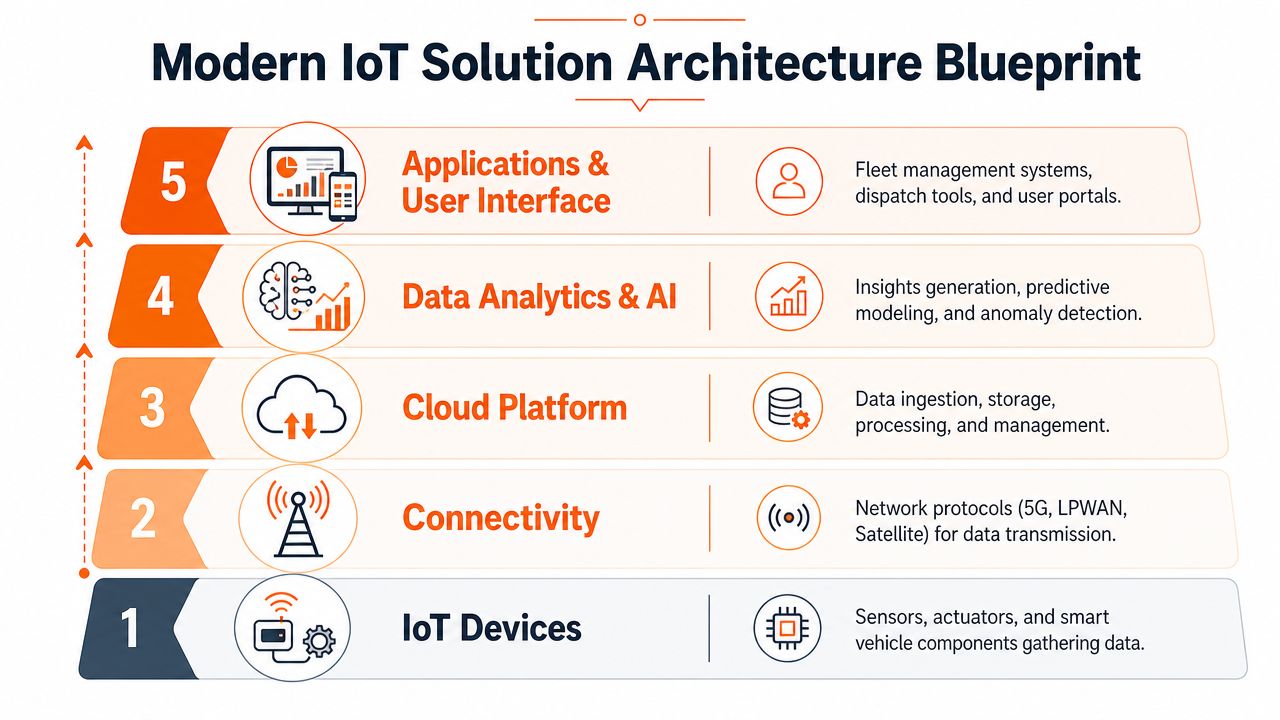
Most architecture conversations fail because they drown decision-makers in diagrams. The stack is simpler than people make it sound. Think of it as a chain of responsibility. Something senses. Something transmits. Something processes. Something interprets. Someone acts.
Layer one to three from signal to system
The bottom of the stack is the physical world. Sensors on engines, cargo units, doors, tyres, refrigeration units, or vehicle cabins generate raw data. That's the easy part.
The next layer is connectivity. Mobile networks, local wireless standards, gateways, and protocol handling move data from asset to platform. Many teams often overcomplicate the build. You don't need every protocol on day one. You need reliable transmission for the data that drives your first business case.
Then comes the cloud platform. This is the operating core where ingestion, storage, device management, rules, and workflows live. If you're building a SaaS product, this layer needs product discipline, not just infrastructure competence.
For a more detailed breakdown of how these layers fit together in delivery, Rite NRG's overview of Internet of Things architecture is a useful reference.
Layer four and five where ROI actually appears
Analytics is where raw telemetry becomes action. This is the point of the whole system. By implementing IoT for predictive maintenance, UK logistics companies have achieved up to 20% fewer mechanical failures and a 30% reduction in emergency repair spending, according to Epicor's analysis of logistics operations. That result comes from converting sensor signals into maintenance alerts teams find actionable.
The top layer is the application interface. Dashboards, mobile tools, exception alerts, dispatcher consoles, customer portals. Here, product quality becomes evident. If your interface forces managers to hunt through charts to answer simple operational questions, the architecture has failed even if the data pipeline is technically sound.
A transport platform earns trust when the user can see one issue, understand it quickly, and act inside the same workflow.
Build for operations, not for architecture theatre
I've seen teams waste months polishing technical elegance while the business still can't answer basic questions about asset status. That's not maturity. That's avoidance.
A modern architecture for IoT in transportation should do three things well:
- Handle messy inputs: Real fleets produce inconsistent, delayed, and incomplete data.
- Expose decision-ready outputs: Alerts, exceptions, and recommendations matter more than raw feeds.
- Scale by modularity: Add use cases without rebuilding the core ingestion and rules engine.
If your roadmap includes multimodal logistics, the Coreties air ground tracking guide is a practical example of how tracking complexity expands once assets cross operational environments.
Your Fast-Track to Market The SaaS MVP Roadmap
The biggest strategic error in IoT product delivery is trying to launch a full platform before validating one high-value use case. That approach burns capital, slows feedback, and floods the roadmap with assumptions.
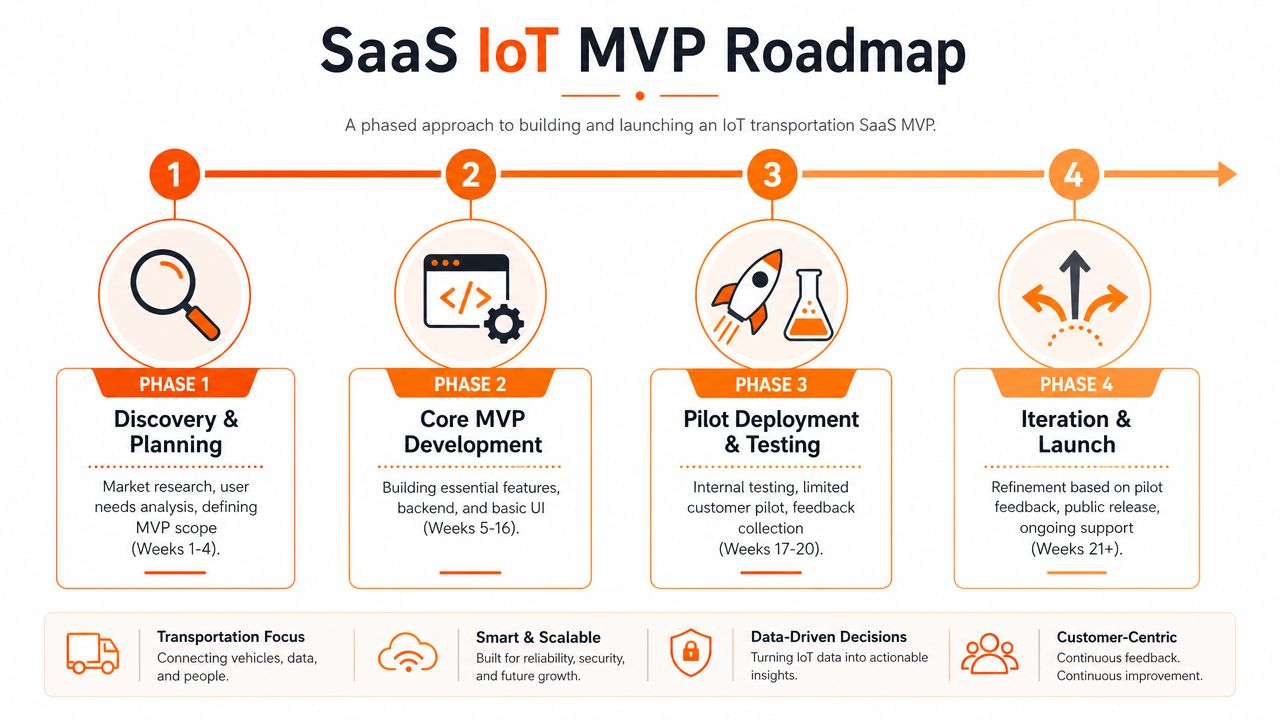
A serious SaaS MVP for IoT in transportation does less, earlier, with more discipline. The aim isn't to prove that sensors can send data. The aim is to prove that a user will change behaviour because your product improves a business decision.
Phase one discovery that narrows the fight
Start by cutting scope hard. Pick one user, one operational pain point, and one measurable outcome. Not five.
Good discovery answers questions like these:
Who feels the pain daily
A fleet manager handling fuel variance has a different need from a rail maintenance lead or a customer service team managing ETA disputes.What action must the product trigger
If the answer is vague, the MVP is vague. “Better visibility” is not an action. “Reassign vehicle, schedule maintenance, notify consignee” are actions.Which data source is essential
The MVP only needs the inputs required to support that first operating decision.
Founders need backbone. Every extra integration, dashboard, report, and permission model increases time-to-market. Most of it can wait.
Operator mindset: Scope the first release around one workflow that saves money or protects service reliability. Everything else is backlog.
Phase two build the operational core
Once scope is clear, build the smallest coherent system that delivers value end to end. That usually means device ingestion, a clean data model, one rules engine, one user-facing workflow, and a basic admin layer.
A solid MVP in this category often includes:
- Device and event ingestion: Reliable capture of telemetry from the chosen asset group.
- Core business rules: Thresholds, exceptions, and logic that turn data into useful prompts.
- User dashboard or mobile view: One operational screen that helps the right person act quickly.
- Auditability: A record of events, decisions, and outcomes. This matters early, especially in regulated environments.
The #riteway methodology fits here because speed without ownership creates mess. Teams need proactive engineering, not order-taking. Product, engineering, and operations should work as one delivery unit, flagging risk early and killing weak ideas before they hit production.
Phase three pilot with a real customer
Internal demos don't validate transport products. Real users in live conditions do.
A pilot should answer three hard questions. Does the product fit into the user's actual routine? Does the data stay reliable under operational stress? Does the workflow change behaviour enough to justify expansion?
Use a short feedback loop. Weekly issue review. Fast prioritisation. Tight instrumentation. No vanity roadmap theatre.
A good pilot also exposes hidden friction:
| Pilot Area | What to test | Why it matters |
|---|---|---|
| Data quality | Missing, delayed, or noisy events | Poor telemetry kills trust quickly |
| Workflow fit | How dispatchers or managers actually respond | Great software still fails if the process is wrong |
| Alert quality | Whether notifications are actionable | Too many weak alerts train users to ignore the system |
| Integration strain | Impact on existing tools and teams | Adoption drops when staff duplicate work |
Phase four scale only after proof
Scaling comes after evidence, not optimism. Once the pilot proves value, extend by adjacent workflows, not by random feature demand.
The smartest sequencing usually looks like this:
- Expand user roles carefully: Bring in another operational persona only when the first workflow is stable.
- Add analytics after workflow adoption: Advanced reporting is useful once teams trust the operational core.
- Broaden integrations selectively: Connect TMS, ERP, maintenance, or customer systems where they remove friction.
This is also where leadership should decide whether the product is becoming a standalone SaaS platform, an internal operations layer, or a hybrid commercial offering. That decision affects pricing, support, architecture depth, and roadmap governance.
What founders should refuse
A few things consistently derail delivery:
- Feature-led scoping: Customers often ask for outputs that don't solve the root problem.
- Hardware-first planning: Device decisions should follow product requirements, not the other way around.
- Big-bang launches: They hide learning and amplify risk.
- Passive vendors: If your delivery partner only executes tickets, you're carrying strategy risk alone.
Fast delivery isn't chaos. It's controlled focus. That's how you ship a product the market can test, buy, and expand.
Navigating Security Privacy and Integration Hurdles
Security problems in IoT rarely come from one catastrophic mistake. They come from dozens of small decisions nobody owned properly. Weak device identity. Loose access controls. Incomplete logging. Unclear data retention. Hand-waved integration assumptions.

That's why I challenge the common assumption that security slows delivery. Poor security slows delivery. Clear security decisions made early keep programmes moving.
Security by design beats security by cleanup
For transport SaaS, security architecture needs to cover the full chain. Device identity, transmission controls, platform access, tenant separation, admin roles, and audit trails all need deliberate design.
The right mindset is practical:
- Define trust boundaries early: Decide where data enters, where it's transformed, and who can act on it.
- Minimise sensitive exposure: Don't collect data you can't justify operationally.
- Design for recovery: Failures and suspicious events will happen. Teams need fast containment and traceability.
This is ownership work. Not a compliance afterthought.
The strongest delivery teams treat security stories as product stories. If users depend on the system, resilience is part of the feature set.
Privacy and compliance need operational clarity
Transport products often handle location, behavioural, and workforce-related data. That creates privacy obligations immediately, especially when platforms combine operational telemetry with user accounts, mobile apps, or customer notifications.
The mistake is treating privacy as a legal document problem. It's an operational design problem. You need clear retention policies, role-based access, and straightforward internal rules for who can see what and why.
Legacy integration is the hard part worth solving
The UK rail sector, which holds a 44.7% market share, faces a major challenge integrating modern IoT sensors into legacy pre-2000 systems, as highlighted by IMARC Group. This demonstrates the fundamental integration challenge across transport. The hardest value often sits inside old platforms that were never designed for modern data exchange.
Don't let that become an excuse for paralysis. Legacy environments can be modernised incrementally if teams stop pretending replacement is the only strategy.
A practical approach usually includes:
- Wrapper services around legacy systems: Expose the minimum useful interfaces first.
- Parallel data validation: Compare new telemetry outputs with old operational records before pushing broad automation.
- Phased rollout by asset class: Start where operational disruption is easiest to contain.
Security, privacy, and integration are not blockers. They're engineering responsibilities. Teams that accept that early move faster with fewer surprises.
Measuring What Matters KPIs and True ROI
If your scorecard is full of connected devices, data points collected, or dashboards launched, you're measuring implementation theatre. The business doesn't care how much telemetry you store. It cares whether service got cheaper, more reliable, and easier to scale.
KPIs that deserve executive attention
The cleanest IoT business cases tie system behaviour to operating outcomes. In a UK project across Manchester and Birmingham, integrated IoT systems delivered a 12-minute reduction in average bus journey times and an 18% decrease in congestion-related fuel consumption, according to Ignitec's write-up on urban mobility innovation. That's what useful measurement looks like. A technology intervention mapped to operational KPIs leaders already care about.
Use that same standard inside your own product planning.
Essential IoT Transportation KPIs
| Business Goal | Primary KPI | Description |
|---|---|---|
| Lower operating cost | Fuel consumption per route or asset | Tracks whether routing, usage, and driving patterns are reducing spend |
| Increase fleet reliability | Unplanned downtime | Shows whether maintenance workflows are preventing service disruption |
| Improve service performance | On-time delivery or arrival adherence | Measures whether real-time visibility is improving execution |
| Raise asset productivity | Asset utilisation | Reveals whether vehicles or equipment are spending more time in productive use |
| Strengthen customer experience | ETA accuracy and service issue resolution time | Connects operational visibility to customer trust |
| Control maintenance spend | Emergency repair incidence | Highlights whether teams are replacing reactive repairs with planned interventions |
How to build an ROI model that survives scrutiny
A credible ROI model for IoT in transportation needs three inputs. First, establish the baseline cost or performance problem. Second, define the workflow change the product will create. Third, track the operational result over time.
That means your ROI discussion should include questions like:
- Which manual decision gets faster or better
- Which recurring cost line should move
- Which team owns the KPI after launch
- Which evidence threshold triggers expansion
Frequent commercial failure of IoT products stems from organisational, not technical, reasons. Teams launch the platform, but nobody owns the post-launch operating model.
If the KPI has no owner, the ROI won't hold. Someone in the business must be accountable for turning alerts and insights into action.
What good reporting looks like
Good reporting isn't a giant dashboard with every metric available. It's a small set of indicators tied to business intent. Executives need trend clarity. Operations teams need exceptions and actionability. Product teams need adoption and workflow evidence.
Separate those views. Don't dump the same interface on everyone and call it analytics.
The best transport SaaS products win because they make performance visible in the language each stakeholder already uses. Finance wants cost movement. Operations wants service stability. Product wants proof of repeated user value.
Your Next Move Accelerate Delivery with a Strategic Partner
Most companies don't lose on the idea. They lose on execution speed, roadmap discipline, and ownership gaps between product, engineering, and operations.
That's why your next move shouldn't be “start an IoT project”. It should be “build a delivery system that can ship, validate, and scale an IoT product without wasting a year”. If you need a sharper frame for that work, Rite NRG's perspective on IoT consulting and delivery strategy is a strong starting point.
What to demand from a delivery partner
A serious partner in this space should bring more than developers. You need strategic pressure, technical depth, and operational pragmatism.
Look for teams that can do all three:
- Challenge scope hard: They should protect the MVP, not inflate it.
- Own delivery risk: They should surface integration, data, and adoption risks before they become expensive.
- Think in business terms: They should connect architecture and roadmap choices to cost, launch speed, and ROI.
That's the difference between a vendor and an advisor. A vendor waits for tickets. An advisor helps you make the right product and delivery decisions early, when they're still cheap to change.
The companies that win in IoT in transportation don't just connect assets. They organise execution around outcomes. That's the bar.
If you're building an IoT transportation product and want a partner that combines senior engineering, product-first thinking, and proactive delivery, talk to Rite NRG. They help SaaS teams move from roadmap to market-ready platform faster, with the kind of ownership that keeps scope tight, risks visible, and delivery predictable.