Most advice on a product development roadmap is wrong.
It tells you to make a detailed plan, lock dates, fill slides with features, and call that strategy. That's how teams get busy without getting closer to revenue, adoption, retention, or investor confidence. A roadmap that behaves like a project tracker becomes stale fast. A roadmap that behaves like a decision system helps you ship.
I've spent years helping SaaS teams get products out of the door under pressure. The pattern is consistent. Teams don't fail because they lack ideas. They fail because they confuse motion with progress, planning with certainty, and output with outcome. The fix is simple. Build a roadmap around business results, keep it alive, and execute it with a team that owns the result, not just the tickets.
Your Roadmap Is a Compass Not a Gantt Chart
A product development roadmap should give direction, not pretend to predict reality. If your roadmap is a spreadsheet full of dates and feature promises, you've built a reporting artefact, not a delivery tool.
That approach doesn't create confidence. It creates false certainty.

Most roadmaps fail before delivery starts
The biggest issue isn't execution. It's weak strategic intent. Only 13% of UK-based companies maintain detailed product development roadmaps beyond a year, and 23% of UK product development investments fail due to unclear company strategies, according to UK product development statistics.
That tells you something important. Teams aren't suffering from too much planning. They're suffering from planning that doesn't connect long-term direction to short-term choices.
A useful roadmap answers four hard questions:
- What commercial outcome matters most
- Which customer problem deserves priority
- What won't be built yet
- What evidence will trigger a change in direction
If your roadmap can't answer those, it's decorative.
A roadmap should help your team make better trade-offs this week. If it only helps leadership talk about next quarter, it's incomplete.
The #riteway standard
At Rite NRG we use the #riteway mindset. That means extreme ownership, high energy, and proactive delivery discipline. Nobody waits for perfect information. Nobody hides behind process. The team surfaces risk early, challenges weak assumptions, and moves fast on what matters.
That's the standard I recommend for any SaaS company, even if you build internally.
A strong roadmap also needs the right shape. If you want a practical reference on roadmap strategy and execution, use it to sanity-check whether your roadmap is strategic enough to guide decisions and simple enough to communicate clearly.
What a compass-style roadmap includes
Use a product development roadmap as a strategic layer above sprint planning. Keep it focused on themes, decisions, dependencies, and proof points.
| Roadmap element | What it should do |
|---|---|
| Strategic themes | Frame the business bets you're making |
| Outcome signals | Define what success looks like in the market |
| Decision gates | Force a review before more time or money is committed |
| Delivery horizons | Show sequence without pretending every date is fixed |
Teams regain speed at this stage. They stop trying to plan everything. They start making sharper calls.
Define Business Outcomes Before You Write a Line of Code
Starting with features is a prevalent habit because they are easy to discuss. They're visible. They feel productive. They also distract people from the only question that matters. What business result are we trying to create?
Start there.
If you can't tie a product initiative to activation, retention, expansion, cost reduction, or a strategic market move, it doesn't belong at the top of the roadmap. It may still matter later. It just doesn't deserve early capacity.
Feature lists create noise
Outcome-led roadmaps perform better because they force discipline. Enterprises adopting outcome-oriented product roadmaps report 52% higher ROI and 37% lower failure rates. Meanwhile, 55% of traditional projects are negatively affected by feature overload, according to the Clutch UK survey summary cited here.
That's why I push founders and product leads to ban vague roadmap language. “Improve dashboard.” “Modernise onboarding.” “Add admin tools.” None of that is good enough.
Use language like this instead:
- Reduce time to first value for new accounts
- Increase activation in the core workflow
- Support enterprise buyers with role-based control
- Reduce onboarding friction for trial users
Those statements are useful because they connect product work to a measurable business direction.
Write outcomes that survive stakeholder pressure
Investors, founders, sales, and engineering all want input. Good. Let them contribute. But don't let every request turn into a roadmap commitment.
I use a simple filter with leadership teams:
State the business objective
Example: improve conversion from trial to paid.Name the user behaviour that should change
Example: more trial users complete the first successful workflow.Define the proof
Example: activation moves in the right direction and support friction drops.List the smallest set of product bets
Not every good idea gets funded in the first release.
Practical rule: if a roadmap item can't be linked to a business objective in one sentence, it's not ready.
Use documents to sharpen thinking, not add bureaucracy
I'm not anti-documentation. I'm anti-documentation that replaces thinking. A lean PRD is useful when it captures problem, user, scope, exclusions, dependencies, and success criteria. If you need a starting point, this mobile app PRD template is a decent structure to adapt for SaaS discovery.
The key is what goes into the document. Keep it commercially grounded.
Here's the difference:
| Weak roadmap input | Strong roadmap input |
|---|---|
| Build analytics dashboard | Help account owners identify stalled users earlier |
| Launch notifications | Bring inactive users back into the primary workflow |
| Add team permissions | Remove blockers for enterprise rollout |
What I recommend in practice
For an early-stage SaaS company, set one primary outcome and one supporting outcome per roadmap horizon. That keeps everyone aligned. For a scale-up, use a small set of outcomes tied to company priorities and investor expectations, then force every squad to show how its work supports one of them.
Do that before engineering starts. Not after discovery. Not halfway through delivery. Before the first ticket exists.
Because once code starts, people defend effort. If you define outcomes first, they defend value instead.
Prioritise Your MVP for Speed and Market Validation
An MVP isn't the cheapest version of your product. It's the fastest credible test of your business hypothesis.
Teams get this wrong all the time. They treat the MVP like a trimmed backlog. That still leaves too much surface area, too many edge cases, and too much engineering drag. Your product development roadmap needs an MVP that proves one thing clearly.

Ruthless scope wins
The data supports this. A step-by-step agile product development roadmap methodology emphasising MVP validation yields a 68% success rate in achieving time-to-market under 6 months for UK SaaS scale-ups, compared to 32% for traditional waterfall approaches, based on the agile roadmap benchmark summary.
That gap exists because agile MVP planning forces sequencing. Waterfall encourages accumulation.
Here's the approach I use.
Cut to one critical journey
Don't begin with a feature list. Begin with the journey that proves your product deserves to exist.
For a B2B SaaS platform, that could be:
- User signs up and connects data
- System processes one real workflow
- User gets one useful result
- Team sees enough value to return
Everything outside that path is a candidate for later.
That means many items that feel important get cut from the first release:
- Advanced permissions can wait if one buyer persona is enough to validate demand
- Custom reporting can wait if one default success view proves value
- Complex integrations can wait if one core integration enables the workflow
- Nice-to-have design polish can wait if usability is clear and the path is stable
Your MVP should solve one painful problem for one clear customer segment. Broad ambition kills early momentum.
Score by evidence, not by politics
I don't care how loudly a stakeholder argues for a feature. I care whether that feature shortens the path to market proof.
Use three filters:
| Filter | Question |
|---|---|
| Revenue relevance | Does this help us validate willingness to pay or support a sale? |
| User proof | Does this help a target user reach value quickly? |
| Delivery drag | Does this slow the release more than the learning is worth? |
If a feature scores weakly on the first two and heavily on the third, cut it.
For teams that need a more detailed delivery approach, this guide to agile development for MVP delivery is a practical companion to roadmap work because it connects prioritisation to sprint execution.
A quick explainer helps here:
What goes into the first release
A sharp MVP roadmap usually includes four lanes:
Core user flow
The smallest path from sign-up to value.Essential data and integrations
Only what the core flow requires.Minimum trust layer
Basic security, reliability, and supportability.Learning instrumentation
Event tracking, user feedback capture, and commercial feedback loops.
That's enough to launch, learn, and earn the right to expand.
Execute Flawlessly with a Nearshore Powerhouse
Roadmaps don't ship products. Teams do.
You can have a smart product development roadmap and still miss the market because hiring drags, communication fragments, and engineering decisions happen too late. That's why execution model matters as much as prioritisation.
Tech Nation's 2025 data says 68% of SaaS companies in London and Manchester report engineer hiring delays of 3 to 6 months, inflating MVP timelines by 40% on average. AI-embedded workflows and nearshore models directly mitigate this risk, as summarised in this roadmap and delivery analysis.
That should change how you plan. If local hiring is the bottleneck, don't build a roadmap that assumes instant team formation.

Build the roadmap around delivery reality
A nearshore model works when the roadmap accounts for integration from day one. Don't treat the external team as a capacity add-on. Treat them like part of the product unit.
That means your roadmap should include:
Decision ownership
Product, engineering, and design leads must know who decides what.Cadence
Weekly planning, daily stand-ups, and regular demos. No ambiguity.Risk surfacing
Teams need a way to flag dependency, scope, or architecture issues before they become delays.Shared tooling
Jira, Linear, Slack, GitHub, Notion, Miro. One operating environment.
What high-ownership execution looks like
The best nearshore teams don't wait for instructions. They challenge assumptions, clarify edge cases, and propose better options. That's the difference between a vendor mindset and a delivery partner mindset.
I'd structure execution around these habits:
| Habit | Why it matters |
|---|---|
| Daily visibility | Leaders see blockers early, not after sprint review |
| Demo discipline | Progress stays tied to working software |
| Engineering involvement in discovery | Scope gets grounded before commitment |
| AI-assisted planning | Teams surface risk and prioritise faster |
One option here is nearshore software delivery, especially with Polish teams that can integrate quickly into UK and European SaaS environments. In practice, that model works best when senior engineers join discovery, not just delivery.
If your roadmap assumes perfect hiring, perfect estimates, and zero communication lag, it isn't ambitious. It's detached from reality.
Use AI where it actually helps
A lot of teams talk about AI and then use it for slide decks. That's not the win. The win is using AI inside delivery operations.
Use it to:
- Surface sprint risk early by identifying vague tickets, blocked dependencies, or missing acceptance criteria
- Accelerate planning by clustering requests and exposing overlap in scope
- Support recruitment and ramp-up by matching capability to roadmap need faster
- Tighten feedback loops by summarising user input and incident patterns
That doesn't replace product judgement. It sharpens it.
Why Poland works for roadmap execution
Poland remains one of the strongest nearshore options for SaaS companies that need senior technical depth, strong communication, and practical overlap with UK teams. The advantage isn't just cost structure. It's operational tempo.
When the team is close enough culturally and geographically to collaborate in real time, your roadmap stops being a document and starts becoming a delivery system. That's what founders need.
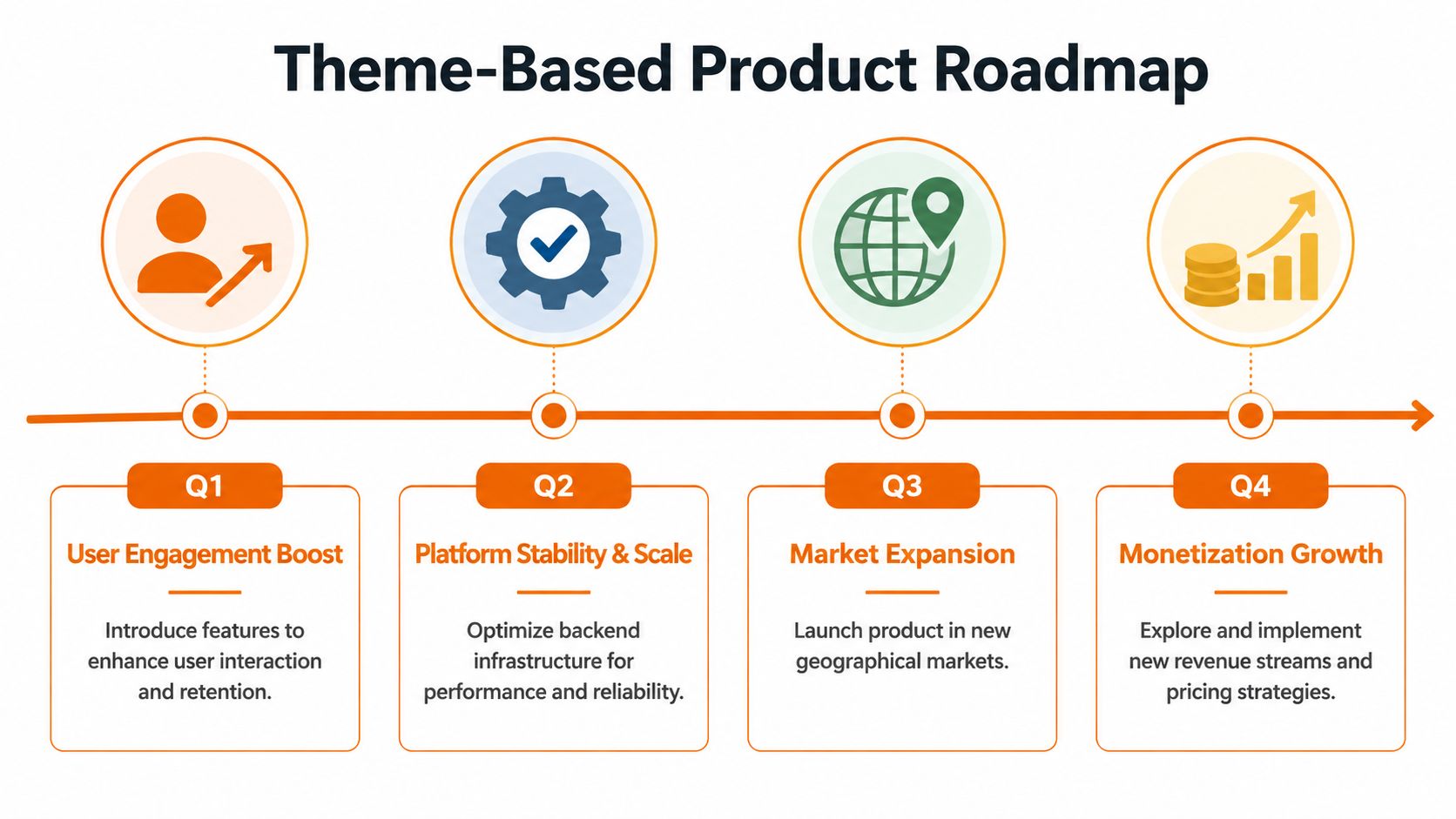
Map Your Milestones on a Theme-Based Roadmap
Feature roadmaps age badly. Theme-based roadmaps stay useful because they communicate intent without locking the team into brittle promises.
That's the format I recommend to most SaaS companies. It gives leadership clarity, protects delivery flexibility, and makes trade-offs visible. Your product development roadmap should show where the product is heading, why each milestone matters, and what has to be true before you move to the next stage.
Build around themes, not tickets
A strong theme captures a business priority and creates room for the team to solve it well. Good themes sound like strategic bets, not backlog items.
Examples:
- User onboarding that gets accounts to value faster
- Platform stability for larger customer workloads
- Expansion into a new buyer segment
- Monetisation improvements for existing usage
That format forces better conversations. Stakeholders discuss outcomes and trade-offs instead of fighting over isolated features.
What each milestone needs
Each roadmap milestone should include more than a label. Add the controls that make execution predictable.
Here's the minimum set:
Theme
The strategic focus for that period.Expected business movement
What should improve if the work succeeds.Go or no-go gate
What the team must learn or complete before expanding scope.Key dependency
The one thing most likely to slow progress.Quality checkpoint
QA, security, support readiness, or migration readiness.
A roadmap milestone without a decision gate is just a date with better branding.
Keep the format simple enough to use
I prefer a quarterly visual with a small number of themes. Boards and investors can read it quickly. Product and engineering can map detailed plans under it. Sales and customer teams can understand what's changing without being handed a flood of ticket-level noise.
A practical pattern looks like this:
| Quarter | Theme | Decision gate |
|---|---|---|
| Q1 | User engagement boost | Are users reaching first value cleanly? |
| Q2 | Platform stability and scale | Can the platform support growing demand confidently? |
| Q3 | Market expansion | Is the product ready for a new geography or segment? |
| Q4 | Monetisation growth | Are pricing and packaging supporting expansion? |
That's enough structure to align people. It's not so much detail that the roadmap becomes rigid.
Scale Your Platform with a Build-Operate-Transfer Model
A roadmap that gets you to MVP is only half the job. If the product gains traction, you need a credible path to scale delivery, absorb complexity, and reduce dependency risk. That's where Build-Operate-Transfer earns its place.
This matters even more for companies dealing with legacy platforms, platform rewrites, or multi-team growth. Recent data shows 42% of UK scale-ups struggle with legacy migrations and scaling delays, Polish R&D hubs grew 28% in SaaS deliveries to UK clients, and a roadmap designed for a BOT model can boost success by 35% by planning for handover, according to this Build-Operate-Transfer roadmap context.
BOT changes how you roadmap scale
Most scale-up roadmaps assume one of two futures. Either the original team keeps growing forever, or the company will “figure out structure later”. Both approaches create drag.
A BOT roadmap is more disciplined. It plans for three phases:
Build
Form the delivery team, establish practices, stabilise architecture, and create momentum.Operate
Run the product with clear KPIs, governance, documentation, and team rituals.Transfer
Hand over ownership, knowledge, operations, and management in a controlled way.
The handover doesn't happen by accident. It needs to be designed into the roadmap.
What to include early
If you want the option to transfer a team or capability later, put these items on the roadmap long before the handover date:
| Area | What to plan |
|---|---|
| Knowledge transfer | System documentation, pairing, and recorded decisions |
| Compliance | UK GDPR obligations and Polish employment realities |
| Operational readiness | Access control, support process, and incident ownership |
| Leadership continuity | Named owners for product, engineering, and delivery |
That's why I recommend reading a practical guide on the build-operate-transfer model if you're considering a Polish R&D capability. The model works well, but only when the transfer path is designed upfront.
The strategic payoff
BOT gives founders and CTOs a path from speed to control. You launch fast with an embedded team, operationalise the function, then take ownership when the timing is right for the business.
That's smarter than hiring in panic mode or locking yourself into a permanent outsourcing relationship that never evolves.
If your product development roadmap still looks like a feature dump with deadlines, fix it now. Build it around business outcomes, cut scope harder, execute with a team that owns delivery, and design for scale from the start. If you want a strategic partner to help shape that roadmap and execute it with senior nearshore teams in Poland, talk to Rite NRG.