You're probably living this right now. A release is queued, product wants it live today, engineering says the build is stable, and QA is staring at a test suite that's half useful and half noise. A flaky UI test fails for the wrong reason. A manual regression pass takes longer than planned. Then a real defect slips through anyway and blocks deployment at the worst possible moment.
That's not a tooling problem alone. It's a delivery problem.
Founders who treat quality as a late-stage checkpoint keep paying for the same pain twice. First in slower releases, then again in production risk. AI in quality assurance changes that when it's adopted with discipline. Done well, it doesn't just make testing faster. It gives you a tighter release loop, fewer surprises, and more confidence to ship when the market window is open.
That's the standard I'd push for as a delivery advisor. Not more test activity. Better business outcomes. Faster time-to-market, lower risk, clearer ownership, and a QA function that helps growth instead of slowing it down.
The End of Release Day Anxiety
Release day anxiety has a pattern. The team thinks they're close. Then one brittle automated check breaks because a selector changed. Someone reruns the pipeline. Someone else starts a manual check “just to be safe”. Slack fills up. Nobody knows whether the blocker is real, whether production is at risk, or whether the team is burning hours on false alarms.
That's the moment where weak QA shows itself. Not in a demo. Not in a sprint report. In the final mile, when speed and confidence should work together and don't.
A lot of SaaS teams still run quality like a safety net stitched together over time. Manual checks cover gaps. Legacy automation handles yesterday's workflows. New features land faster than the test suite can keep up. That model breaks as soon as release pressure rises.
Practical rule: If your team can't tell the difference between a flaky failure and a critical defect within minutes, your release process is already too expensive.
The shift is already underway. 77% of organisations are actively adopting AI in their quality engineering to deliver tangible quality outcomes, moving beyond technical output to focus on value-driven delivery according to Capgemini's quality engineering findings.
That matters because AI QA isn't about replacing judgment. It's about removing waste. It helps teams detect change, adapt tests, generate missing coverage, and surface risk earlier. In practice, that means fewer late-night release debates and more predictable delivery.
What founders should demand instead
A founder shouldn't accept “we ran the tests” as a quality strategy. Ask for a release system that does three things well:
- Flags real risk early: The team should know what's likely to break before a full regression cycle starts.
- Cuts maintenance drag: Engineers shouldn't spend their best hours fixing automation that broke because the product evolved.
- Protects delivery speed: QA should help teams ship more often with confidence, not create a ritual of delay.
That's the #riteway mindset in practice. Extreme Ownership. High energy. No passive waiting for defects to appear. Teams take control of quality before release day turns into damage control.
What AI in Quality Assurance Really Means
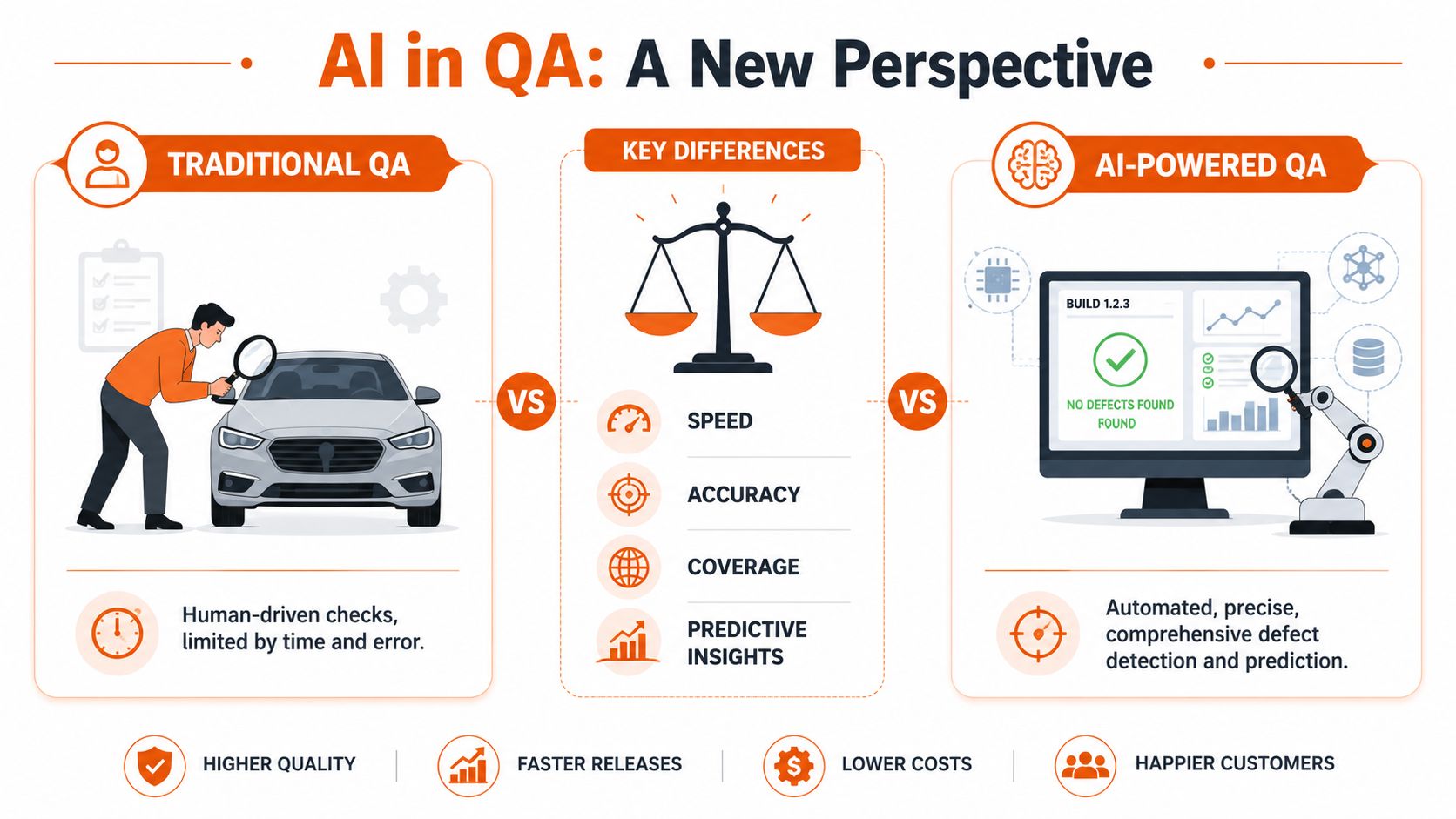
Traditional automation is like a rookie inspector with a checklist. It works hard, follows instructions, and catches what it was explicitly told to look for. The problem starts when the product changes. The checklist goes stale. The inspector keeps looking in the wrong places.
AI-powered QA behaves more like an experienced investigator. It spots patterns, notices what's missing, and adjusts when the application shifts.
The practical difference
When people hear AI in QA, they often imagine a black box that magically tests software. That's the wrong framing. The useful version is much simpler. AI adds intelligence to the parts of QA that usually waste time.
That includes:
- Intelligent test generation: AI can analyse code and identify untested areas, then generate missing tests to improve coverage.
- Self-healing automation: Instead of collapsing after minor UI or workflow changes, test suites can adapt with less manual repair.
- Pattern recognition: AI can identify where risk clusters, so teams focus effort where defects are more likely.
97% of companies report increased QA productivity after integrating AI, largely because it can analyse code for untested areas and automatically generate the missing tests, while self-healing platforms reduce the maintenance tax of automation suites, as outlined in DeviQA's industry analysis.
If you want a broader outside perspective on where this is heading, this piece on optimizing quality with AI solutions is worth reading because it frames AI as an operational quality lever, not just a tooling upgrade.
Traditional automation vs AI-powered QA
| Aspect | Traditional Automation | AI-Powered QA |
|---|---|---|
| Test creation | Engineers write and maintain explicit scripts | AI helps generate missing tests from code patterns and gaps |
| Maintenance | Breaks often after UI or workflow updates | Self-healing tools reduce constant script repair |
| Coverage | Limited to predefined paths | Expands coverage by analysing what hasn't been tested |
| Decision support | Reports failures | Helps teams prioritise likely risk areas |
| Team impact | QA spends time maintaining the system | QA spends more time validating business-critical behaviour |
What this means for the business
This is why I push founders to stop treating QA as a support function. Good AI QA reduces drag across delivery. It lowers the cost of maintaining automation, gives faster feedback to engineering, and makes release planning less political because the team has better evidence.
AI in quality assurance is an intelligence upgrade for delivery. Not just a speed upgrade for testing.
That distinction matters. Faster bad testing still creates bad releases. Smarter testing creates better decisions.
Powerful AI QA Use Cases That Drive Business Value
The strongest AI QA initiatives don't start with a platform demo. They start with a business bottleneck. A team can't keep regression stable. Customer support quality is inconsistent. Releases are slowed by test maintenance instead of actual validation.
That's where the wins show up.

Intelligent test generation that follows real product change
A growing SaaS product adds features every sprint. Product teams move quickly, but QA still relies on manually authored regression cases from months ago. Coverage looks decent on paper, but the suite doesn't reflect how the product is changing.
AI helps by identifying untested code paths and generating missing tests around current changes. That shortens the lag between feature delivery and quality coverage. For a founder, the gain is simple. New work becomes testable sooner, so release cadence stops depending on how quickly someone can handcraft more scripts.
A good companion read here is AI-driven software development and testing, especially if you're trying to connect engineering speed with quality discipline instead of treating them as separate tracks.
Self-healing automation that cuts maintenance drag
Another common scenario is the suite that “works” until the interface changes. A button label moves. A component gets refactored. Suddenly half the automation pack fails and engineers lose a day repairing tests that were supposed to save time.
Self-healing platforms such as Testim and Mabl are useful in this context because they reduce the maintenance burden in volatile codebases. The business outcome is bigger than fewer broken scripts. It's better use of senior engineering time. Your expensive people stay focused on product delivery, not constant suite repair.
If frontend speed and test resilience are both hurting release quality, this guide on how to optimize your full-stack app adds useful context because performance and quality issues often travel together.
AI in customer service quality assurance
Not every QA use case lives inside product code. Support quality matters just as much when your growth depends on retention and trust. In UK-based customer service QA, AI technologies using natural language processing and machine learning automatically analyse calls, emails, and chats to ensure support aligns with internal quality criteria, resulting in improved customer experience and operational efficiency, as described by Zendesk's overview of AI in quality assurance.
That matters for SaaS founders because support interactions are part of the product experience. If AI can help detect tone issues, policy gaps, or inconsistent resolution quality across channels, you're not just improving operations. You're protecting renewals and reputation.
A quick walkthrough of how teams are thinking about these capabilities in practice is useful here:
Predictive defect analysis that changes where teams focus
The most mature use case is predictive. Instead of testing everything with equal intensity, teams use AI to identify which changes carry the most risk. That changes sprint behaviour. QA focuses on business-critical paths. Developers get earlier warning on unstable areas. Product managers stop treating every release as an equal-risk event.
The best AI QA systems don't replace prioritisation. They make prioritisation sharper.
That's what drives business value. Less wasted effort. Faster feedback. Better release confidence where it matters most.
Defining Success with AI Driven QA Metrics
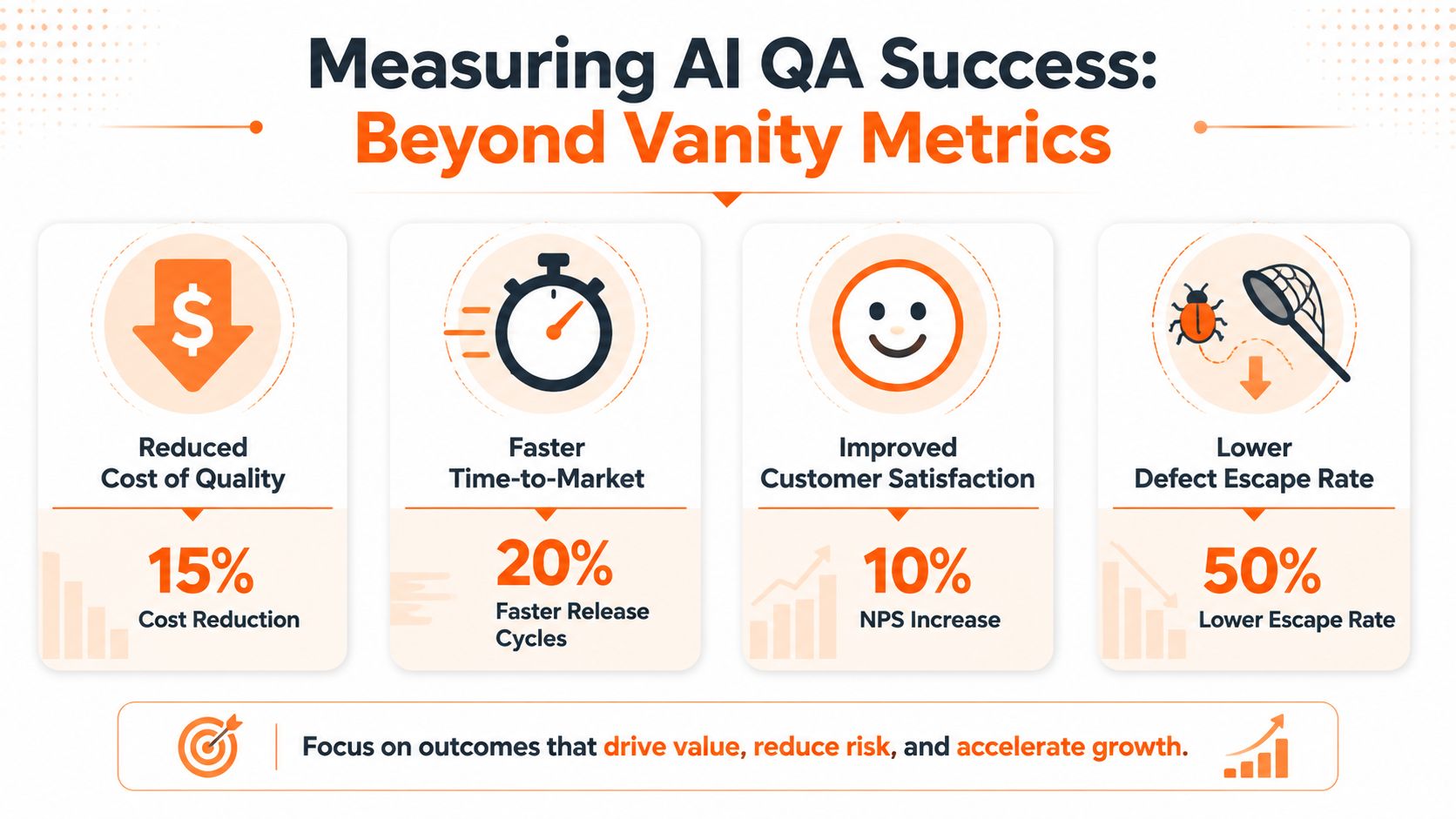
Most QA dashboards are noisy. They report activity, not value. Test counts go up. Execution numbers look healthy. Pipelines run. None of that tells a founder whether the team is releasing safer software faster.
The right metrics for AI in quality assurance sit much closer to business performance.
Stop reporting vanity metrics
“Number of tests executed” sounds useful until you realise a bloated suite can execute thousands of weak checks and still miss what matters. I'd rather see a lean system that finds meaningful defects early than a giant one that burns time proving nothing.
Track metrics that force the team to link QA work to delivery outcomes:
- Defect escape rate: How many important issues still reach production
- Test maintenance effort: How much engineering time is consumed keeping automation usable
- Mean time to resolution: How quickly teams identify and fix quality issues
- Cycle time: How fast work moves from development into a releasable state
These metrics create accountability. They also make investment decisions easier. If AI reduces maintenance effort and shortens cycle time, the value is visible beyond the QA team.
Use accuracy as a business measure
There's one number worth paying attention to because it connects quality capability directly to commercial impact. AI-powered quality assurance systems can increase model accuracy by up to 25%, which directly translates to measurable business outcomes such as reduced defect escape rates and improved customer satisfaction, according to the G-Cloud service listing on AI-powered quality assurance.
That's the framing leadership needs. Better quality isn't abstract. It affects trust, retention, support load, and how confidently the business can launch.
| Metric | Why leadership should care | What good AI QA improves |
|---|---|---|
| Defect escape rate | Production bugs damage trust and create support cost | Earlier detection and broader intelligent coverage |
| Maintenance effort | Senior engineers lose time fixing brittle tests | Self-healing automation and smarter suite upkeep |
| Resolution time | Slow fixes keep teams reactive | Better signals and faster issue targeting |
| Cycle time | Release delays slow growth | Faster validation and clearer go/no-go decisions |
Board-level lens: If your QA metrics don't connect to release speed, customer impact, or engineering efficiency, they won't influence strategy.
What to review every month
A practical operating rhythm works better than a giant quarterly quality review. Every month, leadership should ask:
- Are production defects trending down in critical workflows?
- Is the team spending less time maintaining tests?
- Are releases moving faster without more rollback risk?
- Is customer-facing quality becoming more predictable?
If those answers aren't improving, the AI layer isn't solving the right problem yet.
Navigating the Pitfalls of AI Implementation
There's too much lazy hype around AI QA. Tools can generate tests. Great. That doesn't mean those tests are valid, complete, or safe in a regulated environment.
Weak leadership becomes apparent when teams buy the promise of automation, skip governance, and only realise the gap when compliance or production incidents force a reckoning.
The risk most teams underestimate
AI-generated tests can look impressive and still miss critical edge cases. That matters everywhere, but it matters more in regulated UK sectors where a missed validation path isn't just a defect. It can become a compliance event.
The gap is real. There's still a lack of documented UK-specific data on how often AI-generated tests miss critical compliance scenarios in sectors like finance and healthcare. That means founders shouldn't assume coverage quality just because a tool generated more tests. They need review controls.
The warning sign is already visible. The UK's Financial Conduct Authority reported a 22% increase in algorithmic testing failures in 2025 related to AI-driven QA tools, as noted in this overview of 2025 quality management trends.
UK assurance requirements aren't optional
The UK has moved past broad discussion and into assurance expectations. The government's Introduction to AI assurance guidance makes clear that organisations need safety testing, conformity assessments, and bias audits to measure and mitigate harmful capabilities of frontier AI models.
That changes the operating model for teams building or using AI-assisted QA in serious environments. You need evidence. You need controls. You need a repeatable way to show that your system meets the required performance standard before it influences release decisions.
What responsible implementation looks like
I'd insist on a human-in-the-loop model for any business-critical or regulated workflow. Not because AI isn't useful. Because ownership still sits with the delivery team.
Use this baseline:
- Validate generated tests: Review AI-created test cases against business rules and compliance requirements before trusting them in release gates.
- Audit for bias and blind spots: Don't assume a model has seen the edge cases that matter in your domain.
- Separate critical paths: Treat payments, health data, identity workflows, and regulated reporting as higher-assurance areas with stricter validation.
- Document decisions: If AI influences test generation or release confidence, teams should be able to explain how and why.
If your AI QA process can't stand up to audit, it isn't production-ready for a regulated business.
That's Extreme Ownership applied to quality. No shortcuts. No pretending generated output is automatically trustworthy.
Your Step by Step Roadmap to AI Powered QA
Organizations often overcomplicate adoption. They try to transform everything at once, buy too many tools, and create more confusion than progress. The smart path is phased. Start where quality pain is highest, prove value quickly, then scale with control.
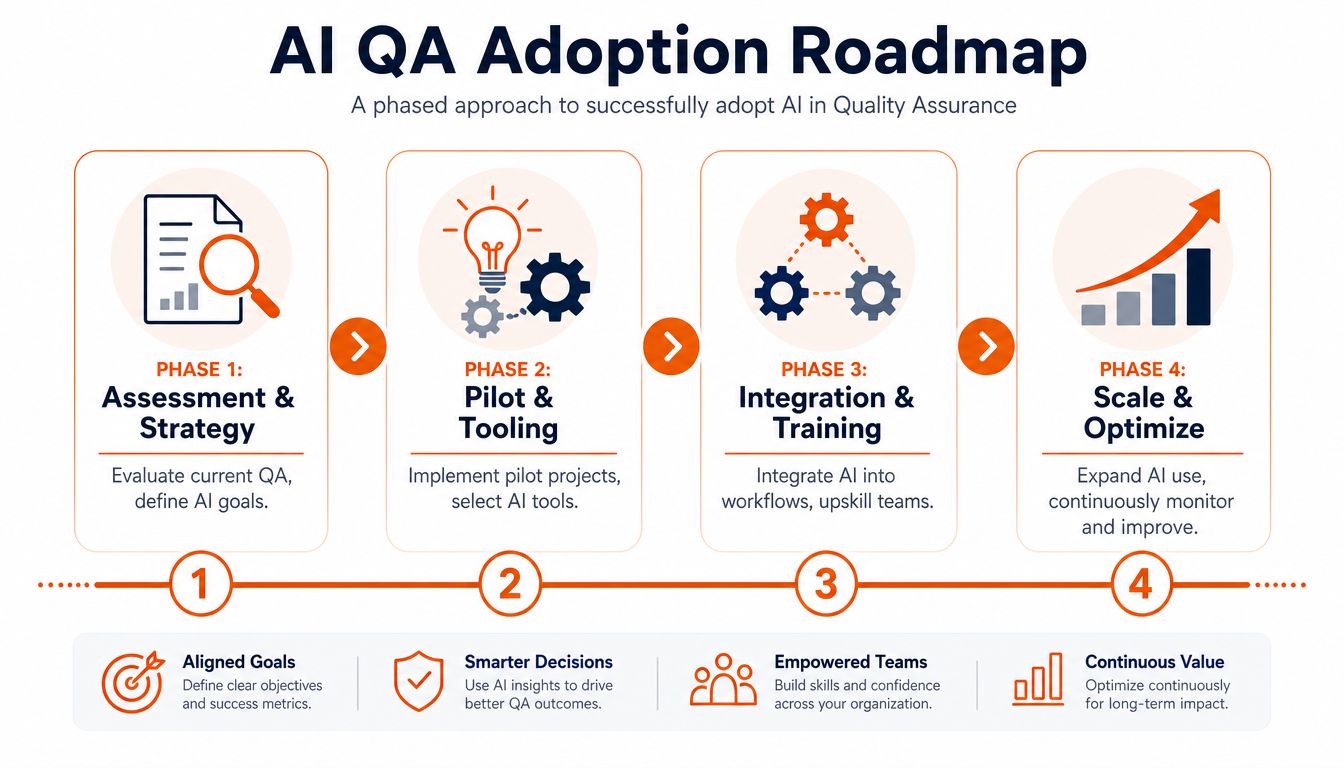
Phase 1 assessment and strategy
Start with a hard audit. Don't ask where AI could be interesting. Ask where QA is currently expensive, slow, or unreliable.
Look at your bottlenecks. Maybe regression testing blocks releases. Maybe your automation suite is brittle. Maybe support quality checks are too manual. Pick one pain point with clear business impact.
A strong first phase includes:
- Map current friction: Identify where release flow stalls, where rework happens, and where confidence breaks down.
- Choose one pilot: Intelligent test generation or self-healing automation are usually sensible entry points.
- Set success criteria: Define what improvement looks like before the pilot starts.
If your team needs a stronger baseline before introducing AI, this guide to quality assurance processes is useful because it helps separate process gaps from tooling gaps.
Phase 2 pilot and tooling
Now run a contained pilot with real delivery stakes. Not a lab exercise. Not a side experiment no one depends on.
Pick one product area, integrate one AI capability, and evaluate it against quality and delivery outcomes. If you're exploring custom automation workflows or agent-based support around QA operations, this primer on step-by-step AI agent creation can help your team think more clearly about where agents fit and where they don't.
This phase works when you keep scope tight:
- Select one workflow with visible release pain.
- Add one tool or capability, such as AI-assisted test generation.
- Run it in parallel with existing QA controls.
- Measure maintenance effort, coverage quality, and release confidence.
Phase 3 integration and training
Once the pilot proves useful, integrate it into daily delivery. That means CI/CD, team rituals, ownership rules, and review standards.
This is also where many efforts stall because teams treat AI as a specialist layer owned by one person. Don't do that. QA, engineering, and product all need to understand what the system does, what it can't do, and where human review is mandatory.
Focus here on:
- Workflow integration: Connect AI outputs to the release pipeline, not a disconnected dashboard.
- Team enablement: Train engineers and QA leads to review and improve AI-generated assets.
- Operating guardrails: Define which areas can use automation aggressively and which need extra validation.
Phase 4 scale and optimise
When the core motion is working, scale it. Expand from one team or product surface to the broader platform. Introduce predictive analysis. Improve post-release monitoring. Tighten feedback loops between defects, support signals, and test updates.
This is the point where AI in quality assurance becomes part of delivery culture rather than a bolt-on initiative.
Start small, but don't stay small. The win comes when quality intelligence shapes release decisions across the business.
A mature roadmap creates three outcomes. It makes quality more predictable, delivery more confident, and engineering time more productive.
Accelerate Your Journey with a Proactive Partner
The roadmap is clear. Execution is where companies struggle.
AI QA needs senior engineering judgment, delivery discipline, and the kind of ownership that keeps momentum high when the first pilot gets messy. Most internal teams are already balancing roadmap pressure, technical debt, and hiring gaps. Adding AI-enabled QA transformation on top often stretches them too far.
That's one reason a nearshore model makes sense for SaaS companies moving quickly in the UK. The average AI QA team size in UK enterprises is 8 members and top-tier talent commands salaries averaging £75,000 in London, according to Gitnux's AI quality assurance testing industry statistics. Building that capability from scratch isn't impossible. It's just slower and more expensive than most founders expect.
Why a proactive partner changes the outcome
A strong partner doesn't just provide engineers. They bring a delivery system. They know how to audit your current QA motion, identify the fastest safe pilot, integrate AI without derailing release flow, and keep governance tight when compliance matters.
That's where a nearshore model becomes an accelerator instead of a staffing workaround. Senior people can step into your workflows, move fast, and keep the focus on outcomes. Better release confidence. Lower maintenance drag. Faster path from backlog to production.
A credible AI delivery partner should help you:
- Reduce adoption risk: Put validation, review, and control mechanisms around AI-generated outputs
- Move faster with less chaos: Add capability without forcing a full process rewrite
- Keep ownership visible: Make responsibilities clear across engineering, QA, and product
- Scale without losing predictability: Build a repeatable model instead of a collection of isolated experiments
For companies that need deeper context on what a specialised partner should look like, artificial intelligence software development company expertise is a useful lens.
Speed without ownership creates defects. Ownership with the right team creates momentum.
That's the difference between buying tools and building a real AI QA capability. The right partner brings energy, structure, and follow-through. The #riteway is simple. Take ownership early, stay proactive, and make delivery predictable.
If you want to turn AI in quality assurance into faster releases and lower delivery risk, talk to Rite NRG. They help SaaS companies build and scale with senior nearshore teams, product-first delivery, and AI-powered processes that keep quality aligned with business outcomes.