Typing “software development company near me” into Google feels sensible. It also pushes many UK tech leaders towards the wrong shortlist.
If you're a founder, CTO, or product leader trying to ship faster, geography is a weak filter. Delivery capability is the primary filter. UK hiring pressure hasn't eased, and local availability often tells you less about execution than your procurement team wants to believe.
The companies worth your time don't feel close because they share your postcode. They feel close because they move at your speed, challenge weak assumptions, and take ownership when things get messy.
Stop Searching for a Software Development Company Near You
Most advice on finding a software development company near me is outdated. It assumes the safest choice is the team with the nearest office, the easiest train route, or the nicest boardroom for quarterly meetings.
That's lazy buying.
Recent UK labour data shows persistent software-talent pressure. The ONS reported that in 2025, computer-programming and related activities remained among sectors with high vacancy intensity, while the broader digital-skills shortage continued to constrain hiring and delivery capacity, as noted in this review of UK hiring pressure in software-related roles. The commercial question isn't “Who is nearest?” It's who can assemble a credible team quickly without sacrificing quality.
Local doesn't mean available
A nearby supplier can still be slow to staff, thin on seniority, or overloaded with too many clients. You don't buy software delivery to admire office proximity. You buy it to hit roadmap goals, reduce delivery risk, and get product into customers' hands.
If your internal team is blocked on recruitment, architecture debt, or release slippage, a local logo doesn't solve the problem.
Practical rule: Treat physical proximity as a bonus, not a decision criterion.
Search for operational closeness instead
The right partner should feel available during your working day, plugged into your priorities, and accountable for outcomes. That matters far more than whether they're ten minutes away.
If your wider leadership team is also comparing local service partners across operations, payroll, and workforce support, this resource for HR and finance leaders gives a useful parallel view of how “near me” decisions should be judged by operating fit, not just map location.
A software partner should do the same. They should shorten decisions, not just shorten travel.
Redefine Proximity for Business Impact
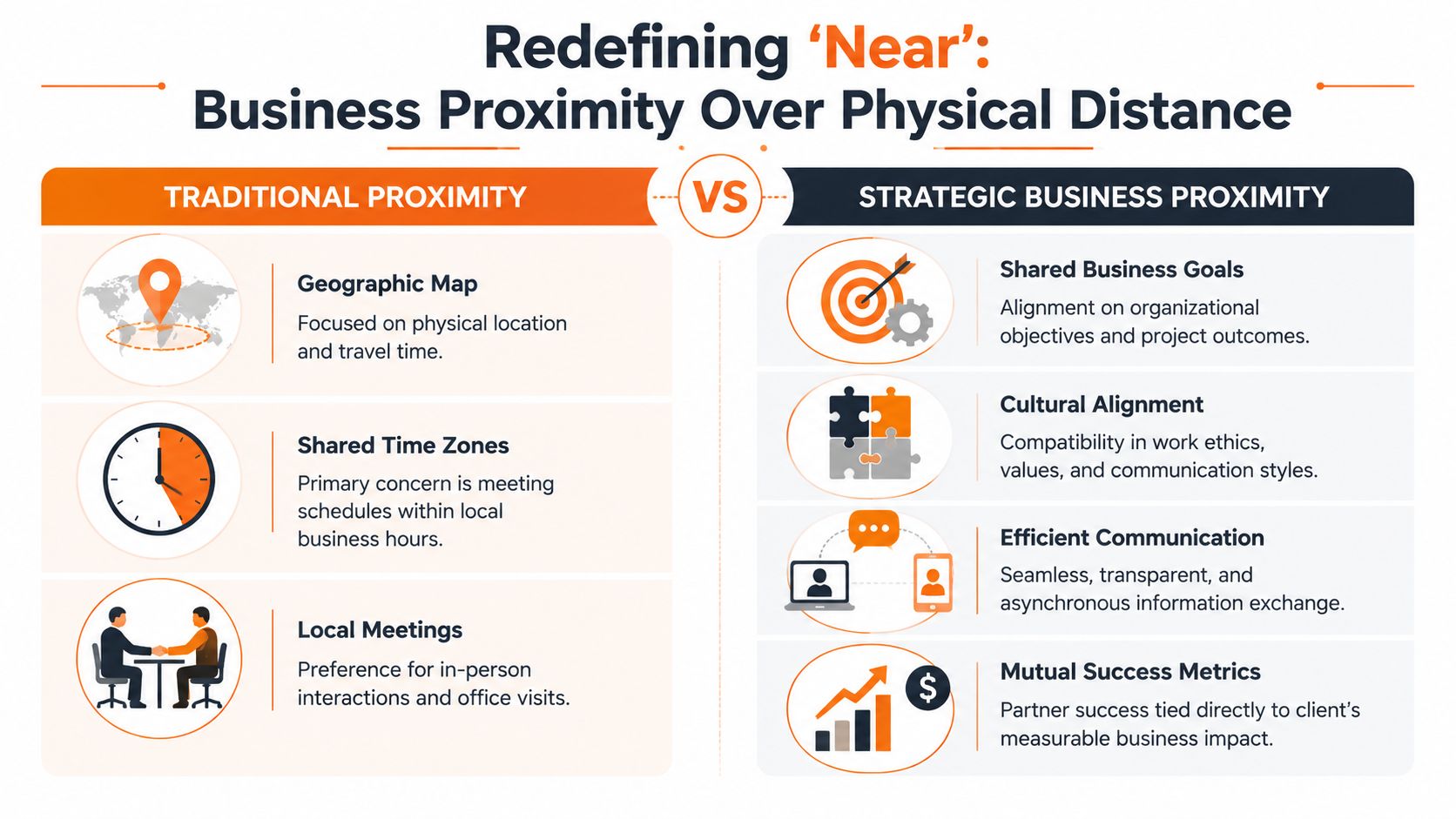
Proximity in software delivery should mean one thing. Business alignment with low friction.
That's the version of “near” that affects release cycles, product quality, and leadership confidence. For UK growth companies, this matters because the buyer pressure is real. According to the British Business Bank, the UK had around 35,000 scaleups in 2023, defined as businesses with 20%+ annual growth in employees or turnover for three consecutive years, as cited in this overview of UK scaleup demand and software delivery pressure. Those businesses don't need generic capacity. They need senior talent that keeps momentum.
Three ways to measure real proximity
Cultural alignment
Weak vendor relationships usually fail. If your partner waits to be told what to do, escalates too late, or hides uncertainty behind polished status updates, you'll feel distance immediately.
The opposite is what we call the Rite Way. Extreme Ownership. High energy. Proactivity. A team that says, “We spotted a delivery risk, here are the options, here's our recommendation, and here's what we've already started.”
That feels local because it reduces management drag.
Working-day overlap
You need collaboration inside UK business hours. Product reviews, backlog refinement, architectural decisions, and release planning all move faster when your partner is available when your team is working.
This is one reason many leadership teams now compare nearshore and offshore software delivery models through a business lens rather than a rate-card lens. Time-zone fit isn't cosmetic. It shapes how quickly issues get resolved and how often blockers die on the same day they appear.
Communication cadence
The best teams don't disappear between stand-ups. They create a rhythm that keeps product, engineering, and leadership aligned without flooding people with noise.
A partner should make you feel informed, not managed. Expect concise weekly reporting, direct access to decision-makers, and visibility into blockers before they become excuses.
What strategic proximity looks like
Use this quick comparison when evaluating any company that appears for software development company near me searches:
| Model | What it optimises for | What usually breaks |
|---|---|---|
| Local-only selection | Familiarity and in-person access | Slow staffing, narrow talent pool |
| Offshore-first selection | Cost compression | Communication lag, context loss |
| Nearshore strategic selection | Speed, collaboration, senior capacity | Requires disciplined partner vetting |
The partner that feels closest is the one that protects your roadmap without needing constant supervision.
That's the benchmark. Not office distance. Not postcode. Not whether someone can pop in for coffee.
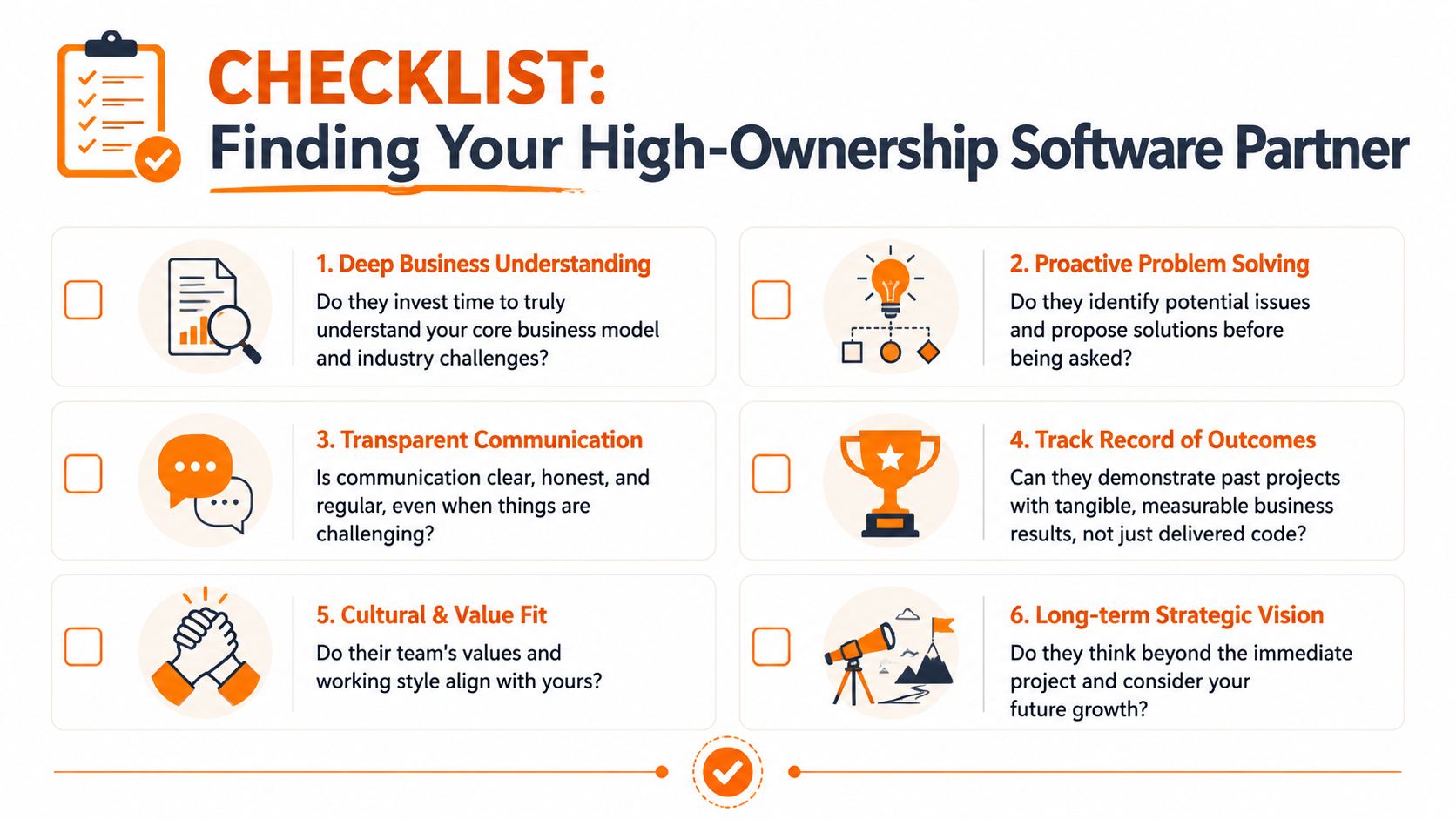
Your Due Diligence Checklist for a High-Ownership Partner
A polished portfolio proves almost nothing. Any vendor can show logos, screenshots, and a tidy process diagram.
What matters is whether they behave like owners when delivery gets uncomfortable.
A strong due-diligence process should also look beyond build cost. A robust ROI framework should measure not only build cost but also time-to-market, maintenance, and user adoption, and the most common pitfall is measuring only initial implementation cost, which underestimates total cost of ownership, as explained in this guide to measuring ROI in custom software development. Make every vendor document baseline values, target values, and a review cadence for each KPI.
Six checks that expose weak partners fast
Ask how they report bad news. If they talk about “keeping communication positive” or “managing expectations” without explaining escalation mechanics, be cautious. Good partners surface risk early and attach options to every problem.
Ask for an example of proactive intervention. You want to hear how they stopped a client making a poor technical or product decision. Order-taking is not consulting.
Ask how they integrate with your team. Scrum theatre isn't enough. You need specifics on ceremonies, tooling, code review habits, decision rights, and who owns release confidence.
Ask how they measure success after launch. If the answer stays inside velocity, output, or feature counts, they're still thinking like a coding shop.
Ask how they handle handovers and continuity. Strong partners reduce dependency risk. Weak ones raise it.
Ask who owns commercial outcomes. Not in a legal sense. In a behavioural sense. Who is responsible for keeping the engagement useful when priorities change?
One fast way to pressure-test capability
Use a realistic scenario. Don't ask abstract questions. Give them your actual context.
For example:
- Roadmap pressure: “We need to accelerate release plans without destabilising production.”
- Team gap: “We lack senior backend leadership for a critical workstream.”
- Legacy drag: “We have an inherited platform slowing new feature delivery.”
Then ask what they'd do in the first month, what they'd measure, what they'd challenge, and what they'd refuse to do.
If you're comparing flexible staffing approaches, this overview of how to hire a dedicated developer is a useful reference point for understanding where individual capacity helps and where you need a delivery system.
Later in your assessment, watch how they explain themselves under pressure.
A partner with ownership talks in decisions, trade-offs, and business consequences. A vendor without ownership talks in tasks.
Decoding Engagement Models That Accelerate Growth
Engagement models aren't procurement categories. They're operating choices.
Pick the wrong one and you'll create friction that no sprint ritual can fix. Pick the right one and you'll move faster with less executive babysitting.
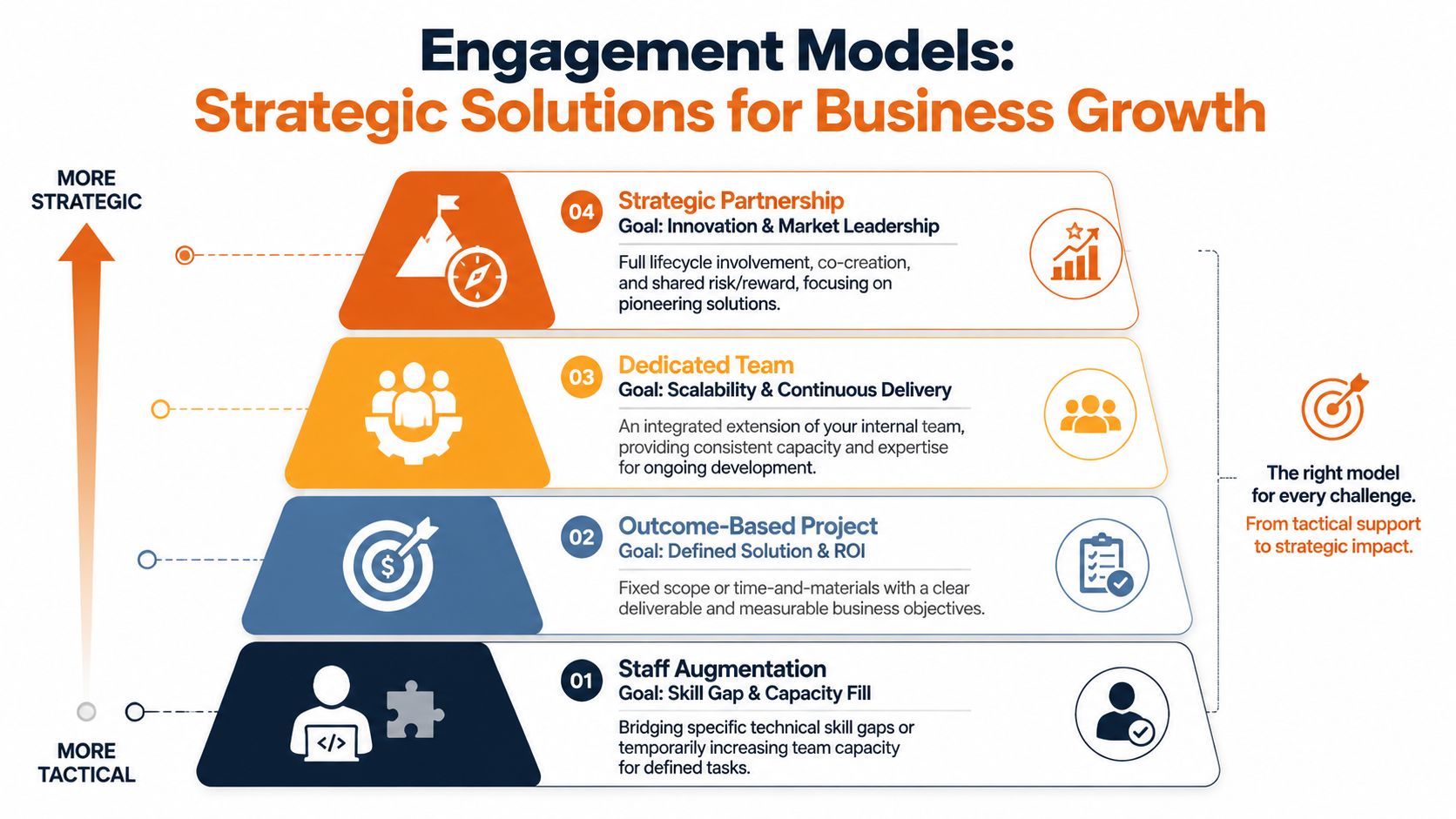
When you need capacity, choose the lightest model that works
Here's the practical view.
Staff augmentation
Choose this when you already have a strong internal engineering system and only need a specific skill gap filled.
It works well for narrow needs. A missing QA automation specialist. A senior React engineer. A DevOps bottleneck. It fails when leadership expects an individual contractor to solve team-level delivery issues.
Dedicated team
Choose this when your roadmap is healthy but underpowered. You need a team that plugs into your product rhythm and behaves like part of your organisation.
This is often the right answer for scale-ups with sustained product pressure. The model creates continuity, domain knowledge, and predictable throughput. Rite NRG offers this type of Dedicated Teams engagement for companies that need senior delivery capacity integrated into existing workflows.
Outcome-based project
Choose this when the business problem is defined and you need a partner to own delivery around a clear result. Think platform rebuilds, product launches, or major feature programmes with explicit milestones.
This model works when scope discipline is real. It breaks when leadership says “fixed outcome” while all the while changing the target every fortnight.
When you need a long-term capability, think beyond delivery
Some companies don't just need shipped software. They need a durable operating asset.
Build-Operate-Transfer
This is the right model when you want to establish a long-term team or R&D capability in a high-talent region without building the full operation from scratch on day one.
It gives you a path from external delivery to internal ownership. That's powerful when you need speed now and strategic control later.
Match the model to the business constraint
Use this decision grid:
| If your main problem is | Better fit |
|---|---|
| One missing capability in a strong team | Staff augmentation |
| Sustained roadmap pressure | Dedicated team |
| A defined build with clear commercial goals | Outcome-based project |
| Creating a long-term delivery centre | Build-Operate-Transfer |
Don't overbuy. Don't underbuy either. The smartest model is the one that removes your current bottleneck without creating a new one six months later.
Vetting for Culture and Capability With Killer Questions
Portfolios are easy to curate. Answers under pressure are harder to fake.
If you want a strategic partner rather than a polite code supplier, your interview process should expose mindset, not just technical breadth. Many buyers become lax at this point. They ask about stack experience, delivery methods, and rates. Then they act surprised when they hire a reactive team.
Ask questions that reveal ownership
Start with situations that force judgement.
- “Tell me about a time a project started slipping. What did you do before the client asked?”
- “Describe a moment when you pushed back on a client decision. Why did you do it, and what happened next?”
- “What's your process when engineers disagree with product priorities?”
- “How do you stop status reporting from becoming theatre?”
These questions matter because they reveal whether the partner defaults to compliance or leadership.
Good partners don't hide behind tickets. They interpret, challenge, and improve the plan.
Ask questions that reveal operating maturity
Now move from behaviour to delivery discipline.
Use prompts like:
- “How do you handle a weak handover from an incumbent supplier?”
- “What happens in your first two weeks on a new engagement?”
- “How do you make sure senior engineers stay close to decisions instead of disappearing behind account management?”
- “Which delivery signals tell you a sprint is healthy, and which ones tell you we're fooling ourselves?”
You're looking for detailed, practical answers. Tooling, rituals, escalation paths, and examples. Not polished generalities.
Ask AI questions that test governance, not hype
AI claims are cheap. Governance is harder.
In the UK, the FCA's September 2025 survey found that 85% of financial-services firms were already using AI, yet only 6% were “highly confident” in their ability to identify and manage AI-related risks, according to this summary of the UK AI confidence gap in financial services. That gap tells you exactly what to ask a software partner.
Ask this instead:
- “Where do you use AI in delivery, and where don't you?”
- “Who reviews AI-assisted outputs before they affect architecture, security, or production?”
- “How do you prevent speed gains from creating quality debt?”
- “Show me your controls for traceability, review, and accountability.”
A serious partner will answer with boundaries, review practices, and risk controls. A weak one will just tell you they're “AI-enabled”.
That's not enough. Not for a regulated environment. Not for a SaaS product customers depend on. Not for a leadership team that has to explain delivery decisions to investors or the board.
The KPIs That Guarantee Predictable Delivery
If a partner resists meaningful measurement, they don't want accountability. It's that simple.
Projects with explicit, measurable objectives are 30% more likely to be completed on time and within budget, and best practice is to define success metrics before kickoff and track engineering KPIs such as lead time, defect density, and test coverage, grouped into speed, effectiveness, quality, and impact, according to this analysis of results-driven software development metrics.
Measure the system, not just the activity
Too many software partnerships still revolve around effort reporting. Story points completed. Tickets closed. Hours burned.
That's weak management data.
A better operating view combines engineering signals with business consequences. If you want predictable delivery, insist on a KPI set that answers four questions:
| KPI area | What it tells you | Business meaning |
|---|---|---|
| Speed | How quickly work moves from idea to release | Time-to-market |
| Effectiveness | Whether the team is completing the right work | Delivery focus |
| Quality | Whether releases create avoidable issues | Stability and trust |
| Impact | Whether shipped work changes user or business outcomes | Commercial value |
The KPIs worth putting in front of leadership
Lead time
How long it takes for a change to move from development into production. If lead time is widening, your organisation is losing responsiveness.
Defect density
How many defects appear relative to the delivered software. This isn't just an engineering concern. It affects support load, customer trust, and release confidence.
Test coverage
Not as a vanity number. As a signal of whether the team is creating safe conditions for ongoing change.
Budget compliance
Delivery without financial discipline creates a different kind of failure. You need transparency on whether the current path still supports the original business case.
Release and incident pairing
Track release frequency next to incident rate. Faster shipping only matters if the platform stays reliable.
A mature partner should also be comfortable connecting these measures to wider operational frameworks. If your leadership team wants a broader view of process maturity and predictable delivery systems, this guide to the CMMI maturity model in software delivery is a useful reference.
Board-level test: If a KPI can't help you decide whether to speed up, slow down, or change direction, it's probably noise.
The best software development company near me result isn't the nearest supplier. It's the team that insists on transparent goals, measurable progress, and real ownership from kickoff to release.
Rite NRG works with SaaS companies and technology leaders that need senior nearshore delivery support, product-focused consulting, and integrated teams that operate with ownership. If you want a partner that treats speed, transparency, and business outcomes as paramount, explore Rite NRG.