
Your roadmap is slipping. Your internal team is overloaded. Hiring in the UK feels slow and expensive. Meanwhile, competitors are shipping faster, learning faster, and taking market share while you're still debating whether to build locally, outsource, or wait for the “right” senior hire to appear.
That's the nearshore vs offshore decision. It isn't a geography question. It's a speed, control, and value question.
If you run a SaaS business, you don't need more abstract outsourcing theory. You need a delivery model that helps you release product faster, make better decisions with less friction, and keep enough control to avoid expensive surprises. Cost matters. Of course it does. But if a cheaper model slows product decisions, adds management drag, or creates governance headaches, it can become the most expensive choice on the table.
The Growth Dilemma Every SaaS Leader Faces
A lot of founders and CTOs are making this decision under pressure. Revenue targets are moving. Investor expectations aren't getting softer. Product gaps are visible in every demo, every sales call, and every renewal conversation.
The old idea that distributed work is somehow unusual has already collapsed. The UK Office for National Statistics reported that in late 2022, 56% of working adults did at least some work from home, and 18% worked from home exclusively, compared with 5% working from home exclusively in 2019, according to the UK remote work shift referenced here. That changed how software teams operate. It normalised remote collaboration, but it didn't remove the difference between teams that can work together in real time and teams that mostly rely on delayed handoffs.
That's where many SaaS leaders get stuck. They know they don't need everyone in one office. But they also know that not all distributed models perform the same.
Practical rule: If your roadmap changes every sprint, your delivery model must support fast conversation, not just cheap execution.
Nearshore and offshore both solve capacity problems. They do not solve the same business problem.
Offshore is usually chosen when the strongest priority is rate reduction and the work can be handed over in clearly defined chunks. Nearshore is usually the better move when your business needs tight collaboration, fast feedback, and fewer delays between product, engineering, and leadership. If you're building a SaaS platform that's still evolving, that distinction matters more than is often acknowledged.
Redefining Your Sourcing Strategy Beyond the Map
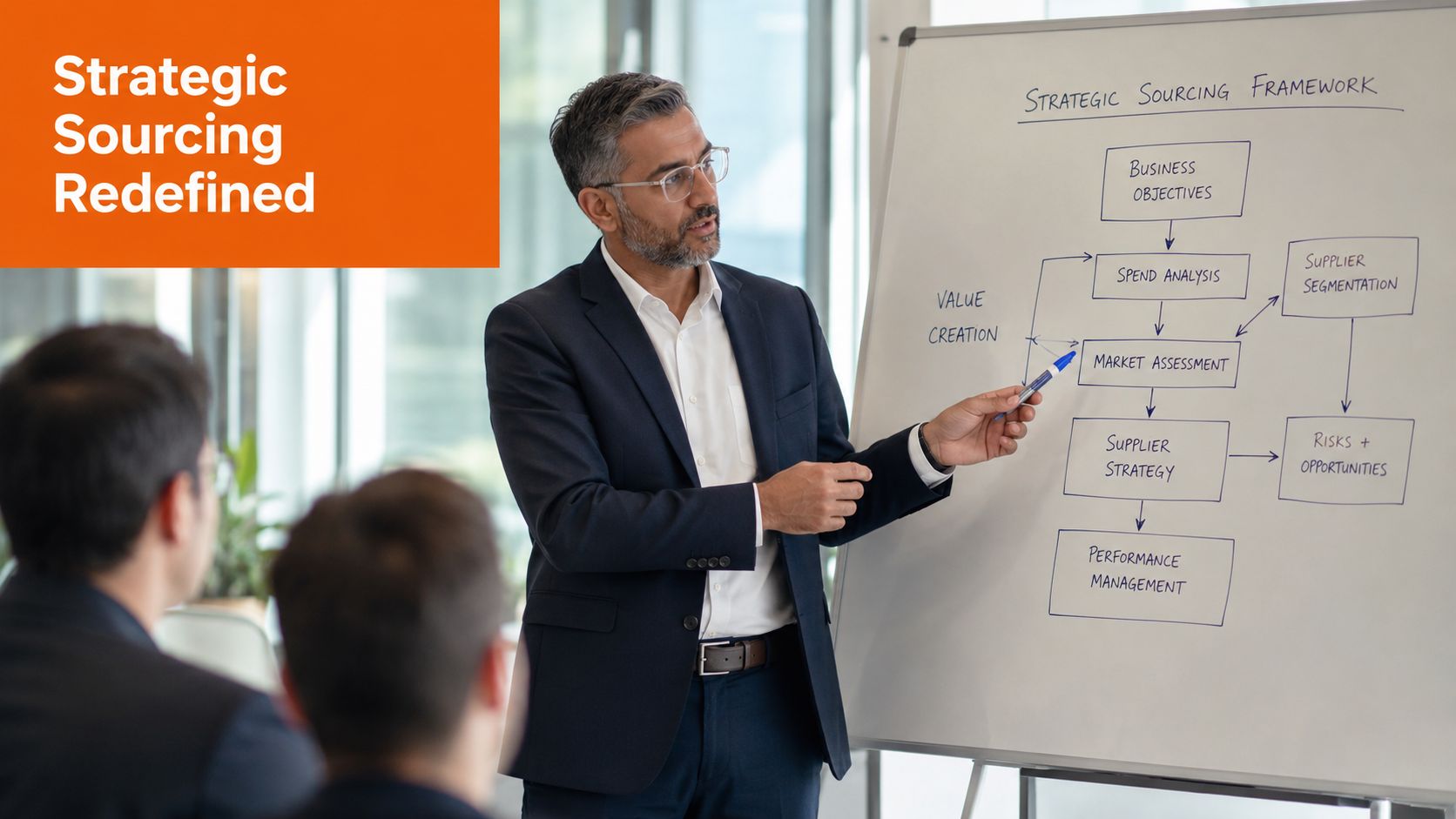
Most content about nearshore vs offshore gets the framing wrong. It treats the choice like a travel brochure. Close country versus far country. Similar culture versus different culture. Lower cost versus lower risk.
That's too shallow to be useful.
Nearshore and offshore are operating models
Offshore is an operating model built for deeper labour-cost arbitrage. It works best when the scope is stable, requirements are explicit, and the business can tolerate asynchronous delivery. You define the work carefully, create strong handoff discipline, and accept that speed comes from process structure rather than constant collaboration.
Nearshore is an operating model built for collaboration. It fits product environments where priorities move, stakeholders need direct access to delivery teams, and decisions can't wait a day for the next overlap window.
The UK market already shows that businesses aren't thinking only in offshore terms. According to the UK government's 2023 Supplier Management and Outsourcing Survey, 54% of organisations use outsourcing, but only 31% use offshoring specifically, as noted in this summary of the UK outsourcing survey. That matters because it suggests companies are actively choosing delivery models for reasons beyond raw labour savings.
Stop asking where and start asking how
If you're assessing partners, ask operational questions first:
- How often will product decisions change? If the answer is “weekly”, you need real-time interaction.
- How complete are your specs? If they're rough and evolving, offshore friction rises quickly.
- Who owns delivery quality? A transactional vendor waits for instructions. A strategic partner spots risk early and acts on it.
- How much management bandwidth do you have? Most SaaS teams overestimate this.
If you want a deeper view on the practical mechanics of scaling with external teams, this guide on outsourcing software development is useful because it frames sourcing around delivery outcomes, not procurement categories.
The right sourcing model should feel like an extension of your operating rhythm, not a workaround for hiring pain.
A Practical Comparison of Core Business Trade-Offs
Your roadmap slips for one simple reason. The team building it cannot make decisions at the speed your business needs.
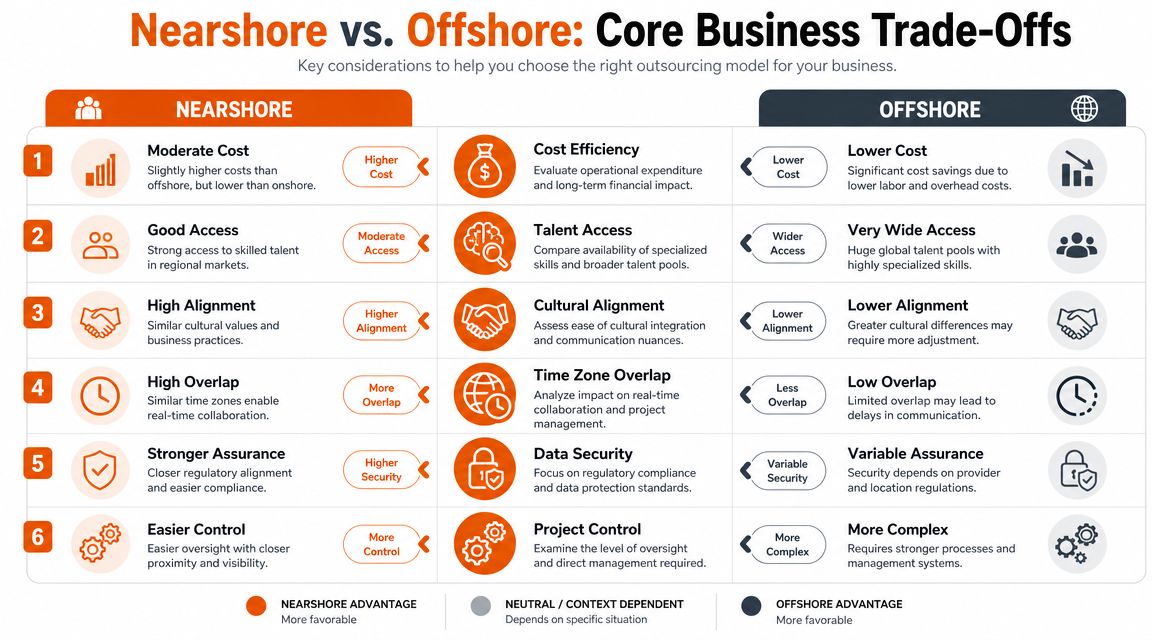
That is the true nearshore versus offshore choice for a SaaS founder. It is not a geography decision first. It is a decision about how much speed you need, how much control you want, and how much management drag you can tolerate while the product is still changing.
| Factor | Nearshore (e.g., Poland) | Offshore (e.g., Southeast Asia) |
|---|---|---|
| Cost profile | Moderate savings with lower coordination friction | Deeper direct-rate savings |
| Collaboration style | High real-time interaction | More asynchronous handoffs |
| Sprint velocity | Better suited to changing priorities | Better suited to stable, well-defined work |
| Management overhead | Lower in many Agile setups | Higher when teams need frequent alignment |
| Quality control | Easier day-to-day oversight | Stronger dependence on process and documentation |
| Communication rhythm | Faster issue resolution during shared working hours | Slower feedback across larger time gaps |
| Governance burden | Often simpler for UK firms working within Europe | Can require more legal and operational effort |
| Best fit | Product-led SaaS teams that need speed and control | Cost-sensitive delivery with modular scope |
Cheap rates do not guarantee cheap delivery
If you compare day rates alone, offshore usually looks stronger. Enshored outlines that gap clearly in its comparison of nearshore and offshore cost ranges.
That view is too narrow for a scaling SaaS business.
You are not buying hours. You are buying release speed, product learning, engineering judgment, and management confidence. A lower rate loses its appeal fast if your product team spends extra time writing detailed tickets, repeating context, chasing updates, and correcting work after the fact.
That is why nearshore often produces better value even when the invoice is higher.
Speed comes from decision cycles
Nearshore works best when your roadmap changes every week, your customer feedback loops are active, and your founders still want a hand in product decisions. Shared working hours shorten the distance between problem and answer. Designers can clarify flows quickly. Engineers can challenge assumptions before they become rework. Product leaders can reset priorities inside the same day.
Offshore can still work well. But it rewards a different operating model. You need cleaner specifications, tighter acceptance criteria, stronger delivery management, and work that can move through planned handoffs without constant clarification.
That is a trade-off, not a flaw.
Control depends on operating rhythm
Founders often describe nearshore teams as easier to manage. The location helps, but the bigger factor is rhythm. More overlap creates a tighter control loop. You can review progress sooner, resolve ambiguity faster, and spot delivery risk before it turns into missed milestones.
Offshore teams need more structure to produce the same level of control. If your internal team is already stretched, that extra coordination cost lands on your most expensive people.
Security discipline belongs in this calculation too. If you are assessing delivery partners, use an IT security audit checklist for external engineering teams before you sign, not after a release goes sideways.
Ownership beats order-taking
The biggest sourcing mistake is choosing by region and ignoring delivery behaviour.
A transactional vendor waits for instructions. A strong partner takes ownership of outcomes, raises risk early, questions weak assumptions, and protects momentum when requirements are still evolving. That model matters more in nearshore because you can use the access. It matters more in offshore because you need someone to reduce handoff failure before it spreads.
This is the difference between outsourced capacity and delivery leadership.
Which model should a SaaS founder choose?
Choose nearshore if speed, tighter collaboration, and direct control affect growth. That is usually the right call for product-led SaaS companies still refining positioning, onboarding, integrations, pricing, or customer workflows.
Choose offshore if cost reduction is the main target and the work can be broken into stable, well-documented units with limited daily decision-making.
My recommendation is simple. If your product is still moving, optimise for speed and control first. Cost follows delivery quality far more often than founders expect.
Navigating Risk Security and UK Compliance
A lot of sourcing decisions fall apart here. Not in the sprint plan. Not in the stand-up. In governance.

Governance burden is part of delivery cost
UK firms can't treat delivery location as a neutral detail when personal data, customer workflows, or sensitive platform logic are involved. UK ICO guidance on international data transfers under UK GDPR requires a lawful mechanism and risk assessment, which means offshore delivery can add legal and operational work, as outlined in this overview of nearshore, offshore, and onshore governance considerations.
That changes the core comparison.
A cheaper engineering model can become slower and heavier once legal review, transfer assessments, security approvals, and audit expectations enter the picture. For SaaS businesses, especially those selling into regulated customers, governance burden isn't back-office admin. It affects sales confidence, procurement speed, and operational resilience.
What to check before you sign
Don't stop at “we take security seriously”. That phrase means nothing without delivery evidence.
Ask for clarity on:
- Data handling practices: Who can access what, under which controls, and with what approvals?
- Audit support: Can the partner document workflows, permissions, environments, and decision trails?
- IP protection: How are repositories, credentials, and asset ownership managed?
- Incident response: If something goes wrong, who owns communication, containment, and remediation?
If you're reviewing your own risk posture before adding an external team, this guide to an information technology security audit is a practical place to start.
Governance isn't a legal checkbox. It's part of your delivery system.
Nearshore often reduces friction, not responsibility
Working with a nearshore team in Europe can simplify parts of the compliance picture for UK businesses, but don't confuse simpler with automatic. You still need diligence, clear contracts, and operational discipline.
The point is narrower and more useful than that. If two teams can deliver similar engineering quality, the one that creates less governance drag usually gives you more room to move. For a SaaS company scaling under pressure, that matters.
How to Scale Your Engineering Team the #riteway
Most outsourcing failures start long before delivery. They start in hiring.
A company says it needs five engineers. A vendor sends CVs. Skills look acceptable. Interviews happen. Work begins. Three months later, nobody trusts the estimates, the team waits for instructions, and leadership is spending too much time managing people who were supposed to reduce management load.
That's a sourcing mistake, not a bad sprint.
Hire for ownership, not just availability
The #riteway approach starts with a hard truth. A strong software team isn't a spreadsheet of matching keywords. It's a group of people who bring judgment, pace, accountability, and the confidence to flag problems early.
That means screening for more than technical competence. You want people who:
- Take initiative: They don't park blockers in silence.
- Communicate commercially: They understand why a delayed feature affects sales, churn, or investment readiness.
- Handle ambiguity: They can move forward without requiring every answer in advance.
- Work with energy: They raise the pace of the team instead of draining it.
For leaders building remote and distributed teams, Madeira Remote's team guide is worth reading because it focuses on management habits that keep distributed delivery aligned once the team is in place.
Delivery should feel proactive from week one
A proper scaling model does three things well.
First, it finds senior people who can integrate into your actual product environment, not just write code in isolation.
Second, it creates operating clarity. Roles, rituals, escalation paths, and decision ownership have to be explicit.
Third, it keeps future options open. Some SaaS businesses need a dedicated embedded team. Others want a path to building their own R&D capability over time through a Build-Operate-Transfer model in Poland.
If you're evaluating formats for scaling engineering capacity without building everything internally, this guide to a dedicated software development team lays out the practical model.
The #riteway in practice
This methodology is simple to describe and hard to fake:
Extreme Ownership
The team owns outcomes, not activity. Risks get surfaced early. Excuses get replaced with action.High energy delivery
Momentum matters. Fast response, active collaboration, and visible follow-through change the pace of execution.Proactive advisory
Good partners don't wait to be managed. They challenge weak assumptions, improve process, and help leadership make better decisions.
That's how you build a team that supports growth instead of becoming another layer to manage.
The Rite NRG Model Predictable Delivery in Action
Monday starts with a familiar problem. A UK SaaS leadership team inherits a weak vendor handover, the backlog is unreliable, key product knowledge sits with too few people, and no one trusts the delivery plan. Every missed detail turns into another delay. Every delay chips away at confidence.
The right response is to restore control fast.
Speed comes from working in the same operating window
Nearshore delivery works best when your product team needs constant decisions, fast clarification, and same-day problem solving. For UK SaaS companies, that usually means a European team can join stand-ups, challenge unclear requirements, resolve blockers, and ship updates while stakeholders are still online.
That changes the economics of delivery.
Offshore can still reduce day rates. It often slows decision-making when your roadmap is fluid and your team depends on rapid feedback. If your product changes weekly, long time-zone gaps create drag. Questions wait. Reviews slip. Rework grows.
A Poland-based team keeps momentum high because the conversations that shape delivery happen in real time, not a day later.
Control comes from ownership, not headcount
Rite NRG is one nearshore model built around that principle. The setup focuses on senior engineers in Poland, close product collaboration, and AI-supported delivery processes that expose risk early and make progress easier to track.
That model improves delivery because it fixes the failure points that usually derail outsourced teams:
- Transitions stabilise sooner. Knowledge gaps get identified and closed before they become missed commitments.
- Decisions happen faster. Product and engineering resolve ambiguity in working hours, not through overnight back-and-forth.
- Leadership gets clear visibility. Risks, blockers, and delivery trade-offs surface early enough to act on them.
A strong partner reduces uncertainty. Status reports alone do not.
Nearshore will not rescue a weak product strategy or absent leadership. It will give a capable SaaS business a faster, more controlled way to execute. If your priority is shipping with confidence, not just buying cheaper capacity, this is the model to choose.
Your Final Decision Checklist for SaaS Leaders
If you're choosing between nearshore and offshore, don't ask which model is cheaper. Ask which model helps your business move with fewer compromises.
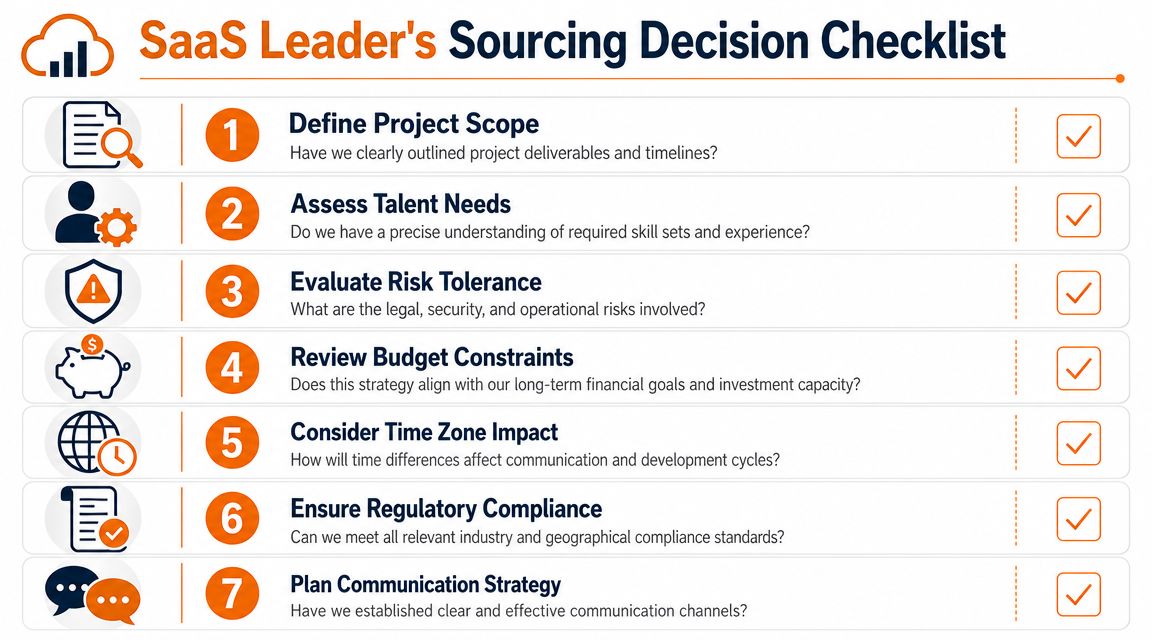
Ask these questions before you commit
Is your roadmap fixed or fluid?
Fluid roadmaps favour nearshore because they need faster feedback and shared context.How much management overhead can your leadership team absorb?
If your CTO or product lead is already stretched, don't choose a model that requires heavy handholding.Can your work be cleanly specified in advance?
Offshore performs better when the answer is yes.How expensive is delay for your business?
If slower release cycles affect revenue, fundraising, onboarding, or renewals, speed matters more than headline rate savings.What's your real risk tolerance?
Consider legal review, data handling, audit expectations, and customer trust.Do you need a supplier or a delivery partner?
A supplier follows instructions. A delivery partner improves the outcome.Are you building temporary capacity or a long-term capability?
That answer should shape team structure, governance, and knowledge ownership from day one.
The recommendation
Choose nearshore if you need speed, active collaboration, stronger control, and a team that can think with you.
Choose offshore if your scope is stable, your process is mature, and your priority is maximum direct cost reduction.
If you're a SaaS founder or CTO with an ambitious roadmap, nearshore is usually the stronger decision. Not because it's fashionable. Because it gives you a better operating system for growth.
If you want to pressure-test your sourcing model before you commit, talk to Rite NRG. The useful conversation isn't “how many developers do we need?” It's “what delivery setup gets this roadmap shipped with the right balance of speed, control, and value?”