Successful software development for startups is about one thing: driving real, measurable business outcomes. It’s not just about writing clean code or hitting technical milestones. It's the strategic engine that helps you grab market share, validate your business model, and secure critical investment.
Every single technical decision must directly support a commercial goal. True success isn’t a fancy tech stack; it's a product that solves a real problem, creates loyal users, and generates revenue. It's about turning your vision into a viable, valuable business.
Why Your Approach to Software Defines Your Success
For a startup, software isn't just a part of the business—it is the business. Misalign your tech strategy with your business goals, and you're building a fast track to failure. It's a classic trap: treating your development team like a feature factory, churning out code without a clear connection to market demand. This approach is a guaranteed way to burn cash and miss out on crucial user feedback.
It's time for a different, more energetic way of thinking. Your development partner shouldn’t be a passive order-taker. They must be a proactive, strategic consultant who challenges assumptions, provides expert technology advisory, and takes Extreme Ownership of the results. This is the heart of our #riteway Methodology—a high-energy framework built on proactivity and an obsessive focus on delivering business value.
This consulting mindset changes everything:
- Focus on Value: The question isn't "Can we build this?" It’s "What business outcome will building this drive, and is it the most valuable thing we can do right now?"
- Speed to Learning: The goal is to get a working product into users' hands as quickly as humanly possible to learn what truly works and what doesn't.
- Strategic Partnership: Your team becomes a core part of your strategic engine, offering technology and delivery advisory because they are genuinely invested in your commercial success.
And let's be honest, the startup world is more competitive than ever. The UK tech scene is buzzing, with renewed confidence fuelling the digital economy. In a climate where the UK software market's impressive growth creates fierce competition, a slow or unfocused development process isn't just a weakness; it's a fatal flaw.
The right team is more than just a list of skills. They are your strategic co-pilots on the journey to market-fit, accountable for the business impact of every line of code.
By putting business outcomes first, you stop seeing software development as a cost centre and start leveraging it as your most powerful tool for growth. This guide will show you exactly how.
For a real-world example, see how we translated this approach into measurable success when scaling a media startup to an investor-ready platform.
How to Drive Market Entry With The MVP Mindset
Let's clear something up. A Minimum Viable Product (MVP) is not a cheap, half-baked version of your final product. For a modern startup, the MVP is your single most powerful learning tool—a strategic experiment designed to answer one critical business question: "Does this solve a big enough problem that people will pay for it?"
This "product-first" mindset demands ruthless prioritisation. Instead of getting lost in a jungle of 'nice-to-have' features, you pour all your energy into building the leanest possible solution to your target user's biggest headache. This is how you deliver immediate value.
From Feature-Led to Product-First
Many startups fall into the feature-led trap. They measure success by the number of features shipped, ending up with a bloated, confusing product that doesn't solve any single problem well. This is a direct path to burning your runway on things nobody wants.
A product-first approach flips that on its head. It’s about building the absolute simplest thing you can to validate your core hypothesis with real users. If your vision is a car, you don't start by building a wheel. You start with a skateboard to prove people want a faster way to get from A to B.
A strategic MVP isn’t about building less; it’s about learning more, faster. It’s the shortest path from an idea to market validation, proving your concept with hard data and de-risking your investment.
This sharp focus gets you to market with incredible speed, allowing you to gather genuine user feedback while competitors are still on the drawing board. If you're curious about just how fast this can be, check out our guide on how to build an MVP in just two weeks.
The Business Value of a True MVP
Embracing the MVP mindset is a core business strategy, not just a development tactic. It ensures every pound spent and every line of code written is aimed squarely at achieving product-market fit. This focused process builds momentum and creates genuine confidence with your first users and potential investors.
Here’s the measurable business value a properly executed MVP delivers:
- De-risked Investment: You prove market demand before sinking a fortune into a full-scale build.
- Faster Time-to-Market: Get your solution into users' hands quickly, capturing first-mover advantage.
- Data-Driven Decisions: Your next moves are guided by what users actually do, not what you think they'll do.
- Secured Early Adopters: You create a loyal following by solving their most pressing problem first.
Ultimately, a product-first MVP is the heartbeat of a high-energy, proactive development culture. It’s about taking ownership of the business result, not just ticking off technical tasks. By obsessing over learning and validation, you build the foundation for real, sustainable growth.
Choosing Your Development Team Is Your Most Critical Decision
Let's be blunt. Your first major investment isn't in marketing or office space—it's in the engineering team that will bring your vision to life. This single decision will define your speed, your culture, and your ability to pivot when the market throws you a curveball.
This isn’t just about finding people who can code. It's about finding a strategic partner who shares your "can-do" attitude and takes Extreme Ownership of your business outcomes.
Too many founders get lost comparing team models. The choice becomes clear when you focus on what truly moves the needle: energy, accountability, and a relentless obsession with delivering value. Your team's mindset is infinitely more important than their location.
The Strategic Balance of a Dedicated Partner
Startups are often stuck between a rock and a hard place. Do you burn cash and time building an in-house team from scratch? Or do you hire a traditional agency that treats you like just another ticket in their system?
There’s a third way that delivers the best of both worlds: a dedicated nearshore partner.
This model is a game-changer. You get the deep integration and shared purpose of an in-house team, with the speed, flexibility, and cost-efficiency of an external one. This is the essence of The #riteway Methodology. We don’t just work for you; we operate as you. Your success is our success. We're not a line item on your budget; we're a proactive force obsessed with your commercial wins, providing strategic advice on technology and delivery.
The right development partner acts as a seamless extension of your core team. They challenge assumptions, offer strategic guidance, and measure their success by your market traction—not by the number of tasks completed.
Making the right choice from day one is critical. This flowchart perfectly captures the fork in the road between a value-destroying, feature-led approach and a value-creating, product-first strategy.
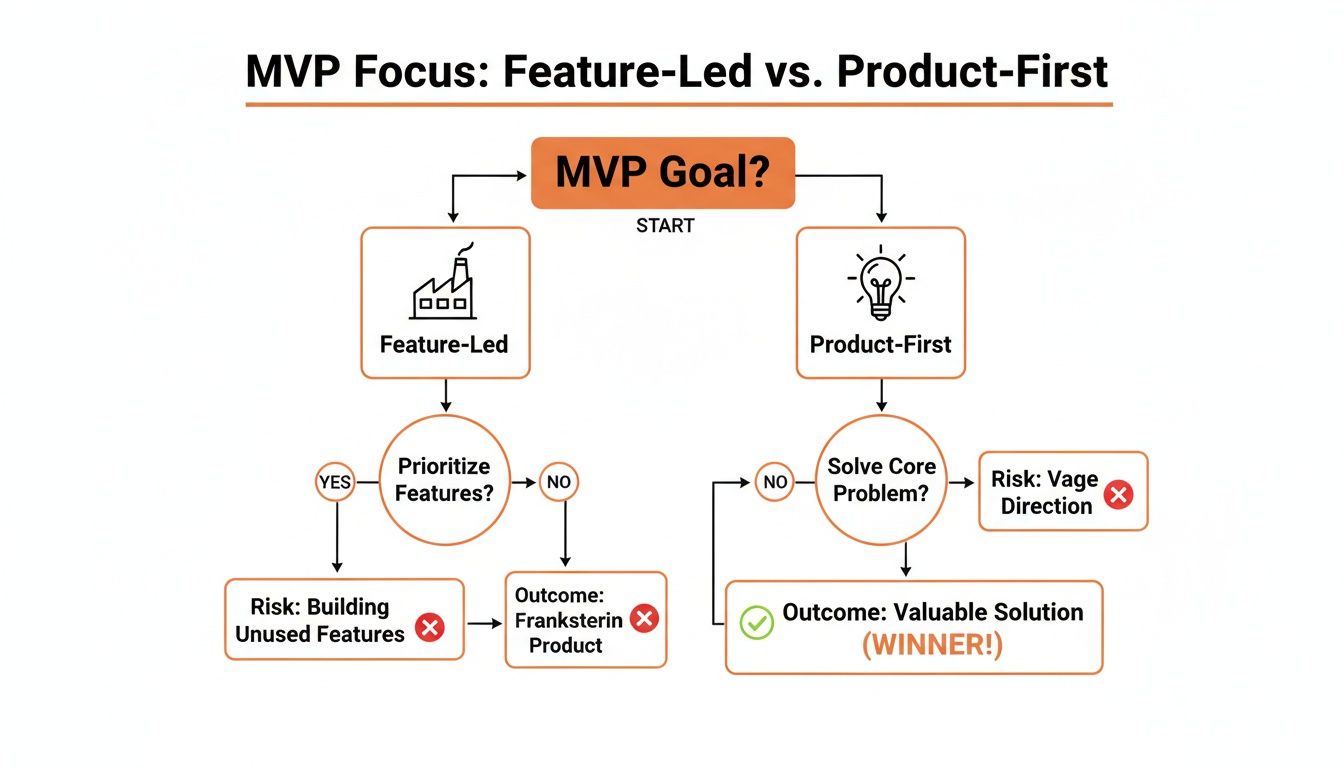
As you can see, a product-first focus leads directly to what your business needs most: market validation and real user feedback. The alternative is a fast track to burning cash on features nobody values.
Startup Team Models: A Business Outcome Comparison
Let's cut through the noise and evaluate team models based on the metrics that matter to a founder. The goal is simple: maximise your runway and get to product-market fit faster than anyone else.
A dedicated partner gives you a powerful edge. For example, we've helped companies by scaling a team of 34 engineers in just four months—a pace that’s almost impossible with traditional in-house hiring.
Here's how the different approaches stack up on key business outcomes:
| Model | Time to Productivity | Cost Efficiency | Scalability | Strategic Control | Best For |
|---|---|---|---|---|---|
| In-House | Very Slow (3-6+ months) | Low (High salaries & overheads) | Slow & Difficult | High | Core IP & long-term stability |
| Agency | Fast (Weeks) | Medium (High hourly rates) | Medium | Low | Short-term projects, non-core tasks |
| Freelancers | Very Fast (Days) | High (For specific tasks) | Very Low | Very Low | Small, isolated tasks |
| Dedicated Partner | Very Fast (1-2 weeks) | High (Lower overheads) | Very High | High | Rapid MVP delivery & long-term growth |
Ultimately, your choice here is a strategic one that will shape your startup's journey. Picking the model that aligns with your need for speed, control, and smart capital allocation is paramount to winning.
Building a Tech Stack That Enables Growth

Choosing your technology isn't a purely technical exercise; it's a critical business decision. It dictates your speed to market, your ability to scale, and your access to talent. It's easy to be seduced by the latest tech trend, but the smartest software development for startups resists that temptation in favour of what delivers business value.
A great development partner, acting as a technology consultant, won't just ask what you want to build; they'll advise you on the tools that get you to your business goals fastest. The magic lies in three things: speed, scalability, and talent access. A practical, battle-tested tech stack is your secret weapon for lapping the competition.
From Rigid Marble to Flexible LEGOs
Imagine building your product. You could carve it from a single block of marble. It would be beautiful but rigid, expensive, and a nightmare to change based on user feedback.
Or, you could build it with LEGO bricks. Modular, adaptable, and easy to reconfigure as you learn from the market. Which one sounds more like a startup?
This LEGO-brick mindset is a survival tactic. It means leveraging battle-tested frameworks and cloud platforms like AWS or Azure to handle the heavy lifting. This keeps your capital and your team’s energy focused on what truly matters: creating unique value for your customers, not managing infrastructure.
The right tech stack isn't the most complex or cutting-edge; it's the one that empowers your business to adapt and scale without needing a complete, soul-destroying rewrite down the line.
This flexibility is everything. A modular architecture means you can swap out components, add new capabilities, and even pivot your strategy without tearing everything down. It’s how you build for a future you can’t predict.
Prioritising Talent and Speed
Here’s a crucial piece of the puzzle that's often missed: people. Choosing an obscure programming language might feel innovative, but try hiring for it. It's a recipe for delays and inflated costs.
The UK software market is projected to reach staggering new heights. With a vast talent pool already proficient in established technologies, doesn't it make business sense to fish where the fish are? For instance, choosing JavaScript for your web app gives you instant access to a massive talent pool. You can get a deeper dive into the UK software market's impressive growth and see the trends for yourself.
Making this kind of strategic choice means you can build your team faster and maintain momentum. In the startup world, the best tech decisions are often the "boring" ones—the ones that just work and let you build, ship, and learn faster than everyone else.
How to Guarantee Momentum With Your Delivery Process
In the startup game, momentum is everything. A clunky, unpredictable development process is more than a drag on your timeline; it's an energy vampire that drains morale and burns cash. The secret to maintaining forward motion isn't about blindly following rigid methodologies. It's about establishing a powerful, predictable rhythm that builds unstoppable stakeholder trust.
This is where the high-energy, proactive philosophy of The #riteway thrives. We see agile principles not as rules, but as a toolkit for smashing business goals. Every sprint, stand-up, and retrospective is engineered for one purpose: creating perfect alignment, enabling rapid pivots, and shipping tangible value to your users, week after week.
This consulting mindset redefines what "done" means. It's not when a developer ticks a box saying the code is finished.
For us, 'Done' means the feature is live, in the hands of users, solving a real-world problem, and actively advancing your core business goals. It's about shipping value, not just code.
Getting this distinction right is the heart of a winning delivery process.
Driving Predictability and Transparency
A great delivery process eliminates surprises. Founders and stakeholders should never wonder what the team is working on or when they'll see results. We achieve this with a simple, transparent framework that puts business impact front and centre.
- Outcome-Focused Sprints: We don’t just plan two weeks of tasks. We commit to a clear business goal for every sprint, ensuring every piece of work is a direct step towards a measurable outcome, like improving user onboarding or reducing churn.
- Business-Centric Stand-ups: Our daily check-ins are not dry technical reports. They're high-energy huddles focused on demolishing blockers and ensuring everyone is laser-focused on the sprint's commercial objective.
- Proactive Communication: We live by Extreme Ownership. If there's a risk or potential delay, you hear about it immediately, along with a proactive plan to tackle it. We don't hide problems; we hunt them down and solve them.
Accelerating Delivery with AI-Powered Processes
With this solid foundation, we inject AI into our workflows to accelerate speed and efficiency. Think of it as giving a high-performance team a superpower. Our AI-powered processes don’t replace our expert developers; they augment them, making them faster, smarter, and freeing them to focus on creative problem-solving that delivers the most value.
This isn't a future concept; it's how we operate now. We use AI to automate repetitive tasks, analyse code to prevent issues, and predict bottlenecks in the development cycle. By flagging risks early and making the workflow smarter, we make the entire process radically more predictable. This tech-forward approach ensures your startup maintains the relentless momentum needed to win.
Defining Success With Metrics That Actually Matter
Let's be blunt: vanity metrics are a trap. In the high-stakes world of startup software development, measuring success by features shipped or lines of code written is like measuring a chef's skill by how many pots they use. It’s activity, not achievement. A true strategic partner understands this. They know their success is tied to one thing: your startup’s growth.
This is a complete mindset shift. A top-tier team doesn't just build what's on the roadmap. They obsessively link every engineering decision back to what your business needs to achieve. The conversation changes from, "Is that feature finished?" to "Did that feature increase user retention or lower our acquisition cost?"
From Technical Output to Business Impact
This relentless focus on business outcomes is everything. You get what you measure. So, it's time to measure what keeps your startup alive. This means focusing on key performance indicators (KPIs) that tell the real story of your commercial health.
A strategic partner will be as obsessed with these numbers as you are:
- Time to First Value (TTFV): How quickly can a new user experience the "Aha!" moment where they understand your product's value? The shorter this time, the higher your retention.
- Customer Churn Rate: What percentage of customers are leaving each month? This is the ultimate, unfiltered feedback on whether your product is delivering on its promise.
- Customer Acquisition Cost (CAC): How much does it cost to acquire each new customer? Every feature should either help drive this cost down or increase the lifetime value of that customer.
When you find a team that lives and breathes these numbers, they stop being a vendor. They become a core part of your growth engine, taking Extreme Ownership of your success and channelling their high energy into hitting your most critical commercial targets.
This approach isn't just "nice to have"; it's essential for survival. In a hot market where competition is fierce, focusing on the right metrics is what separates the winners from the forgotten. You can discover more insights about the UK's booming software market to understand the landscape you're competing in.
Burning Questions Every Founder Asks About Software Development
When you're launching a startup, software development can feel like a black box. You have questions, and you need straight answers from a partner who thinks like a founder. Let's get right to it.
How Much Should We Really Be Budgeting for This?
It's tempting to look for a fixed price, but that's the wrong approach. The question isn't "how much does an app cost?" but "how much should we invest to validate our core business hypothesis?"
Avoid partners who offer a cheap, fixed quote. That path almost always leads to a dead end, costing you more in missed opportunities and expensive re-work. A strategic partner will advise you on building the absolute minimum required to get real user feedback. Every pound spent should buy knowledge and validation, not just code.
What are the Real Dangers I Should Look Out For?
Many founders worry about technology, but the biggest risks are rarely technical. They are the strategic mistakes that silently burn your cash and kill your momentum.
Here are the three startup killers we see time and again:
- Building the Wrong Thing: Wasting your runway on a product nobody actually wants.
- Moving Too Slowly: Getting stuck in analysis paralysis while a competitor captures the market.
- Hiring a Disconnected Team: Working with a vendor who just ticks off tasks instead of a partner who owns the outcome.
The #riteway methodology was created to combat these exact problems. It’s built on Extreme Ownership and a relentless product-first focus. We align completely with your business goals because we treat your success as our own. It's about shipping value, fast, and being accountable for the results.
Can a Nearshore Team Really Deliver the Quality I Need?
I get it. Entrusting your vision to an external team can be daunting. But concerns about quality disappear when you stop looking for a 'vendor' and start searching for a 'partner'.
Quality is not about geography. It’s about culture, clear communication, and a shared commitment to the mission. A true nearshore partner integrates into your team. They're in your Slack, they join your stand-ups, and most importantly, they get just as fired up about hitting your business goals as you are. With that alignment, incredible quality isn't just possible—it's inevitable.
Ready to build a product that actually moves the needle? Rite NRG is a nearshore software delivery partner that helps startups and scale-ups get to market faster with elite engineering teams and smart, AI-driven processes. Find out how we can help you ship up to 50% faster.
Produced via the Outrank tool