Software delivery is the end-to-end process of designing, building, testing, shipping, and maintaining software products to achieve measurable business outcomes. In the UK, software development employed 274,975 people in 2026, up from 264,399 in 2025, so delivery is clearly a core business capability rather than a narrow coding task.
That distinction matters. A team can produce elegant code and still fail to deliver value if customers can't use the feature, sales can't demonstrate it, or the business waits months for a release that should have validated demand quickly. Software delivery connects product intent to commercial impact through decisions, engineering, quality, deployment, operations, and learning.
For SaaS founders and CTOs, the practical question isn't “Can we build this?” It's, “Can we turn this idea into reliable customer value at a pace the business can sustain?” The answer depends on the operating model, the seniority and ownership of the team, the strength of the delivery pipeline, and whether leadership measures throughput instead of activity.
Why Software Delivery Is a Business Outcome Problem
UK IT teams experienced software delays, and those delays cost an average of £107,000 per year while adding an average of 3.8 months to delivery timelines, according to UK research on software project delays. That isn't an internal inconvenience. It can mean postponed revenue, slower customer validation, missed renewals, and competitors reaching the market first.
Software delivery is the system that prevents those losses. It starts with understanding a business problem and continues through discovery, design, development, testing, deployment, monitoring, maintenance, and improvement. Coding is one activity inside delivery, not the definition of delivery itself.
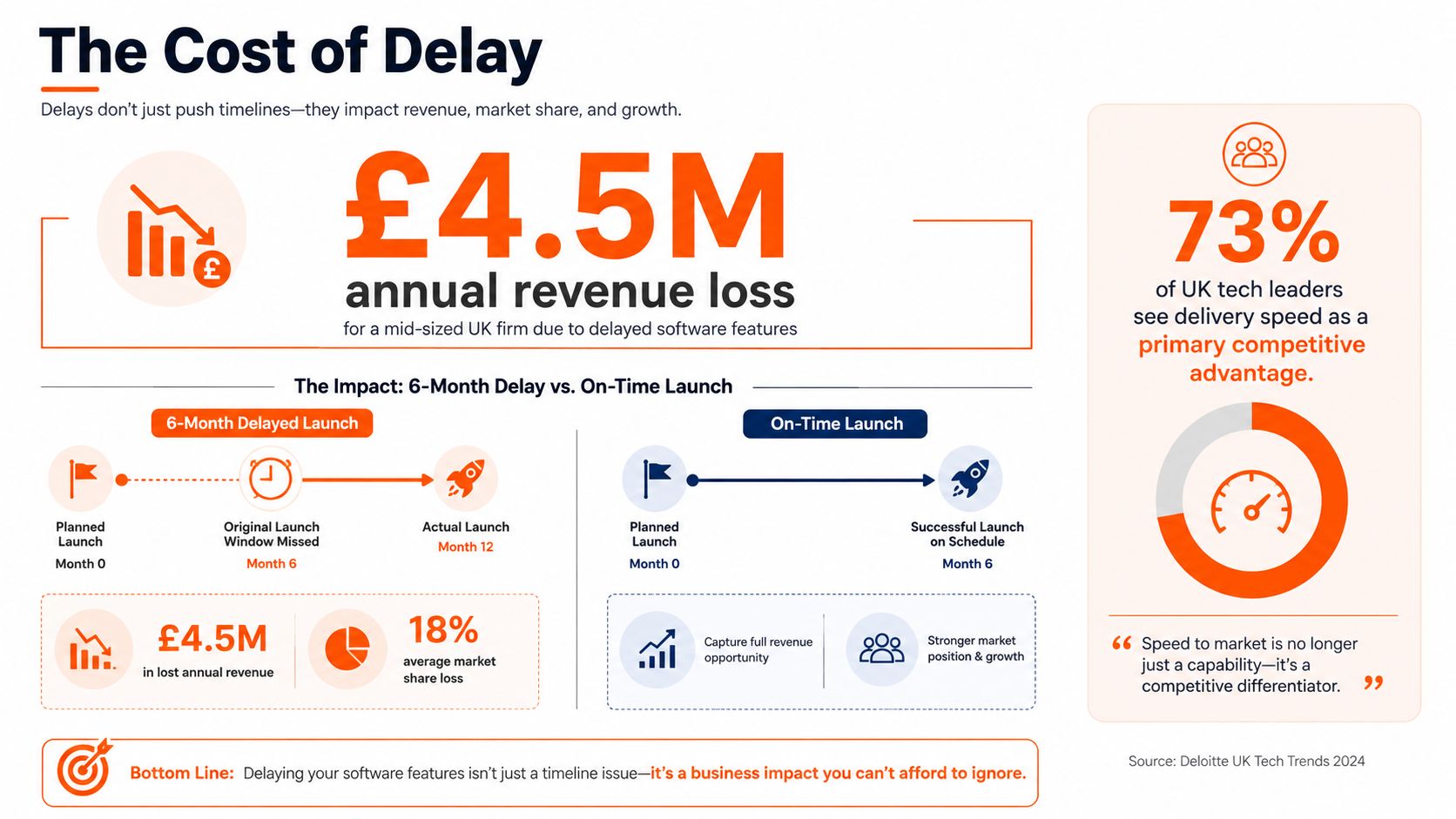
A delayed release has an opportunity cost. Every week spent waiting can defer annual recurring revenue, leave a user problem unresolved, or give another supplier time to establish a stronger position. The precise business effect varies by product, but the principle is consistent: delivery speed changes the value of an idea.
Throughput matters more than headcount
Adding developers doesn't automatically increase throughput. New people need context, architecture knowledge, product decisions, code review, and coordination. If those systems are weak, a larger team can create more handoffs and more rework.
UK software and computing sectors have recorded productivity at around £60,000 gross value added per employee since 2011, according to research on competitiveness, productivity, and innovation in the UK computing sector. That makes delivery efficiency a productivity question, not merely a recruitment question.
DORA provides a useful operating language. Its metrics cover change lead time, deployment frequency, failed deployment recovery time, change fail rate, and deployment rework rate, as described in the DORA metrics guide. These measures show whether a team can move from idea to production safely and recover when something goes wrong.
Practical rule: Fund the constraint in the delivery system, not the largest possible team.
The #riteway methodology applies that principle through Extreme Ownership, high energy, and proactive problem-solving. A delivery partner shouldn't wait for a ticket to become urgent or treat requirements as someone else's problem. The team should understand the desired outcome, surface risks early, and take responsibility for moving the work forward.
Founders who want a practical framework for connecting delivery activity to commercial value can also use outcome measurement to define what success means before development begins. That discipline keeps the conversation focused on adoption, retention, revenue, efficiency, or risk reduction rather than completed tasks.
The End-to-End Software Delivery Lifecycle
Consider a subscription SaaS platform launching a new billing module. The module might support invoices, payment retries, tax rules, and customer-facing billing history. Professional delivery turns that ambition into a sequence of decisions and feedback loops.
Discovery creates a valuable problem definition
The team begins with customer evidence, commercial priorities, technical constraints, and operational risks. Product leaders might identify failed payments as a source of churn, while finance needs accurate invoices and support wants fewer billing tickets.
The output should be a prioritised problem statement, user stories, acceptance criteria, assumptions, and a decision about what not to build. A discovery gate asks whether the proposed slice can produce useful evidence without committing the company to an oversized programme.
Design makes the risk visible
Designers map the billing journey and create flows for payment updates, invoice access, and failed-payment recovery. A prototype lets customers, support staff, and internal stakeholders react to the experience before engineers spend time implementing it.
The gate here is evidence of usability and feasibility. AI-assisted tools can accelerate research synthesis, draft interface variations, and turn accepted patterns into usable design artefacts, but a product team still needs human judgement about customer trust, accessibility, and commercial priorities.
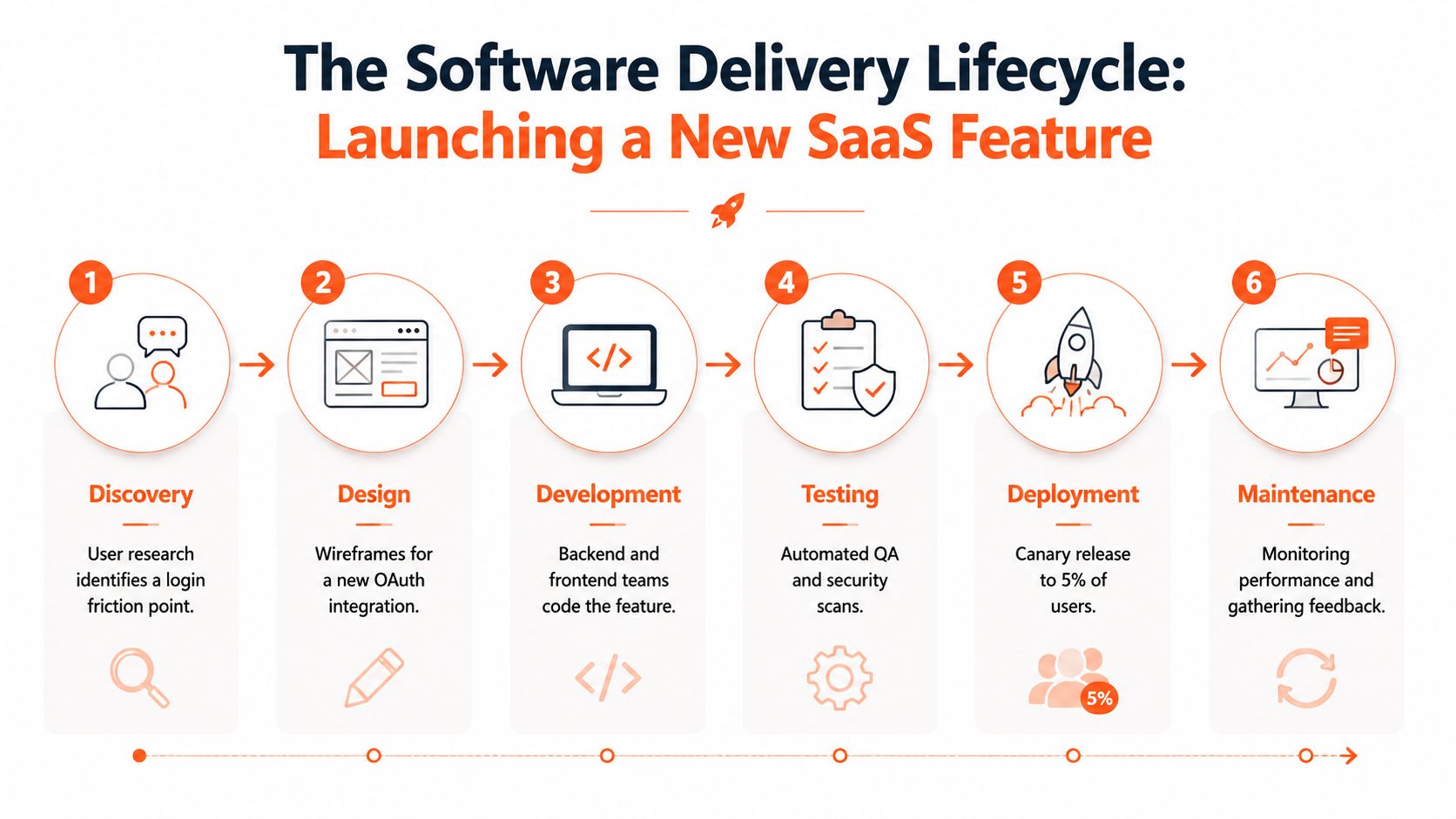
Development and testing turn intent into evidence
Engineers build the smallest coherent slice, connecting the billing interface to payment services, data models, notifications, and permissions. Each iteration should produce working software that can be reviewed against acceptance criteria.
Automated unit, integration, end-to-end, security, and regression tests then provide fast feedback. Test automation isn't paperwork. It protects the release decision by showing whether the billing module behaves correctly across expected and failure scenarios.
For teams comparing approaches to the lifecycle, choosing the right software model offers useful context on how different models affect planning and control.
Deployment is a controlled business experiment
The team releases the module gradually, monitors errors and payment outcomes, and confirms that customer behaviour matches expectations. Feature flags, canary releases, rollback procedures, and clear ownership reduce the blast radius when reality differs from the plan.
Delivery becomes measurable. A successful deployment isn't one that just reaches production. It should improve a customer or business outcome without creating unacceptable operational risk.
Maintenance completes the value loop
After launch, telemetry, support conversations, payment outcomes, and customer feedback inform the next product decision. The team may discover that retries reduce failed payments but confuse administrators, creating a new design and discovery question.
Skipping a lifecycle stage creates downstream cost. Compressed discovery produces unclear scope, rushed design creates rework, weak testing raises incident risk, and neglected maintenance turns a successful feature into an operational burden. Use the lifecycle as a value-creation system, not a bureaucratic checklist.
Choosing the Right Delivery Model for Your Stage
The right delivery model depends on your product stage, risk profile, internal leadership, and need for control. Hourly cost is only one input. Coordination overhead, quality predictability, and speed to useful output often matter more.
| Delivery Model | Best For | Time-to-Ramp | Cost Range | Communication Overhead | IP Control |
|---|---|---|---|---|---|
| In-house team | Companies with stable funding, strong hiring capability, and long-term product ownership | Slower while recruiting and onboarding | Higher fixed commitment | Low once established | High |
| Offshore outsourcing | Clearly specified work where cost pressure outweighs coordination friction | Variable | Lower direct cost, with wider delivery risk | High when working hours and context differ | Contract-dependent |
| Nearshore partnership | SaaS teams needing senior capability and working-hour overlap | Faster than building from scratch | Mid-range partnership cost | Lower with shared working hours | Contract-dependent |
| Dedicated team | Growth companies needing an integrated product squad without immediate permanent hiring | Fast once the team is selected | Flexible team investment | Low to moderate | Strong with clear agreements |
| Build-Operate-Transfer | Companies planning a long-term engineering centre and eventual internal ownership | Structured and progressive | Investment spread across setup and operation | Moderate during transition | Builds towards internal control |
In-house teams
In-house engineering gives you direct control over product context, employment, architecture, and intellectual property. It makes sense when product-market fit is established, the roadmap is durable, and you can support hiring, management, and retention.
The drawback is timing. Early-stage founders can spend heavily on permanent capacity before they know which product direction deserves sustained investment. Hiring also doesn't solve weak discovery or poor release discipline.
Offshore outsourcing
Offshore teams can suit contained work with stable requirements and clear acceptance criteria. They become harder to manage when the product changes quickly, because asynchronous clarification adds coordination tax and unresolved decisions wait for the next overlap.
Nearshore and dedicated teams
Nearshore partnerships offer closer working-hour alignment and easier collaboration, while dedicated teams provide continuity around a product area. These models work well for scale-ups that need experienced engineers but don't want every delivery decision to pass through a large internal hiring programme.
Build-Operate-Transfer
BOT suits organisations that want to establish an R&D centre with support for recruitment, compliance, operations, and transition. It demands clear governance from the beginning. Without ownership milestones and documented ways of working, the transfer becomes a staffing exercise rather than a capability strategy.
The #riteway approach fits a partner model by combining Extreme Ownership, proactive communication, and high-energy execution. The partner team should work inside the client's product and engineering rhythms, not operate as a detached queue of skills.
Tooling and CI/CD Pipelines That Accelerate Shipping
A dependable CI/CD pipeline makes the path from code commit to production visible, repeatable, and fast. It should build the application, run automated checks, package deployable artefacts, provision or validate infrastructure, deploy to a controlled environment, and provide feedback to the people who made the change.
A practical pipeline usually includes:
- Code commit: Pull requests trigger the workflow and record the change.
- Automated build: The system compiles, packages, and validates dependencies.
- Unit tests: Developers receive rapid feedback on isolated behaviour.
- Integration tests: The pipeline checks connections between services, databases, and external systems.
- Staging deployment: The team evaluates the release in a production-like environment.
- Production deployment: Approved changes move through a controlled release process.
Automated testing should be layered. Unit tests catch local logic errors quickly, integration tests expose broken contracts, and end-to-end tests verify critical customer journeys. A fintech team might add security analysis and AI-assisted review with a tool such as CodeRabbit before merge, while a SaaS team could use GitHub Actions to run parallel checks and return feedback quickly. Those are workflow examples, not substitutes for a test strategy.
Release safely, not theatrically
Feature flags separate deployment from customer release. Engineers can deploy code while product leaders control exposure, validate behaviour, and roll back access without reversing the entire application change.
Infrastructure-as-code tools such as Terraform and Pulumi make environments reproducible. They reduce configuration drift by turning infrastructure decisions into versioned, reviewable changes.
AI can help generate test cases, summarise logs, identify suspicious changes, and estimate deployment risk. The team still owns the decision. AI-augmented delivery works when engineers define quality gates, review outputs, and keep production accountability clear.
Teams building with limited resources may find a bootstrapped startup backlink useful when evaluating lightweight pipeline and delivery resources. The principle remains the same: choose tooling that shortens feedback, not tooling that adds another dashboard.
A healthy pipeline is a product capability. Assign ownership, measure failures, remove flaky tests, and treat pipeline downtime as a delivery interruption. You can also use this CI/CD pipeline guide to structure the underlying practices.
KPIs That Make Delivery Predictable
More developers don't guarantee faster delivery. Leadership needs measures that reveal how quickly a team moves valuable changes through the system and how safely it recovers when those changes fail.
DORA's framework uses four commonly discussed delivery measures, alongside its broader treatment of rework: deployment frequency, lead time for changes, change failure rate, and mean time to recovery. These metrics focus on delivery outcomes rather than the volume of activity.
| DORA Metric | Elite Performers | Low Performers |
|---|---|---|
| Deployment frequency | Frequent, dependable releases | Infrequent releases with large batches |
| Lead time for changes | Short path from accepted change to production | Long queues and delayed feedback |
| Change failure rate | Small proportion of releases require remediation | Releases regularly create incidents or rework |
| Mean time to recovery | Fast restoration when production fails | Slow diagnosis, ownership gaps, and extended disruption |
Don't use lines of code, hours logged, or story points as proxies for value. They can reward complexity, encourage oversized work, and hide the primary constraint. A team that completes many tickets but waits for review or testing isn't delivering quickly.
Find the bottleneck before hiring
Track cycle time across the work item, including discovery, implementation, review, testing, approval, and release. If code review creates the queue, recruit reviewers, improve ownership, or reduce change size. If testing blocks releases, fix flaky automation and clarify test responsibility.
Technical debt belongs in this conversation because it consumes delivery capacity. UK-facing technical commentary cites a 28% productivity loss for developers working in high technical debt environments compared with modern, well-maintained systems, as reported in research on the budget impact of technical debt.
Set a baseline, review the trend in weekly delivery meetings, and connect movement to business results. A shorter lead time should help validate features sooner. Better recovery should reduce customer disruption. Fewer failed changes should protect trust and support capacity.
For a practical measurement structure, use these software delivery metrics alongside product measures such as activation, retention, expansion, and support demand. The delivery dashboard should explain business movement, not merely report engineering busyness.
Common Delivery Challenges and How to Overcome Them
The worst delivery problems usually start with ownership, scope, or communication. Technology exposes those weaknesses, but adding another framework rarely fixes them.
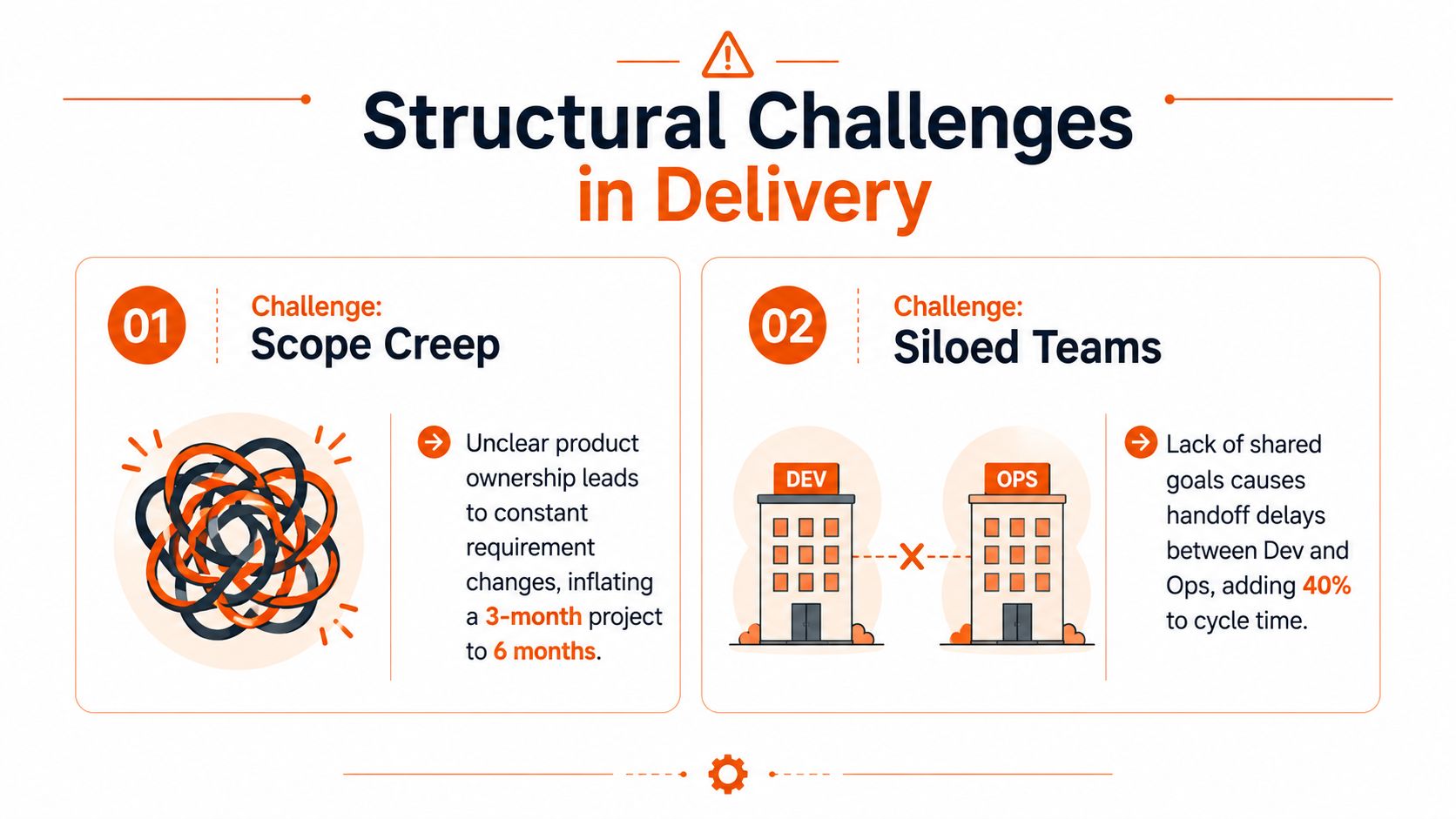
Scope creep begins when nobody has final authority over the outcome. Stakeholders keep adding requests, engineers make assumptions, and the team discovers late that different people meant different things by “done”. A structured discovery sprint creates a shared problem definition, explicit acceptance criteria, and a decision-maker who can protect the release boundary.
Seniority changes the quality of decisions
Junior-heavy teams may produce visible activity while missing architectural trade-offs, failure modes, and sequencing risks. Senior engineers don't just write difficult code. They reduce uncertainty, challenge weak assumptions, and help the team avoid rework.
The #riteway method puts Extreme Ownership at the centre. That means the delivery partner doesn't hide behind a ticket, specification, or dependency. Someone owns the outcome, raises the issue early, and proposes a route through it.
Distributed teams need an operating rhythm that matches the work. Offshore collaboration can become painful when urgent questions sit unanswered because working hours don't overlap. Nearshore teams can create a more practical balance, with shared UK and European working time for design decisions, pairing, incident response, and product conversations.
Make the operating model explicit
Use a single prioritised backlog, named decision owners, shared delivery metrics, documented release criteria, and regular demonstrations of working software. Keep product, engineering, design, and operations connected to the same outcome.
Silos shrink when teams share responsibility for production behaviour. Developers should understand operational impact, while operations specialists should have a voice before release rather than entering the process only after failure.
The cure isn't heroic effort. It's a team with enough senior judgement, aligned working hours, clear ownership, and the discipline to make problems visible while they remain affordable to solve.
How to Choose a Delivery Partner That Ships Faster
Don't choose a delivery partner because its website lists more engineers or its hourly rate looks lower. Choose the team that can show how it turns a product objective into reliable throughput.
Start with these questions:
- Who owns the outcome? Ask who makes delivery risks visible, manages dependencies, and decides what happens when the plan changes.
- How senior is the actual squad? Review the people assigned to your product, not the wider talent pool. Confirm who will design architecture, lead reviews, and handle incidents.
- How does the team release? Request deployment frequency, lead-time, change-failure, and recovery benchmarks from comparable engagements. A partner that can't explain its delivery performance probably isn't managing it.
- How mature is the pipeline? Ask to see the CI/CD workflow, quality gates, feature-flag approach, observability practices, and rollback process.
- Where does AI help? Look for responsible use of automated test generation, code review, documentation, and risk detection. AI should strengthen engineering judgement, not replace it.
- How quickly can the team understand your product? Assess onboarding, domain discovery, access to documentation, and the route from first conversation to useful contribution.
- How does collaboration work day to day? Confirm time-zone overlap, escalation routes, product ceremonies, written decisions, and incident communication.
A capable partner can explain trade-offs without hiding behind process. It can discuss modern and legacy systems, work inside your tools, and take responsibility for production outcomes. Nearshore teams are often a strong option for SaaS companies that need senior capability, practical working-hour overlap, and room to scale without building every function internally.
Rite NRG offers nearshore dedicated teams, end-to-end SaaS platform development, technology and delivery consulting, and Build-Operate-Transfer support for R&D centres in Poland. Its stated approach combines senior engineering, product-focused delivery, AI-supported processes, and the #riteway principles of ownership and proactive communication.
Watch for red flags:
- Vague service levels: The partner avoids clear commitments around response, quality, and recovery.
- Junior-heavy staffing: The sales team presents senior expertise, then assigns less experienced people.
- No delivery evidence: The partner can't articulate deployment frequency, change failure rate, or recovery practice.
- Output-only contracts: The arrangement rewards tickets or hours while nobody owns the business result.
- Passive communication: Risks appear only after deadlines move.
Your decision should favour predictable throughput, transparent accountability, and measurable value. Visit Rite NRG to discuss a nearshore delivery model built around senior teams, technology advisory, and full ownership from discovery through live operation. Bring a real product constraint, not a generic staffing request, and ask for a delivery plan tied to the outcome you need.