Trunk-based development is a strategy where developers integrate small, frequent changes into a single shared mainline to achieve continuous delivery without long-lived branches. DORA defines the capability around fewer than three active branches and branches that merge into mainline in less than a day.
Most advice about branching starts with fear. Keep work isolated, create release branches, protect the main branch, and integrate only when everything feels finished. That sounds responsible. In a SaaS business, it often creates the very instability it claims to prevent.
The commercial question isn't how many branches your repository contains. It's how quickly a validated product decision reaches customers, how soon users can respond to it, and how reliably your team can recover when something goes wrong. Trunk-based development addresses that gap through Extreme Ownership, disciplined integration, and a relentless focus on deployable value.
Why Your Branching Strategy Is Slowing Down Business Value
Long-lived branches don't remove integration risk. They postpone it, enlarge it, and hand the bill to the whole team at the worst possible moment.
A developer working in isolation can produce clean code and still create a difficult merge. The trunk changes while the branch remains separate. Interfaces evolve, tests move, product assumptions shift, and nobody gets feedback from the integrated system. By the time the branch returns, the team isn't reviewing one change. They're reconciling competing versions of reality.
That delay hurts the business directly. Product managers wait longer for validated learning, founders make decisions using stale evidence, and sales teams can't confidently promise improvements. A branch that feels safe to an individual contributor can be expensive for the company.
Integration is a discipline, not a restriction
Trunk-based development doesn't tell engineers to work carelessly. It requires them to make changes small enough to integrate safely and often enough to expose problems while they're still cheap to fix. The shared trunk becomes the team's working agreement: everyone contributes to it, everyone protects it, and everyone responds when it breaks.
That's where Extreme Ownership matters. A developer who owns the trunk doesn't say, “My branch worked.” They ask whether the integrated product builds, passes its checks, and remains useful to customers. That mindset changes behaviour. Engineers communicate earlier, split work vertically, improve test coverage where it matters, and treat a failed build as a business interruption rather than somebody else's technical inconvenience.
Practical rule: If a change can't be integrated safely in a small slice, the solution isn't a longer branch. The solution is better decomposition, stronger automation, or a safer release mechanism.
The distance between commit and deployment is a useful operational signal because it reveals how much friction sits between effort and customer value. Trunk-based development shortens that distance by making integration routine. It also makes weak engineering practices visible quickly, which is uncomfortable but valuable. A hidden pipeline problem can delay a launch for weeks. An exposed failure can be assigned, fixed, and prevented from recurring.
For a fast-moving SaaS company, that is the offensive posture. You don't win by building a complex waiting room for unfinished work. You win by creating a system where the next valuable improvement can move through the organisation with minimal delay and clear accountability.
The Core Definition and Historical Roots of the Trunk
The answer to what is trunk based development needs more precision than “developers merge often”. DORA defines it as a capability with fewer than three active branches, branches and forks that live for less than a day before merging to mainline, and teams that rarely or never enter code-lock periods caused by merge conflicts, code freezes, or stabilisation phases. These criteria make trunk-based development observable rather than ideological. You can inspect the repository and delivery behaviour instead of arguing about labels.
UK government digital guidance gives the practice a similarly concrete shape. Developers make small, frequent updates to a shared trunk and merge at least once per day. The guidance also recommends keeping three or fewer active branches, running automated unit tests before every commit, and maintaining a build and test cycle that completes in a few minutes, all to preserve deployability and reduce integration risk. UK government guidance on trunk-based development sets the standard clearly.
The word “trunk” carries useful meaning in a UK context. Britain has long used it for nationally managed strategic assets. The Trunk Roads Act of 1936 identified 30 trunk roads and transferred responsibility to the Ministry of Transport, creating a centrally controlled backbone for important routes. The history of trunk-based development and the trunk concept explores that parallel. A software trunk serves a similar organisational purpose: it is the shared, current backbone from which the product moves forward.
This isn't a recent Agile fashion. Trunk-based development has been described as a branching model used since the mid-1990s and discussed tactically since the 1980s, making it a long-established approach rather than a recent Agile invention. Background on the model's historical description supports that distinction.
The practical definition is simple but demanding. Engineers integrate into one current mainline, branches live briefly when they're used at all, automated checks run continuously, and the team avoids the stabilisation rituals that turn integration into a separate project. The trunk isn't merely the default Git branch. It's the product's most trusted representation of what can be delivered.
Trunk-Based Development Versus GitFlow The Branching Dilemma
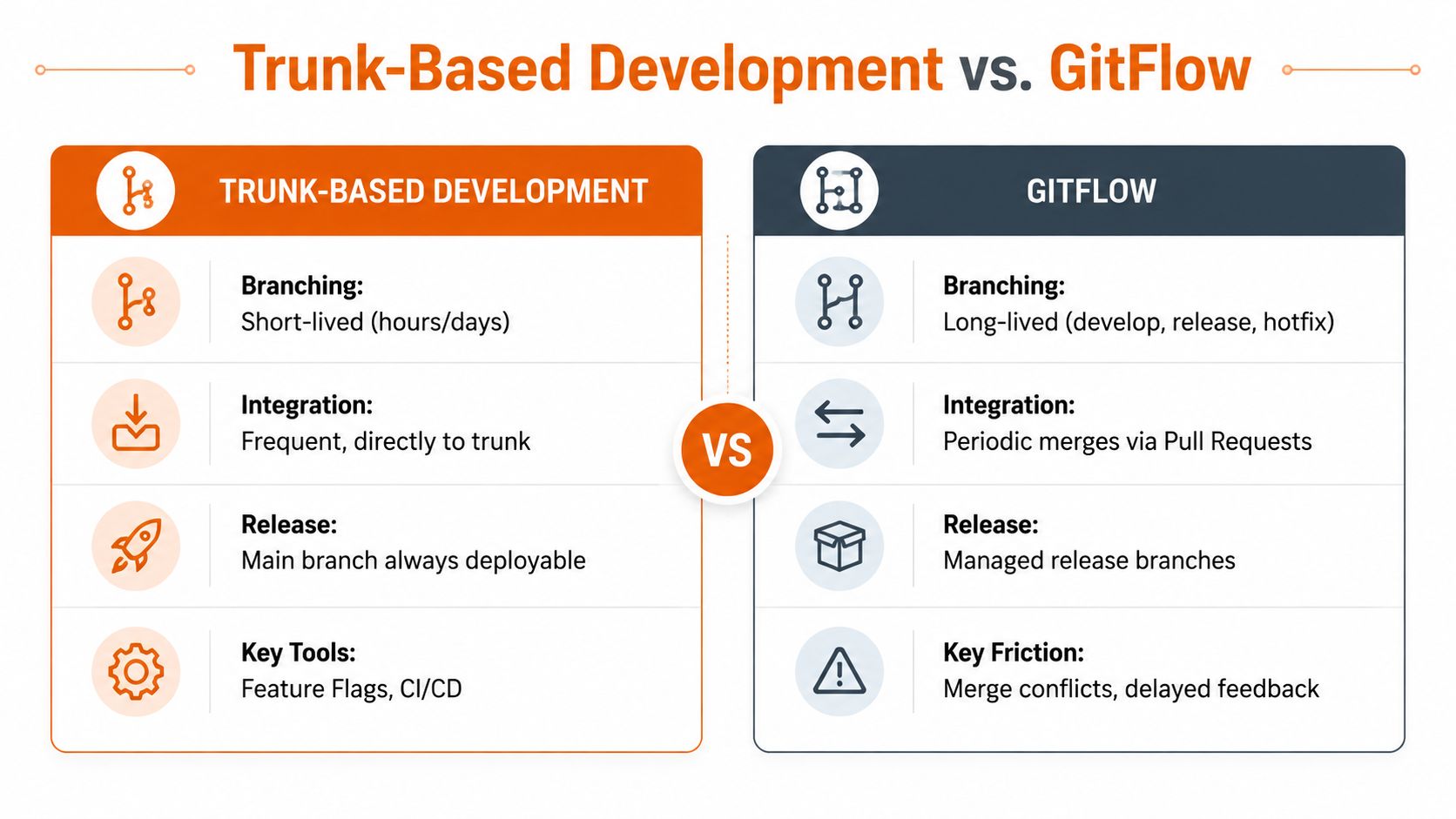
GitFlow organises work around multiple branch types, commonly including feature, development, release, and hotfix branches. That structure can make sense when a product ships distinct versions, supports several maintained lines, or requires a formal release process. For a continuously delivered SaaS product, it often adds ceremony without adding customer protection.
The central difference is timing. GitFlow delays integration until a branch is ready for a merge or release event. Trunk-based development integrates while the work is being created. The first approach concentrates risk at the end of a cycle. The second distributes feedback across the work itself.
Where the friction appears
A branch-heavy process can hide defects because tests and reviewers see a branch in isolation. A feature may pass locally while conflicting with changes already merged elsewhere. Release branches then become crowded with fixes, and the team enters a stabilisation phase that blocks normal product movement.
DORA's definition specifically excludes the pattern of routinely entering code locks, merge-conflict periods, or stabilisation phases. That matters commercially. Every freeze creates a period when engineers spend time protecting a snapshot instead of responding to customers, competitors, or operational evidence.
| Delivery concern | Trunk-based development | GitFlow-style branching |
|---|---|---|
| Integration point | Frequent integration into the shared mainline | Periodic merges between long-lived branches |
| Feedback timing | Close to the change that caused the issue | Often delayed until merge or release preparation |
| Release posture | Trunk remains close to deployable | Release branches provide a separate stabilisation path |
| Business effect | Faster learning and smaller recovery decisions | More coordination before value reaches customers |
This isn't an argument that GitFlow is always wrong. It is an argument against using it by default for a cloud product with one current version in production. If your customers need separately supported installed versions, a structured release model may be justified. If your goal is predictable SaaS delivery, long-lived branches deserve a serious challenge.
Trunk-based development also changes what “safe” means. Safety doesn't come from keeping changes away from the trunk until the end. It comes from small changes, automated verification, clear ownership, controlled exposure, and rapid correction. That is a stronger system than hoping a large final merge will behave.
Implementing the Workflow with CI CD and Feature Flags
Trunk-based development succeeds or fails in the delivery system around Git. A shared trunk without reliable automation is just a shared failure point. Build the guardrails first, then shorten branch lifetimes.
Create a fast feedback path
Start with a pipeline that runs automatically whenever a developer commits. DORA's continuous integration capability includes automated tests triggered by commits, daily successful automated builds and tests, current builds available for exploratory testing, same-day feedback from acceptance and performance tests, and immediate fixes for broken builds. DORA's continuous integration capability defines the operating standard.
A practical implementation sequence looks like this:
- Make a small change. Developers should slice work into a deployable or safely hidden increment, not a private project that spans an uncertain period.
- Use a temporary branch only when useful. The branch exists for review and collaboration, then disappears after merge. Direct commits can work for teams with the required controls and trust.
- Run automated gates. Build, unit tests, integration tests, static analysis, and relevant security checks should run without manual coordination.
- Merge quickly when checks pass. Branch protection should prevent unsafe merges, while reviewers should focus on risk, design, and customer impact rather than cosmetic preferences.
- Separate deployment from release. A feature flag can place code in the deployed product while keeping the user-facing behaviour disabled.
- Observe and iterate. Monitor the live behaviour, enable the capability deliberately, and remove the flag when the transition is complete.
The CI/CD pipeline guide can help teams connect these controls into an operating workflow rather than treating the pipeline as a collection of disconnected jobs.
Feature flags are essential when a feature takes longer to build than the integration rhythm. The code can reach the trunk and production while the capability remains unavailable to customers. That gives product leaders control over exposure without forcing engineers to maintain a separate long-lived branch.
Keep the trunk trustworthy
UK government guidance recommends small, frequent updates and merging at least daily. That cadence only works when the team treats a broken trunk as urgent. Revert a damaging change, restore the pipeline, and investigate with a smaller follow-up change. Don't leave every other developer waiting while the original author searches for a perfect fix.
Feature flags need ownership too. Each flag should have a clear purpose, an owner, and a removal decision. Otherwise, the team replaces branch complexity with conditional logic that nobody understands. The business outcome is achieved when the trunk supports a reliable flow of value, not when the repository merely contains fewer branches.
The Human Factor Scaling Teams and Fostering Ownership
Trunk-based development exposes culture faster than it exposes code. A team that communicates poorly, ignores broken builds, or treats reviews as somebody else's responsibility will struggle with a shared trunk. The repository makes those habits visible.
Comparative research has found that trunk-based development was preferred by more experienced programmers and smaller teams, while branch-based workflows were more common overall and remained easier for less experienced or larger teams to manage. The comparative research record points to the key decision criterion: fit. The question isn't whether trunk-based development sounds modern. It's whether the team can operate it responsibly.
Ownership has to be explicit
Extreme Ownership means every engineer is accountable for the health of the integrated product. That includes writing maintainable code, adding the tests needed to protect the change, responding to failures, and communicating risk before it becomes a release problem.
Senior engineers set the tone by making the safe path easy. They help colleagues split work, review small changes promptly, improve pipeline speed, and remove obsolete flags. They don't create a heroic dependency where one person alone knows how the trunk works. They build shared capability.
A distributed or nearshore team can operate this model effectively when communication is proactive rather than ceremonial. Team members need clear working agreements, overlapping collaboration time where necessary, visible ownership of services, and a shared definition of a healthy trunk. A handoff that leaves unanswered questions in a ticket is a delivery risk, not an administrative detail.
Match the method to the organisation
Don't force trunk-based development onto a team that lacks basic automation and psychological safety. First establish:
- Build accountability: Someone responds immediately when the mainline fails.
- Review discipline: Engineers review small changes promptly and discuss risk directly.
- Testing confidence: The pipeline tests the product behaviours that matter to customers.
- Flag literacy: Developers and product managers understand deployment, release, rollback, and cleanup.
- Decision clarity: People know who can approve a release and who owns the outcome.
A focused change management strategy helps leaders address the behavioural transition instead of pretending a Git setting can solve it. Trunk-based development is a mirror. If trust and accountability are weak, integration pain will appear immediately. If the team practises ownership and communicates early, the same visibility becomes a competitive advantage.
Measuring Success with DORA Metrics and Business Outcomes
Lines of code, branch counts viewed in isolation, and ticket throughput are weak proxies for business value. They can increase while customers wait longer for improvements. Measure the path from a product decision to a reliable customer outcome.
DORA defines trunk-based development through repository behaviour: fewer than three active branches, with branches and forks living less than a day before merging to mainline. DORA's trunk-based development capability gives engineering leaders a concrete health check. Use it to identify whether the team is integrating or renaming a branch-heavy workflow.
Track delivery health, not activity
The most useful dashboard connects engineering flow to customer impact:
- Deployment frequency: How often can the team deliver a valuable, verified change?
- Lead time for changes: How long does a change take to move from commit to production?
- Change failure rate: How often does a deployment create customer or operational harm?
- Time to restore service: How quickly can the team recover when a change causes trouble?
- Pipeline feedback time: How quickly do automated checks tell an engineer that a change is unsafe?
DORA's continuous integration criteria add important operational detail. Automated tests should run from commits, builds and tests should succeed daily, exploratory testing should use current builds, acceptance and performance checks should provide same-day feedback, and broken builds should be fixed immediately. Those behaviours reduce uncertainty before it reaches a customer.
For practical guidance on improving the engineering system behind these measures, SpecStory, Inc.'s engineering efficiency tips offer a useful complementary resource. For a broader measurement framework, review software delivery metrics and connect each indicator to a business decision.
The goal isn't to produce an impressive dashboard. The goal is to shorten learning cycles, release validated improvements sooner, respond to market evidence while it still matters, and reduce the size of failures. A metric earns its place when a leader can use it to change behaviour or make a better investment decision.
Your Roadmap to Trunk-Based Migration and Future Growth
Migration should be deliberate, but it shouldn't become another long-lived programme with no customer outcome. Start with the current delivery bottleneck and remove the causes in order.
A practical migration sequence
Assess the baseline. Map how long branches live, where merges wait, how often the mainline breaks, and which pipeline checks provide useful feedback. Don't optimise a process you haven't observed.
Choose a bounded pilot. Select a product area with a clear owner and a team willing to practise small integration. Avoid starting with the most regulated or most fragile service unless the business requires it.
Strengthen the safety net. Automate the tests and build checks that must run before merge. Make the feedback fast enough for developers to act on it during the same working session.
Reduce branch lifetime. Move from long-lived feature branches to temporary branches used for review, or to direct integration where the team's controls support it. The target is the DORA capability described earlier, not a superficial branch-count exercise.
Introduce feature flags carefully. Use flags to separate deployment from release, especially for incomplete product work. Assign ownership and a removal condition before the flag enters the trunk.
Protect the mainline. Require successful checks and appropriate review. When the trunk breaks, stop normal delivery, restore it quickly, and capture the lesson in automation or working practice.
Expand through evidence. Compare lead time, deployment frequency, failure rate, restoration time, and feedback speed before and after the pilot. Scale the operating model when it improves customer delivery, not because the team has adopted fashionable terminology.
The fit question deserves more attention than introductory explanations usually give it. The under-explained issue is whether trunk-based development matches a team's size, experience level, and delivery cadence, as highlighted by the comparative research record linked earlier. If those conditions aren't ready, build the capability first instead of mandating a branch strategy that increases risk.
During the transition, clarify responsibilities between product, engineering, design, quality, and operations. A concise developer handoff playbook can support that coordination, particularly when multiple teams contribute to the same product flow.
Track a small set of strict KPIs: branch age, active branch count, successful build frequency, feedback latency, lead time for changes, deployment frequency, change failure rate, and time to restore service. Review them with business stakeholders. If the numbers improve but customers don't receive value sooner or more reliably, change the system.
A trunk isn't valuable because it is central. It is valuable because the organisation keeps it current, trustworthy, and connected to delivery. That requires Extreme Ownership, high energy, and proactive engineering judgement. It also requires the courage to stop protecting slow processes that make the business less responsive.
Rite NRG provides senior nearshore engineering teams, technology and delivery advisory, and end-to-end SaaS development built around ownership, proactive communication, and predictable release flow. If your pipeline is slowing product decisions or your team needs a practical trunk-based migration plan, visit Rite NRG to start a focused conversation about your delivery goals.