Your lead architect is leaving, the nearshore team is taking on more production work, or a Build-Operate-Transfer programme is approaching its first ownership milestone. The repository is full of runbooks. Meetings are on the calendar. Everyone says the handover is under control.
Then an incident exposes the truth. The receiving team knows where the documentation lives, but not which assumption is safe, why a workaround exists, who can approve an exception, or how to recover when the normal path fails. That isn't a documentation problem. It's a knowledge transfer failure with a business cost.
The practical knowledge transfer best practices in this guide treat transfer as a continuous operating discipline. They connect independent operation, service quality, decision confidence, IP protection, and measurable delivery outcomes to the #riteway methodology of Extreme Ownership, high energy, and proactivity. A strong team isn't just a list of skills. It takes responsibility for the result.
Why Knowledge Transfer Is a Business Outcome, Not a Documentation Task
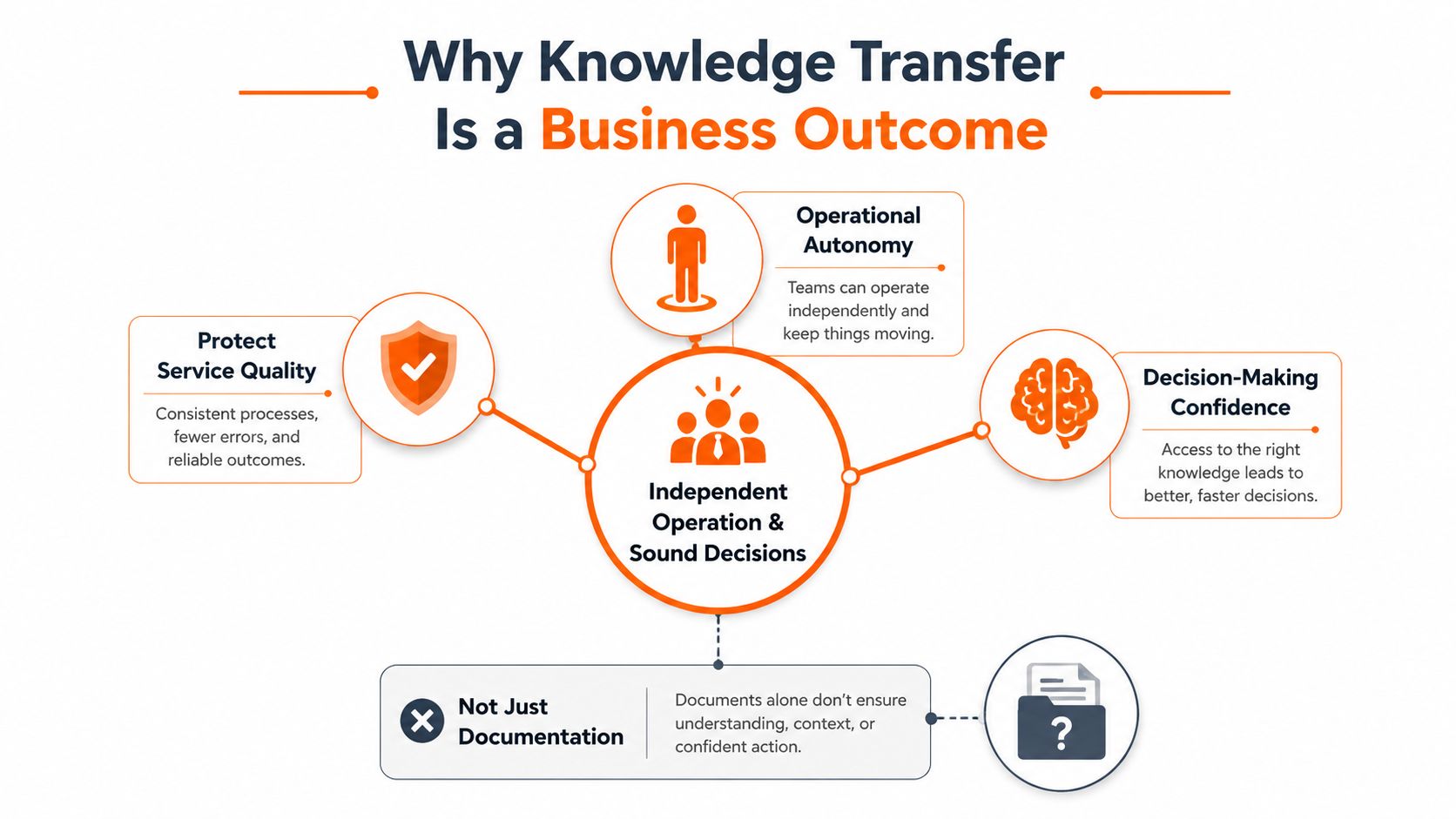
A knowledge base can be complete and still be useless. The receiving team should be able to release safely, resolve incidents, protect customer commitments, and make sound decisions without waiting for the outgoing expert. That is the outcome. Documentation is only one control that helps produce it.
The APM handover guidance makes the critical point that handover is a process, not a date. It should start at project inception and move knowledge and operations incrementally into business-as-usual. If your team defines completion as “all documents uploaded”, it has chosen an administrative milestone instead of an operational one.
Start with the work that protects value
Transfer the knowledge that can damage the business first:
- Production operations: Releases, rollback paths, alert interpretation, incident command, and escalation routes.
- Architecture and dependencies: Critical design decisions, fragile integrations, service boundaries, and known constraints.
- Security and access: Controls, approval paths, secrets management responsibilities, and evidence required for audits.
- Customer obligations: Service commitments, contractual constraints, support expectations, and known account sensitivities.
- Tacit decisions: The reasoning buried in conversations, Slack threads, exceptions, and historical trade-offs.
For a nearshore team, the transfer also needs communication paths and time-zone coverage. A technically accurate runbook won't tell an engineer who to call when a customer-facing issue appears outside the overlap window.
The #riteway approach assigns one accountable owner for both transfer and results. Multiple contributors can teach, review, and document, but one person must own the readiness decision. That owner should maintain a scorecard covering readiness assessments, observed execution, support-shadow completion, and post-handover operating signals. Teams can align those measures with a broader software delivery metrics framework rather than inventing a separate reporting island.
Practical rule: Every critical knowledge item needs an owner, a freshness date, and evidence that the recipient can use it under real conditions.
If nobody can describe independent operation, the programme isn't ready for more documents. It needs clearer outcomes, stronger demonstrations, and an accountable decision-maker.
Setting the Pre-Transfer Foundation
Start before the first walkthrough. A transfer charter turns an informal intention into an operating agreement.
Name the current owner, receiving owner, sponsor, decision authority, start date, and target end state. Then define what the receiving team may decide without permission. Task lists tell people what to do. Decision rights tell them when they can approve a release, accept an exception, escalate a risk, or change an architectural direction.
Build the transfer charter
Use the charter to answer five questions:
- Who owns the result now? Identify the person accountable for current service performance.
- Who owns it next? Name the receiving lead, not just the receiving department.
- What does independent operation mean? Define the workflows, scenarios, and decisions the team must handle unaided.
- What creates unacceptable risk? Include customer impact, security exposure, data misuse, IP loss, and operational disruption.
- Which gates control progression? Set evidence requirements for moving from explanation to shadowing, from shadowing to execution, and from execution to ownership.
Inventory the estate with business context. Include systems, repositories, environments, vendors, credentials, dependencies, incidents, customer obligations, and informal workarounds. Rank each item by business impact, time sensitivity, replacement difficulty, and IP sensitivity. Many handovers fail at this point. Teams catalogue assets but don't identify which missing knowledge could stop revenue, breach a commitment, or delay recovery.
Confirm rights before sharing knowledge
Knowledge transfer is also an IP, data, and rights-management problem. The UK government's guidance on IP and wider knowledge assets in technology transfer recommends identifying IP, data, software, and know-how early, then confirming ownership and permissions. Apply that discipline to supplier, consultant, and nearshore arrangements.
Check contract rights, data access, licensing, export-control requirements, security obligations, and the permitted use of customer information. In a Poland-based BOT arrangement, involve legal and security specialists before material crosses organisational or national boundaries.
Define success measures before activity begins. Useful measures include the share of critical workflows completed independently, performance against seeded incidents, release accuracy, and the decline in unanswered questions. The UK knowledge and skills transfer guidance supports defining roles, success measures, and transfer mechanisms up front.
| Knowledge Area | Risk and Business Impact | Required Evidence | Readiness Gate |
|---|---|---|---|
| Production operations | Service interruption, slow recovery, customer disruption | Observed release, rollback, alert response, and incident exercise | Receiving team completes the workflow without prompts |
| Architecture | Unsafe changes, recurring defects, blocked delivery | Decision records, dependency map, and architecture review | Team explains constraints and makes a justified change proposal |
| Security and access | Unauthorised access, audit exposure, data risk | Access matrix, approval path, control evidence, and escalation route | Named owners demonstrate compliant access handling |
| Customer commitments | Missed obligations, poor prioritisation, avoidable escalations | Service context, support scenarios, and customer-impact rules | Team handles a representative customer-facing scenario |
| IP and data | Unusable assets, ownership disputes, compliance exposure | Rights inventory, permissions, licences, and data-handling rules | Legal and security owners approve the transfer boundary |
Run recurring decision forums before production ownership begins. The receiving team must be able to challenge assumptions while the outgoing experts are still available. That is how a vague handover becomes a controlled transition.
Running a Nearshore Handoff That Sticks
A Polish nearshore team is ready when it can deliver, recover, and make sound decisions without waiting for the outgoing engineer. Presentations and complete documentation support that outcome, but repeated performance proves it.
Run the handoff loop
Start with a controlled production task. On the first run, the outgoing engineer demonstrates the workflow while the receiving engineer records questions, constraints, missing access, and unresolved decisions. Convert the demonstration into a usable runbook, then test the runbook through execution rather than treating its completion as evidence of readiness.
On the next run, the receiving engineer shadows the same workflow. After that, the receiving engineer leads while the outgoing specialist observes and intervenes only when risk requires it. End each session with a short review:
- What was clear: Record the steps and decisions the recipient can explain.
- What was missing: Capture undocumented dependencies, permissions, and assumptions.
- Which decision changed: Update the decision log when the receiving team challenges an established approach.
- What needs verification: Assign an owner and a date for every unanswered question.
Apply the loop to releases, deployments, incident response, access management, and customer-facing operations. Increase complexity only after the team completes the lower-risk workflow without prompts. Use daily check-ins during the first week and twice-weekly reviews afterward. The shared decision log should explain why consequential choices were made, not merely list changes.
Protect the time allocated to transfer. A busy specialist paired with a passive observer creates activity without capability. Record missed demonstrations in the delivery plan, and require the transfer owner to escalate them before they affect the readiness date.
Test behaviour under pressure
Use objective readiness checks. The receiving engineer must explain the workflow, execute it without step-by-step prompts, recover from a simulated failure, and identify when escalation is required. An “any questions?” close does not test competence.
For Poland-based teams, protect overlapping work hours and document local escalation paths. Address language and cultural differences directly, particularly around raising bad news, challenging an architectural decision, and stopping a risky release. The choice of partner sets the starting conditions, so use this guide on how to choose a nearshore partner to assess communication, ownership, and transition behaviour alongside technical skills.
Keep the handoff tied to business outcomes. Track whether the team can release safely, restore service, meet customer commitments, and make decisions within its authority. Recheck those outcomes after ownership transfers. Knowledge transfer is an operating discipline, consistent with the #riteway Extreme Ownership mindset, not a calendar event.
The handoff is complete when independent performance is demonstrated, not when the calendar says it is.
Documentation, Shadowing and Decision Logs Compared
A transfer can look complete while the receiving team still depends on one expert. These channels solve different problems, so combine them deliberately instead of treating a populated wiki as proof of readiness.
Documentation scales, but it decays quickly. Runbooks, API references, deployment instructions, and support procedures provide a repeatable baseline for stable workflows and asynchronous access. They rarely capture judgement, exceptions, or the reason a rule exists. A document can be technically correct yet operationally irrelevant when it does not match the reader's context. Assign an owner, review trigger, and user-facing test to every high-value document.
Shadowing transfers tacit knowledge, but it consumes senior time. An engineer can demonstrate how to interpret an alert, decide whether a rollback is safe, or recognise an integration failure before it becomes obvious. That knowledge matters because it is difficult to write down. Its weakness is repeatability. If the recipient does not perform the task and record the lesson, the capability remains attached to the observer.
Decision logs preserve context. Architecture Decision Records, post-mortems, and recorded walkthroughs explain the trade-offs behind the current system. They help a new team avoid reopening settled questions and repeating old mistakes. The risk is selective capture. Teams record major architecture changes, then omit small operational decisions that later shape support, delivery, and escalation.
| Channel | Best Use | Strength | Weakness | Cost to Maintain |
|---|---|---|---|---|
| Documentation | Stable procedures, interfaces, access rules, and reference material | Searchable and reusable across the team | Goes stale and struggles with tacit knowledge | Ongoing review, ownership, and version control |
| Shadowing | Incident response, releases, judgement-heavy work, and exceptions | Shows behaviour in context | Depends on expert availability and recipient participation | Protected time from senior specialists |
| Decision logs | Architecture changes, exceptions, post-mortems, and trade-offs | Preserves the reasoning behind choices | Incomplete capture creates false confidence | Lightweight contribution after consequential decisions |
Choose a layered mix
Use runbooks and API documentation as the baseline. Use pair-programming and reverse shadowing during the first 30 to 60 days, then retain observation for high-risk or infrequent workflows. Require a written decision record whenever architecture or process changes.
Tie each channel to a business outcome. Documentation should shorten onboarding and reduce repeat questions. Shadowing should improve recovery readiness and reduce avoidable escalation. Decision logs should reduce repeated debate, recurring defects, and unsafe changes. Review those outcomes as ownership shifts, consistent with the #riteway Extreme Ownership mindset.
The UKRA lessons management guidance sets a useful standard: handover material must be meaningful, applicable, relevant, and written for end users. “The wiki has been updated” is an activity report. Readiness requires evidence that the team can use the material independently.
Build-Operate-Transfer Playbook for a Poland R&D Centre
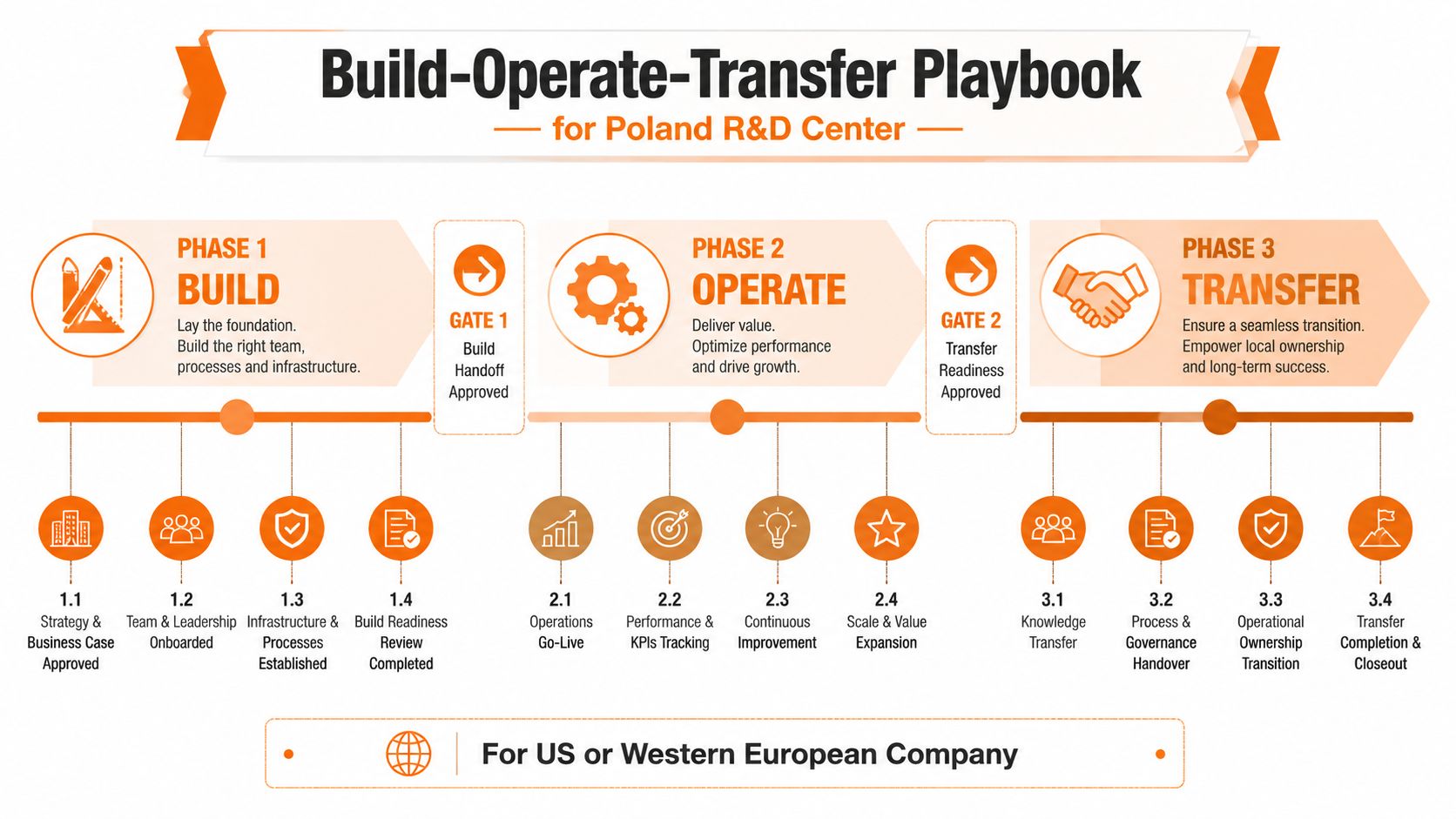
A Poland R&D centre needs explicit gates between Build, Operate, and Transfer. Without them, the customer remains an invisible dependency while the supplier reports progress against activity.
The Build phase establishes capability alongside the customer's core engineers. Hire the founding Polish team, pair it with the customer's specialists, and make code ownership visible from the first sprint. Require CI/CD parity, shared engineering standards, and one Definition of Done. The Polish team should understand not only how to merge code, but also how quality, security, release readiness, and customer value are judged.
Build with shared ownership
The Build gate should require:
- Code ownership: Repositories, modules, review responsibilities, and operational ownership are assigned.
- Delivery parity: Environments, pipelines, testing expectations, observability, and release controls work consistently.
- Decision access: The team can join architecture reviews and understands which decisions remain reserved.
- Rights protection: IP assignment, NDAs enforceable under Polish law, licensing, and data-handling obligations are reviewed.
The Operate phase shifts feature delivery to the Polish team while the customer retains architecture review and on-call escalation rights. The team owns day-to-day execution, but the customer still has defined authority over high-risk design and production decisions. Track the transition through a weekly risk register covering dependencies, staffing, security, unresolved decisions, and operational performance.
Operate before you transfer
Don't call the centre operational because it has delivered features. It must also demonstrate support behaviour, release discipline, incident response, and transparent risk escalation. Run parallel ownership for critical workflows and use the decision log to identify where the Polish team still waits for customer approval.
The Transfer phase begins when the customer owns the product end-to-end and the Polish team becomes the long-run delivery partner. Gate that change with SLA evidence, a security audit, and a 90-day stabilisation window. The customer should know who owns the product, who handles incidents, who approves architecture, and how the partnership evolves after the transition.
Poland-specific planning matters. Confirm IP assignment and confidentiality terms before engineers handle proprietary material. Review how NDAs operate under Polish law, and align EU and GDPR data-residency requirements with the actual environments, support model, and vendor chain. A generic BOT contract often describes staffing and misses the rights needed to operate safely.
A detailed Build-Operate-Transfer model should therefore define not just the phases, but the evidence that permits ownership to move between them.
The Risks Most Knowledge Transfer Playbooks Ignore
A handover can pass every meeting milestone and still fail during the first production incident. The real test begins after cutover, when the receiving team must make decisions without waiting for the original experts.
Retention is the first overlooked risk. If outgoing specialists leave immediately, the receiving team may inherit documents while losing the reasoning behind them. Treat knowledge transfer as a continuing operating discipline. Keep shared working records current, record decisions as they happen, and plan expert availability before the handover begins. Under the #riteway Extreme Ownership mindset, each owner remains accountable for proving that knowledge can be applied, not merely presented.
Private channels create a second failure point. A workaround buried in Slack, a personal notebook, or an old meeting recording is unavailable when an operator needs it. Require teams to move operational knowledge into controlled repositories, attach owners to important decisions, and test whether another engineer can find and use the information without help.
Third-party dependencies create a third risk. SaaS vendors, payment providers, identity services, monitoring tools, and data feeds often contain assumptions absent from the product repository. A transfer is incomplete until the receiving team knows how each dependency works, what failure looks like, who can change it, and where access is maintained.
Design for the post-cutover quarter
Use direct controls:
- Retention milestones: Tie incentives to demonstrated handover outcomes, not meeting attendance.
- Decision digests: Publish a weekly summary of consequential decisions, open questions, and changed assumptions.
- Integration inventory: Record an owner, purpose, dependency, access path, failure mode, and renewal detail for every external integration.
- Named bilateral ownership: Assign one engineer on each side to own the transfer through 90 days post-cutover.
- Freshness reviews: Require owners to validate runbooks and decision records after incidents, releases, and major changes.
A document can look complete and still fail an operator. Reviewers of the published lessons guidance identified weak validation, overly technical material, and unclear lifecycle ownership as practical barriers to effective handover.
Run a controlled operating period instead of holding one large meeting and declaring success. Seed realistic failures, inspect the receiving team's decisions, and keep the outgoing owner available for defined escalation. That discipline exposes missing knowledge before a serious incident does.
A 90-Day Knowledge Transfer Operating Checklist
A delivery lead can start this checklist the day after signing a statement of work. The sequence matters. Ownership comes before activity, validation comes before cutover, and measurement continues after the team takes control.
Days 1 to 30 focus on ownership and risk
Sign the IP and ownership charter. Map critical systems, dependencies, integrations, customer obligations, and operational risks. Baseline incident MTTR, deploy success measures, ticket backlog, and onboarding ramp time. Lock the shadowing rota with protected time for outgoing specialists and named receiving leads.
Required artefacts:
- Ownership matrix: Current owner, receiving owner, decision authority, and escalation route.
- Risk register: Business impact, time sensitivity, replacement difficulty, IP sensitivity, and mitigation.
- Runbook index: Critical workflows, owners, freshness dates, and validation status.
Days 31 to 60 validate the transfer
Run documentation sprints, recorded decision reviews, paired incident response, and reverse-shadowing sessions. The receiving team should lead representative releases and support scenarios while the outgoing team observes. Hold the first formal handoff gate with clear go or no-go criteria, including independent execution and recovery from a simulated failure.
The decision log should show which assumptions changed. The runbook index should show which documents were validated against real work. A completed meeting schedule is not evidence.
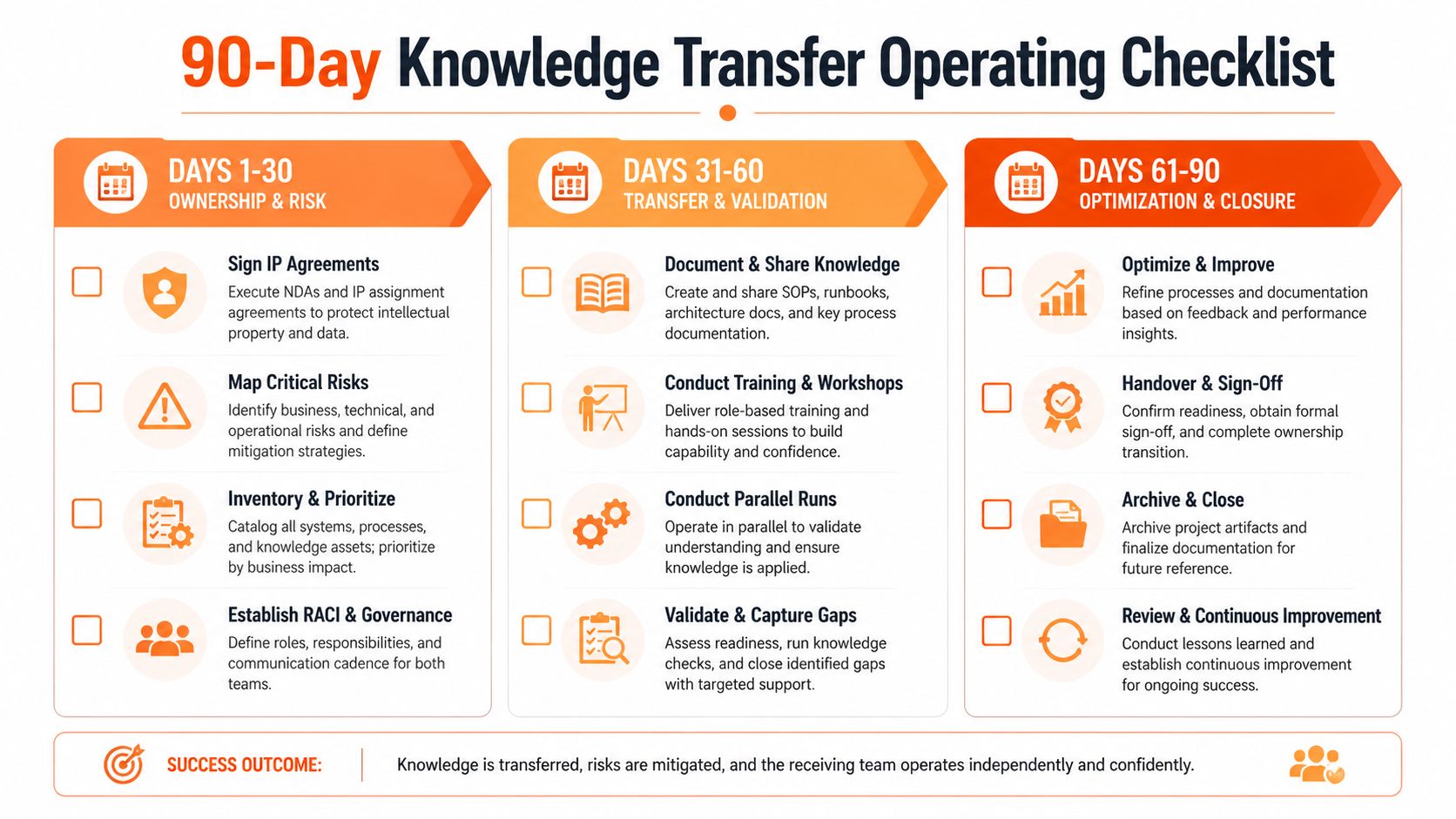
Days 61 to 90 measure retention and stability
Cut over to the receiving team, retain a defined escalation path, and run a 30-day stability review inside the final block. Audit documentation freshness, review incidents and releases, and publish a transfer scorecard against the baselined measures.
Track MTTR, change failure rate, ticket backlog, onboarding ramp time, unresolved questions, and independent workflow completion. Review the signals with the same ownership discipline used during the transfer. After day 90, keep a recurring decision review, documentation freshness check, incident learning cycle, and quarterly ownership audit.
The transfer is working when the team operates without hidden dependence, decisions remain explainable, and business performance holds after the original experts step back.
Rite NRG provides advisory, nearshore delivery, and Build-Operate-Transfer support for teams that need to retain knowledge while scaling software operations, including specialized R&D centre setup in Poland. Visit Rite NRG to discuss a measurable transfer plan built around Extreme Ownership, proactive delivery, and the operating outcomes your business needs.