The first sign is rarely a dramatic collapse. It's a calmer, nastier problem, sales keeps winning, the roadmap keeps expanding, and the team starts looking busy in every direction while delivery gets less predictable. One week the CTO is hiring like mad, the next week product is asking why incidents are rising, onboarding drags, and every release feels like it needs luck as much as engineering.
That's the point where scaling operations stops being an abstract management topic and becomes the only lever that matters. In the UK, that pressure lands harder because the market is dominated by small firms, with about 5.5 million private-sector businesses in 2023 and roughly 99.9% of them classed as SMEs, including 5.45 million microbusinesses with 0 to 9 employees, so growth usually has to happen without a big headcount base RFGEN. If you're trying to grow a SaaS company in that environment, the question isn't how fast you can hire. It's how much demand your operating model can absorb before cost, risk, and chaos outrun revenue.
The Moment Headcount Stops Being the Answer
A founder usually spots the shift the same way. A sales win lands, the team adds people fast, and everyone expects relief. Instead, the roadmap gets noisier, handoffs multiply, and the new hires spend their first month learning where the tribal knowledge lives.
Practical rule: If every new hire takes the pressure off for two weeks and then creates more coordination work, your operating model is the bottleneck.
That's why I define scaling operations as the operating system that lets a SaaS business absorb demand while cost growth stays below revenue growth. It is not a synonym for hiring, and it's not just process improvement. It's the combination of delivery design, controls, tooling, and ownership that keeps output rising without forcing a proportional rise in payroll, rework, and management overhead.
The UK context makes this even less negotiable. ONS business data showed that by late 2020 around 46% of UK businesses were using homeworking in some form, and that shift pushed firms to formalise workflows, documentation, and digital collaboration ONS via Maui Mastermind. The same country now has a labour market that makes simple hiring-led scaling slow and expensive, with 664,000 vacancies in May to July 2024 and unemployment at 4.2% ONS via Digital Diconsultants. Add the rise in employer National Insurance from 13.8% to 15% from April 2025, plus the lower secondary threshold of £5,000, and headcount-heavy growth starts looking like a weak financial strategy Project Manager Template.
Three signals tell you the bottleneck has moved:
- Lead time stretches even when the team is busy.
- Onboarding slows because knowledge is trapped in people, not process.
- Change quality drops because release discipline can't keep up with demand.
For a useful resource on one adjacent scaling problem, I'd also point teams to Halo AI's support scaling strategies, because support, like engineering, breaks first when growth outruns process.
The working definition I use is simple, scaling operations is the disciplined design of repeatable delivery systems so output grows faster than complexity and cost.
What Scaling Operations Really Means for SaaS Teams
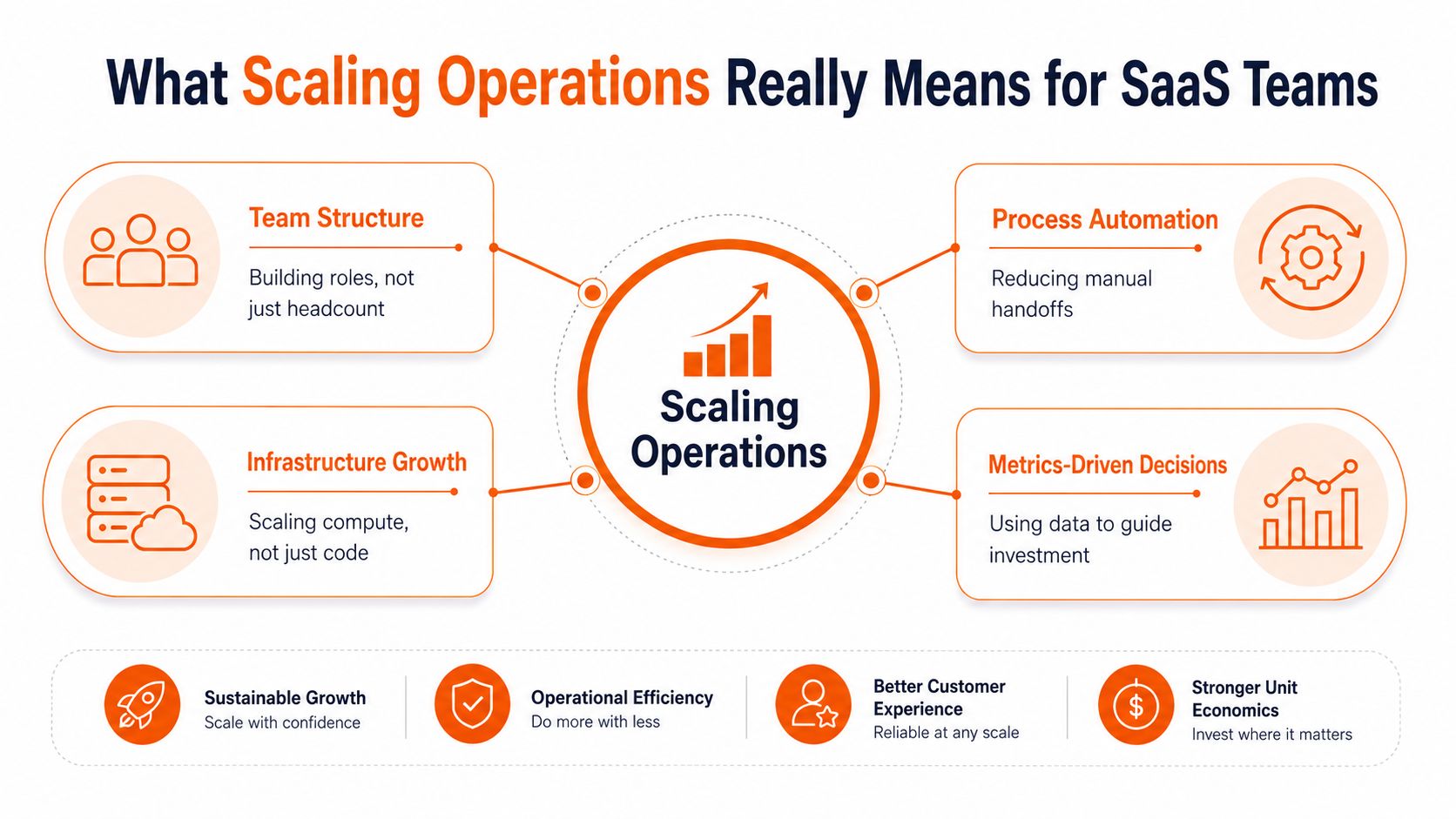
A lot of teams misuse the phrase. They hear scaling operations and think DevOps, ticket routing, or a cleaner Jira board. That's too narrow. For SaaS, it means designing the full delivery machine so product, engineering, support, and partners can all move faster without forcing the business into constant hero mode.
Start with process, not people
The restaurant analogy is useful because it's brutally honest. A kitchen that can serve 30 covers doesn't scale to 300 by hiring ten more cooks and hoping for the best. It scales when recipes are codified, prep stations are organised, supplier relationships are stable, and the pass works under pressure.
That's the same order SaaS teams should respect. Process comes first, because it tells people how work moves. Platform comes next, because tooling reduces friction and enforces standards. People come after that, because new hires should slot into a working system, not invent one from scratch. Partners come last, or early only if they can plug into a defined operating model.
Practical rule: If you can't describe how work flows from request to release in one page, hiring will mostly add confusion.
The ONS says 74.6% of UK businesses were digitally advanced in 2024, but only 17.0% were fully advanced, which means most firms still have gaps in cloud, data, automation, and cybersecurity maturity Tender Consultants. That matters because SaaS scaling dies when the team assumes good intent can replace standardised execution.
Extreme ownership has to show up in the workflow
The #riteway Methodology fits cleanly. Extreme ownership is not a slogan on a wall; it shows up in who clears blockers, who closes the loop on incidents, and who owns the handoff without blaming another team. High energy and proactivity matter because scaling breaks when people wait for permission instead of fixing the obvious problem.
The right operating model usually includes product-first prioritisation and AI-assisted delivery where it removes manual steps, not where it just adds noise. The point is measurable throughput, shorter cycle time, and fewer surprises for customers and the board.
Designing the Engineering Org for Predictable Delivery
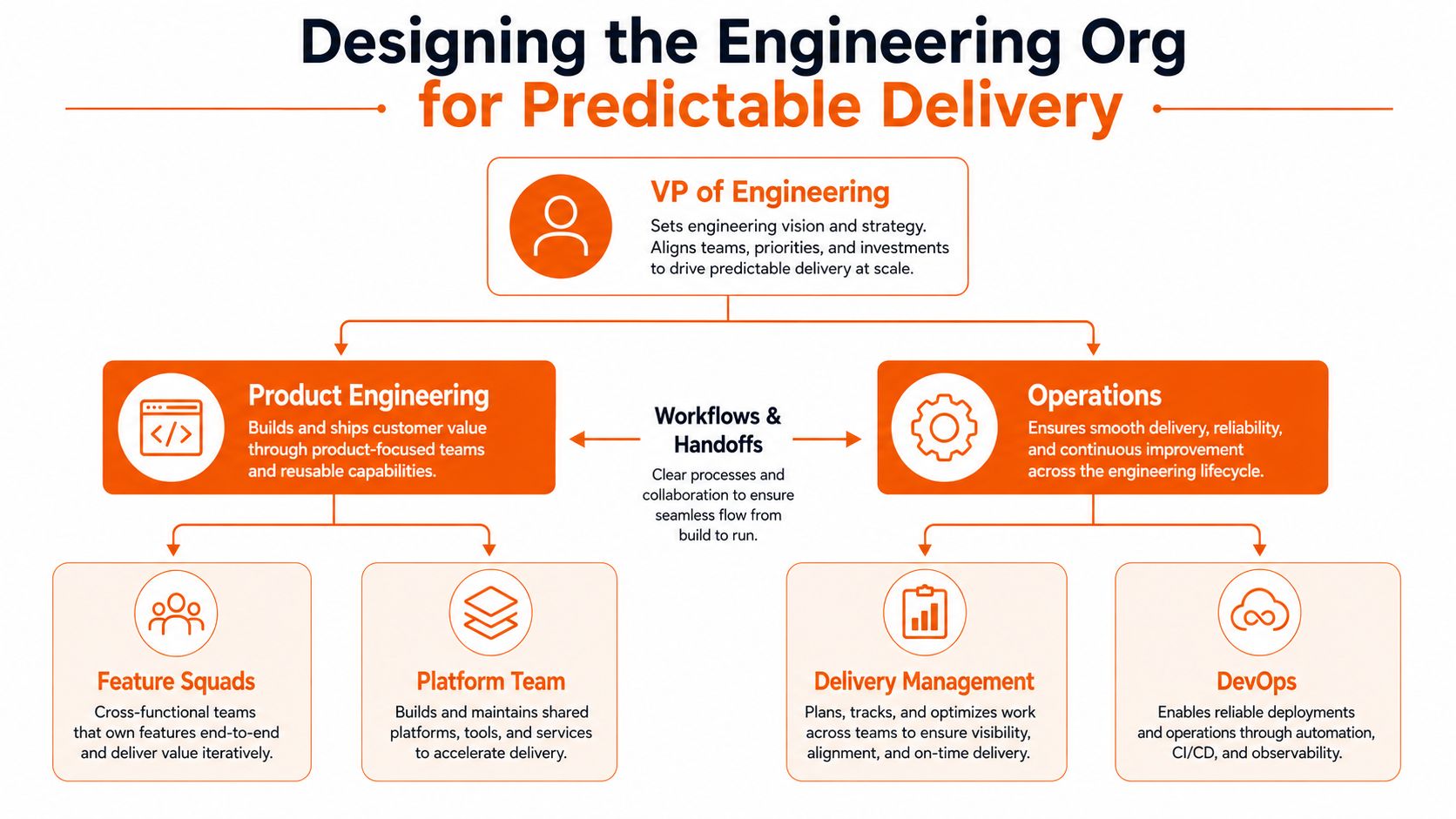
Start by shaping the org around outcomes, not around job titles. I'd rather see a lean set of squads with explicit ownership than a neat hierarchy that nobody can use to make decisions. If the squad boundary is wrong, every other decision becomes a workaround.
Use squads, chapters, and clear ownership boundaries
A good default is a squad of five to seven engineers, with one clear product outcome, one clear backlog, and one accountable lead. Product engineering should usually be federated, because customer problems rarely fit clean departmental silos. Platform, security, data, and release engineering are better centralised, because standards matter more there than local optimisation.
That split keeps the system honest. The product squad moves fast on customer value, while the central capabilities keep architecture, controls, and release reliability consistent. If those two layers blur together, local teams start solving global problems badly.
I'd hire in this order when the company is still proving the shape:
- A strong engineering manager, because someone has to make trade-offs visible and keep delivery honest.
- A senior platform or DevOps lead, because release friction and infrastructure debt always become the hidden tax.
- A product-minded technical lead, because architecture only matters if it moves customer outcomes.
Hire for speed of integration, not just seniority
Senior-heavy teams can be brilliant, but only if they are small, aligned, and strongly owned. Balanced teams work well when the operating model is already stable and the onboarding path is clean. A weak mix creates a strange failure mode, too many people with context, not enough people who can execute independently.
A good delivery partner should be able to onboard contributors in one to two weeks if the operating model is real and the scope is defined. If onboarding takes months, you haven't built a delivery engine, you've built a knowledge bottleneck.
For a practical lens on distributed team management, the structure in PEO Metrics' guide for distributed teams is worth reading because the people side only works when the workflow is already explicit.
Decide what stays internal
Keep strategic ownership, customer context, and final prioritisation inside the business. Bring in nearshore capacity, a dedicated team, or a BOT model when you need dependable execution speed and can define the boundary cleanly. As a consulting partner, I'd rather advise a founder to narrow scope first than to over-hire into an unclear operating model.
Building the Delivery Engine from CI/CD to Observability
Engineering culture sits on top of tooling. If your platform can't ship safely, the org will start compensating with meetings, manual checks, and fear. That's why the delivery engine is where scaling either starts to feel easy or turns into a daily firefight.
Roll out the stack in the right order
A 12-person team doesn't need enterprise theatre. It needs a clean delivery path that removes friction without slowing the team down. I'd sequence it like this, and I'd keep each step tight:
- Trunk-based development and feature flags, so work stays small and releasable.
- Automated tests, starting with the paths that protect revenue and customer trust.
- CI/CD with deployment gates, so releases are repeatable instead of heroic.
- Infrastructure as code, so environments stop drifting.
- Structured observability tied to SLOs, so engineering decisions connect to real service health.
- Error-budget-based release decisions, so you stop pretending all releases carry the same risk.
If you can't tell whether a release is healthy within minutes, you're flying blind.
The point of observability is not more dashboards. It's decision quality. Teams that watch logs without SLOs are usually collecting noise, while teams that tie service targets to release behaviour can make better calls about when to ship, pause, or roll back.
The UK maturity gap matters here too. Since only 17.0% of UK businesses were fully digitally advanced in 2024, the hidden win is not “better tooling” in the abstract, it's closing the operational gap between what the business says it wants and what the team can safely run Tender Consultants.
A practical internal reference for this layer is monitoring and observability, because the team needs a working standard for what good looks like before incidents start teaching the lesson the hard way.
Make post-incident reviews compound
Blameless reviews only work if they end in changed behaviour. The best ones answer three questions, what failed, what the system allowed, and what gets changed this week. If the review ends with “be more careful”, nothing changed.
The minimum viable platform capabilities are straightforward, safe deploys, test coverage on critical paths, infra that's reproducible, service-level targets that mean something, and incident learning that feeds back into the roadmap. Once those are in place, a distributed or nearshore team can work to the same standard as an in-house team without constant supervision.
Metrics That Tie Operations to Business Outcomes
Boards do not care about ticket counts, story points, or how busy the team felt. They care about whether delivery is protecting margin, growth, and customer trust. If your metrics don't connect to those outcomes, they're decoration.
| Operational KPI | Business Outcome It Protects | Target for Scaling SaaS | What to Do When It Breaks |
|---|---|---|---|
| Lead time for changes | Faster time to value | Keep the path short and predictable | Remove handoffs, simplify approvals, shrink batch size |
| Deployment frequency | Learning speed and product agility | Ship regularly without drama | Reduce release coupling, improve automation, cut release risk |
| Change failure rate | Customer trust and support load | Keep releases safe enough to ship confidently | Tighten testing, add gates, review risky changes earlier |
| Mean time to recovery | Revenue continuity and reputation | Recover fast enough that incidents don't become events | Improve alerts, runbooks, rollback paths, and incident ownership |
| Revenue per engineer | Margin discipline | Increase output without bloating the team | Cut low-value work, focus engineers on business-moving work |
For a more detailed metric lens, the internal software delivery metrics piece is the right companion, because the KPI tree only works if the leadership team uses it in real reviews.
Ignore the metrics that push bad behaviour
Velocity points are useful inside a squad and mostly useless above it. Ticket volume rewards noise. Lines of code can even punish good architecture, because smaller, cleaner solutions look worse on the dashboard than bloated ones.
Use a simple rule. If a metric makes a team faster only by making the customer experience worse, drop it. The right measures should force better trade-offs, not gaming.
I also like adding on-call burden and customer-impacting incident frequency to the leadership view, because they tell you whether growth is being bought with burnout. That's a poor trade in any market, and especially poor in the UK environment where payroll costs and compliance overhead are already moving against headcount-heavy scale Project Manager Template.
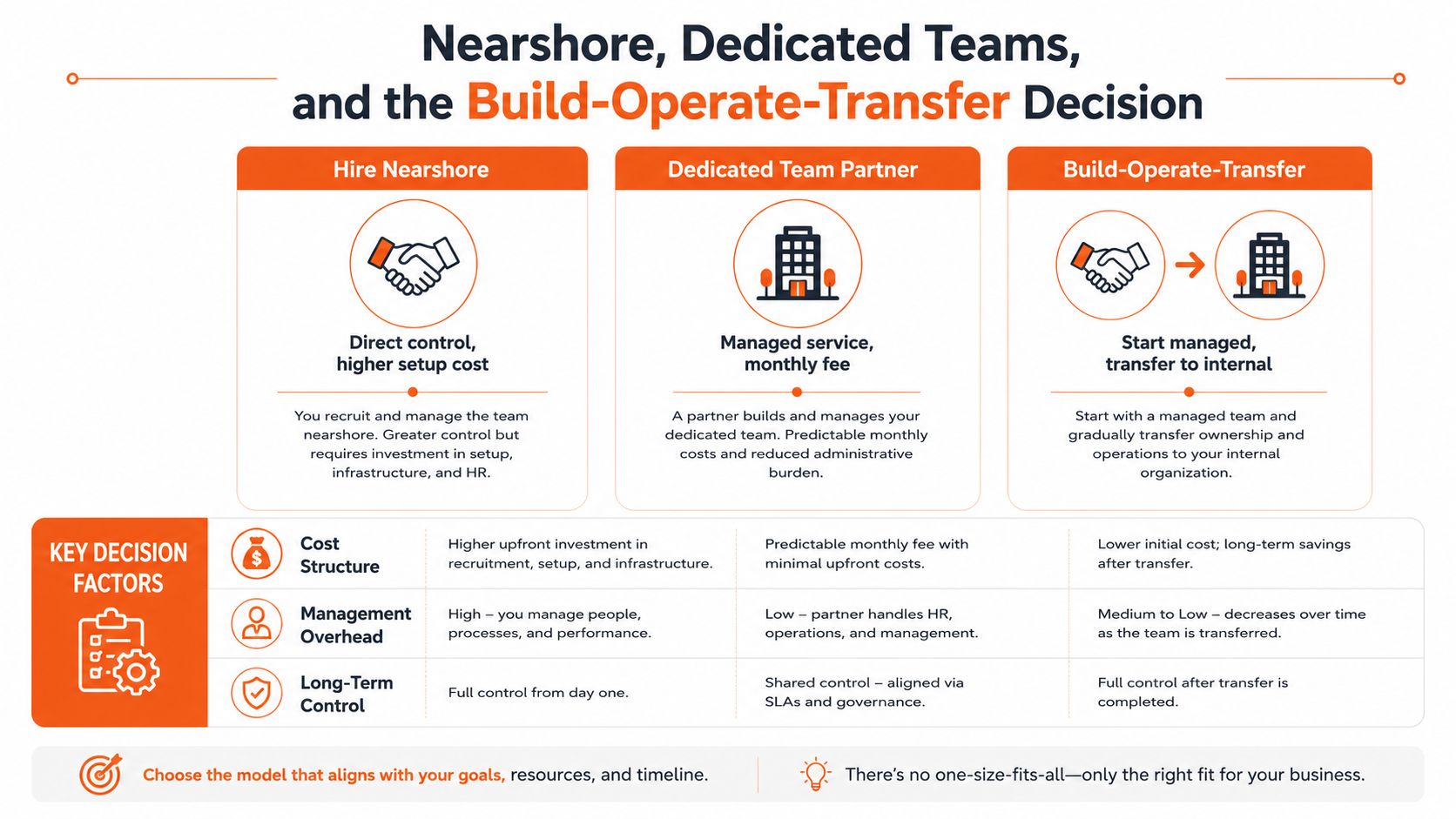
Nearshore, Dedicated Teams, and the Build-Operate-Transfer Decision
The wrong partner model can wreck a good plan. The right one can turn an overloaded internal group into a reliable delivery system almost immediately. The decision should come down to control, time, and total cost, not a glossy pitch deck.
Choose the model that fits the horizon
A Dedicated Team works when the roadmap is uncertain, speed matters more than permanent internal build-out, and you need senior people who can plug into your process quickly. A Build-Operate-Transfer model works when you expect a longer horizon, want eventual ownership, and need a path to a controlled internal centre. A hybrid nearshore model sits between those two when you want control and proximity without absorbing all the recruiting and operations burden on day one.
For a longer discussion of that model, build-operate-transfer model is the internal reference I'd give a CTO before they sign anything.
The UK labour market makes the partner route more attractive than many founders admit. With 664,000 vacancies and unemployment at 4.2%, automation, role redesign, and workflow simplification usually beat “just hire more” as the first answer ONS via Digital Diconsultants. That's especially true when employer NI has moved to 15% and the threshold has dropped to £5,000, because the cost of a new hire is no longer just salary Project Manager Template.
Demand a contract that says who owns what
A BOT agreement should spell out hiring control, compliance responsibility, operating standards, knowledge transfer, and the exit path. If those parts are vague, the model turns into dependency disguised as flexibility. A dedicated team agreement should be equally direct on IP ownership, security, performance expectations, and governance cadence.
Rule of thumb: If the vendor can't describe how the team will work on day 1, day 30, and handover day, they haven't sold you an operating model.
For distributed teams, the practical management issues matter more than geography. A useful context piece is PEO Metrics' guide for distributed teams, because communication discipline and ownership boundaries decide whether the partner helps or hinders delivery.
If you're evaluating a delivery centre in Poland or another nearshore market, focus on time-zone overlap, seniority mix, and the team's ability to operate with your product and engineering rituals. That's the difference between a staffing arrangement and a real scaling mechanism.
Common Pitfalls and Real-World Scaling Scenarios
The failure pattern is painfully familiar. A Series B SaaS company hires fast, doubles the engineering team, and assumes momentum will take care of the rest. Instead, onboarding stays ad hoc, observability is thin, and release discipline never catches up, so incidents rise, customer confidence drops, and a key renewal gets harder than it should have been.
The fix would've been less glamorous. The company needed a tighter squad shape, a real release engine, and a clear owner for operational health before the hiring wave. More people without those guardrails just meant more motion, not more throughput.
The better example is cleaner. A venture-backed platform paired a small internal core with a senior nearshore partner early, codified delivery rituals before the roadmap got messy, and used a narrow integration boundary so work could move without constant supervision. That model didn't remove risk, but it did make delivery more predictable, and predictability is what investors, customers, and operators all reward.
Five mistakes keep showing up:
- Premature specialisation, fix it by keeping ownership broad until throughput justifies more split roles.
- Managers who can't interview well, fix it by making hiring calibration a shared discipline, not a side task.
- Platform work that never ships, fix it by tying platform roadmaps to release pain and customer impact.
- AI as theatre, fix it by using AI only where it removes manual work or speeds decision-making.
- Ignoring on-call sustainability, fix it by treating incident load as an operating cost, not a badge of honour.
The regulatory backdrop matters too. The Employment Rights Bill was introduced in October 2024, and the Autumn Budget 2024 changed employer NI from 13.8% to 15% while lowering the threshold to £5,000 from April 2025 Project Manager Template. If your scale plan still assumes people are cheap and instantly available, it's already out of date.
Your 90-Day Scaling Operations Checklist and Common Questions
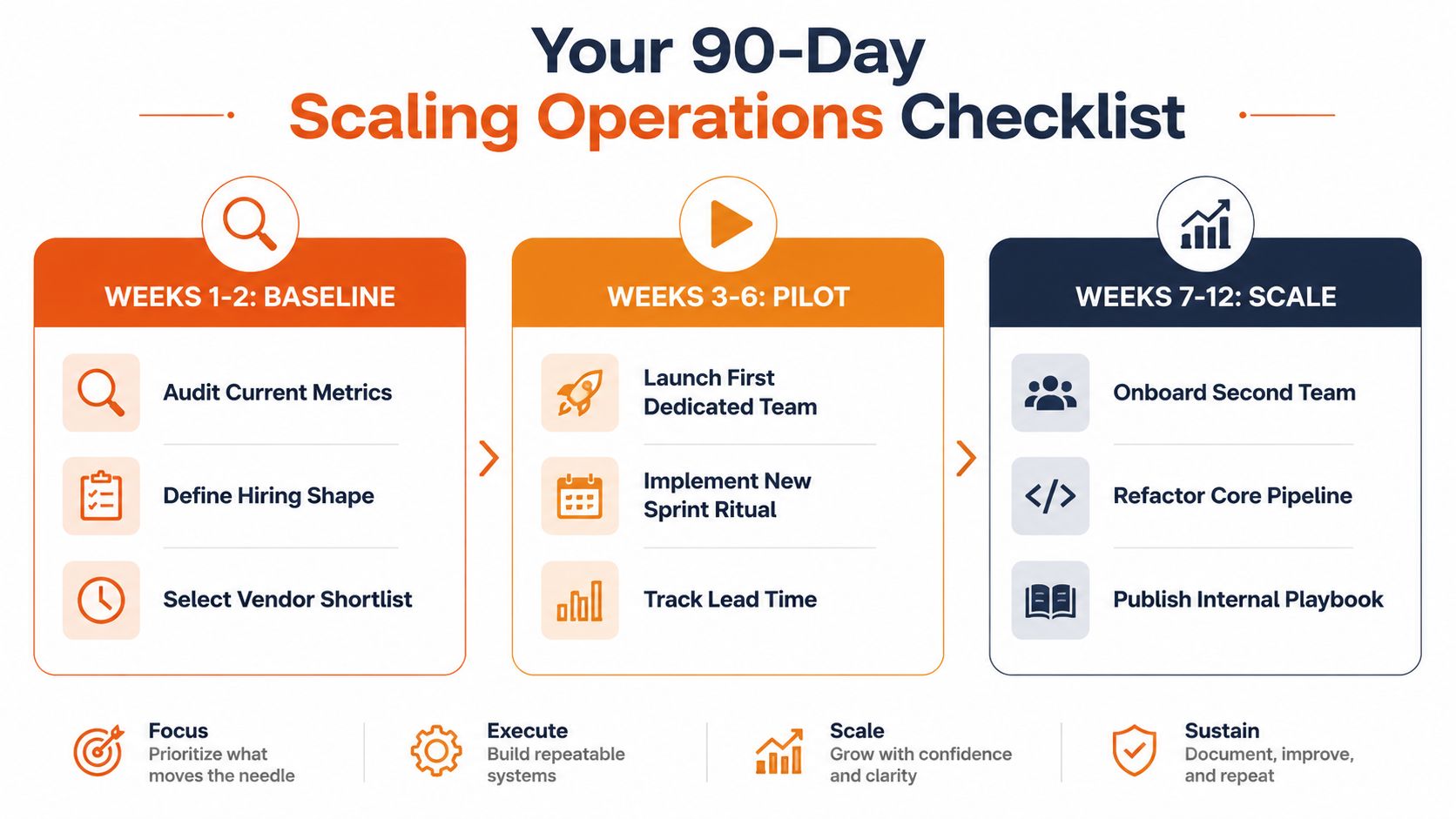
Weeks 1 to 2, establish the baseline
Audit the current delivery path, not just the org chart. Decide which metrics leadership will review, define the hiring shape you want, and shortlist the partner model before the next hiring push gets locked in. If you can't explain your current bottleneck in one sentence, don't add people yet.
Weeks 3 to 6, pilot the operating model
Launch the first dedicated team or restructure the existing squad around a real outcome. Rewrite onboarding so it teaches the flow of work, not just the stack. Put release ritual, incident ownership, and lead-time tracking in place before you expand again.
Weeks 7 to 12, scale with discipline
Roll out SLOs, run blameless post-incident reviews, and decide whether BOT or a dedicated-team contract is the better long-term move. Publish the internal playbook so the next team doesn't relearn the same lessons. If the model is working, repeat it. If it isn't, cut the experiment fast.
Common questions I hear from founders and CTOs
When does scaling operations become a board-level topic?
When delivery risk starts shaping revenue, margin, or renewals. If incidents, onboarding drag, or release hesitation are changing commercial outcomes, this is no longer just an engineering issue.
How do you scale without destroying margin in the UK?
Design for automation, role clarity, and partner use before you add permanent cost. With employer NI higher and vacancies still tight, headcount-led growth is a blunt instrument.
Is nearshore delivery really a competitive advantage?
Yes, if it reduces cycle time and gives you senior execution with clear ownership. No, if you use it as a cheap labour story and leave the operating model undefined.
Scaling operations is a discipline, not a project. The team that owns outcomes, simplifies workflow, and instruments the business properly will outship the team that just hired faster.
If you want a partner that treats delivery as a business outcome, not a headcount exercise, talk to Rite NRG. They build dedicated teams, platform capability, and Build-Operate-Transfer centres with the operating discipline needed to keep SaaS growth predictable.