
€177 billion. That's the size of the UK e-commerce market in 2025, making it the third-largest globally, with consumers spending an average of £50 weekly online and digital transactions accounting for 27% of all retail sales, according to Landmark Global's UK e-commerce overview.
If you're a SaaS founder or product leader, that number shouldn't sit in your head as trivia. It should change how you build. Advantages of commerce aren't abstract economic talking points. They show up in your roadmap, your architecture, your data model, your fulfilment integrations, your customer experience, and your delivery speed.
Commerce rewards teams that translate market opportunity into product decisions fast. That means shipping the right MVP, instrumenting the platform properly, personalising with purpose, and choosing a delivery model that gives you senior execution without burning runway. It also means acting with ownership. Not waiting for requirements to become perfect. Not treating delivery like a ticket factory.
That's where high-performance teams separate themselves. The best ones operate with urgency, challenge weak assumptions early, and stay relentlessly focused on business outcomes over technical theatre.
Your Starting Point in a Multi-Billion Pound Market
More than a quarter of UK retail now happens online. That is not a trend to watch. It is the operating environment product teams have to build for. According to the House of Commons Library's retail sector research, internet sales accounted for 26.9% of UK retail sales in 2023.
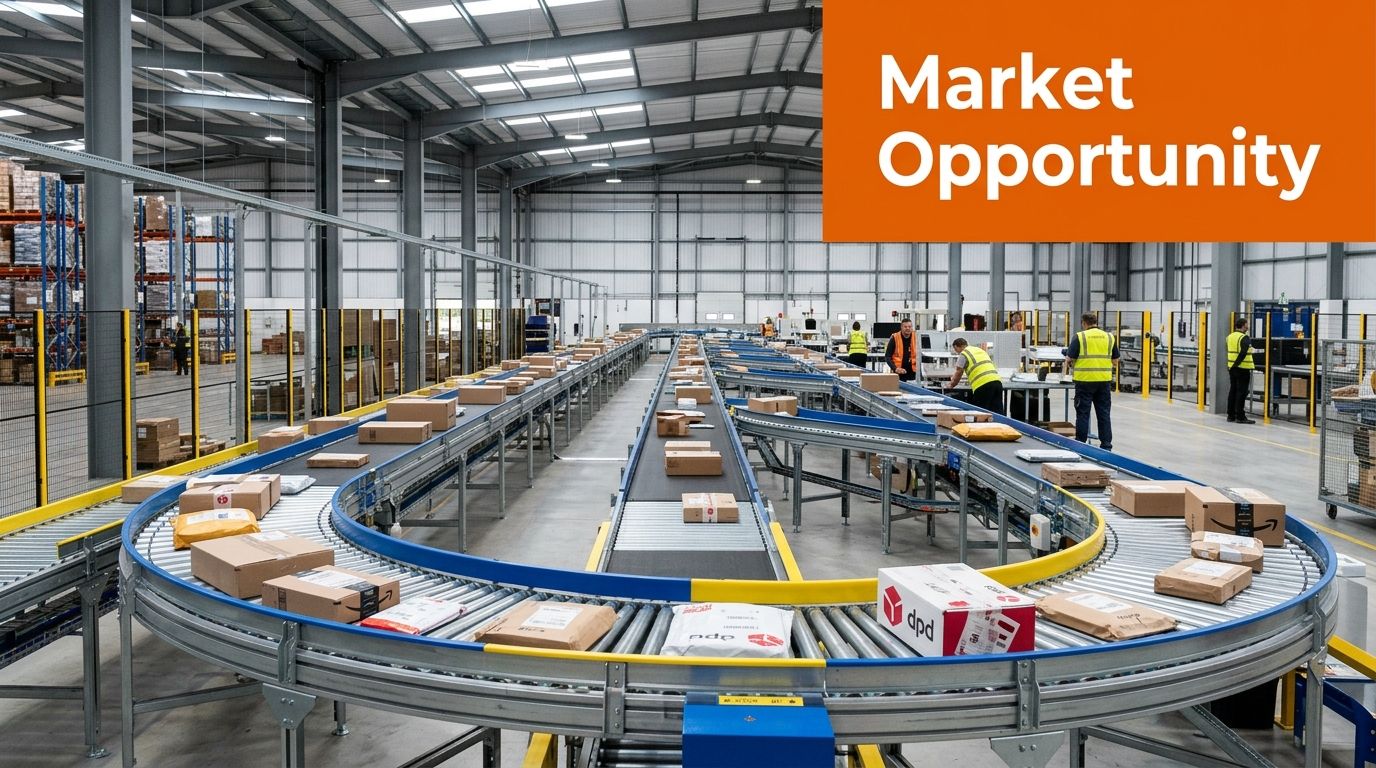
Market size raises the bar
Founders waste time when they frame commerce as a storefront project. In the UK, buyer behaviour is already digital, expectations are already high, and weak delivery gets exposed fast. The primary starting point is not design. It is execution across catalogue structure, checkout logic, payments, fulfilment, returns, and the data flowing between them.
That has a direct product implication. You are entering a market where customers compare you against the best buying experience they had this week, not just against your closest competitor.
Practical rule: In a mature commerce market, operational quality wins before brand storytelling does.
What this means for product strategy
Start with the buying journey, then work backwards into the platform decisions that support it.
- Cut friction early: Remove avoidable steps in search, sign-up, checkout, approvals, and post-purchase support.
- Build for repeat revenue: Account structures, saved preferences, subscriptions, reorder flows, and lifecycle messaging should be part of the product from the start.
- Track commercial behaviour properly: Instrument discovery, conversion, drop-off, repeat purchase, and support interactions so your team can improve what drives revenue.
- Treat operations as product scope: Payments, tax logic, fulfilment updates, returns, stock visibility, and third-party integrations shape conversion as much as front-end UX does.
If you are serious about scaling your ecommerce business, stop separating commercial strategy from engineering strategy. They are the same conversation.
Founders need delivery discipline
Commerce gives SaaS teams a rare advantage. Small product improvements can compound into measurable revenue gains if the platform is built to support them. Better product data improves discovery. Faster checkout improves conversion. Cleaner integrations reduce operational drag. Faster release cycles let you test and improve before slower competitors catch up.
This is the opportunity in this market. Commerce is not just a channel. It is a system for turning product decisions into growth, provided your team can ship reliably and connect architecture choices to commercial outcomes.
Strong founders act accordingly. They prioritise platforms that can scale, choose delivery partners who can execute at speed, and build the technical foundations early enough to support growth without expensive rebuilds later.
The Economic Engine Fuelling Growth and Opportunity
Commerce generates more than transactions. It provides an operational advantage for businesses willing to use wider markets, faster feedback loops, and stronger supply-side options to their benefit.
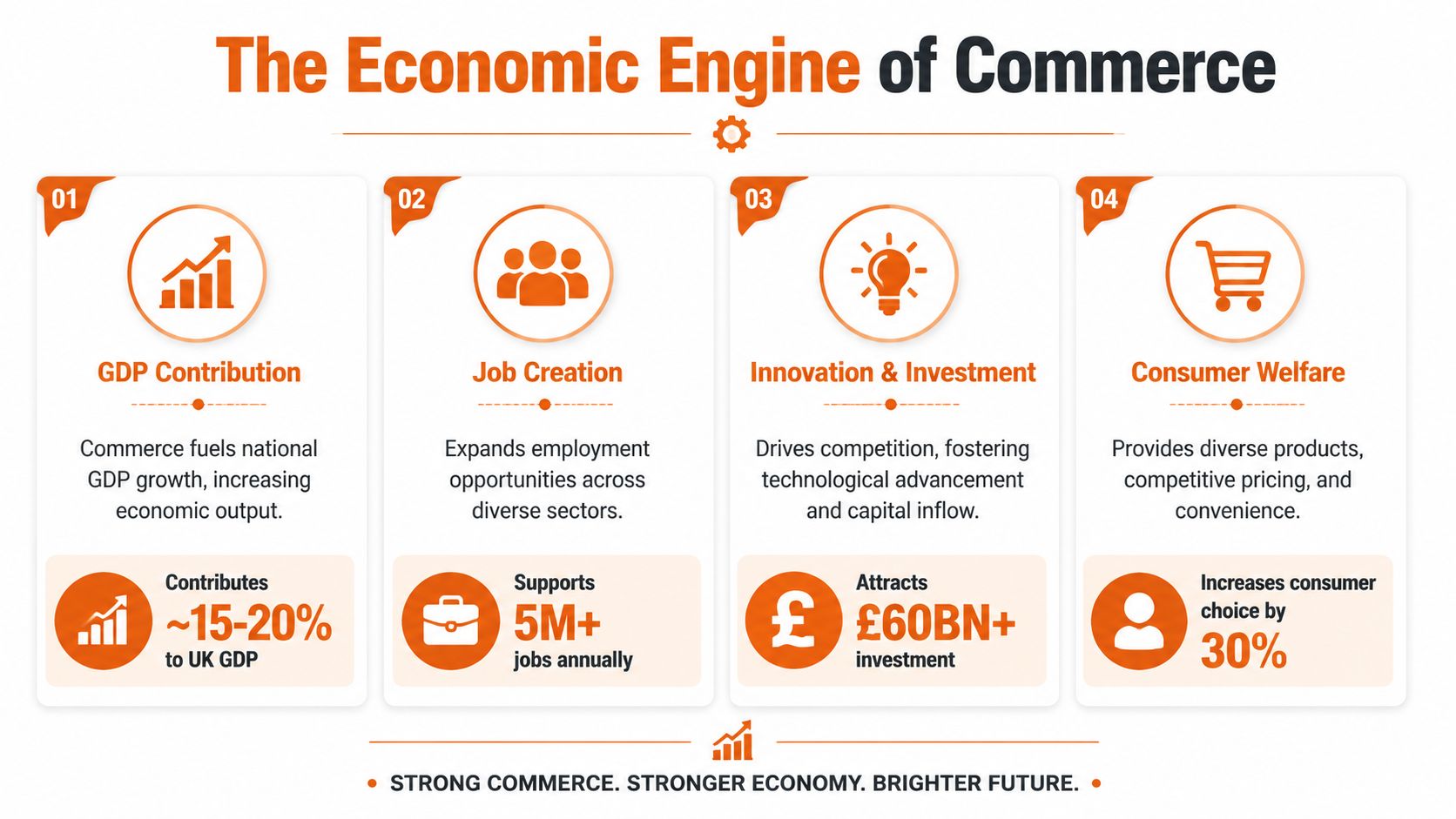
Openness increases the size of the game
One of the clearest economic arguments for commerce is simple. Broader market access creates more room to grow, more pressure to improve, and more ways to earn.
According to the UK government summary of OECD analysis on trade openness, a 10% increase in a nation's trade openness is directly correlated with a 4% rise in income per head. That matters because it connects commerce to prosperity in a concrete way. More openness doesn't just move goods. It expands opportunity.
For founders, the practical takeaway is direct. When commerce barriers fall, demand pools widen. Your product can reach more customers, your buyers get more alternatives, and your team gets pushed to compete on quality, speed, and relevance instead of geography.
Better commerce systems lower waste
Think of commerce as infrastructure, not just selling activity. Strong commerce systems reduce drag across the whole business.
A better ordering flow reduces support burden. Better trade access increases customer reach. Better supply coordination lowers delays. Better information flow shortens decision cycles. None of this is glamorous, but all of it compounds.
Here's a useful resource if your next challenge is scaling your ecommerce business. It's worth reading because scaling problems rarely come from demand alone. They come from weak operations, fragmented tooling, and product decisions that don't hold under load.
Commerce gives businesses access to more than buyers. It gives them more ways to improve.
A lot of leaders miss that. They treat expansion as a sales problem when it's often a systems problem.
To make this more concrete, watch this quick overview before revisiting your own growth model:
Why this matters to SaaS leaders
If you run a SaaS company with commerce inside the product, or around it, you need to think beyond top-line conversion. The economic advantages of commerce create second-order effects:
| Commercial force | What it means for your product team |
|---|---|
| Wider market access | Support multiple customer types, regions, workflows, and payment expectations |
| Competitive pressure | Prioritise UX, speed, and service quality over feature sprawl |
| More buyer choice | Differentiate through trust, convenience, and operational reliability |
| Lower friction in trade | Build integrations and process automation early, not after launch |
The strategic mistake is building as if the market will forgive clunky flows because your idea is good. It won't. Buyers compare your experience against the best process they used this week, not against your internal constraints.
That's why the advantages of commerce should influence architecture and delivery from day one. Growth becomes easier when the surrounding economic environment supports openness. But only teams that build for that environment capture the value.
Gaining a Data-Driven Competitive Edge
Commerce used to reward visibility. Now it rewards relevance. If your platform can't turn behaviour into better decisions, you're leaving revenue on the table.
Personalisation should be operational, not cosmetic
A lot of teams say they do personalisation when they really mean they swapped a homepage banner or inserted a first name into an email. That's not a competitive edge. That's decoration.
The commercial upside comes when data changes what a user sees, what they're offered, how quickly they reach value, and what action feels obvious next. According to the UK government's report on business data use and productivity, UK businesses that effectively personalise products and services using consumer data can achieve a 20% sales uplift and a 50% increase in average order value.
That should reshape your backlog. Personalisation isn't a nice add-on for later. It belongs in core product thinking.
The right data stack starts with discipline
Organizations don't have a tooling problem first. They have a decision problem first. They collect too much weak data, too little useful data, and they update it too slowly.
If you want data to drive commercial outcomes, get the sequence right:
- Define key user actions: Focus on behaviours tied to buying intent, retention, expansion, and churn risk.
- Standardise event tracking: Product, engineering, and commercial teams need a shared understanding of what each event means.
- Unify customer context: Orders, support interactions, account usage, and campaign responses should inform one commercial picture.
- Refresh quickly enough to matter: Delayed data leads to delayed action, and delayed action weakens relevance.
If your team needs a good primer on why stale information creates bad decisions, digna's guide on data freshness is worth your time.
Operating advice: If a recommendation engine, pricing rule, or lifecycle message runs on outdated inputs, it doesn't personalise. It misfires.
Build these capabilities into the platform
The strongest commerce products don't bolt on intelligence after launch. They bake it into platform behaviour.
Use your roadmap to prioritise capabilities such as:
- Behaviour-based recommendations: Not generic “popular items”, but context-aware suggestions tied to intent.
- Audience segmentation: Group users by action patterns, lifecycle stage, or buying signals.
- Triggered communications: Send prompts when behaviour indicates readiness, hesitation, or drop-off.
- Experimentation infrastructure: Let product teams test commercial hypotheses without creating delivery chaos.
- Decision support for internal teams: Give sales, support, and ops visibility into what customers are doing now.
Founders often ask when to bring in specialist help. The answer is early enough that the architecture can support meaningful data use. If your team is planning advanced recommendation logic, predictive workflows, or decisioning models, this guide on machine learning consultancy is a useful place to sharpen your approach.
Data quality is a product issue
Many engineering teams get it wrong. They treat analytics as reporting and personalisation as marketing. In commerce, both are product concerns.
If your product catalogue is inconsistent, recommendations degrade. If customer identity resolution is weak, segmentation degrades. If event names are messy, trust in reporting degrades. Once trust drops, people stop using the data. Then decisions revert to opinion.
The advantage of commerce isn't that data exists. It's that disciplined teams can turn it into sharper action faster than competitors can.
Building the Platform Modern Consumers Demand
Mobile traffic already dominates large parts of commerce. If your product still treats the phone as a secondary screen, you are building against customer behaviour instead of with it.
Mobile-first isn't optional
Modern buyers browse, compare, and buy in short bursts. They switch networks, pause mid-checkout, return from messages, and expect the session to recover cleanly. Analysts at Statista's UK mobile commerce market overview show how central mobile has become to online buying in the UK. Founders should treat that as a product directive, not a design preference.
That means thumb-friendly navigation, fast page loads, low-friction sign-in, and checkout flows that survive interruption. It also means your architecture has to support mobile reality behind the interface. Search needs to return useful results fast. Account states need to persist reliably. Notifications need timing that helps conversion instead of creating noise. Support paths need to be easy to reach from a small screen.
Mobile-first changes delivery priorities. Teams should test on real devices early, trim interaction steps aggressively, and treat every extra field as a conversion risk.
Platform priorities that actually matter
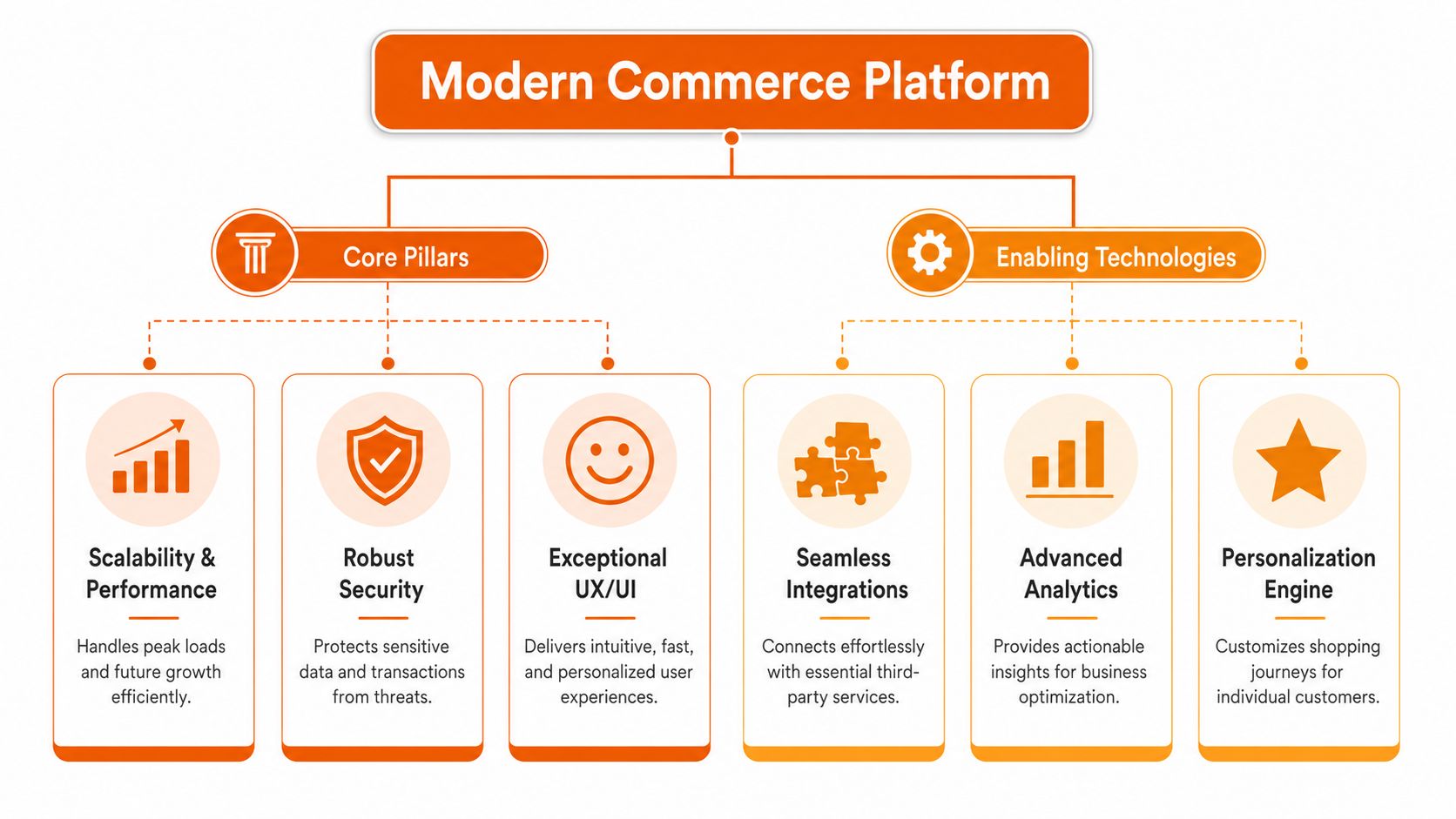
Founders do not need a bloated commerce stack. They need a platform that ships quickly, supports change, and gives internal teams control when transaction volume rises.
I'd prioritise five things:
- Fast MVP delivery: Release the smallest product that proves demand, validates workflows, and exposes buying friction.
- Clean integrations: Payments, tax, shipping, CRM, analytics, and support systems should connect without custom spaghetti.
- High performance under load: Slow pages, failed lookups, and fragile checkout flows destroy trust fast.
- Security built into delivery: Customer data, payment flows, and access controls need clear ownership from the start.
- Operational visibility: Sales, support, and ops teams need dashboards, alerts, and clear exception handling.
Teams get this wrong all the time. They chase edge features before they have stable flows, usable tooling, and a platform shape that can carry the business.
Architecture should support change
Commerce products get more complicated quickly. New regions bring new tax rules. New channels bring new fulfilment logic. Enterprise customers ask for custom pricing, approval flows, and account hierarchies. If the platform is tightly coupled, every commercial win creates delivery drag.
Architecture choices should follow business intent. If your roadmap includes multi-region selling, partner integrations, or workflow variation by customer segment, design for that now. A practical guide to SaaS platform architecture for scaling products can help teams choose service boundaries and integration patterns that support growth instead of slowing it down.
Build for the next two commercial moves, not just the launch.
SMEs need systems they can actually operate
This matters even more for smaller businesses. The British Chambers of Commerce report on why trade matters highlights that digital trade processes can improve commerce, but many SMEs struggle with implementation because of complexity and limited resources.
That is a product decision, not just an operational headache.
Teams that simplify documentation, border-related data capture, workflow approvals, and partner handoffs create value fast. The winners are rarely the platforms with the longest feature list. The winners are the ones that reduce effort, shorten task time, and let commercial teams operate confidently without engineering support for every change.
The Delivery Advantage of Nearshore Teams
Strong commerce products don't fail because the market is too small. They fail because delivery gets slow, expensive, and reactive. That's why team model matters more than many founders admit.
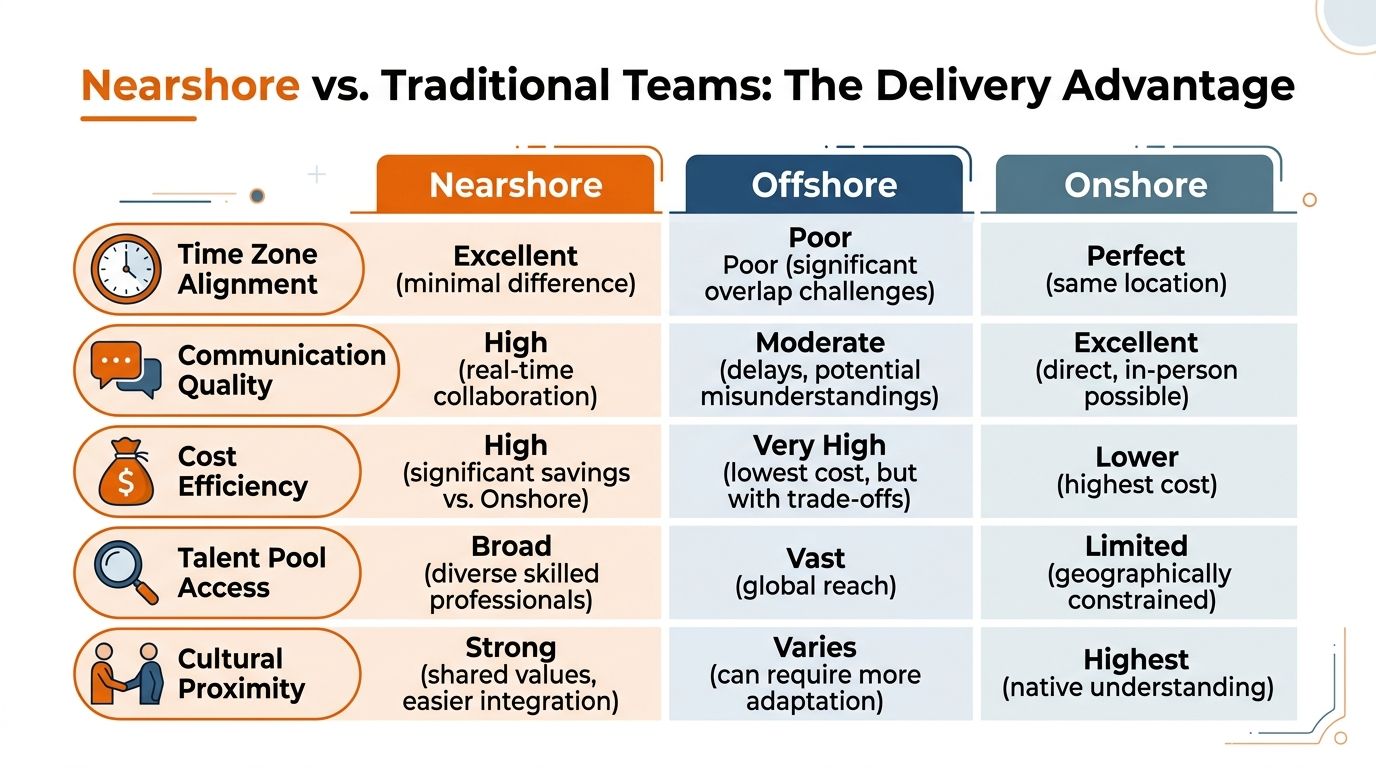
The real question isn't cost alone
A lot of leaders still frame delivery as a simple rate-card comparison. That's lazy thinking. The better question is this: which team model gives you the best speed, ownership, communication quality, and predictability for the money you're spending?
That's where nearshore stands out. According to Belitsoft's UK nearshore software development trends, UK enterprises augmenting their teams with nearshore developers from Eastern Europe can cut labour costs by an average of 40% per year, with savings reaching up to 70% per employee without any degradation in quality.
Those numbers matter, but cost isn't the only reason I'd recommend nearshore. The stronger case is operational.
Why nearshore fits commerce delivery
Commerce work is collaborative by nature. Product, engineering, design, data, QA, operations, and business stakeholders all influence the result. You need a team that can stay in sync, challenge assumptions, and resolve blockers in real time.
Nearshore delivery works well because it supports:
- Closer collaboration: Time zone overlap makes day-to-day problem solving faster.
- Senior integration: Teams can plug into your product rituals instead of operating as a distant factory.
- Better issue resolution: Questions get handled while the context is still fresh.
- Stronger continuity: Long-running platform work benefits from stable relationships and shared accountability.
A high-performance delivery mindset matters. The #riteway methodology is built on Extreme Ownership, high energy, and proactive execution. That means teams don't wait to be managed into action. They surface risks early, own outcomes, and push towards business value instead of hiding behind scope documents.
Leadership test: If your delivery partner only reports progress, you hired capacity. If they prevent avoidable mistakes, you hired leverage.
Compare team models by execution quality
Here's the practical comparison founders should care about:
| Team model | Typical strength | Typical weakness |
|---|---|---|
| Onshore | Strong local context and direct access | Expensive, harder to scale quickly |
| Offshore | Lower headline rates | More communication drag, more delivery friction |
| Nearshore | Balance of cost efficiency, collaboration, and senior talent access | Requires careful partner selection |
That last point matters. Nearshore isn't automatically good. You still need to choose well. Look for product thinking, technical depth, transparent communication, and evidence that the team can own delivery instead of waiting for instruction. This guide on how to choose a nearshore partner is a strong starting point if you're evaluating options seriously.
Commerce speed comes from ownership
The delivery model should reinforce the way good commerce products get built. Fast feedback. Clear responsibility. Sharp prioritisation. Tight collaboration between product and engineering. Proactive handling of unknowns.
That's why I'd push founders away from transactional outsourcing and towards integrated nearshore teams. You don't need people who only write tickets into code. You need people who understand that a delayed integration, weak event schema, or brittle checkout flow is a business problem first.
The advantages of commerce are real. Capturing them depends on who builds with you.
Seize Your Commerce Opportunity with the #riteway
The advantages of commerce are bigger than convenience and bigger than online selling. Commerce expands market access, sharpens competition, improves customer reach, and gives disciplined teams more ways to create value through software.
For founders, that value becomes tangible only when strategy turns into delivery. A large digital market means nothing if your platform is slow to launch. Trade opportunity means little if your workflows are confusing. Customer data has no value if your systems can't turn it into relevant action. And none of it compounds if your delivery team lacks ownership.
That's why execution is the ultimate multiplier.
The strongest teams think like advisors, not task-takers. They challenge weak feature ideas, protect platform quality, and prioritise business outcomes over technical vanity. They know an MVP should prove the business, not just demonstrate engineering activity. They understand that architecture must support the next move, not just the current release. They act early when risks appear.
That's the #riteway mindset. Extreme Ownership. High energy. Proactive delivery. It's the difference between a team that waits for direction and one that helps you build a category-defining platform with intent.
If you're serious about winning in commerce, stop treating delivery as a support function. It's a strategic weapon. The partner you choose will shape your speed, your product quality, your ability to adapt, and ultimately your commercial outcome.
The market is there. The opportunity is clear. The only meaningful question left is whether your team can execute at the level the market demands.
If you want a strategic delivery partner that can help you build and scale SaaS products with senior nearshore teams, product-first thinking, and a high-ownership approach, talk to Rite NRG. They help ambitious companies move faster, make better technology decisions, and deliver platforms the #riteway.