
You're probably in one of two situations right now. Either you're about to sign a Statement of Work that looks tidy, professional, and dangerously vague, or you're already living with the consequences of one. Milestones are slipping, your team keeps asking what was agreed, and every “small change” is suddenly a negotiation.
I've seen this pattern too many times. Founders think the SOW is procurement paperwork. Product leaders assume the delivery team will sort out the details once sprint planning starts. That's backwards. If your SOW is soft, your delivery will be soft. If your SOW is precise, owned, and tied to outcomes, you've got a real shot at predictable execution.
Good sow development isn't contract admin. It's delivery design.
Beyond a Contract Why Your SOW Drives Project Velocity
A weak SOW slows a project before the first ticket is created. Teams don't miss deadlines because Jira exists or because stand-ups were too short. They miss deadlines because nobody forced clarity early enough.
Most content on sow development gets this wrong. It treats the SOW like a legal template problem. That's why so many teams end up with polished documents that still fail in practice. In UK legal contexts, 94% of search results focus on legal templates, with zero coverage on how SOWs impact engineering velocity or MVP delivery speed, even though unclear scope definitions are tied to 3.2x longer MVP timelines according to Sprintlaw's SOW discussion.
That gap matters because legal completeness and delivery readiness are not the same thing.
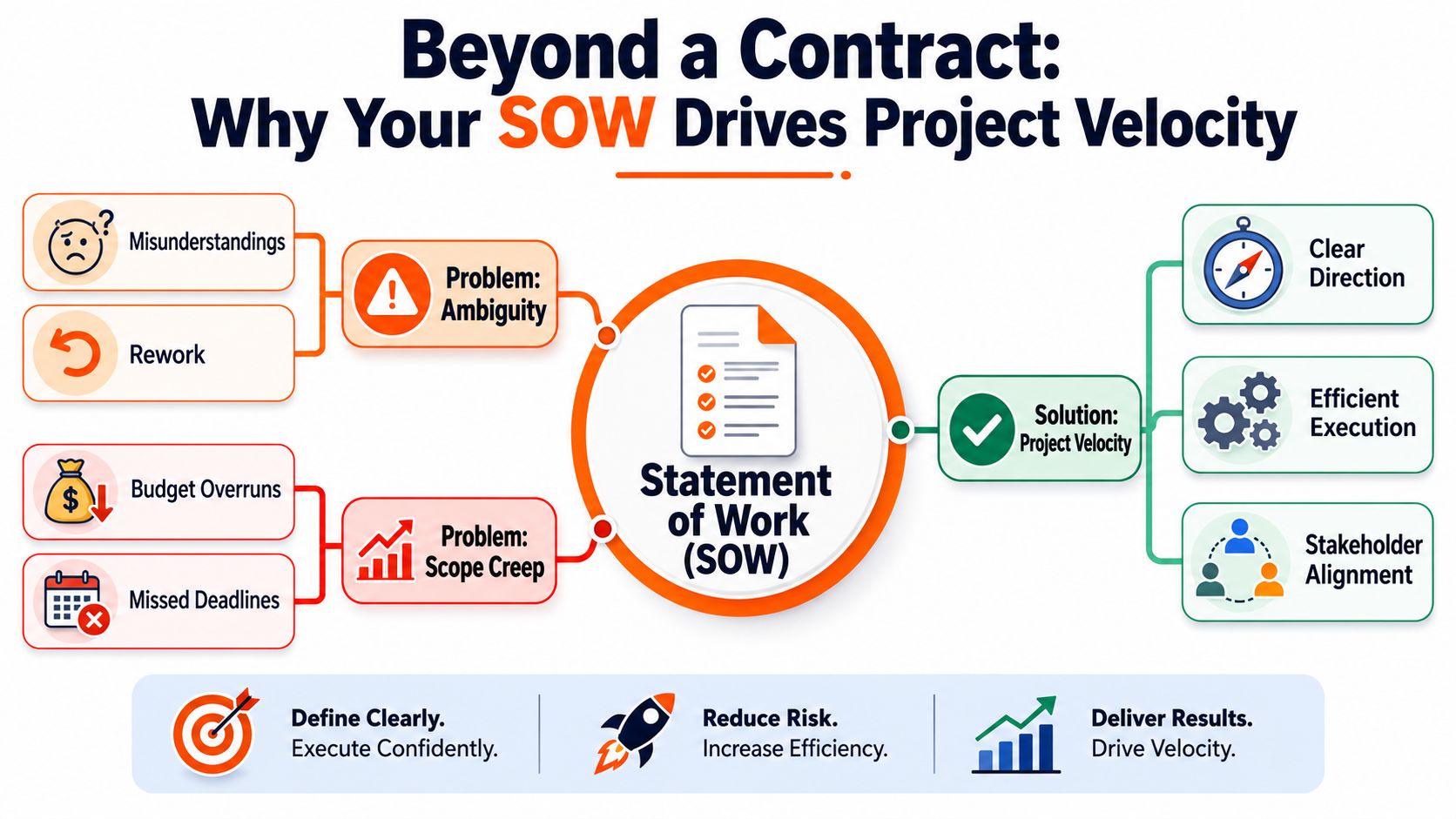
What the SOW actually does
A proper SOW gives your team three things.
- Direction: It tells engineers, designers, QA, and stakeholders what problem they're solving and what won't be built.
- Decision rules: It defines how changes are handled, who approves them, and what counts as done.
- Delivery speed: It reduces time wasted on clarification loops, rework, and avoidable conflict.
That's why I don't treat the SOW as a static document. I treat it as the first operational model of the project.
Practical rule: If your SOW can't guide backlog decisions, it's not finished.
Why “good enough” fails
A “good enough” SOW usually sounds harmless. It includes broad business goals, a timeline that looks ambitious, and a list of features that nobody has pressure-tested. Then delivery starts and the holes appear.
One stakeholder thought “admin dashboard” meant analytics. Another thought it meant user permissions. Engineering assumed third-party integrations were client-owned. The client assumed the delivery partner would lead that work. Nobody is technically lying. Everyone is operating from ambiguity.
That's where Extreme Ownership matters. The right delivery team doesn't hide behind the document and say, “That wasn't specified.” They challenge weak assumptions before signature. They push for hard decisions. They make ambiguity visible while there's still time to fix it.
Velocity starts before development
If you want a fast MVP, start by writing an SOW that removes excuses. Not a bloated document. A disciplined one. Clear outcomes. Defined boundaries. Explicit assumptions. Acceptance criteria with teeth.
A solid SOW doesn't slow momentum. It creates it.
The Anatomy of a Bulletproof Software SOW
A bulletproof SOW is specific enough to guide delivery and flexible enough to survive reality. That balance doesn't happen by accident. You get it by structuring the document around decisions that protect business outcomes.
The strongest approach I've seen follows a validated four-step method: Discovery, Analyze/Forecast/Decide, Detailed Design, and Final Revisions. In UK-based SaaS teams, projects using formal change management in that process reported 45% fewer delays and a 38% increase in MVP delivery speed, as described in this four-step SOW methodology.
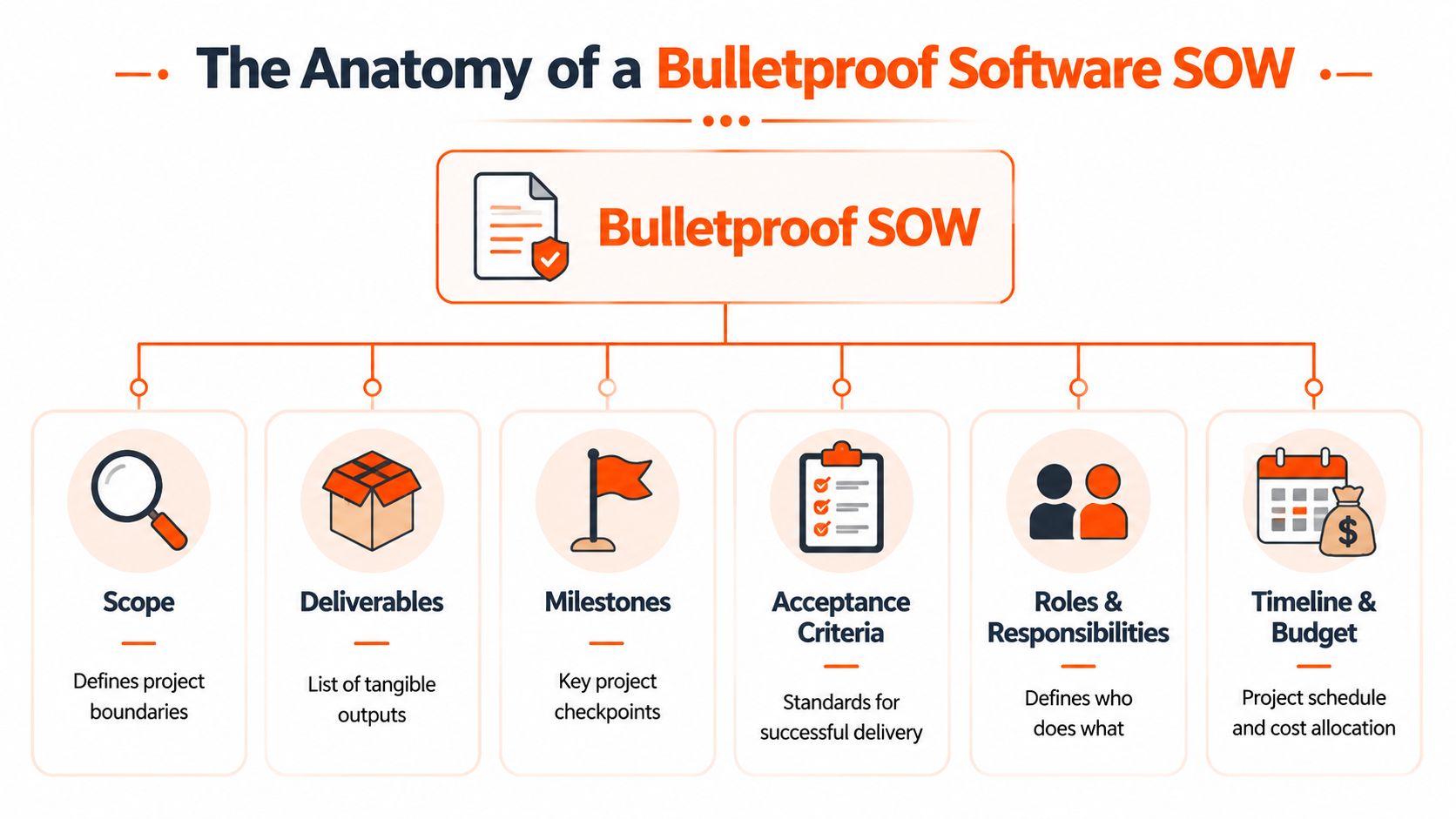
Start with scope, not wishful thinking
Scope isn't your feature wishlist. It's your boundary line.
A strong scope section answers four questions clearly:
- What business problem are we solving?
- What's in scope for this engagement?
- What is explicitly out of scope?
- What assumptions must stay true for the plan to work?
If you skip the fourth question, the rest of the SOW is fragile. Assumptions are where hidden risk lives. Access to APIs, stakeholder availability, design ownership, data readiness, compliance reviews. If these are fuzzy, the plan is fantasy.
Deliverables must be testable
“Build an MVP” is not a deliverable. “Launch customer onboarding flow with sign-up, email verification, account creation, and admin approval path” is closer. The point is that a deliverable must be something a team can verify, review, and accept.
If your product team needs help tightening that thinking, a practical product requirements document guide can help translate loose ideas into structured requirements before they harden into SOW language.
Here's the difference that matters:
| Weak wording | Strong wording |
|---|---|
| User dashboard | Authenticated dashboard showing account summary, latest activity, and role-based navigation |
| Payment integration | Stripe integration for subscription checkout, billing status sync, and failed payment alerts |
| Admin tools | Admin panel for viewing users, changing account status, and exporting CSV reports |
Milestones should expose risk early
Bad milestones are date labels. Good milestones are decision points.
Use milestones to force validation at the right moments. For example:
- Discovery complete: stakeholders aligned, feature inventory approved
- Technical design approved: architecture and dependencies confirmed
- Build phase checkpoint: core workflows demoed against acceptance criteria
- Pre-release review: defects triaged, release conditions confirmed
This isn't bureaucracy. It's control. You want problems to surface while they're still cheap.
A milestone should tell you whether to continue, change course, or stop. If it only marks elapsed time, it's decorative.
Acceptance criteria are where quality gets real
Acceptance criteria stop endless interpretation. They define what success looks like in behaviour, not in aspiration.
Use criteria that a product manager, engineer, and tester can all evaluate without debate. “Fast”, “intuitive”, and “user-friendly” don't belong here unless you've translated them into observable outcomes.
Good acceptance criteria also reduce rework because they remove the classic trap of late-stage surprise. If a stakeholder sees the output and says, “That's not what I meant,” the SOW has already failed.
Roles, responsibilities, and budget need hard edges
A mature SOW also names ownership. Who provides content? Who approves UX? Who controls production access? Who signs off each milestone?
Then tie the commercial model to delivery reality. Fixed-price can work for tightly defined work. Time and materials can work when controlled by clear scope governance. The mistake isn't choosing one model over another. The mistake is choosing a pricing model that rewards confusion.
A bulletproof SOW doesn't just describe the project. It aligns incentives around speed, quality, and accountability.
From Vague Ideas to Crystal-Clear Deliverables
Most failed software engagements don't start with bad intent. They start with polite ambiguity.
A founder says, “We need an MVP for customer onboarding.” The delivery partner nods. Product writes a few bullets. Sales wants reporting. Ops wants role permissions. Compliance wants audit history. Development starts anyway. Three sprints later, everyone's frustrated because the project is delivering work, but not confidence.
That's not a delivery problem. It's a scope translation problem.

A weak scope statement
Here's the sort of wording that causes pain:
Build a modern onboarding system for new users, including automation, admin visibility, and integration with existing tools.
It sounds reasonable. It's also full of traps. What kind of users? Which automations? What admin actions? Which tools? What level of integration? Read-only sync or bi-directional workflows? Nobody knows.
A delivery-ready version
Now compare that with this:
- Primary outcome: Reduce manual effort in new customer setup by moving account creation and approval into a single web workflow.
- User groups: End users, internal operations staff, platform administrators.
- Core deliverables: Sign-up flow, email verification, document upload, approval queue, account activation, admin dashboard, activity log.
- Integration boundary: CRM sync for approved accounts only. No billing integration in this phase.
- Out of scope: Mobile app, multilingual support, partner portal, advanced analytics.
- Acceptance basis: Each workflow is demoed against approved user stories and agreed review criteria.
That version gives the team something to build and gives the client something to evaluate.
What proactive clarification looks like
In the UK software market, ambiguous deliverables and weak change control contribute to scope creep in 60–70% of underperforming software projects, according to IBISWorld's UK software developers data. That's exactly why a proper delivery partner must push harder during sow development.
A team with real ownership asks uncomfortable questions early:
- If approval is delayed, what happens to the user?
- Who owns copy and legal text?
- What data must appear in the admin view on day one?
- What's the fallback if the integration endpoint isn't stable?
Those questions don't create friction. They remove future friction.
If you're tightening legal and commercial wording alongside delivery scope, tools like an AI Contract Writer can speed up first-pass drafting. Just don't confuse faster drafting with better thinking. The value still comes from the conversations.
Turn ideas into working units
I prefer a simple progression during sow development:
| Stage | What you have | What you need next |
|---|---|---|
| Goal | “Improve onboarding” | Business outcome and user groups |
| Epic | “User registration” | Workflow boundaries and dependencies |
| Story | “User submits application” | Entry conditions and expected result |
| Acceptance | “Reviewed and approved” | Observable pass/fail criteria |
If your team struggles to document early feasibility and decision logic, this guide to proof of concept documentation is a useful reference before the SOW gets locked.
The best partners don't just collect requirements. They interrogate them until everyone can act on the same understanding.
That's the #riteway in practice. High energy, zero passivity, and no hiding behind vague briefs.
Managing Change and Mitigating Project Risk
Change isn't the enemy. Uncontrolled change is.
Too many buyers treat change control, IP clauses, warranties, and SLAs like legal ballast. They want the project to feel agile, so they keep these sections light. Then reality hits. A dependency slips. A stakeholder changes direction. A release needs support coverage. Suddenly the project is improvising under pressure.
That's avoidable.
Change control is an agility tool
A proper change control clause doesn't block adaptation. It creates a clean path for it. The team documents the requested change, explains the effect on scope, timing, budget, or sequencing, and gets a decision quickly. That process protects momentum because it stops hidden work from leaking into delivery.
Without change control, one of two things happens. Either the team absorbs extra work and quality drops, or the team pushes back late and trust drops. Neither outcome is acceptable.
Use a simple structure:
- Describe the change: what is being added, removed, or altered
- Assess the impact: delivery timeline, dependencies, testing, commercial terms
- Name the decision-maker: one owner, not a committee
- Record the outcome: approved, rejected, or deferred
IP, warranties, and SLAs support execution
Intellectual property clauses matter because nobody wants to discover ownership confusion at release time. Warranties matter because you need a shared expectation for defect correction and post-delivery responsibility. SLAs matter when the engagement includes operational support, response expectations, or production care.
These terms are operational, not academic.
Here's where teams usually go wrong:
| Clause | Bad approach | Better approach |
|---|---|---|
| Change control | Buried in generic legal language | Clear workflow with owner and approval path |
| IP | Assumed rather than stated | Explicit ownership, licence, and third-party dependency terms |
| Warranty | Vague quality promise | Defined remediation window and defect handling rules |
| SLA | Generic uptime language | Service expectations tied to the actual support model |
For a deeper look at structuring delivery risk before it becomes commercial damage, this guide to software project risk management is worth keeping close.
Don't outsource ownership to the contract
A strong SOW doesn't eliminate risk by wording alone. People still need to operate it. That's where ownership matters most. The team should flag issues early, document trade-offs, and make change visible before it becomes conflict.
If a project changes and your SOW has no practical way to absorb that change, the document isn't protecting delivery. It's just recording disappointment.
The best SOWs create room for adaptation without inviting chaos. That's the balance you want.
Negotiating Your SOW for a Nearshore Partnership
Nearshore delivery adds advantage when it's managed well. It also exposes weak assumptions faster because communication, ownership, and operating rhythm become impossible to fake.
That's why SOW negotiation with a nearshore partner shouldn't feel like a legal arm-wrestle. It should feel like an alignment workshop. You're not just agreeing what gets built. You're agreeing how two teams will make decisions together under pressure.
What to settle before signature
Don't leave operational basics to “team norms” after kick-off. Put them in the SOW or its working appendices.
Focus on points that affect delivery day by day:
- Communication cadence: who joins weekly reviews, who handles daily clarification, where decisions are recorded
- Working overlap: expected hours for live collaboration, not just timezone compatibility on paper
- Escalation path: what happens when blockers sit unresolved
- Approval expectations: who signs off designs, stories, releases, and change requests
- Artefact ownership: backlog, documentation, environments, release notes, support handover
If a partner resists this level of clarity, pay attention. That resistance usually shows up later as “misalignment”.
How to spot a consulting partner
A vendor waits for instructions. A consulting partner challenges assumptions, protects outcomes, and speaks up before issues become expensive.
There are hard indicators for that standard. A true consulting partner can be identified by metrics such as rework below 5% and defect density under 15 bugs per 1,000 lines of code, as outlined in this nearshore quality management guide. Those aren't marketing slogans. They're quality floors.
A partner with a consulting mindset should also do three things during SOW negotiation:
- Push back on unrealistic sequencing.
- Expose hidden dependencies.
- Recommend trade-offs that improve time to value.
If you're comparing engagement models before locking the SOW, this overview of AI staff augmentation is a useful contrast to a more outcome-led partnership approach.
The nearshore SOW should test behaviour, not just wording
The negotiation process tells you a lot. Do they ask sharp questions? Do they propose better delivery mechanics? Do they surface risks without drama? That's the behaviour you want when the project gets difficult.
This guide on how to choose a nearshore partner is useful if you're still evaluating who should sit on the other side of the SOW.
“We can build that” is easy to say. “Here's where this can fail, and here's how we'll prevent it” is the answer that matters.
A nearshore SOW should lock in ownership, communication discipline, and quality standards before the first sprint starts. If it does that, the partnership has a strong base. If it doesn't, distance amplifies every weakness.
Your Post-Signature SOW Success Checklist
Signing the SOW doesn't create control. Operating it does.
Following initial approvals, many teams relax too early. Procurement is happy, legal is done, the project is “approved”, and then the delivery team gets a rushed handover with half the context missing. That's how a strong document turns into weak execution.
The SOW needs to become a living delivery reference from day one.
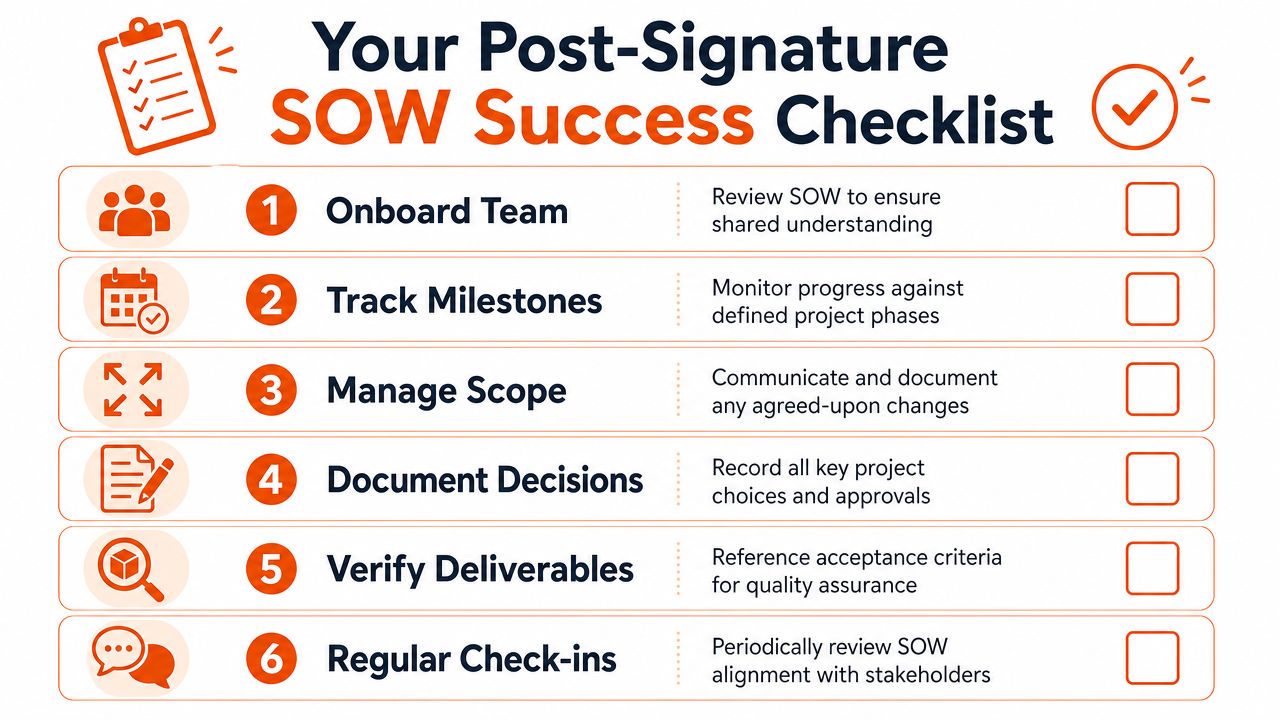
What to do immediately after signature
The first move is a structured handover. Not an email. A working session.
Walk the team through the agreed outcomes, scope edges, assumptions, milestones, acceptance logic, and change process. Then check for silent gaps. Engineers, QA, product, and stakeholders should all be able to explain the same project in similar language.
After that, establish outcome-led reporting. Don't ask for busyness metrics. Ask whether the team is moving the agreed business outcome forward.
The metrics that matter
To measure value over technical output, teams should track Lead Time for Changes and Deployment Frequency, establishing a baseline in the first 30 days and reviewing monthly, as recommended in this guide to software engineering metrics for business outcomes. That pushes reporting away from activity and towards delivery performance.
Those metrics matter because they show whether the system is becoming easier to change and whether the team can ship consistently. Both are stronger signals than raw ticket counts.
Use the SOW to align on what gets monitored:
- Lead Time for Changes: how long it takes to move work from commit to production
- Deployment Frequency: how often the team ships working changes
- Milestone confidence: whether the next agreed checkpoint is on track
- Scope integrity: whether changes are visible, documented, and approved
- Acceptance readiness: whether deliverables meet the agreed standard before review
SOW Handover and Monitoring Checklist
| Phase | Action Item | Outcome Focus |
|---|---|---|
| Kick-off | Review the SOW with delivery, product, QA, and stakeholders | Shared understanding of goals, scope, and constraints |
| Planning | Map backlog items to deliverables and milestones | Work stays tied to business intent |
| Execution | Track approved scope against active development | Prevent hidden scope drift |
| Governance | Log key decisions, approvals, and trade-offs | Keep accountability visible |
| Review | Validate deliverables against acceptance criteria | Reduce subjective sign-off disputes |
| Monitoring | Review delivery KPIs on a regular cadence | Measure progress through outcomes, not effort |
Keep the SOW active
The strongest teams bring the SOW back into weekly and milestone conversations. Not to wave it around in disputes, but to anchor decisions. If scope changes, update the record. If assumptions break, raise it. If priorities shift, decide what moves and what doesn't.
That's how sow development pays off. Not at signature. In operation.
One final check: if your weekly project review can happen without referencing outcomes, scope boundaries, or acceptance criteria, your SOW is already fading into the background.
If you want a nearshore partner that treats sow development as a delivery system rather than a paperwork exercise, talk to Rite NRG. We help SaaS teams turn vague plans into clear execution, bring senior engineers into the process early, and apply the #riteway of Extreme Ownership so scope, speed, and quality stay aligned from day one.