
You're probably in one of two situations right now. Either your in-house team can't ship fast enough, or you're staring at a stack of nearshore proposals that all sound the same. Senior engineers. Agile delivery. Flexible engagement. Strong communication. Every deck says it. Very few partners actually deliver it.
That's why most advice on how to choose a nearshore partner is too weak to be useful. It treats partner selection like procurement. Compare rates, check the stack, skim a few case studies, sign a contract. That approach creates vendor relationships. It doesn't create delivery momentum.
A strong nearshore engagement should change your execution speed, sharpen product decisions, and reduce delivery risk. If it doesn't, you didn't hire a partner. You rented capacity.
Beyond Cost Savings Defining Your True North
A CTO approves a nearshore partner because the rates look good. Ninety days later, velocity is flat, product decisions still bottleneck internally, and the external team waits for tickets instead of driving progress. The budget line improved. The business did not.
Start with outcomes, not hourly rates.
Cost matters, but cost is a filter, not your strategy. Nearshore can reduce spend and give UK teams better working-hour overlap than offshore models. That matters. It still does not tell you whether you are buying extra hands or a delivery partner that will carry work with Extreme Ownership.

Stop buying output
If your brief says "we need three backend developers and a QA," you are setting the wrong frame. You will get capacity offers, CVs, and promises of agile delivery. You will not get much ownership.
Write the brief around the business event you need to deliver. Be specific:
- Commercial goal: Are you trying to launch an MVP, stabilise a product that is hurting retention, complete a migration, or get investor-ready?
- Operating model: Do you need staff augmentation, a product squad, end-to-end ownership, or a Build-Operate-Transfer path that becomes your own team later?
- Decision rights: Do you expect the partner to challenge weak requirements, flag delivery risk early, and propose better sequencing?
- Success measures: Will you judge the engagement by time-to-value, release frequency, adoption, and quality, or by how many tickets they close?
For SaaS teams, this is the dividing line between a vendor and a partner. A vendor waits for instructions. A partner owns the result, asks uncomfortable questions, and protects the outcome even when your original plan is flawed.
A partner that only asks for requirements is showing you how they will behave after kickoff.
A better benchmark
Judge nearshore options by how much business movement they can create. Faster releases. Fewer handoff delays. Better product calls. Lower execution risk.
This also shapes the location decision. If ownership, collaboration speed, and shared working hours matter more than maximum labour arbitrage, review the tradeoffs in these nearshore vs offshore delivery models. The cheaper model on paper often becomes the slower and more expensive model in practice.
Set your true north before you shortlist anyone. Decide what must change in the next 6 to 12 months, then choose the partner that can connect engineering work to that outcome with clear accountability. If they cannot speak in those terms on the first call, remove them from the process.
Building Your Partner Scorecard The Non-Negotiable Criteria
Most selection processes fail because they mix hard requirements with gut feel and call it due diligence. Don't do that. Use a scorecard. Force every bidder through the same lens. If they resist structure, that's a signal in itself.
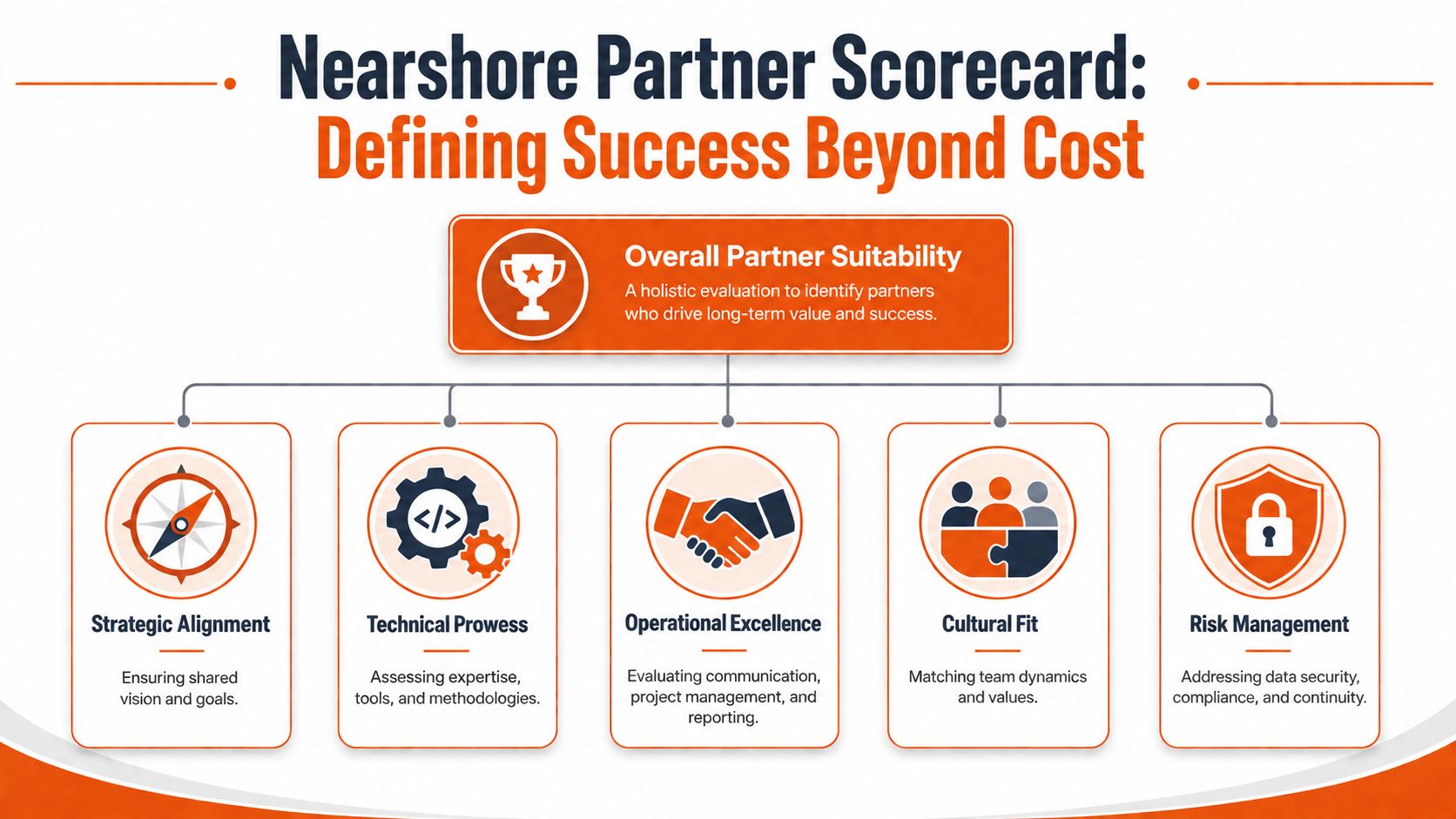
Pillar one and two strategic alignment and technical fit
Start with strategy, then move to stack. A partner can have excellent engineers and still be wrong for your business.
Use questions like these:
- Business alignment: What business event are we hiring for? MVP launch, migration, stabilisation, BOT, or scale-up?
- Decision maturity: Can they explain how they'd sequence work against product risk and time-to-market?
- Domain context: Have they worked inside your kind of delivery pressure, not just your programming language?
Then get specific on stack and geography. For the UK market, tech stack alignment is a strong filter. If your environment is more than 40% Microsoft platforms, ServiceNow, or SAP, Poland wins by default because of its enterprise integration depth and banking expertise. For cost-sensitive backend or DevOps work, Bulgaria is the statistically superior choice, according to this UK nearshore Poland guide.
Pillar three culture and ownership
Most buyers become vague during evaluations. Don't ask whether they value communication. Ask how they surface risk, challenge assumptions, and handle ambiguity.
A useful way to assess that is to borrow discipline from formal vendor management practices rather than treating the selection as a chemistry test.
Ask:
- Escalation behaviour: What happens when a delivery manager thinks our requested timeline is unrealistic?
- Ownership signal: Tell me about a time you pushed a client to change scope, architecture, or priority.
- Team energy: Who owns blockers between stand-ups?
Practical rule: If every answer sounds smooth and agreeable, you're probably talking to a passive team.
Pillar four security and compliance
Security isn't a legal appendix. It's delivery infrastructure. If they're touching customer data, production workflows, or regulated systems, weak controls will turn into delays and risk.
Check:
- Access discipline: How do they handle environment access, onboarding, and offboarding?
- IP clarity: Who owns code, documentation, and automation produced during the engagement?
- Compliance readiness: Can they work inside your governance model without becoming a bottleneck?
Pillar five pricing and delivery flexibility
Hourly rate matters less than operational efficiency. Cheap teams become expensive when you spend your own leadership time carrying them.
Use this quick decision table:
| Area | Good answer | Bad answer |
|---|---|---|
| Pricing | Clear commercial model tied to team shape and outcomes | Low headline rate with vague assumptions |
| Scaling | Can add or reshape team around delivery stage | Forces one engagement model for every problem |
| Delivery model | Supports dedicated teams, projects, and BOT where relevant | Only offers staff augmentation |
One provider you might evaluate in this category is Rite NRG, which works across dedicated teams, platform development, consulting, and Build-Operate-Transfer models. That matters if your needs won't stay static for long.
Gauging the Engine Assessing Culture Communication and Ownership
Most failed partnerships aren't caused by weak syntax. They fail because the team waits. Waits for direction. Waits for approval. Waits for someone on your side to notice a risk that should have been raised earlier.
That passivity is expensive. Recent UK market data indicates that 47% of nearshore projects fail due to passive communication, where teams wait for explicit instructions instead of surfacing risk early. The answer isn't another vague discussion about “cultural fit”. It's a measurable Ownership Scorecard, backed by a 90% or higher quality audit score from day one, rework below 5%, and defect density under 15 bugs per 1,000 lines of code, as discussed in this analysis on choosing a nearshore company model.
What ownership actually looks like
At Rite NRG, we call this the #riteway Methodology. It's built on Extreme Ownership, energy, and proactive delivery behaviour. That sounds like branding until you translate it into observable actions.
Here's what you should look for in any partner:
- Risk surfacing: Engineers flag delivery threats before they become escalation items.
- Product-first judgement: The team asks why a feature matters, not just how to build it.
- Quality discipline: Rework stays low because they don't throw code over the wall and hope QA catches it.
- Commercial awareness: They understand that delays affect launch windows, churn risk, and investor confidence.
Interview for friction, not charm
Most vendor interviews are useless because the questions are too safe. Don't ask, “How do you communicate with clients?” Everyone has a polished answer ready.
Ask questions that create productive tension:
- Challenge: Tell me about a time you told a client their plan was wrong.
- Priority trade-off: When deadlines slip, what do you cut first and why?
- Early warning: How do you signal architectural risk before it blocks delivery?
- Ownership boundary: What do your engineers own without waiting for client approval?
A team that thinks like an order-taker will answer with process language. A team with ownership will answer with judgement.
The best nearshore teams don't protect themselves from accountability. They move towards it.
Build a simple Ownership Scorecard
You don't need a giant spreadsheet. You need a practical way to compare signals across interviews, workshops, and trial work.
Use criteria such as:
| Signal | What to look for |
|---|---|
| Proactivity | Raises risks unprompted |
| Clarity | Gives direct answers, not sales phrasing |
| Product thinking | Connects engineering decisions to customer outcomes |
| Energy | Shows pace and intent, not just politeness |
| Quality mindset | Talks about preventing rework, not just fixing bugs |
If you want sharper prompts for finding candidates who align with your team, this set of cultural fit interview questions is useful because it goes beyond “nice to work with” and pushes into values, behaviour, and decision-making.
The Ultimate Test Drive Designing a Pilot That Predicts Success
Small pilot projects are one of the worst habits in nearshore selection. They feel cautious, but they don't test anything that matters. A toy task doesn't reveal how a partner handles ambiguity, pressure, changing scope, technical debt, or real stakeholder interaction.
That's why the classic “let's start with a tiny pilot” approach so often leads nowhere. UK-based industry analysis shows that 62% of nearshore partnerships started through small pilots fail to convert into long-term engagements. A stronger method is a 2 to 4 week paid trial costing $8k to $25k that validates technical velocity before full commitment, as covered in this review of how to select the right nearshore partner and minimise risks.
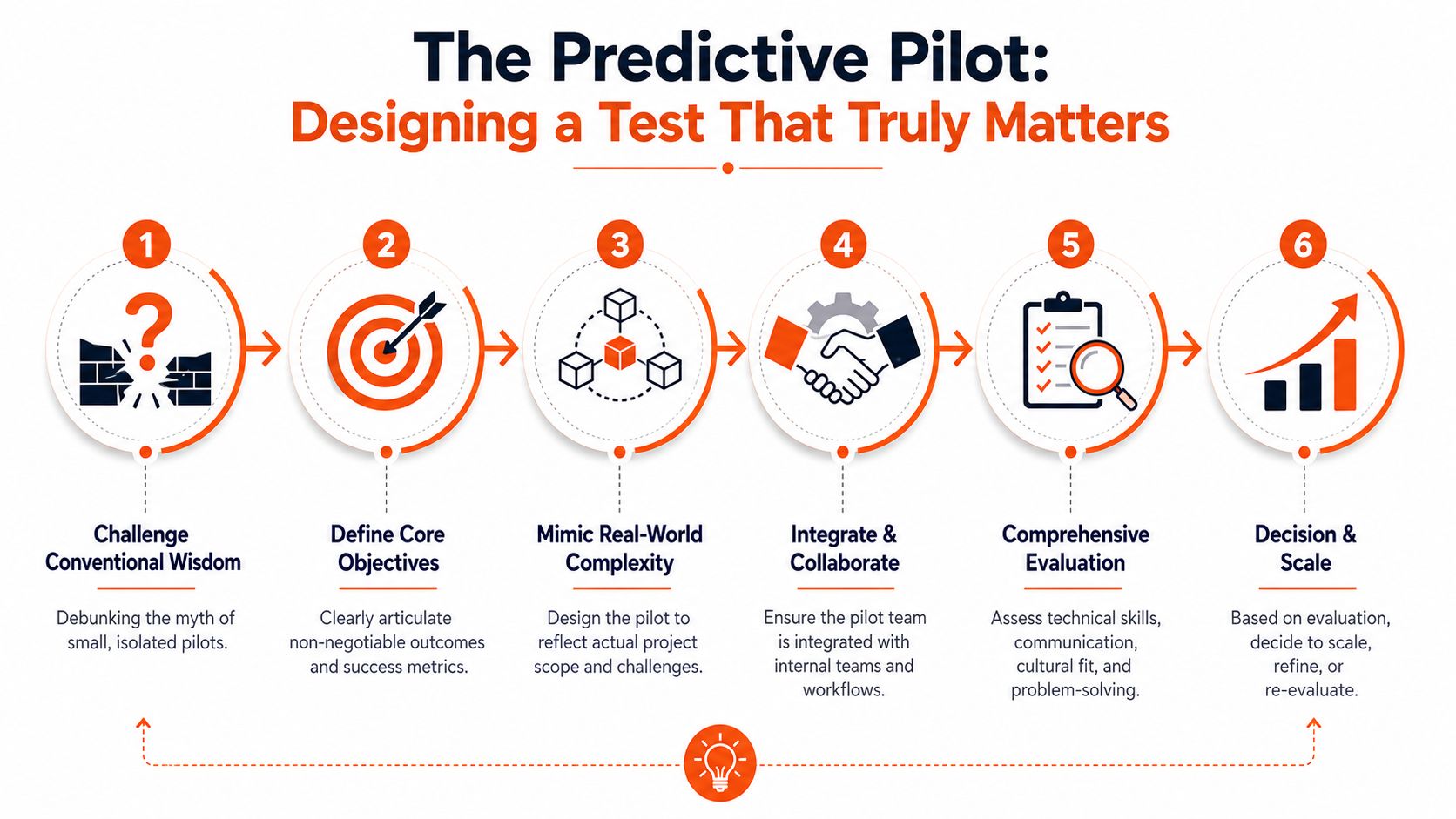
What a predictive pilot must include
The test should look like real delivery, not a sandbox exercise. Pull a genuine problem from your backlog. Give the team access to the people, constraints, and context they'd face if you hired them properly.
A good trial includes:
- A real backlog slice that carries business relevance.
- Cross-functional exposure to your product, engineering, and stakeholder rhythms.
- Decision-making room so you can see whether they challenge weak assumptions.
- Observable outputs such as delivery quality, communication pattern, and risk management.
If you need a stronger internal structure first, this guide to proof of concept documentation can help frame what the trial is supposed to prove before you start.
Use three phases, not one task
A proper trial should mirror the Three-Phase Technical Validation approach used in UK vendor selection.
- Phase one, paid assessment: Give the partner a real backlog problem and watch how they approach it.
- Phase two, day-in-the-life session: Observe collaboration in real time. How they discuss trade-offs matters as much as what they build.
- Phase three, technical debt audit: Ask them to review an existing part of your codebase and identify risks, shortcuts, and architectural concerns.
That combination exposes mismatches early. A small isolated pilot hides them.
To see the concept from another angle, this short walkthrough is worth a look before you design the engagement:
Measure outcomes, not just code shipped
Don't leave the trial with a vague sense that “they seemed good”. Score it.
Look at:
- Velocity under real constraints: Did they move with urgency?
- Communication maturity: Did they surface blockers early?
- Architectural judgement: Did they make sound trade-offs?
- Business alignment: Did they understand what outcome the work was supposed to create?
The point of the pilot isn't to get cheap work done. It's to learn whether you can trust this team for more critical projects.
From Handshake to Launch Contracting and Onboarding Best Practices
You approve the partner on Friday. By Wednesday, legal is stuck on vague IP language, the engineers still do not have repo access, and the team that impressed you in the sales process is nowhere on the kickoff call. That is how good vendor selection work gets wasted.
Contracting and onboarding decide whether your nearshore partner behaves like rented capacity or a delivery partner with Extreme Ownership. Treat this stage like delivery design. If you leave gaps here, you will pay for them in delays, rework, and executive frustration.
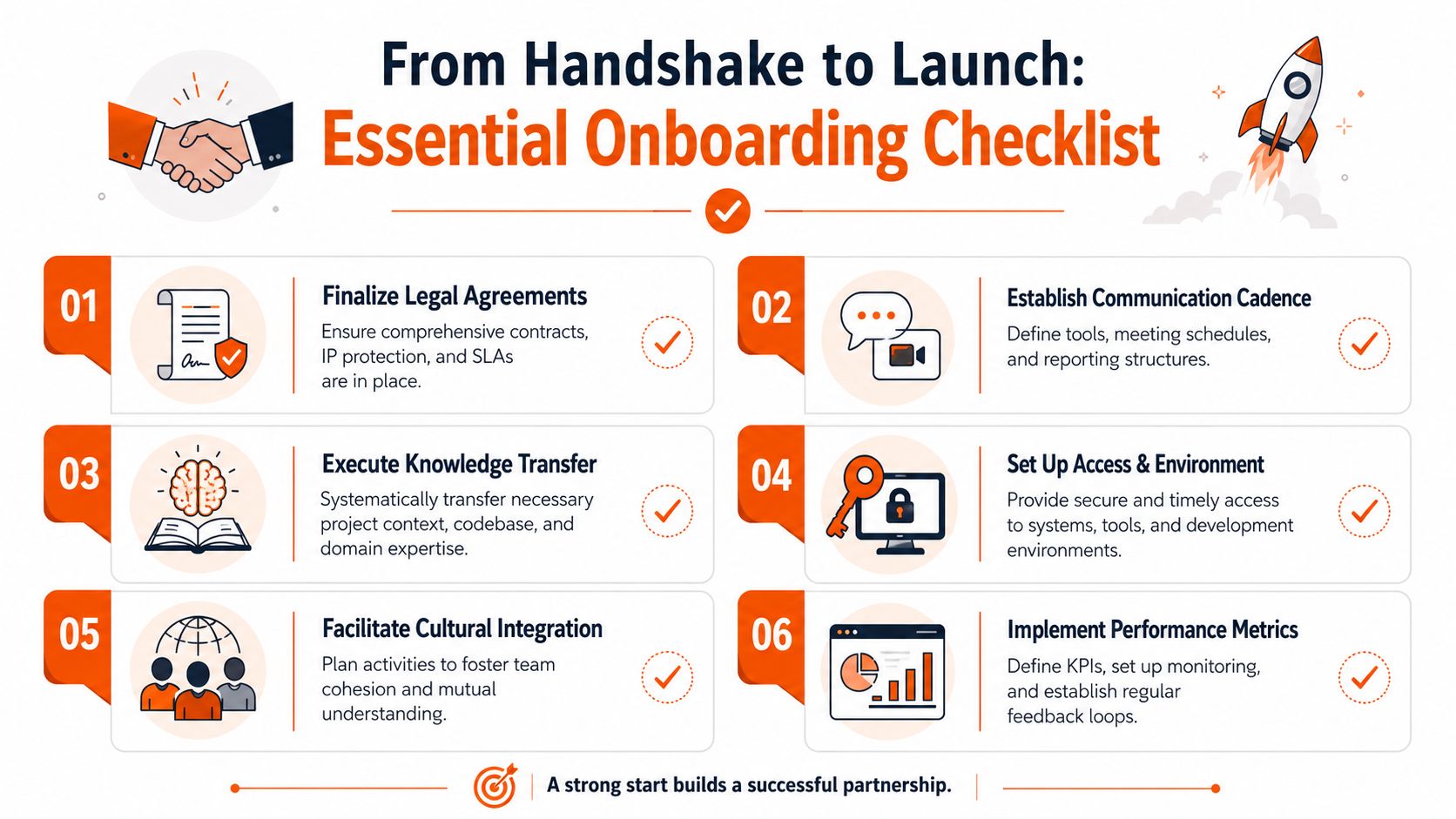
What the contract must settle
Your contract should answer operational questions before they turn into commercial fights.
Start with ownership. Code, documentation, infrastructure definitions, test assets, and AI-assisted outputs should be assigned clearly to your company. If that language is soft, fix it before signature.
Then get specific on the mechanics of delivery:
- Pricing model: define rates, billing triggers, approval rules, and what happens when scope changes
- Named team commitment: list key roles, expected seniority, and the process for replacing people
- Security and data handling: spell out access rules, environments, audit expectations, and compliance duties
- Scaling rules: set notice periods for ramp-up, ramp-down, and role changes
- Service levels: define response times, availability expectations, support boundaries, and escalation paths
- Exit terms: require orderly knowledge transfer, handover support, and continued access to critical documentation
If you want a plain-English legal refresher on what belongs in a service agreement, that breakdown is useful for non-lawyers reviewing contract structure.
For SaaS teams and Build-Operate-Transfer models, add one more clause. The partner must document systems, decisions, and operating routines as they go. If you ever plan to internalise the team, undocumented delivery is a hidden liability.
Red flags before signature
Kill the deal if you see any of these and the partner cannot correct them fast:
- The proposed team changes after the sale: the partner sold senior people and staffed junior replacements
- Commercial assumptions live in email, not the contract: that is how surprise invoices happen
- Onboarding ownership is fuzzy: nobody owns access, environment setup, documentation, or training
- Governance is missing: there is no meeting cadence, no escalation route, and no named decision-makers
- Knowledge stays with individuals: the partner talks about talent but not about documentation, repeatability, or transfer
One rule matters here. If the partner resists clarity before money starts flowing, they will resist accountability once delivery gets hard.
Onboarding as operational integration
Good onboarding puts a new team into motion fast. Bad onboarding creates dead time and then blames the partner for a slow start.
Run onboarding like a launch plan with owners and deadlines on both sides. Your product lead should own business context. Your engineering lead should own architecture and environment access. The partner should own team readiness, communication rhythm, and risk reporting from day one.
Your first days should include:
| Onboarding area | What good looks like |
|---|---|
| Access setup | Tools, repos, environments, and permissions ready on time |
| Context transfer | Product goals, roadmap, architecture, and user realities explained clearly |
| Team rituals | Stand-ups, reviews, demos, and escalation paths agreed |
| KPI baseline | Success measures visible from the start |
Add a 30-60-90 day plan. Keep it simple. What should the team understand by day 30, improve by day 60, and own by day 90? That timeline exposes weak onboarding fast and forces both sides to act like operators, not spectators.
Do not wait for the team to settle in before you expect discipline. Set the rhythm on day one.
Conclusion It's Not Who You Hire It's How You Partner
The nearshore decision gets easier when you stop thinking like a buyer and start thinking like an operator. You are not choosing a vendor from a catalogue. You are choosing who gets to influence your delivery speed, product quality, and execution risk.
That changes the standard.
The right partner doesn't hide behind compliance language, delivery theatre, or polished account management. They show ownership early. They challenge weak assumptions. They communicate with energy. They act like the outcome belongs to them too. That's the difference between rented capacity and a strategic delivery partner.
This is also where the business lens has to stay sharp. UK businesses should evaluate nearshore partners using quantifiable KPIs tied to outcomes such as reduction in time to market for key features and improved customer satisfaction due to faster releases, rather than defaulting to coding volume or raw activity, as outlined in these KPIs that matter for nearshore teams.
Raise your bar
If you take one thing from this guide, let it be this. Don't shortlist partners because they sound capable. Shortlist them because they can prove they'll move the business.
Use a scorecard. Test ownership. Design a predictive trial. Contract for clarity. Onboard with intent.
And keep your standards high:
- Demand outcome thinking: If they can't connect engineering to business value, they're not ready.
- Demand proactive communication: Silence is not professionalism. It's risk.
- Demand shared ownership: A strong partner doesn't wait to be managed.
- Demand energy: Execution speed comes from intent, not headcount.
When you choose that way, nearshore stops being a staffing decision. It becomes a growth decision.
If you're evaluating partners and want a direct view of what good looks like, Rite NRG helps SaaS teams and product-led companies build with senior nearshore engineers, outcome-focused delivery, consulting support, and Build-Operate-Transfer options in Poland. If you're serious about predictable delivery and faster execution, start the conversation with your business outcome, not your vacancy list.