You're likely staring at a spreadsheet right now, trying to turn a product idea into a number you can defend. One tab has feature ideas. Another has contractor quotes that don't line up. A third has investor expectations that definitely don't care how messy software delivery can get.
That's where most founders go wrong. They treat cost estimation for software as a pricing exercise. It isn't. It's a planning exercise. A strong estimate doesn't give you one magic number. It gives you a roadmap, a risk profile, and a clear line between spend and business value.
The right mindset is simple. Stop asking, “What will it cost?” Start asking, “What do we need to know to make delivery predictable?” If you need a useful outside perspective to understand software development costs, that overview is a decent starting point. But the real shift happens when estimation becomes part of strategy, not procurement.
Predictable delivery starts before development. It starts with product clarity, sensible trade-offs, and ownership from day one. That's the thinking behind the #riteway approach. Extreme Ownership. High energy. No hiding behind vague ranges or technical theatre. If the estimate can't support a delivery plan, it's not an estimate worth using.
Stop Guessing Start Planning
A founder I speak with often has the same problem. They want an MVP in market fast, they've got pressure from customers or investors, and they need confidence without wasting months in analysis. They've usually collected a few quotes already. One looks cheap and suspicious. One looks expensive and vague. One promises speed but says very little about risk.
That's not a buying problem. That's a planning problem.

Good cost estimation for software should answer four questions clearly:
- What outcome are we funding
- What scope is essential for that outcome
- What assumptions make the estimate viable
- What risks could move cost or timeline
If your estimate doesn't answer those, it's just a number with a logo attached.
A lot of teams jump straight from an idea into backlog writing. That's too early. Before anyone argues about story points, team shape, or sprint length, you need a roadmap that connects business goals to delivery choices. Product strategy work is vital. A sharp framing exercise like a roadmap and strategy workshop creates the conditions for sane estimation later.
A credible estimate is a decision tool. It helps you choose what to build now, what to delay, and what risk you're accepting.
The practical difference is huge. Founders who treat estimation as discipline move faster because they cut indecision early. They don't budget for everything. They budget for the right first move, then protect delivery with clear assumptions and active risk management.
Define Your Destination Before Drawing the Map
A founder asks for a fixed price to build “a client portal.” Two weeks later, the actual goal turns out to be reducing account churn, cutting support load, and giving enterprise customers self-serve reporting. That is a different project, a different risk profile, and a different estimate.
Predictable delivery starts with a clear destination. If the business outcome is fuzzy, the estimate will swing, scope will drift, and your nearshore team will spend the first sprint decoding intent instead of building momentum.
Start with the business result
Feature requests do not give you estimation accuracy. Outcomes do.
“Build onboarding” gives a delivery team too much room to guess. “Increase trial-to-paid conversion by removing setup friction in week one” gives them a target they can estimate against. “Add reporting” is too broad. “Help account managers spot churn risk before renewal” creates a sharper scope, better trade-offs, and a roadmap tied to value.
That discipline matters even more in nearshore delivery. A distributed team performs best when the commercial goal, user problem, and release boundary are explicit from day one. That is how you get fewer assumptions, faster alignment, and a plan you can govern.
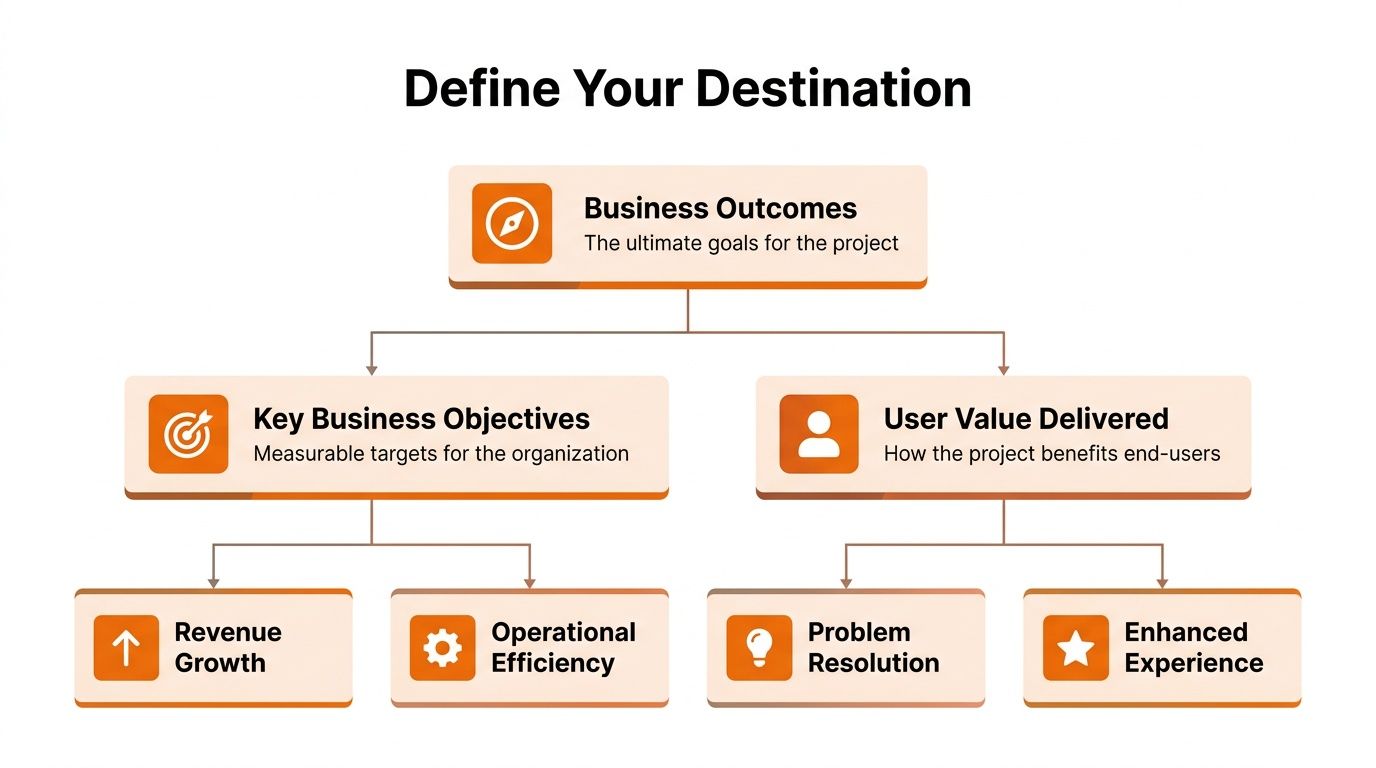
Use a simple outcome stack before anyone estimates effort:
- Business result: What commercial or operational change must this product create?
- User value: What user problem must be solved to create that result?
- Critical capability: What is the smallest release that can prove the bet?
This is the #riteway approach. You do not estimate a wishlist. You estimate the fastest credible route to an outcome, with risk visible early and scope held to the result that matters.
Define what “done” means before pricing anything
Planning work is part of delivery. It protects delivery.
For UK-based bespoke software projects, documentation and planning account for 10% to 25% of total project cost, rising to 25% to 30% in regulated industries, which is why teams that skip this work end up with weaker estimates and more budget movement (Biosistemika on software project estimation).
Set a hard rule. If your team cannot explain what success looks like in business terms, do not ask for a fixed estimate yet.
A good destination statement answers four practical questions:
- What outcome are we buying?
- Who needs the problem solved first?
- What constraints already exist, such as integrations, compliance, or deadlines?
- What can wait until after the first value release?
Founders either protect predictability or destroy it. If every feature is “important,” nothing is prioritised. If priorities are unclear, every estimate is inflated to cover ambiguity.
Use prioritisation to control risk early
MoSCoW works well here because it forces trade-offs before the build starts:
- Must-have: The smallest scope required to prove the business case
- Should-have: High-value scope that can follow if time and budget hold
- Could-have: Nice additions with limited impact on the first release
- Won't-have for now: Scope excluded on purpose to protect speed and focus
That last category matters. Nearshore projects stay predictable when exclusions are written down, agreed early, and revisited through change control, not hallway conversations.
If you want a practical way to connect market opportunity, user pain, and solution choices before estimation, an opportunity solution tree gives the team a clear structure for making those decisions.
Teams that define the destination properly make better estimates because they are estimating a route, not a cloud of ideas. That is how you turn cost estimation for software into a roadmap you can trust.
Break Down the Vision into Actionable Steps
Once the destination is clear, the next job is decomposition. Founders either create delivery clarity or create chaos during decomposition. A big idea must become estimable work. Not a pile of tasks. A sensible hierarchy.
Use epics to hold intent
Take a simple SaaS goal. You want to improve account adoption by making collaboration easier. Don't jump straight into task lists. Start with an epic that describes a meaningful capability.
Example epic: User profile management
That epic is still too large to estimate with confidence, but it gives the team a container for related work. It says what area of the product matters without pretending the details are done.
Turn epics into user stories
Now split the epic into user stories that reflect user value. For example:
- As a user, I want to upload a profile picture so my team can recognise me
- As a user, I want to edit my display name so my account reflects my role
- As an admin, I want to control profile visibility so we can protect internal data
- As a user, I want to receive confirmation when my profile changes are saved
These are estimable because they are narrow, testable, and tied to a use case.
Add acceptance criteria before estimating
A story without boundaries creates fake confidence. Add acceptance criteria before asking the team for effort.
For the profile picture story, that might include:
- Supported formats: The user can upload standard image formats.
- Basic validation: The system rejects invalid files with a clear message.
- Visible result: The updated image appears in relevant product areas.
- Fallback behaviour: A default avatar appears when no image exists.
Now the team has enough context to discuss complexity. They can flag dependencies, raise UX concerns, and spot hidden work such as image handling or permission logic.
Smaller stories don't just improve estimates. They improve decisions. You can cut, reorder, or defer work without breaking the whole roadmap.
One more rule matters here. Keep technical spikes, design work, and integration investigation visible. Don't bury them inside build stories. If the team needs discovery work to estimate properly, label it, estimate it, and manage it openly. That's how you stop “unknowns” from wrecking your forecast.
Choose Your Estimation Method Wisely
Teams love to argue about estimation methods. That debate is often a waste of energy. The right method depends on what you know today, how mature the team is, and what decision you need to make.
In the UK, government-backed cost estimating guidance is clear on the principle. Start with top-down analogy or scenario models early when data is limited, then move to bottom-up first principles or statistical modelling, including Monte Carlo simulation, when project definition is stronger (BCS summary of UK cost estimating guidance).
That's exactly how experienced delivery teams should work. Early estimates should support investment decisions. Later estimates should support execution.
Three methods worth using
T-shirt sizing
This is fast and conversational. Teams label items as small, medium, large, or extra large. It's useful when you need to shape a roadmap, compare themes, or pressure-test scope before details exist.
It's weak at budget precision, but strong at surfacing disagreement. If one engineer says “small” and another says “large”, you've found a hidden assumption worth resolving.
Story points
Story points work well once a stable team has established a shared understanding of effort. They are not hours. They represent relative complexity, uncertainty, and workload.
This method is best for sprint forecasting and release planning. It gets stronger over time because the team calibrates its own velocity. It gets weaker when leaders try to convert points into promises before the team has enough delivery history.
Bottom-up estimation
This is the most detailed method. Teams break features into tasks and estimate each one. It's slower, but more defensible when scope is mature and the work has to support contracts, approvals, or a committed release plan.
It also exposes hidden effort. QA, architecture, DevOps, design review, and integration work all become visible instead of magically “included”.
Comparison of Software Estimation Methods
| Method | Best For | Speed | Accuracy | Rite NRG Tip |
|---|---|---|---|---|
| T-shirt sizing | Early roadmap shaping | Fast | Low to medium | Use it to compare options, not to lock budget |
| Story points | Sprint and release forecasting | Medium | Medium to high with a stable team | Pair points with velocity history, not wishful thinking |
| Bottom-up estimation | Delivery plans and mature scope | Slower | High when requirements are clear | Use it before major commitments and vendor handovers |
What I'd recommend in practice
If you're still validating the product direction, use top-down thinking first. Discuss outcomes, compare feature groups, and avoid false precision.
If you've got a defined MVP and a team ready to execute, move into story-based estimation and velocity tracking.
If you're preparing a board-level budget, contract, or critical deadline, do the slower bottom-up work. It costs more upfront, but it saves pain later.
Precision too early is theatre. Precision at the right moment is control.
The best teams don't pick one method forever. They use the method that matches the maturity of the decision.
Translate Estimates into a Real-World Budget
You approve an estimate, the team starts, and six weeks later the budget still feels fuzzy. That is a planning failure, not a delivery mystery. If the estimate cannot be converted into monthly cash flow, team shape, and a clear release path, it is not ready for a founder decision.
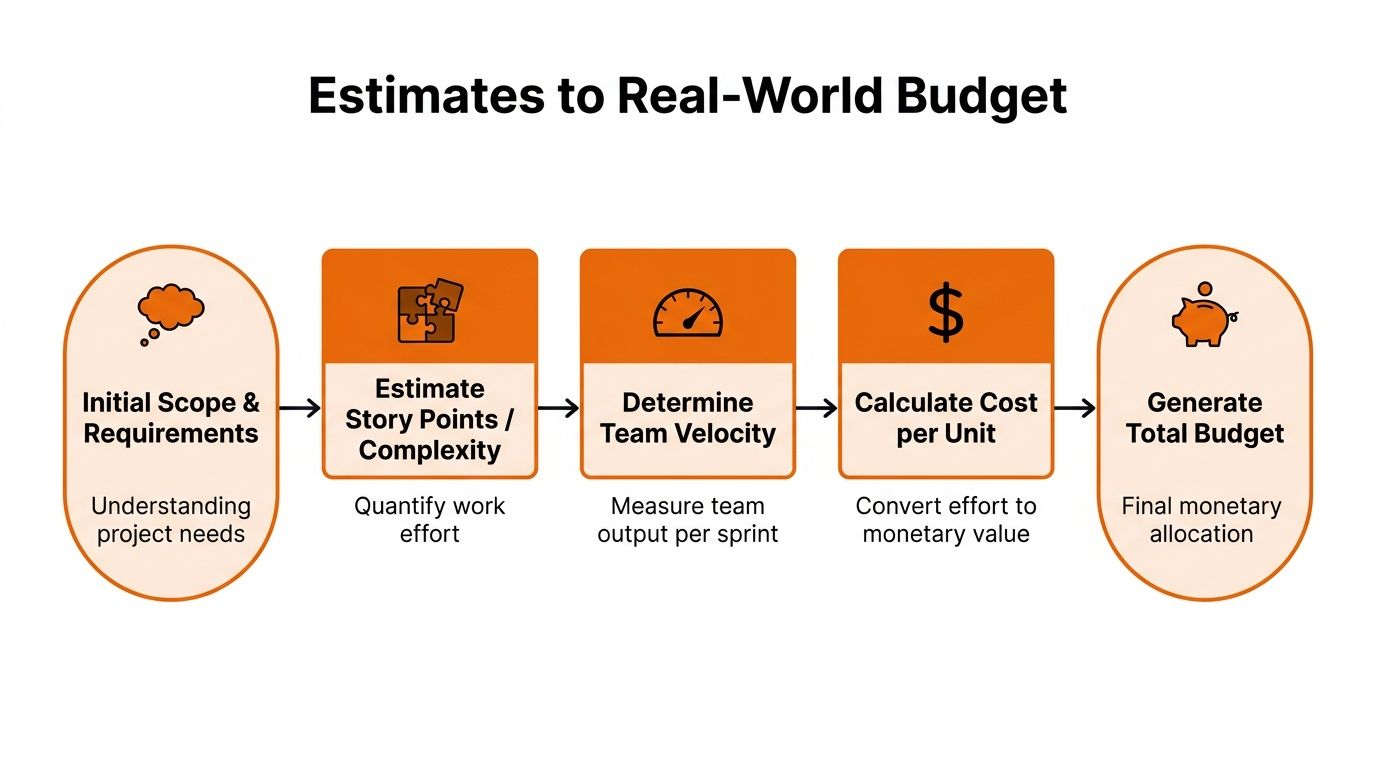
Use a budgeting model that connects effort to delivery capacity:
Total Cost = (Total Story Points / Team Velocity) × Sprint Duration × Team Cost
This works because it forces discipline. You have to define how much validated scope is in play, what the team can finish in a sprint, how long a sprint lasts, and what that sprint costs in full.
Turn effort into numbers the business can use
- Total story points: Count the prioritised release scope only. Leave the “nice to have later” ideas out of the funding decision.
- Team velocity: Use the output of a stable team, not a hopeful target. For a new nearshore team, set an initial planning range and tighten it after the first sprint or two.
- Sprint duration: Keep it fixed so your forecast stays readable.
- Team cost: Price the whole delivery unit. Include engineering, QA, product, design, DevOps, ceremonies, and management overhead.
If your team is still estimating in hours, use hours as a temporary budgeting bridge, then move to team-based forecasting once delivery starts. UK market guidance gives you a rough benchmark. An MVP or simple application typically requires 500 to 800 development hours, translating to £25,000 to £40,000 at a £50 per hour rate, while enterprise platforms can require 3,000+ hours and cost £150,000+ (Luminary Brands on UK software development cost).
Use those figures as orientation, not as a quote. Budget pressure rises fast when scope includes integrations, permissions, workflow complexity, audit trails, or multi-tenant logic. Small product decisions can add whole sprints.
Budget the platform, not just the build
Founders often approve delivery spend and overlook the running cost model. Then finance gets surprised by cloud, data transfer, third-party APIs, environments, monitoring, and support tooling.
If Azure is part of your stack, use tools that help you avoid Azure billing surprises. Cost predictability depends on modelling infrastructure from day one, especially if usage spikes, data volumes grow, or compliance drives environment duplication.
Nearshore budgets work best when they are built around predictability
This is the part many companies get wrong. They compare hourly rates and miss the delivery model.
A nearshore team gives you a clearer budget when the commercial setup matches a defined team, a fixed sprint cadence, and explicit ownership across product, QA, and engineering. That is the #riteway approach. Build the roadmap around business outcomes, expose delivery risks early, and fund a team structure that can hit the plan. You get better forecast control because capacity, communication rhythm, and accountability are visible from the start.
Compare options on three things. Time to productive delivery. Risk of rework. Effort needed from your own leadership team to keep execution on track.
Cheap capacity is expensive when priorities drift and quality slips. A well-run nearshore team usually gives a SaaS founder something far more valuable than a lower rate. A budget you can trust.
Plan for Uncertainty with Smart Contingency
Your team is three sprints in. A key integration behaves differently than the docs promised, customer feedback forces a workflow change, and the launch date stays fixed. If your estimate has no contingency, the budget breaks the moment reality shows up.
Predictable delivery starts by pricing uncertainty on purpose. Strong teams do this early. Weak teams leave risk buried inside optimistic assumptions and call the overrun a surprise.
Poor discovery is one of the fastest ways to destroy estimate accuracy. In the UK, 68% of SaaS projects fail due to poor requirement definition during early discovery, yet estimates still skip budget for user research, prototyping, and iterative validation (PMC article referenced for discovery underestimation and requirement issues).

Contingency protects the roadmap. It gives founders room to make smart decisions without destabilising delivery. In a nearshore model, that matters even more because predictability comes from clear assumptions, visible risks, and a team that can respond fast without constant re-planning.
Where contingency earns its keep
Risk rarely arrives as a single dramatic event. It shows up in specific, familiar places:
- Discovery gaps: The team starts building before core user behaviour is tested well enough.
- Integration surprises: Third-party APIs, legacy systems, and data dependencies take more effort than the estimate allowed.
- UX complexity: A flow that looked tidy in a workshop expands into edge cases, validation rules, and exception handling.
- Stakeholder change: Customer learning changes priorities during delivery.
- Operational readiness: Environments, access, compliance checks, and release approvals move slower than planned.
A contingency buffer in the 15% to 20% range is a sensible planning tool for many software projects. Keep it explicit. Tie it to named risks. Review it during delivery so you know whether it is covering scope change, failed assumptions, or hidden implementation work.
Explain contingency like an operator
Stakeholders do not need vague reassurance. They need a budget they can defend.
State it clearly. Contingency covers uncertainty that is normal at the current level of definition. It protects the delivery plan without inflating the base estimate. If risk drops as discovery improves, some or all of that contingency stays unused.
If your finance team wants a stronger framework for planning discipline, these Steingard Financial budgeting resources are useful context for how mature organisations think about forecasting and control.
Risk should also live inside the delivery model, not in a spreadsheet nobody reads after kickoff. A practical starting point is a clear approach to software project risk management. That is the #riteway approach. Build contingency into the roadmap from day one, assign ownership to each risk, and keep estimate accuracy tied to business outcomes, not wishful thinking.
Here's a useful primer on how experienced teams think about planning uncertainty in delivery:
The teams that stay predictable are the ones that surface risk early, cost it, and respond fast.
Your Estimate Is Your First Act of Ownership
Monday morning. You are in a budget review with your leadership team and nearshore partner. One estimate gives you a clear delivery path, the trade-offs, the risks, and the budget range you can defend. The other is a polished guess dressed up as confidence. Founders pay for that difference later.
An estimate shows how a team will behave once delivery starts. If it is tied to business outcomes, assumptions, scope boundaries, and named risks, you are looking at a team that plans to own the result. If it hides behind vague effort ranges and technical jargon, expect missed expectations, slow decisions, and budget drift.
That is why cost estimation for software matters so much. It sets the operating standard for the whole engagement.
At Rite NRG, we treat estimation as the first proof of delivery discipline. A good estimate turns strategy into a roadmap your product, finance, and engineering leads can all use. It connects expected business value to delivery choices from day one, which is exactly what nearshore teams need to stay predictable across time zones, handoffs, and changing priorities.
Strong estimates improve behaviour early. They force scope decisions before feature sprawl starts. They expose hidden dependencies before they turn into delays. They make trade-offs visible, so founders can decide where to spend for speed, where to simplify, and where to hold the line.
Your first delivery milestone is the estimate your team can explain, defend, and manage against.
That is the #riteway approach. Treat the estimate as an ownership document, not a sales artifact. Set outcomes first. Price risk realistically. Make assumptions explicit. Then run delivery against that plan with enough transparency to correct course before small misses become expensive surprises.
If you want a delivery partner that treats estimation as strategy, not sales theatre, talk to Rite NRG. They help SaaS teams turn rough ideas into predictable roadmaps with senior nearshore engineers, strong product thinking, and the kind of ownership that keeps budgets, scope, and momentum aligned.