
Your SaaS product is selling. New customers are landing. The roadmap looks ambitious. Yet delivery feels slower every month.
Engineering says they need more time. Product says priorities are clear. Ops says costs are climbing. Nobody is wrong, but the system still isn't working. That's usually the moment founders ask the wrong question: “Do we need more developers?”
Usually, no. You need someone who can turn business intent into technical direction before your teams build themselves into a corner. That's what a Solutions Architect does.
A good one doesn't just design systems. They remove friction, align teams, cut waste, and stop expensive technical drift before it spreads. If you're scaling a SaaS platform and release confidence is falling, read this as an operating guide, not a job description.
The Hidden Barrier to Your SaaS Growth
A familiar pattern shows up in fast-growing SaaS companies.
The first version of the product moved quickly because one team knew the codebase, the feature set was narrow, and technical decisions lived in a few people's heads. Then traction arrived. Sales promised integrations. Enterprise prospects asked about security. Product wanted a faster release cadence. Engineering split into teams. Suddenly, what used to feel agile started feeling messy.
You see the symptoms fast. Features take longer to ship. Bugs hit adjacent systems. Teams build overlapping fixes. Nobody can explain why one integration is fragile and another is overengineered. The issue isn't a lack of effort. The issue is structural.
When coding stops being the bottleneck
At this stage, your problem isn't “Can the team build?” It's “Are they building the right thing, in the right way, with enough foresight?”
A founder might say, “We need a billing upgrade, a partner API, better observability, and a new region launch.” Developers hear four projects. A strong architect hears shared dependencies, security implications, service boundaries, data flow changes, and delivery risks.
That difference matters. Without architectural leadership, every team optimises locally. Your platform loses coherence.
Practical rule: When smart teams keep shipping but business outcomes keep slipping, architecture is probably the missing layer.
If your platform is already straining under growth, this deep dive into SaaS platform architecture will help you spot where technical structure is helping or hurting commercial momentum.
The role founders usually hire too late
A Solutions Architect is the person who connects the commercial ask to the engineering reality. They define what must be true for the business goal to succeed, then shape the technical path to get there.
That means they challenge poor assumptions early. They stop wasteful rebuilds. They make trade-offs visible. They push teams to solve for scale, security, maintainability, and delivery speed together, not one at a time.
Under the #riteway standard, that role is built on Extreme Ownership. The architect doesn't hide behind diagrams or hand over a slide deck and disappear. They stay close to the outcome. They anticipate blockers, force clarity, and keep momentum high.
That's the hidden barrier to growth. Not lack of code. Lack of architectural ownership.
Your Business Blueprint for Technical Success
If you're asking what is a Solutions Architect, skip the bloated definitions. The simplest answer is this: they are the business blueprint owner for your technology.
Developers build the houses. The Solutions Architect plans the roads, utilities, zoning, and expansion routes so the city doesn't collapse when demand increases. Without that planning, you still get buildings. You just get congestion, outages, duplicated effort, and ugly compromises later.
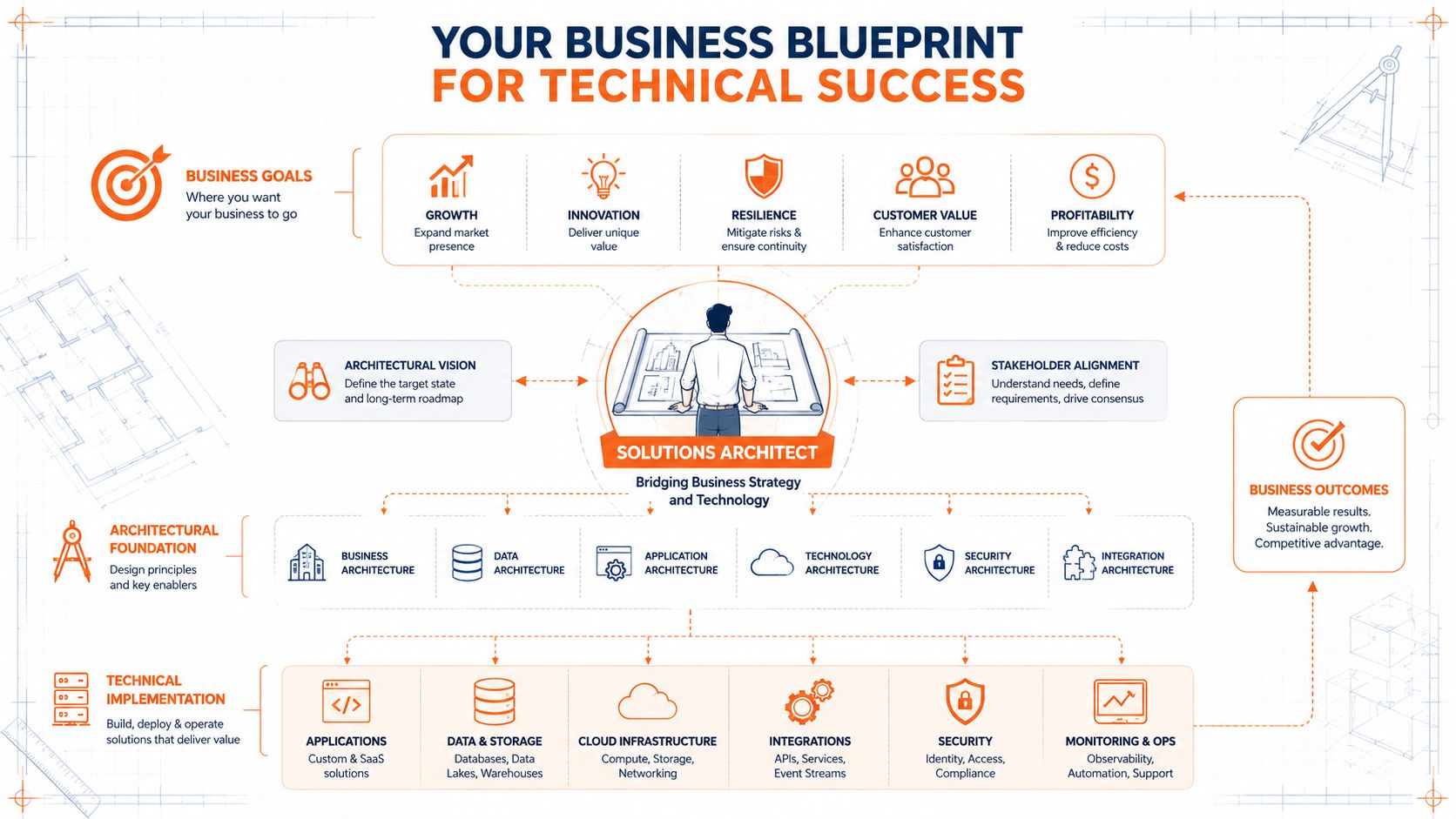
They translate business goals into technical constraints
Founders often speak in market terms. Enter a new region. Win larger accounts. Launch an AI-assisted workflow. Reduce onboarding friction. Those are the right goals, but they aren't implementation plans.
A Solutions Architect converts those goals into technical decisions such as:
- Market expansion requirements like data residency, regional infrastructure choices, and compliance boundaries
- Enterprise sales needs such as auditability, identity integration, and access control design
- Product velocity goals like modular service boundaries, reusable platform components, and deployment standards
- Cost control pressures through sensible hosting patterns, observability discipline, and fewer one-off builds
That's why demand is high. Careerpilot's UK profile for the role notes that as of early 2026, there were over 4,000 open Solutions Architect jobs in the United Kingdom, which tells you employers aren't treating this as a niche function.
They make delivery predictable
An architect's real value isn't technical elegance. It's delivery confidence.
A team without architecture often starts implementation before key assumptions are tested. Then the rewrite cycle begins. A team with a strong architect gets a clearer path: what to build first, which risks to remove early, what to standardise, and what can wait.
That planning is especially important if you're trying to move fast without creating a future mess. This guide to software architecture design is useful if you want to pressure-test whether your platform decisions support scale or just postpone pain.
A good Solutions Architect reduces the number of expensive surprises. That's the real job.
What they own in practice
Here's the practical blueprint they control:
| Business question | Architectural response |
|---|---|
| Can we launch this fast? | Define the leanest safe architecture for current demand |
| Will it scale? | Design for expected load, integration growth, and change tolerance |
| Will it stay secure? | Embed controls in identity, data flow, and infrastructure choices |
| Can teams move independently? | Set boundaries, interfaces, and shared standards |
That's what separates a strategic architect from a senior engineer with a broad title. One is focused on output. The other is focused on business-safe progress.
The High-Impact Responsibilities of a Modern SA
The modern Solutions Architect isn't a document factory. They're a force multiplier for speed, stability, and alignment.
That only works if they operate with ownership. Under the #riteway lens, the standard is simple. They don't wait to be asked. They spot risk early, make decisions visible, and drive action across teams.
They de-risk scale before scale arrives
Most SaaS failures at growth stage don't come from one dramatic outage. They come from a stack of small architectural shortcuts that nobody owns. One fragile integration. One data model that can't flex. One deployment pattern that only two people understand.
A strong architect works upstream of those problems. They decide where standardisation matters, where flexibility matters, and where the business should accept short-term compromise without creating long-term drag.
That means practical design choices around cloud infrastructure, security boundaries, APIs, event flows, environments, and operational resilience. It also means saying no when a “quick win” proves to be an expensive detour.
They align humans, not just systems
The role is cross-functional. According to LeanIX's overview of the solution architect role, solutions architects engage with an average of 5–10 stakeholders per initiative. That matters because architecture fails when communication fails.
A good architect spends time with product, engineering, security, operations, and business stakeholders. They make sure everyone is solving the same problem. They also stop one team's shortcut from becoming another team's operational burden.
If your teams struggle to coordinate handoffs and priorities, stronger cross-functional collaboration practices are usually part of the fix.
Operator's view: The architect should be the person reducing ambiguity in every meeting they enter.
They protect ROI through better technical choices
Every technical decision carries a commercial consequence.
Pick the wrong integration pattern and onboarding slows down. Choose the wrong hosting model and margins tighten. Ignore operational support requirements and your roadmap gets hijacked by maintenance.
A high-impact architect keeps asking uncomfortable but necessary questions:
- Does this design support the revenue model?
- Will this choice increase delivery speed six months from now, or only today?
- Are we solving a platform problem once, or solving the same local problem five times?
- Can support, product, and engineering all live with this decision?
What the best ones consistently bring
Some skills are obvious. Cloud platforms like AWS and Azure. Security awareness. DevOps fluency. System design. Integration strategy.
Harder skills are where the advantage is found:
- Judgement: They know when “good enough” is smart and when it's reckless.
- Translation: They can explain technical trade-offs to non-technical leaders without watering them down.
- Momentum: They don't let unresolved architecture decisions stall delivery.
- Ownership: They stick around after the diagram is approved and make sure reality matches intent.
That's the #riteway bar. High energy. Proactive behaviour. Extreme Ownership. Not theory. Execution.
Solutions vs Software vs Enterprise Architect
A lot of confusion around what is a Solutions Architect comes from title overlap. Founders hear “architect” and assume the roles are interchangeable. They're not.
The fastest way to understand the difference is scope.
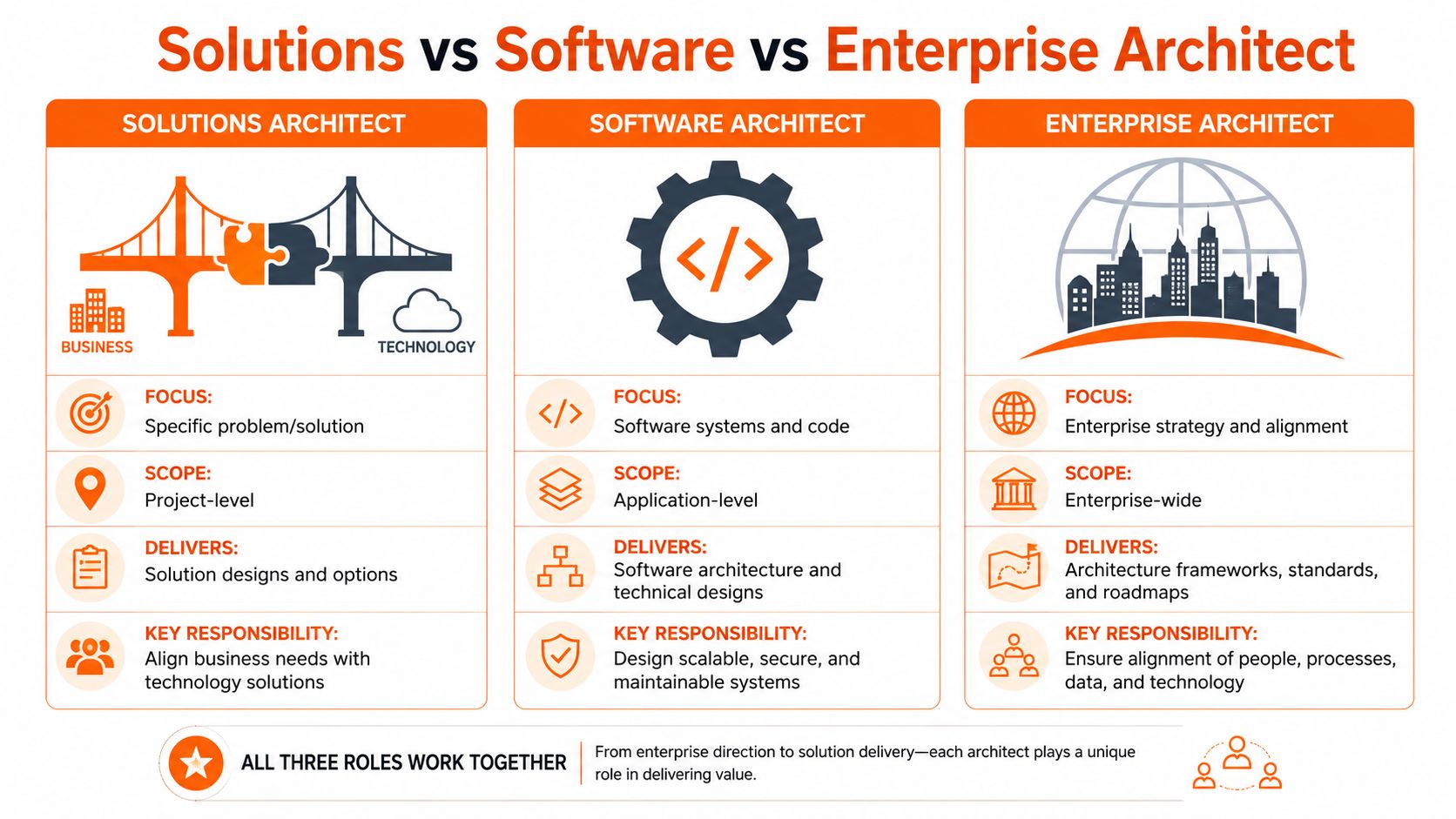
Architect role comparison
| Role | Primary Focus | Scope | Key Deliverable |
|---|---|---|---|
| Solutions Architect | Solving a defined business problem through a coherent technical solution | Project, product area, or programme | Solution design that connects business goals to implementation |
| Software Architect | Structuring a specific application or codebase | Single application or service | Internal software design, patterns, and engineering standards |
| Enterprise Architect | Shaping organisation-wide technology direction | Entire business landscape | Strategic architecture standards, capability maps, and portfolio alignment |
A Software Architect stays closer to code structure. They care about frameworks, components, patterns, modularity, and maintainability inside an application.
An Enterprise Architect works at the organisational level. They care about technology estates, governance, capability planning, and how systems fit the business at large.
The Solutions Architect sits in the middle. That's why the role is so valuable in scaling SaaS businesses. They can speak in revenue, risk, delivery, and systems at the same time.
For teams that want a clean glossary of architecture and product terminology, these key definitions can help clarify where adjacent roles start and stop.
A solid video explainer can also help if your leadership team is still mixing these roles up.
The UK nuance most guides miss
There's another distinction that matters if you work with public sector or hybrid environments in the UK.
Sellick Partnership's public sector career analysis highlights a critical demand for “Solutions Architects” who bridge cloud and legacy infrastructure. It states that 65% of these roles prioritise hybrid system skills, and that this specialism commands a 40% salary premium.
That matters beyond government. Plenty of SaaS firms are selling into organisations that still run a blend of modern cloud services and older internal systems. If your architect only knows greenfield cloud patterns, they may struggle where substantial commercial complexity resides.
The best Solutions Architects don't just design what's new. They create a safe path from what exists today to what the business needs next.
Clear Signals That You Need to Hire an SA Now
You don't hire a Solutions Architect because the org chart says you should. You hire one because the business is leaking speed, money, or confidence.
The warning signs are usually visible well before leaders act on them.
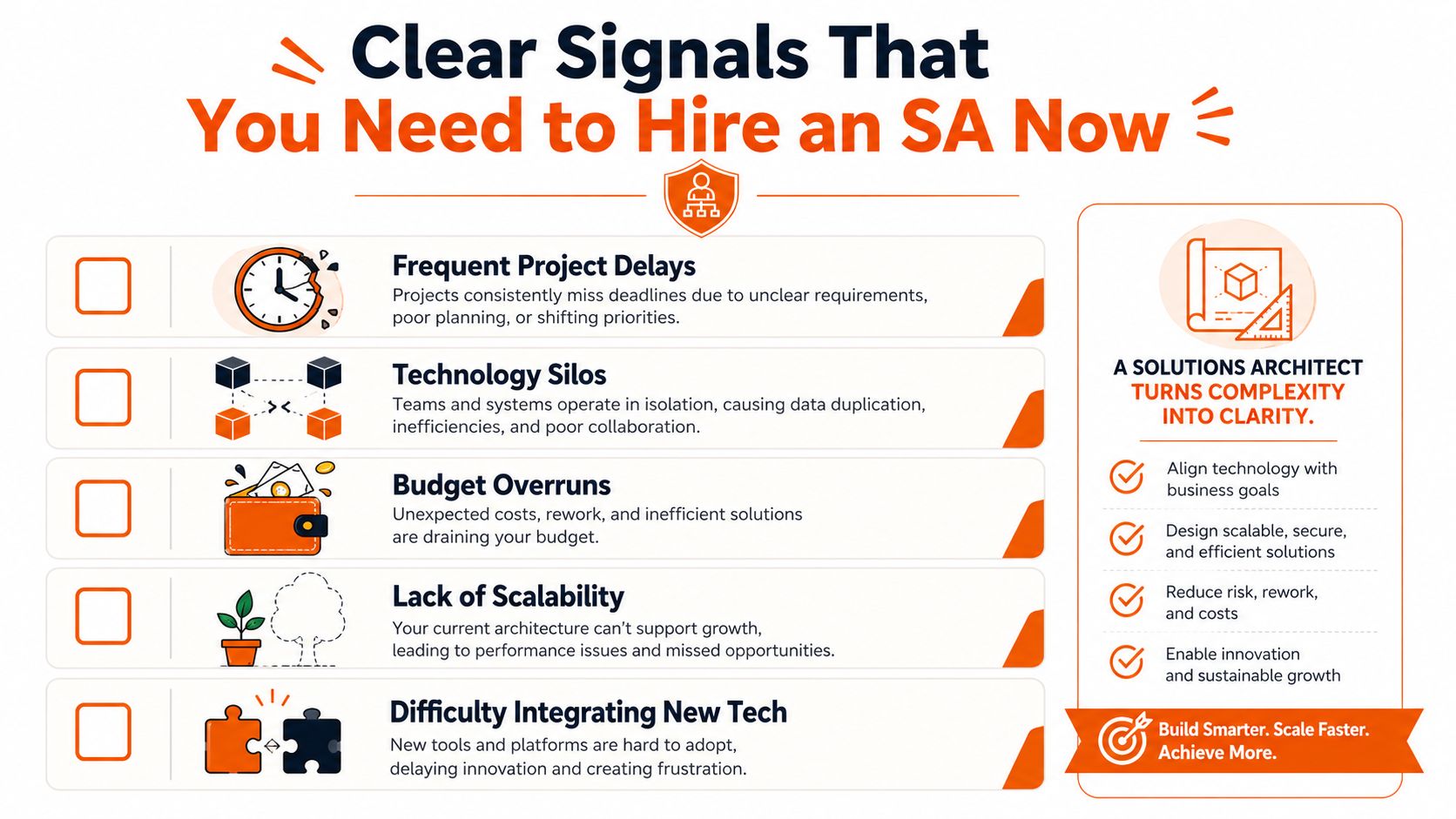
Five signals you shouldn't ignore
- Feature delivery keeps slowing down: Teams are busy, but release timelines stretch because dependencies, rework, and unclear technical direction keep stacking up.
- Your platform is growing in fragments: Different teams create overlapping services, duplicate integrations, or one-off fixes that don't fit a shared architecture.
- Infrastructure spend is rising without strategic benefit: You're paying more for cloud, tooling, and support, but velocity and resilience aren't improving with it.
- A major migration is on the roadmap: Replatforming, legacy modernisation, partner integrations, or enterprise onboarding all increase delivery risk if nobody owns the overall design.
- Leaders keep revisiting the same technical arguments: If product, engineering, and commercial teams can't align on trade-offs, decisions stall and confidence drops.
This is a business KPI role, not just a technical one
In SMB SaaS, efficiency matters fast. Duda's SaaS KPI guidance says customer acquisition costs should be recovered within 7 months, with top performers achieving 4 months. That's not just a marketing metric.
Architecture affects whether you can hit that target. Bloated infrastructure, brittle onboarding flows, and expensive support overhead all make payback slower. A Solutions Architect helps design a platform that supports cleaner unit economics.
Hiring late costs more than hiring early
Founders often wait until delivery pain becomes obvious. That's expensive because by then the architect isn't shaping a clean path forward. They're untangling months of avoidable compromise.
If you're also refining decision-making at the product and delivery layer, these 925 Studios' hiring insights are useful for clarifying adjacent leadership roles. The point is simple: don't fill strategic gaps with vague titles. Hire for the actual bottleneck.
If engineering velocity is falling while business pressure is rising, you're already paying for missing architecture. You just haven't labelled the cost yet.
From Blueprint to Reality A Look at SA Deliverables
A lot of leaders still think architecture is abstract. It isn't. A strong Solutions Architect produces assets your teams use to ship with less confusion and lower risk.
That's one reason the role is valued highly. IT Jobs Watch's UK salary data shows the median annual salary for a Senior Solutions Architect was £90,000 as of June 2026, with the ceiling frequently exceeding £140,000. Companies don't pay that for vague advice. They pay it for tangible deliverables that protect delivery.
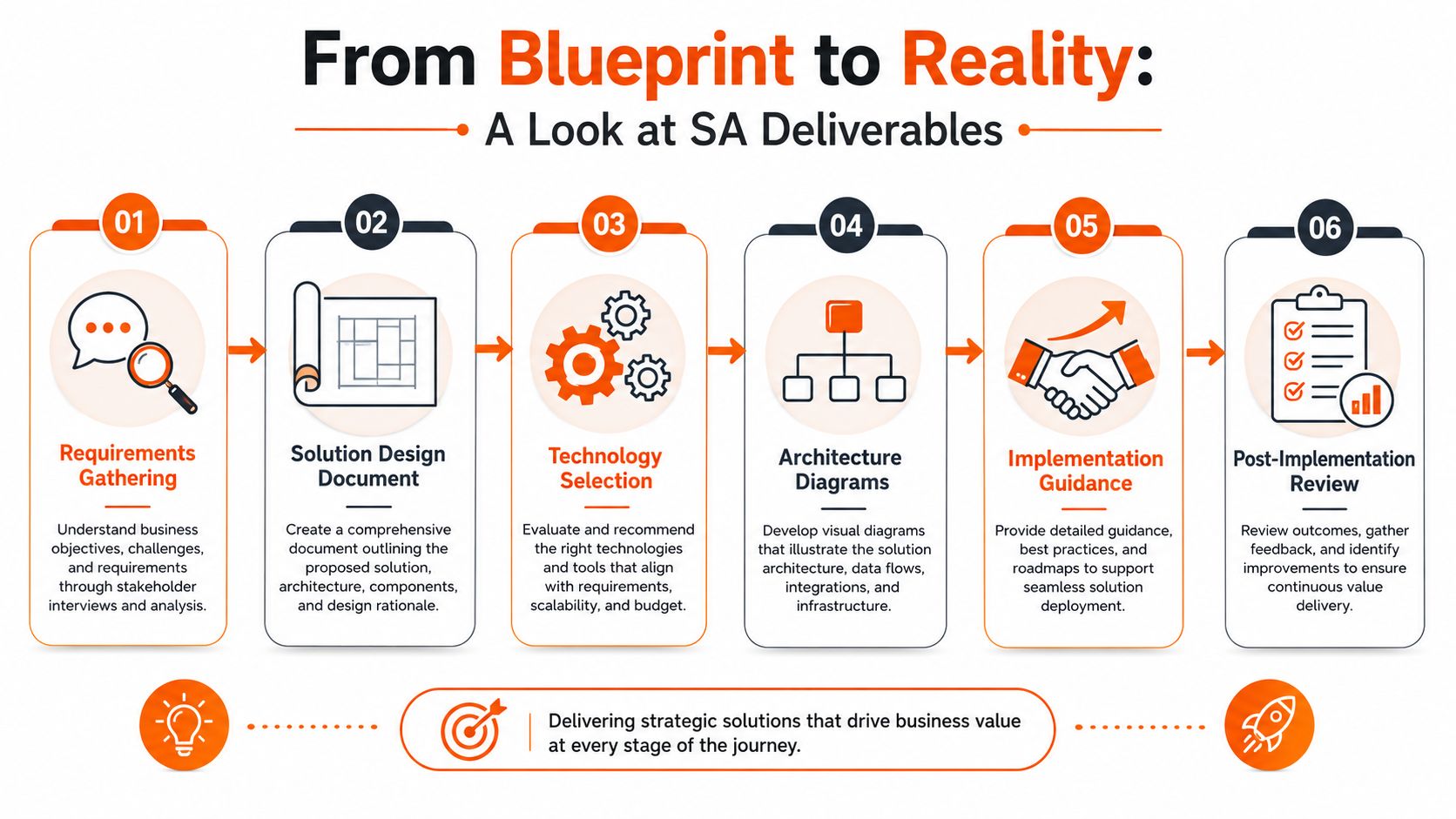
What they actually produce
A capable architect usually leaves behind a working set of artefacts, not just opinions.
- Solution architecture diagrams that show systems, integrations, boundaries, and data movement
- Technology decision records that explain why one option was chosen over another
- Risk and assumption logs that surface uncertainty before it becomes delay
- Proofs of concept for validating high-risk integrations or technical bets
- Scalability and evolution roadmaps that show how today's design can grow without a rewrite
- Implementation guardrails for engineering teams, including security, deployment, and integration standards
These deliverables give the business something concrete. Leaders get visibility. Engineers get clarity. Product gets a more realistic path to delivery.
A typical workflow in the real world
The best architects don't start by drawing boxes. They start by asking hard questions.
First, they gather requirements from stakeholders and identify the actual business problem. Then they map constraints. Security. compliance. time-to-market. existing systems. internal team capability. After that, they shape options and force trade-offs into the open.
A practical flow often looks like this:
- Stakeholder discovery to understand goals, risks, and dependencies
- Current-state assessment of systems, integrations, and pain points
- Target design creation with diagrams and technology choices
- Validation work through reviews or a proof of concept
- Implementation support with engineering during delivery
- Post-launch review to check whether the design is holding up in production
Good architecture is visible in the team's confidence. Everyone knows what they're building, why they're building it, and what trade-offs have already been decided.
The deliverable that matters most
It isn't the diagram. It's decision quality.
A mediocre architect can produce polished documentation. A strong one gives your team a path they can execute without constant second-guessing. That's the difference between architecture as theatre and architecture as a powerful asset.
Find Your Architect Partner with Rite NRG
The strongest Solutions Architects do three things well. They connect business goals to technical design. They remove risk before it becomes delay. They take ownership for outcomes, not just recommendations.
That's the standard serious SaaS teams should hold. Not “smart enough.” Not “good communicator.” Owns the result. Drives clarity. Moves the team forward.
What strong architectural support looks like
If you're building or scaling a SaaS platform, architectural support should feel like a strategic advantage.
It should help you decide what to build now and what to defer. It should make delivery more predictable. It should reduce dead-end technical choices. And it should give product, engineering, and leadership one shared map of reality.
That's especially important when you're under pressure to move fast. For UK-facing AI-assisted MVPs, Bytees Technolab's cost guide for SaaS development points to a target of 10 to 14 weeks at a cost of £35,000 to £65,000 for successful delivery. Those outcomes don't come from random speed. They come from disciplined architectural choices early.
The #riteway standard
The reason many architect hires disappoint is simple. Companies hire for knowledge and ignore behaviour.
The right architect needs strong technical judgement, but they also need the operating habits that keep teams effective under pressure. That means Extreme Ownership, proactive communication, fast escalation of risk, and enough energy to keep momentum high when projects get messy.
That's the #riteway standard. Don't settle for someone who can talk fluently about systems but disappears when trade-offs get uncomfortable. You need someone who can lead through ambiguity and still keep delivery moving.
The bar to set for your next hire or partner
Use this checklist when evaluating an architect:
- Can they translate strategy into delivery? If they can't connect roadmap decisions to architecture choices, they're too narrow.
- Do they challenge weak assumptions? A passive architect becomes an expensive note-taker.
- Can they work across functions? The role only works when product, engineering, and business teams trust the same person.
- Do they design for outcomes? Speed, scalability, security, and cost discipline all need to show up in their decisions.
- Will they own the result? This is the most important one.
If you hire or partner at that level, a Solutions Architect becomes one of the highest-impact roles in your delivery system. Not because they write the most code, but because they make sure the right code gets written in the first place.
If you need a delivery partner that brings senior engineering, architectural thinking, and proactive execution under one roof, talk to Rite NRG. Their teams work the #riteway, with ownership, urgency, and a clear focus on measurable SaaS outcomes like faster MVP delivery, lower delivery risk, and architecture that can scale with the business.