You launched the MVP. The team worked hard, the roadmap looked sensible, and the demo landed well internally. Then customers shrugged.
That moment usually gets blamed on execution. Founders say engineering built the wrong features, design missed the workflow, or sales targeted the wrong segment. Most of the time, the failure happened earlier. You built around assumptions instead of evidence about what buyers were trying to get done, what was blocking them, and what they'd pay to improve.
That's why the Value Proposition Canvas matters. It forces discipline before delivery. It turns fuzzy product ideas into a sharp view of customer jobs, pains, and gains, then tests whether your product earns attention by relieving those pains and creating those gains. If you're still wrestling with what product-market fit really looks like, this is one of the cleanest ways to stop guessing.
Stop Guessing and Start Shipping What Sells
A founder I often think about had a familiar problem. The product was polished. The sprint velocity was strong. The backlog kept moving. Yet trial users kept dropping after the first week because the team had built for a broad idea of “better workflow” instead of a specific pain buyers needed solved now.
That's the trap. SaaS teams often confuse activity with progress. Shipping features feels productive, but customers don't buy feature volume. They buy relief, speed, clarity, compliance, confidence, revenue, fewer manual steps, and lower operational friction.
The Value Proposition Canvas gives you a way to force that conversation early. It helps you answer three hard questions:
- What is the customer trying to achieve?
- What is making that job slower, riskier, or more expensive?
- What outcome would make them switch, renew, or pay more?
When teams skip this work, they produce a backlog full of opinions. When they do it properly, they create a commercial blueprint.
A weak value proposition doesn't create a product problem later. It creates a business problem immediately.
That's why I treat the Value Proposition Canvas as a pre-build filter. Before anyone expands scope, hires more engineers, or commits to a nearshore delivery plan, the team needs clarity on where value lives. If you can't state the customer's top pain in concrete terms, you're not ready to build.
This is the spirit behind the #riteway mindset. Extreme Ownership. High energy. No passive hand-waving. The whole team owns the outcome, not just the output. The canvas isn't a workshop artefact for a shared drive. It's the first serious move towards building something customers will choose.
Decoding the Value Proposition Canvas
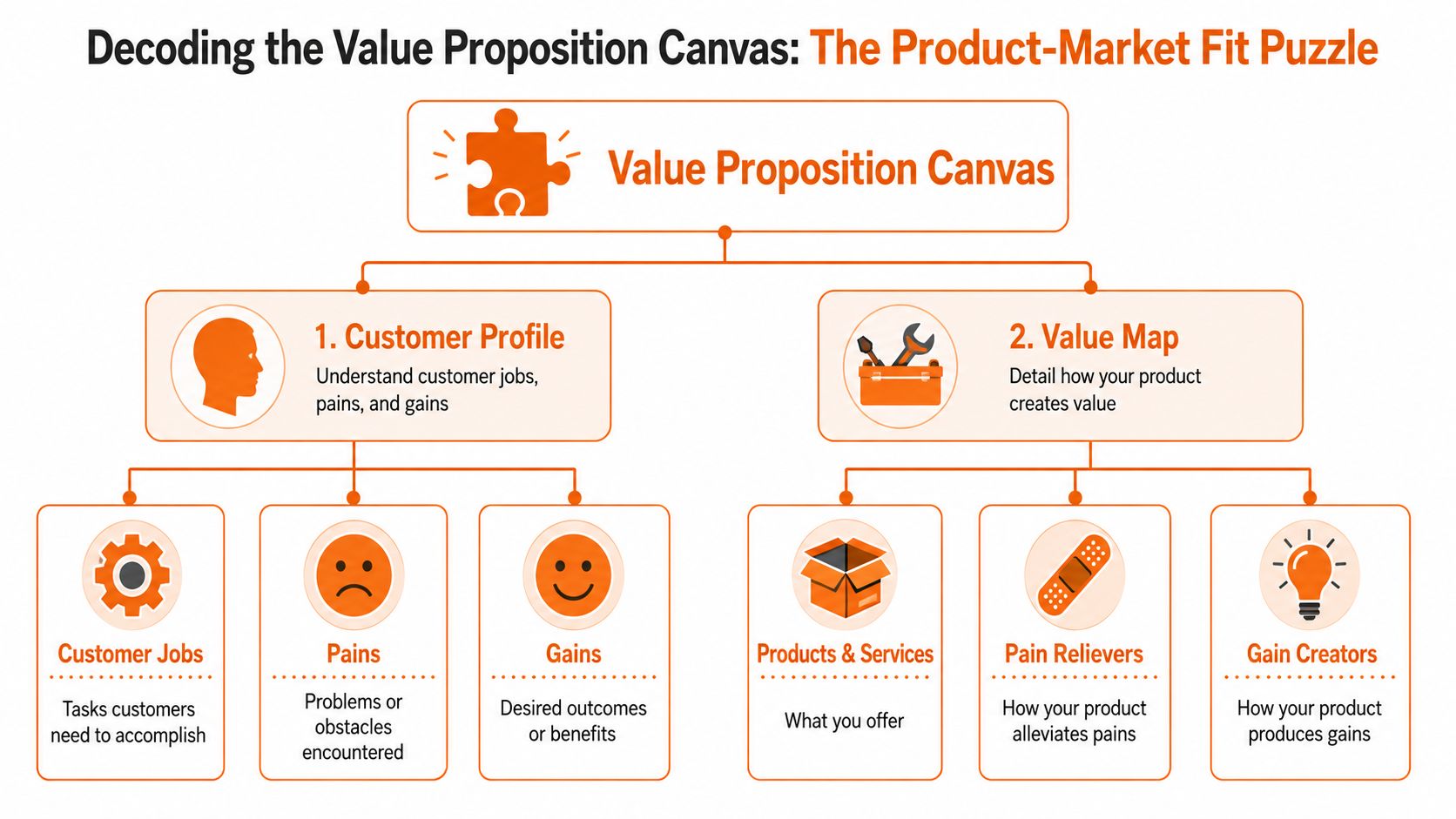
The easiest way to understand the Value Proposition Canvas is to think of it as a lock and key.
The Customer Profile is the lock. It defines what the customer needs, fears, and wants. The Value Map is the key. It shows how your product fits those realities. If the shape is wrong, the product won't meet demand.
The customer profile
Start on the customer side, always.
There are three parts:
- Customer jobs are the tasks or outcomes the buyer is trying to achieve.
- Pains are the frustrations, obstacles, risks, delays, or costs they hit while trying to do that job.
- Gains are the positive outcomes they want, whether functional, emotional, or commercial.
For a SaaS example, imagine a finance lead trying to prepare a Q4 board report.
| Component | Example |
|---|---|
| Job | Collaborate on a board-ready report without chasing updates across teams |
| Pain | Version control chaos, missing numbers, slow approvals |
| Gain | Fast sign-off, a clean audit trail, confidence in the final numbers |
Another example. A RevOps manager wants to improve handoff between marketing and sales.
| Component | Example |
|---|---|
| Job | Move qualified leads into sales without manual admin |
| Pain | Broken fields, duplicate records, unclear ownership |
| Gain | Clean routing, fewer missed opportunities, predictable pipeline flow |
The value map
Now move to your side of the equation.
The Value Map also has three parts:
- Products and services are what you offer.
- Pain relievers explain how the product reduces specific friction.
- Gain creators show how it helps the customer achieve desired outcomes.
At this point, many teams get sloppy. They list features and call it strategy. That's wrong.
A feature like “shared dashboard” means nothing by itself. It only matters if it relieves a pain such as fragmented reporting, or creates a gain such as instant visibility for managers.
Practical rule: If your product statement starts with what the software does instead of what the customer gets, your canvas is still immature.
What good fit looks like
Strong canvases are precise. Weak ones are full of generic language like “easy to use” or “saves time”.
A better pair sounds like this:
- Pain: Approvals require four separate Slack messages and two spreadsheet updates.
- Pain reliever: One approval flow triggers notifications, status changes, and a timestamped audit trail.
That's useful. It gives product, design, and engineering something concrete to validate.
The Value Proposition Canvas works because it forces teams to translate features into buyer value. That's why it remains one of the simplest and strongest tools for early product strategy.
A Step-by-Step Guide for Proactive SaaS Teams
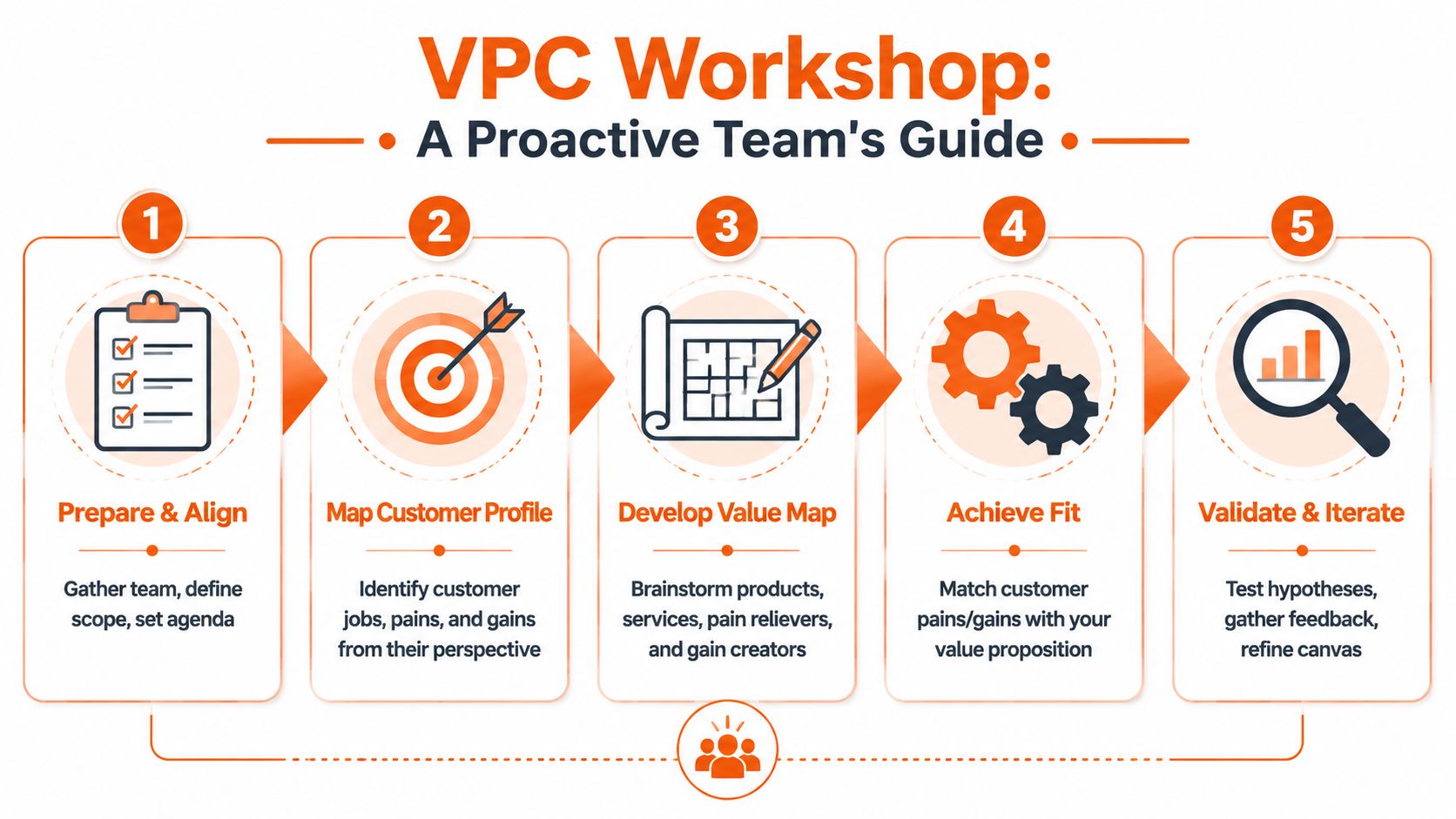
Most Value Proposition Canvas sessions fail because the wrong people are in the room and everyone protects their function. Product talks roadmap, sales talks objections, engineering waits for requirements, and nobody owns the commercial truth.
Run it differently. Use Extreme Ownership. If your SaaS business depends on the next release, everyone responsible for the result needs to help define value.
Alexander Osterwalder developed the Value Proposition Canvas around 2012, and it's now used by 40% of UK-based SaaS startups for MVP validation. UK product managers using the canvas report cutting MVP development cycles by an average of 28 days compared with non-structured approaches. That makes it a practical operating tool, not a theory exercise.
Step one, bring the right team
Don't run this with product alone.
Include:
- Product leadership to frame the opportunity and define scope
- Sales or customer success because they hear objection patterns directly
- Design or research to surface behaviour instead of opinion
- Engineering so feasibility and technical trade-offs are visible early
A strong workshop creates shared language. That matters later when priorities get painful.
Step two, map the customer before the product
Start with one customer segment only. Not “SMBs” or “mid-market teams”. Pick a real buying context.
Then capture:
- Jobs the customer is trying to complete
- Pains blocking those jobs
- Gains they care about enough to notice and pay for
Push the team past vague labels. “Too slow” is weak. “Purchase takes more than three steps” is useful. “Reporting takes half a day” is useful. “Data is messy” is weak until you define what mess costs.
If your team needs stronger discovery inputs, use disciplined user research methods for product teams before you lock the canvas.
Step three, rank everything brutally
Not all pain deserves code.
Sort pains and gains from nice to have to essential. Founder discipline is paramount. The product should solve what blocks purchase, onboarding, activation, renewal, or expansion. Everything else waits.
Teams get faster when they stop treating every request like a priority and start treating value like a ranking exercise.
Step four, build the value map against the top pain
Now define your products, pain relievers, and gain creators. Every item should trace back to a ranked customer need.
Ask direct questions:
- Which pain does this feature remove?
- Which gain does it create?
- Would the buyer notice if it disappeared?
If the answer is fuzzy, cut it.
Step five, validate outside the room
A canvas filled with internal opinion is still a guess.
Take the top assumptions into customer interviews, prototype reviews, or light A/B tests. Then revise the canvas. Good teams treat it as a live decision tool, not workshop wallpaper.
From Canvas to Code Building a Smarter MVP
A strong Value Proposition Canvas is the shortest path between strategy and an MVP that deserves to exist.
Weak canvases produce bloated backlogs. Teams build dashboards, permissions, settings, notifications, exports, and admin flows because each item sounds reasonable in isolation. Then launch arrives and users ignore half of it. That's wasted spend, wasted time, and usually a second round of painful reprioritisation.

Turn pain into backlog logic
The canvas should dictate what enters the MVP and what gets excluded.
If the top-ranked customer pain is “monthly performance reporting requires manual copy-paste from four tools,” then your MVP should centre on that pain reliever. Maybe the core solution is one-click report generation with source sync and approval history. That becomes the spine of the product.
Everything else gets challenged against the same standard:
| Candidate feature | Keep or cut | Why |
|---|---|---|
| Automated data import | Keep | Directly removes manual reporting pain |
| Approval workflow | Keep | Supports the same critical reporting job |
| Custom themes | Cut | Cosmetic, not tied to top pain |
| Advanced analytics lab | Cut for now | Valuable later, not necessary for first proof of value |
Quantify before you build
Disciplined teams pull ahead when achieving fit on the canvas depends on pain relievers directly addressing the customer's top jobs-to-be-done. A 2026 IxDF benchmark found that 78% of UK SaaS startups that quantified customer pains reduced MVP iteration cycles by 42%, and UK firms applying this method reported 50% faster time-to-market for outcome-oriented MVPs according to the IxDF Value Proposition Canvas benchmark.
That finding matters because quantified pain creates cleaner requirements. “Users struggle with onboarding” is not buildable. “Users abandon onboarding before completing the third configuration step” is.
The best MVP brief isn't feature-first. It's pain-first, with a direct line from customer friction to build priority.
Why nearshore teams need this clarity
Nearshore delivery works best when the brief is commercially sharp. A ranked canvas reduces ambiguity, protects scope, and gives engineers the context to make better trade-offs without endless clarification loops.
It also keeps founders honest. If a feature doesn't map to a top customer pain or gain, it probably doesn't belong in sprint one. That's how you build a Minimum Valuable Product, not just a minimum product.
For UK teams planning fast delivery, the commercial guardrails matter alongside speed. Building an AI-assisted MVP with one core automated workflow in the UK costs between £35,000 and £65,000 with a timeline of 10 to 14 weeks, while mid-range AI SaaS platforms cost £70,000 to £130,000 within 4 to 7 months, based on the UK SaaS development cost breakdown from Bytes Technolab. With budgets like that, guessing is expensive.
If you want a cleaner route from strategy to build, study a disciplined MVP development process before you commit engineering capacity.
Real SaaS Examples That Nailed Their Value Proposition
You don't need a textbook case study to see how this works. You can reverse-engineer strong SaaS products by asking one simple question. Which customer pain did they remove so clearly that users changed behaviour?
Slack is a good example. Its early appeal wasn't “team communication software”. That description is too generic. The value was found in a sharper customer profile: teams were drowning in email threads, scattered file sharing, and disconnected conversations that made collaboration slow and annoying.
Slack solved a painful job
The customer job was straightforward. Teams needed to coordinate work quickly and keep everyone aligned.
The pains were heavier:
- Context lived everywhere across email, chat, and documents
- Important decisions vanished into inboxes and side conversations
- Finding history was painful, especially when new people joined
Slack's value map lined up cleanly. Searchable channels relieved the pain of fragmented conversation. Shared threads improved visibility. Faster communication created the gain of a more connected and responsive team.
That's what good product strategy looks like. Not more features. Better alignment.
The commercial effect of fit
The Value Proposition Canvas proves its worth. Companies using the canvas report a 22% higher customer retention rate and a 19% reduction in post-launch feature churn. That outcome is tied to alignment, because 74% of successful UK SaaS launches matched the top three customer pains with corresponding pain relievers.
Those numbers describe what strong products do differently. They don't spread effort across ten maybe-useful ideas. They solve the few problems customers rank highest.
Buyers stay when the product keeps paying off the pain that made them buy in the first place.
A second example is workflow automation software in B2B operations. The winning products rarely lead with “powerful automation engine”. They focus on the pain customers already feel: repetitive admin, broken handoffs, missed approvals, and poor visibility across teams. The best ones position automation as relief from operational friction and as a gain in speed, accountability, and consistency.
That's the pattern founders should copy. Start with a real job. Identify the pain that's most expensive, risky, or irritating. Build the smallest product that removes it convincingly. Then expand.
Integrating the VPC with Your Product Toolkit
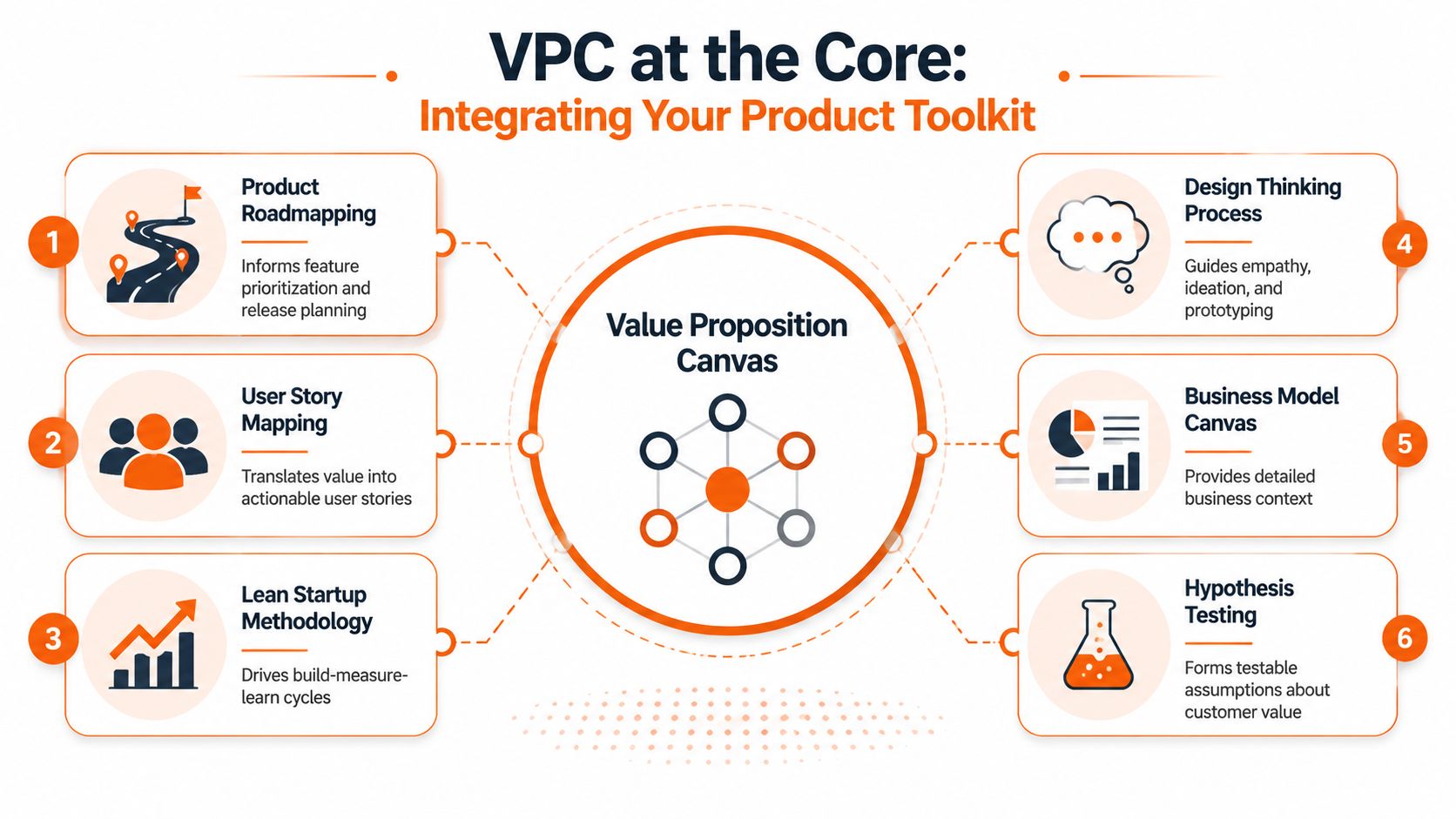
The Value Proposition Canvas is powerful, but don't treat it like a standalone ritual. It should feed the rest of your product system.
Used properly, it becomes the customer-centred engine behind prioritisation, hypothesis testing, roadmapping, user story mapping, and strategic positioning. Used poorly, it becomes a sticky-note performance with no effect on delivery.
Where it fits with other frameworks
Here's the simplest way to use it alongside common product tools:
- Jobs to Be Done helps you understand the progress the customer is trying to make.
- The Value Proposition Canvas translates that understanding into pains, gains, and matching product value.
- Lean Startup thinking gives you a loop for testing whether your assumptions hold in the market.
- User story mapping turns validated value into deliverable slices.
- The Business Model Canvas connects customer value to channels, revenue, partners, and cost structure.
That flow matters because teams often misuse the canvas as a replacement for segmentation or strategy. It isn't. It's a precision tool inside a broader decision stack.
One segment, one canvas
This rule is often broken initially. Teams typically try to use one canvas for everyone.
That creates mush. Different segments have different jobs, risks, budgets, urgency, and buying triggers. A 2025 UK study found that teams using separate Value Proposition Canvases per market segment reduced feature-creep by 55%, increased cross-functional alignment by 67%, and improved delivery predictability by 38%, according to B2B International's guide to the Value Proposition Canvas.
That's a direct operational benefit. Not just a messaging win.
Add competitor mapping or stay generic
One more hard truth. If you only map your own value, you'll often end up sounding like everyone else.
For B2B SaaS especially, teams should create competitor value maps alongside customer profiles. That exposes where rivals already relieve the same pains, where they over-index on weak gains, and where your offer can stand apart. This is especially important in crowded markets where buyers hear near-identical claims from multiple vendors.
A useful toolkit isn't a pile of frameworks. It's a connected system. The Value Proposition Canvas sits near the centre because it keeps every other decision anchored to customer value instead of internal preference.
Avoiding Common Pitfalls and Taking Decisive Action
Many teams don't fail because they never heard of the Value Proposition Canvas. They fail because they use it badly.
They fill it with internal assumptions. They write generic pains like “inefficiency” and generic gains like “ease of use”. They run one workshop, save the file, and never connect it to roadmap choices, MVP scope, or go-to-market decisions.
The mistakes that keep showing up
A few failure patterns appear again and again:
- Treating the canvas as static. Customer priorities shift. Your canvas should move with them.
- Confusing features with value. Buyers don't care that you built a dashboard. They care what headache it removes.
- Using one canvas for multiple segments. That blurs priorities and pollutes the backlog.
- Skipping validation. Internal confidence isn't customer evidence.
- Failing to translate insight into execution. If backlog priorities don't change, the workshop changed nothing.
There's another issue founders underestimate. Regional buying conditions affect value delivery. In the UK, SaaS companies face paid conversion rates that are 5% to 10% lower than peers in the US and Canada, according to Marc Thomas's note on UK SaaS conversion dynamics. That means weak value propositions get punished faster. You don't have room for fuzzy positioning or bloated MVPs.
The business outcome that matters
For B2B SaaS, churn tells the truth. Industry averages sit at 10% annualised churn, a good rate is below 5%, and excellent is under 3%, based on these SaaS churn benchmarks from Troy Lendman.
That's why value proposition work isn't branding theatre. It's retention strategy. If customers don't experience clear value tied to a high-priority pain, they leave.
A product earns retention when the customer can feel the cost of losing it.
The move now is simple. Build one canvas for one segment. Quantify the top pains. Rank them hard. Cut scope aggressively. Validate with real users. Then let that evidence drive roadmap, MVP definition, and delivery choices.
Founders who do this don't eliminate risk. They eliminate avoidable risk. That's the difference between building software and building a business.
If you want a strategic partner that can turn a sharp Value Proposition Canvas into a fast, predictable product build, talk to Rite NRG. Their team combines product-first thinking, senior nearshore delivery, AI-powered execution, and the #riteway mindset of Extreme Ownership, high energy, and proactive communication so you can stop guessing, de-risk the roadmap, and ship software customers will pay for.