Your roadmap probably doesn't look broken on paper. The backlog is full. The team is busy. The idea still sounds strong in investor updates and product meetings.
But release dates keep moving, core assumptions haven't been tested properly, and every decision feels more expensive than it should. That's the point where founders usually realise they don't have a coding problem. They have a product development problem.
If you're trying to ship a UK SaaS MVP faster without creating a mess you'll pay for later, product development consulting matters because it turns vague ambition into a commercial delivery plan. The right partner doesn't just add engineers. They reduce decision risk, tighten delivery, challenge weak assumptions, and help you choose the right operating model before your roadmap burns cash.
Beyond Code What Is Product Development Consulting
Most founders first look for delivery help when momentum drops. The product vision is clear enough, but execution isn't. Maybe your internal team is stretched. Maybe technical debt is slowing every release. Maybe your product manager, CTO, and commercial team are all pulling in slightly different directions.
That's where product development consulting earns its keep. It isn't staff augmentation with nicer language. It's a strategic partnership that connects product strategy, delivery planning, technical feasibility, compliance, and commercial outcomes.
It solves a failure problem, not a capacity problem
The hard truth is that product ideas fail far more often than founders want to admit. According to McKinsey Global Institute data cited in Bain's analysis of product-led growth, only 1 out of 7 product ideas, roughly 14%, ultimately achieves a successful product outcome. That's the main reason to bring in senior consulting support early. You're not buying hands. You're buying judgement.
A good consulting partner pressure-tests four things before delivery expands:
- The problem definition: Are you solving an expensive, urgent problem for a clear buyer?
- The product scope: Is your MVP minimal, or is it a first-year platform disguised as a launch candidate?
- The delivery path: Can the team ship in a sequence that proves value early?
- The operating model: Should you use advisory, a dedicated team, platform delivery, or something longer term?
Practical rule: If your team can't explain why each major feature exists in commercial terms, you're still funding assumptions.
That's why this work sits above implementation. Strong partners combine market logic, technical realism, and delivery discipline. They stop founders from treating software delivery like a procurement exercise. If you're still evaluating options through a generic list of software development services, you're already too far down the execution layer.
The output is clarity
The best consulting engagements don't end with a deck. They produce a sharper roadmap, cleaner priorities, tighter risk controls, and a product that's more likely to survive contact with the market.
That's the difference between hiring a vendor and engaging a strategic partner.
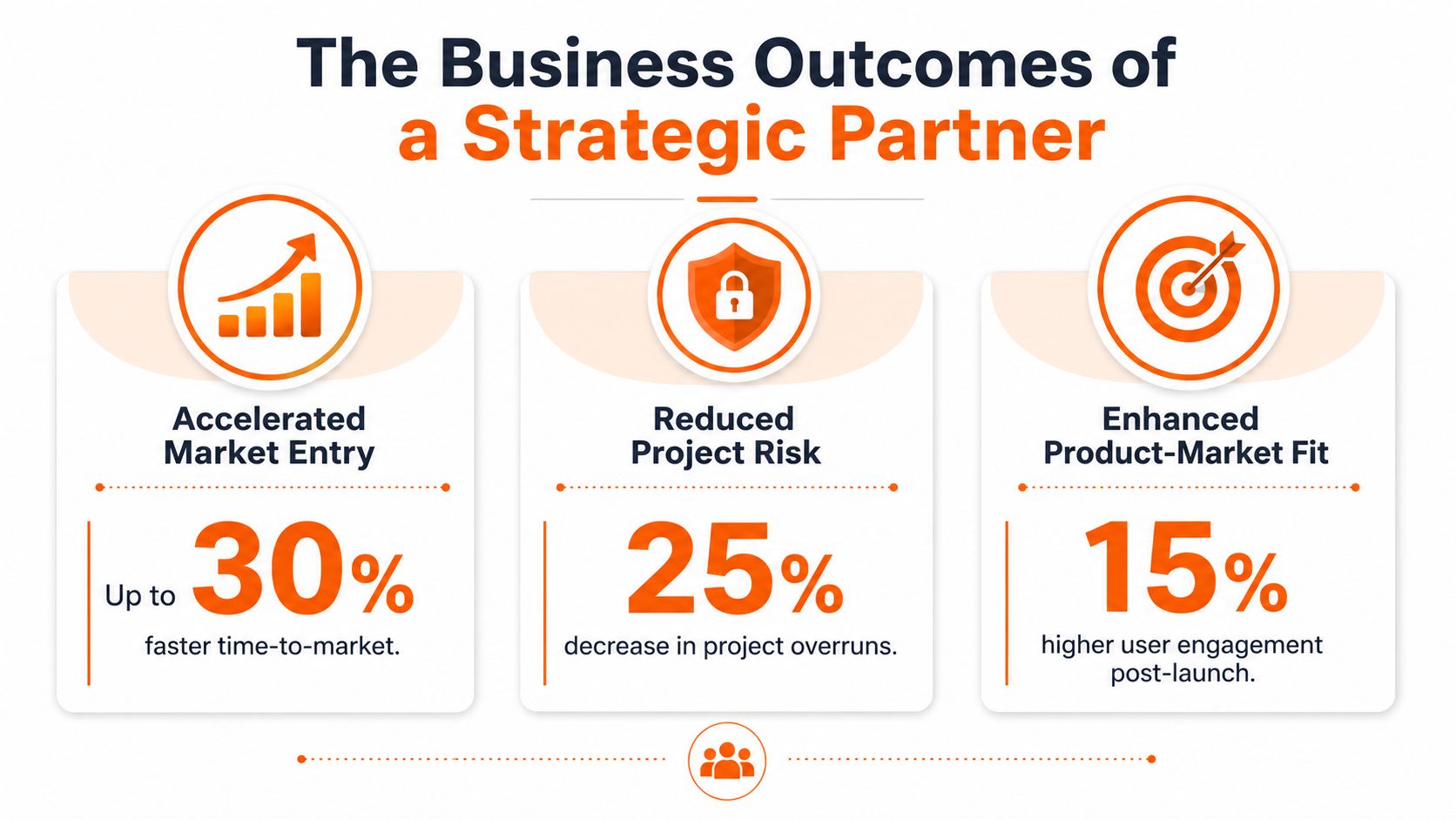
The Business Outcomes of a Strategic Partner
Founders shouldn't invest in consulting because it sounds mature. They should invest because the right partner changes the economics of product delivery.
Focus on value, not activity
Busy teams still miss the market. Shipping code isn't the same as creating product value. Strategic product development consulting works because it forces teams to define success in commercial terms first, then align delivery around those outcomes.
Bain's product development consulting research is useful here because it ties the work to business performance, not technical output. It shows that product development consulting can reduce product costs by 10 to 15% and improve engineering efficiency by 10 to 20%. That's what founders should care about. Better efficiency means fewer wasted sprints. Lower product cost means more runway for learning, iteration, and go-to-market.
Where the gains actually show up
In practice, the impact appears in a few places first:
- Scope control: Teams stop building low-conviction features just because they were discussed in an early workshop.
- Decision quality: Product, engineering, and commercial leaders work from the same priorities instead of parallel assumptions.
- Delivery speed: Senior guidance removes avoidable loops, hand-off delays, and late-stage rework.
- Pricing and packaging clarity: Better market framing improves what you build and what you charge for.
One practical way to sharpen that last point is to look at how others structure pricing visibility and competitor monitoring. A framework like the MyMentions pricing framework is useful because product strategy falls apart when teams ignore how the market anchors value.
Teams don't need more output. They need fewer wrong turns.
What a strategic partner should own
If your partner only reports tasks completed, they're too low in the stack. You need a team that can answer tougher questions:
| Business question | What a strategic partner should do |
|---|---|
| Are we building the right MVP? | Challenge scope and define the smallest commercially useful release |
| Are we using budget well? | Prioritise work that validates demand, retention, or monetisation |
| Can this scale operationally? | Align architecture, team structure, and delivery sequence to the roadmap |
| Are we reducing risk early enough? | Surface product, technical, and compliance risks before they become delays |
That's the standard. Advisory that doesn't move cost, speed, efficiency, or confidence isn't consulting. It's commentary.
Choosing Your Engagement Model
A lot of founders ask the wrong question first. They ask who should build the product. The better question is what operating model gives you the most control with the least friction at your current stage.
The answer changes depending on whether you need strategic clarity, delivery capacity, full product ownership, or a long-term nearshore base.
Engagement Model Comparison
| Model | Best For | Client Involvement | Typical Timeline |
|---|---|---|---|
| Consulting | Early validation, roadmap rescue, delivery planning | High involvement in decisions | Short diagnostic or strategy phase |
| Dedicated Teams | Scale-ups that need embedded senior delivery capacity | Shared day-to-day ownership | Ongoing, aligned to roadmap needs |
| Platform Development | Companies that want end-to-end delivery from one partner | Lower operational involvement, higher governance involvement | Multi-phase product build to launch |
| Build-Operate-Transfer | Firms planning a long-term engineering centre in Poland | High strategic involvement over time | Longer-term capability build |
When consulting is enough
Standalone consulting fits when the product direction is still unstable. You need decisions before you need scale. This works well if your roadmap is bloated, your team is misaligned, or you're preparing an MVP and want a cleaner plan before assigning more budget.
You should choose this model when the main risk is judgement, not capacity.
When a dedicated team is the smarter move
If your roadmap is validated but your internal team can't deliver at pace, a dedicated team usually makes more sense. It gives you hands-on execution without forcing you to build a local hiring machine in the middle of product delivery.
This is also where nearshore becomes attractive for UK SaaS firms, especially with Poland in the mix. According to the UK Department for Business and Trade, senior engineering talent in Poland costs approximately 40 to 50% less than in the UK, while 62% of UK SaaS startups delaying MVP launches cite compliance uncertainty as their primary barrier to nearshore adoption. That hesitation is understandable, but it's solvable.
Nearshore delivery fails when founders buy cheaper talent without buying the operating model that keeps compliance, communication, and accountability under control.
Platform delivery versus BOT
Full platform development is the right call when you want one partner to own delivery from shaping through launch and into scaling. It suits teams that need momentum and accountability more than vendor orchestration.
Build-Operate-Transfer is different. It's a strategic move, not just a resourcing model. You use BOT when you want to create your own R&D capability in Poland but don't want to absorb hiring, setup, and operations risk on day one. If that's the path you're assessing, this breakdown of the Build-Operate-Transfer model is worth reviewing because the trade-offs are operational, not theoretical.
My recommendation
Use a simple rule:
- Choose consulting when your roadmap is unclear.
- Choose dedicated teams when your roadmap is clear but delivery is underpowered.
- Choose platform development when you want one accountable partner across the full build.
- Choose BOT when you want to own a long-term nearshore engineering function.
Teams do not fail because they picked Poland or the UK. They fail because they picked the wrong model for the stage they were in.
The #riteway A Framework for Predictable Delivery
Delivery problems usually look technical from the outside. Missed milestones. Slow releases. Unclear ownership. Rework. In reality, those problems are often cultural and operational before they're technical.
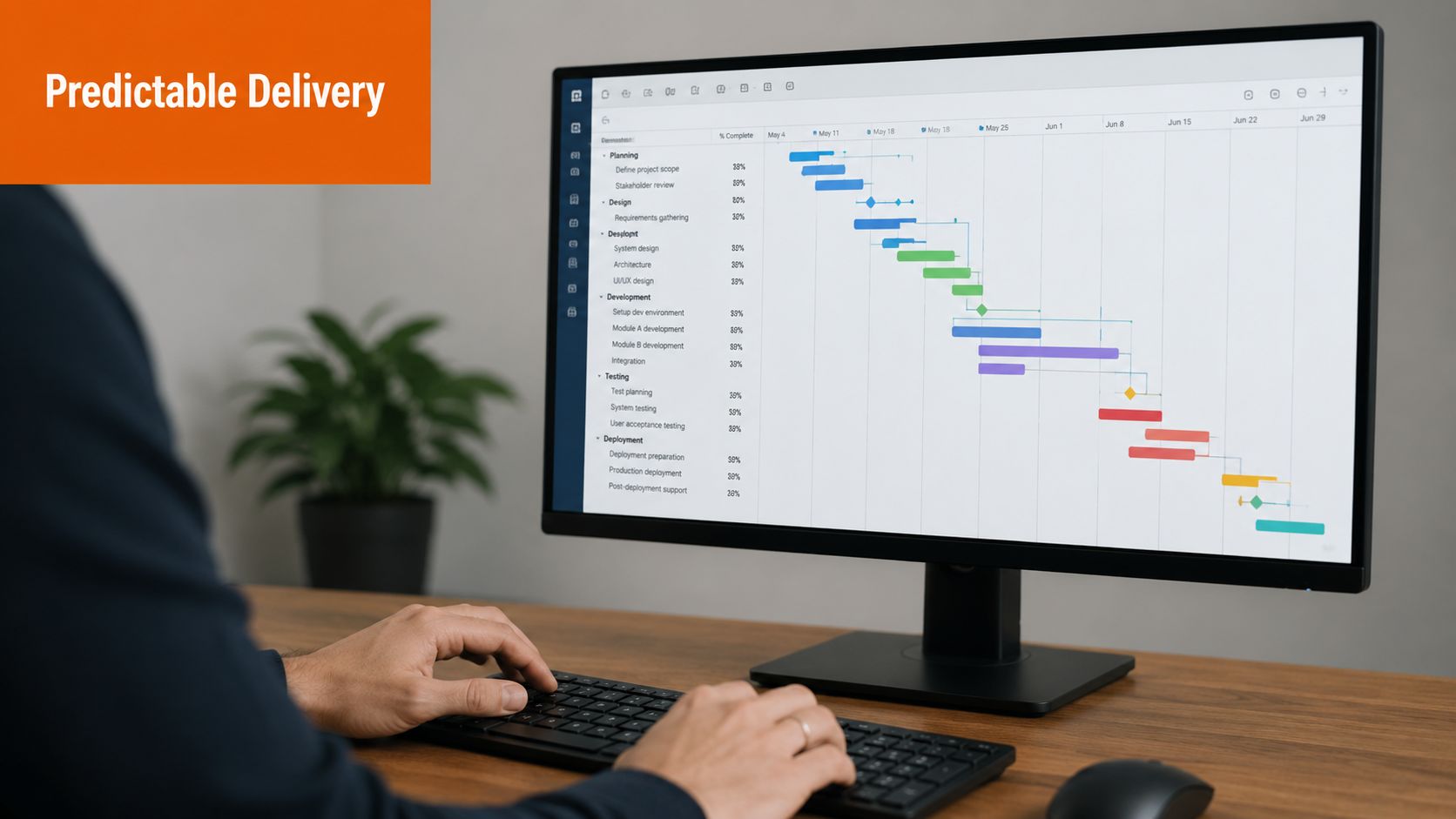
The teams that ship predictably don't wait to be managed into movement. They take ownership early, surface risks before they become blockers, and keep commercial priorities visible inside technical decisions. That's the core of the #riteway Methodology. It's built on Extreme Ownership, high energy, and proactive delivery behaviour.
Extreme Ownership changes delivery tempo
A weak team says, “That dependency blocked us.”
A strong team says, “We saw the dependency coming, escalated it, proposed options, and protected the timeline.”
That difference matters. The AIM Consulting article on digital product development consulting links high-ownership teams with faster time-to-market and stronger stakeholder satisfaction. The exact lesson is simple. Ownership is not soft culture language. It's a delivery mechanism.
For UK SaaS companies working with nearshore teams, this matters even more. Distance only becomes a problem when ownership is weak.
High energy is operational, not cosmetic
A can-do culture isn't about being loud on Slack. It shows up in response time, escalation quality, workshop cadence, and how quickly people move from problem to recommendation.
One option in this category is Rite NRG, a nearshore partner that combines consulting, dedicated teams, platform delivery, and BOT with AI-powered workflows and senior engineering teams. That matters when a founder wants one partner that can advise on delivery architecture and also execute it.
Here's a useful perspective on how strong delivery teams operate in practice:
Predictability comes from proactive habits
The #riteway approach works because it bakes proactive behaviour into daily delivery:
- Risk is surfaced early: Teams raise product, architecture, and delivery concerns before they become sprint surprises.
- Communication is specific: Leaders don't hide behind vague status updates. They explain impact, options, and next actions.
- Momentum is protected: The team keeps moving, even when decisions are pending, by preparing branches, options, and fallback paths.
A predictable team doesn't promise that nothing will go wrong. They make sure nothing goes wrong quietly.
That's how you ship faster without running blind.
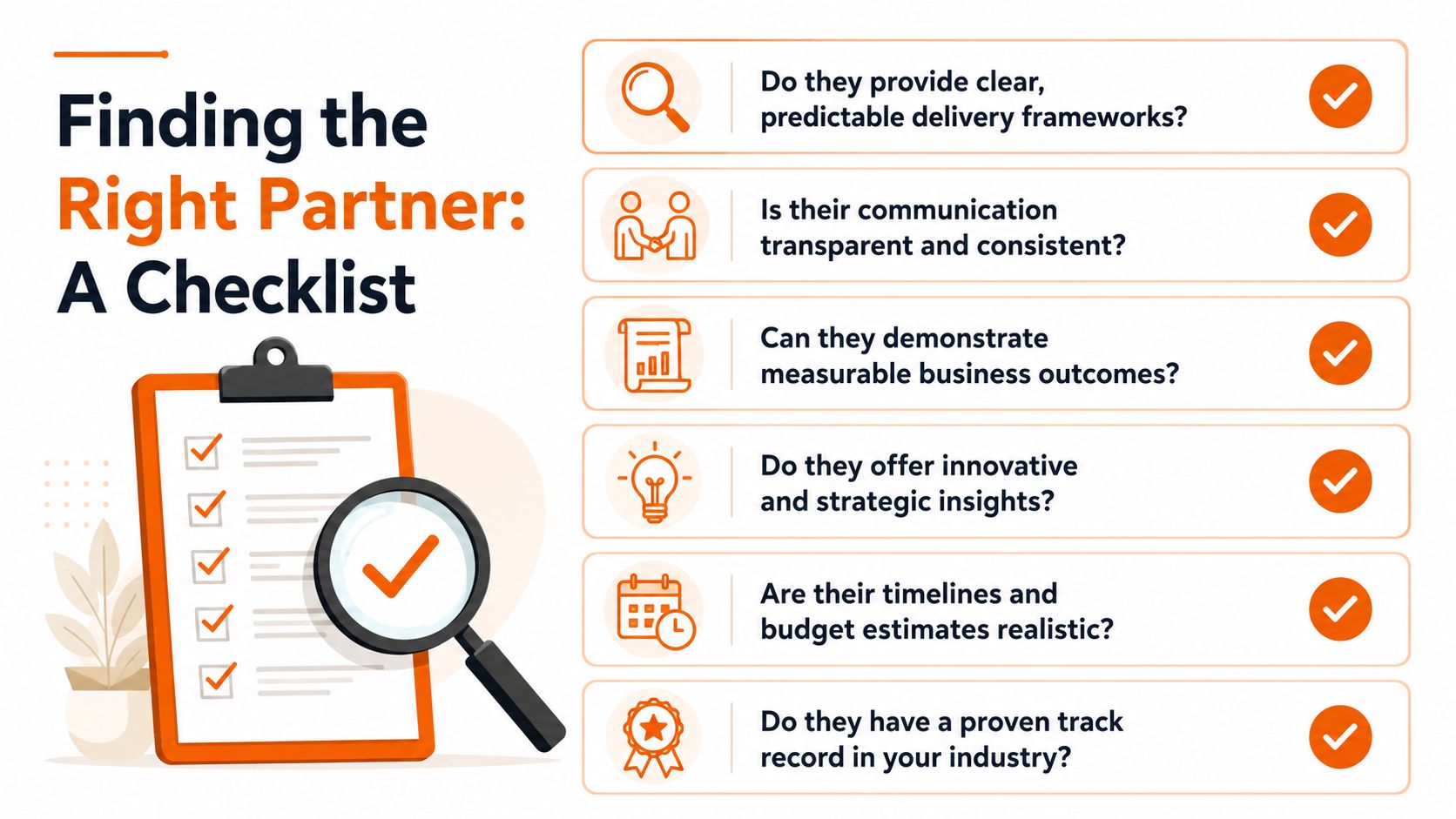
Finding the Right Partner A Checklist
Most founders vet partners too late and too shallowly. They compare day rates, ask for a few case studies, then hope delivery discipline will appear once the contract is signed. It won't.
You need a sharper filter. The right partner should improve the quality of your decisions before they write a line of production code.
Start with seniority
Seniority isn't a nice-to-have when speed matters. According to TechUK benchmarks, senior consultants with 10+ years of experience deliver MVPs 35% faster than junior teams, with a median time-to-market of 4.2 months versus 6.1 months, by identifying 90% of technical risks before development begins.
That's a huge difference for a founder trying to hit a funding milestone, secure design partners, or prove traction before a board review. Junior-heavy teams often look cheaper until you price in rework, delays, and avoidable architecture mistakes.
Use this checklist in every partner conversation
Don't ask generic questions like “What's your process?” Ask questions that reveal how the team thinks under pressure.
- Ask how they define success: If they answer with outputs such as velocity or ticket completion, keep digging. You want a partner who talks about adoption, release confidence, cost control, and roadmap risk.
- Ask who leads the work: Senior people should shape discovery, architecture, and delivery decisions. If the strongest people disappear after the sales call, that's a warning.
- Ask how they surface risk: Strong partners can explain how they identify delivery, technical, and compliance concerns early, and what they do when assumptions fail.
- Ask how they communicate bad news: Every product hits friction. You want fast escalation, clear options, and accountability.
- Ask how they handle handovers and ownership boundaries: This matters whether you're using consulting, a dedicated team, or preparing for a BOT transition.
- Ask what they challenge: If a partner never pushes back on your scope, they're not protecting your business.
Selection test: A serious partner should make your roadmap clearer during the buying process, not just more expensive.
Look for evidence in behaviour
You can usually spot the wrong fit in the first few meetings. They overuse frameworks, underuse specifics, and avoid hard recommendations.
The right fit feels different:
| What weak partners do | What strong partners do |
|---|---|
| Echo your assumptions | Pressure-test them |
| Hide behind process language | Explain trade-offs plainly |
| Sell broad capability | Define a delivery path |
| Focus on headcount | Focus on business outcomes |
Choose the team that helps you make better product decisions before the contract starts. That's the team most likely to deliver when pressure hits.
Realistic Timelines and Pricing Benchmarks
Founders always ask two questions first. How long will it take, and what will it cost? Good. Those are the right questions. Bad partners answer them with confidence too early.
Serious product development consulting starts with enough discovery to produce a realistic delivery model. If someone gives you a fixed answer without understanding your product scope, dependencies, compliance needs, and operating model, they're guessing.
What the market actually looks like
According to Deloitte UK benchmarks, product development consulting for SaaS clients in the UK typically requires a minimum engagement fee of £75,000 to £120,000 for the full lifecycle, and thorough feasibility studies reduce post-launch failure rates by 42%.
That fee range tells you something important. Real consulting isn't a lightweight planning workshop. It covers the heavy lifting that founders often try to skip, such as feasibility, technical shaping, product definition, and release planning.
What changes your budget and timeline
Three variables usually drive the cost and pace of the engagement:
- Product ambiguity: The less clarity you have on users, scope, and workflows, the more effort goes into shaping before build.
- Delivery model: Advisory is lighter than a full embedded team or end-to-end platform engagement.
- Compliance and architecture complexity: Regulated workflows, legacy migration, and integration-heavy products need more diligence upfront.
That's why founders should treat early validation work as a valuable asset, not overhead. A proper feasibility phase can save months of confusion later. If your goal is to build an MVP fast, the fastest route usually starts with better decisions, not faster coding.
Speed comes from eliminating avoidable work before it enters delivery.
My advice on budgeting
Budget for clarity first, then for scale. Don't spend aggressively on implementation until someone has challenged the scope, mapped delivery risk, and forced a hard conversation about what the first release really needs to prove.
That's how you protect both cash and timeline.
From Plan to Launch Your Next Steps
If your roadmap feels heavier every month, stop adding people before you fix the model. Most SaaS delays come from weak assumptions, blurred ownership, and the wrong engagement structure. Those problems don't disappear when you hire faster.
The better move is simpler. Decide what stage you're in. If you need strategic clarity, buy consulting. If you need execution power, add a senior dedicated team. If you want one accountable partner across discovery to launch, choose platform delivery. If you want to build a long-term Polish R&D capability, evaluate BOT properly.
What to do this week
Start with a short internal audit:
- Review your roadmap: Mark which items are validated, assumed, or politically inherited.
- List your top delivery risks: Include product, technical, compliance, hiring, and dependency risks.
- Choose your target outcome: Faster MVP, stronger investor readiness, lower delivery risk, or a scalable team model.
- Stress-test your current partner setup: Be honest about whether it's giving you strategic guidance or just execution labour.
If your team is also exploring AI-assisted delivery, product leaders should understand what modern implementation workflows now look like. This guide on how to build Next.js apps with AI is a useful reference because it connects delivery acceleration with practical build decisions, not abstract AI hype.
The standard to hold
Hold every potential partner to a higher bar. They should challenge your scope, clarify the operating model, expose hidden risk, and help you make cleaner commercial decisions. If they can't do that, they're not de-risking your roadmap.
You don't need more motion. You need a delivery partner with ownership, energy, and the confidence to make hard calls early.
If you want a practical view of how to structure consulting, dedicated teams, platform delivery, or a BOT setup in Poland, talk to Rite NRG. The focus should be simple: reduce roadmap risk, tighten execution, and get your SaaS product to market faster with a model that fits the stage you're in.