Roadmap meetings go sideways when everyone has a strong opinion and nobody has evidence. Sales wants one feature because a prospect asked for it. The founder wants another because a competitor launched something similar. Engineering wants to clean up the platform first. Design wants a better onboarding flow. Two weeks later, the backlog is bigger, conviction is lower, and nothing meaningful has shipped.
That's usually the moment people call user research “important” and still avoid doing it. They assume research means long studies, bloated reports, and a team of specialists slowing down delivery. That assumption is expensive. Bad research slows teams down. Good research does the opposite. It cuts debate, kills weak ideas early, and gives product teams permission to move fast because they're not building blind.
A product team needs Extreme Ownership. Not ownership of tickets. Ownership of outcomes. If your team is serious about shipping a product users will adopt, then user research methods aren't a side activity for later. They're part of delivery. They belong in the same conversation as scope, sprint planning, and release quality.
The UK already proved this at institutional scale. A major turning point came with the creation of the Government Digital Service in 2011, which made user-centred design mainstream across public services and tied research directly to delivery outcomes such as completing tasks online, reducing support burden, and improving usability at scale, as outlined in this GDS user research reference. That matters because it reframed research as an operational discipline, not a design preference.
If you're building SaaS, that's the model to copy. Use research to make decisions faster. Use it to protect engineering capacity. Use it to decide what not to build.
Stop Guessing Start Shipping User Research for Real Results
Most product waste starts the same way. A team confuses internal confidence with market truth. Then they fund the assumption with engineering time.
That's backwards.
User research methods should exist to increase business velocity. If a method doesn't help your team decide what to build, what to cut, or what to fix, it's not helping. You don't need more ceremony. You need sharper evidence.
Research is a delivery tool, not a design ritual
A lot of teams still treat research like a nice extra for mature products. That's a mistake. The earlier you apply it, the cheaper your decisions get. A short round of interviews can expose whether the problem matters. A usability session can reveal whether users can complete a critical task. Analytics can tell you where a flow breaks. Each one protects delivery from guesswork.
That's why strong teams don't ask, “Should we do research?” They ask, “What's the fastest way to reduce uncertainty before we commit more build effort?”
Practical rule: If the team is debating a feature for more than a few days, the real problem is usually missing evidence.
The GDS precedent matters here because it changed how organisations in the UK thought about delivery. Research became part of how teams improved service performance, not a separate design stream. That same mindset works for SaaS. When research is connected to completion rates, support demand, onboarding friction, and feature adoption, it stops being abstract.
Extreme Ownership means owning the learning loop
High-performing product teams don't outsource thinking. They don't wait for perfect certainty either. They create a fast loop.
That loop looks like this:
- Define the risk: What are we uncertain about right now?
- Pick the leanest method: Interview, usability test, survey, analytics review, or experiment.
- Get evidence quickly: Small, focused studies beat broad, vague ones.
- Act on the result: Kill, refine, prioritise, or ship.
Nearshore delivery teams can be especially effective. A strong partner doesn't just take backlog items and produce code. They challenge weak assumptions, push for evidence, and keep momentum high. Research becomes part of the operating model.
Stop rewarding opinions with roadmap space
Opinion-led roadmaps feel decisive, but they create expensive rework. Research-led roadmaps feel sharper because every major decision has a reason behind it. That doesn't mean endless validation. It means choosing the right method at the right moment and moving.
If your product team is still debating based on hierarchy, instinct, or the loudest customer, fix that first. User research methods are how you replace politics with evidence and hesitation with action.
The Full Spectrum of User Research Methods
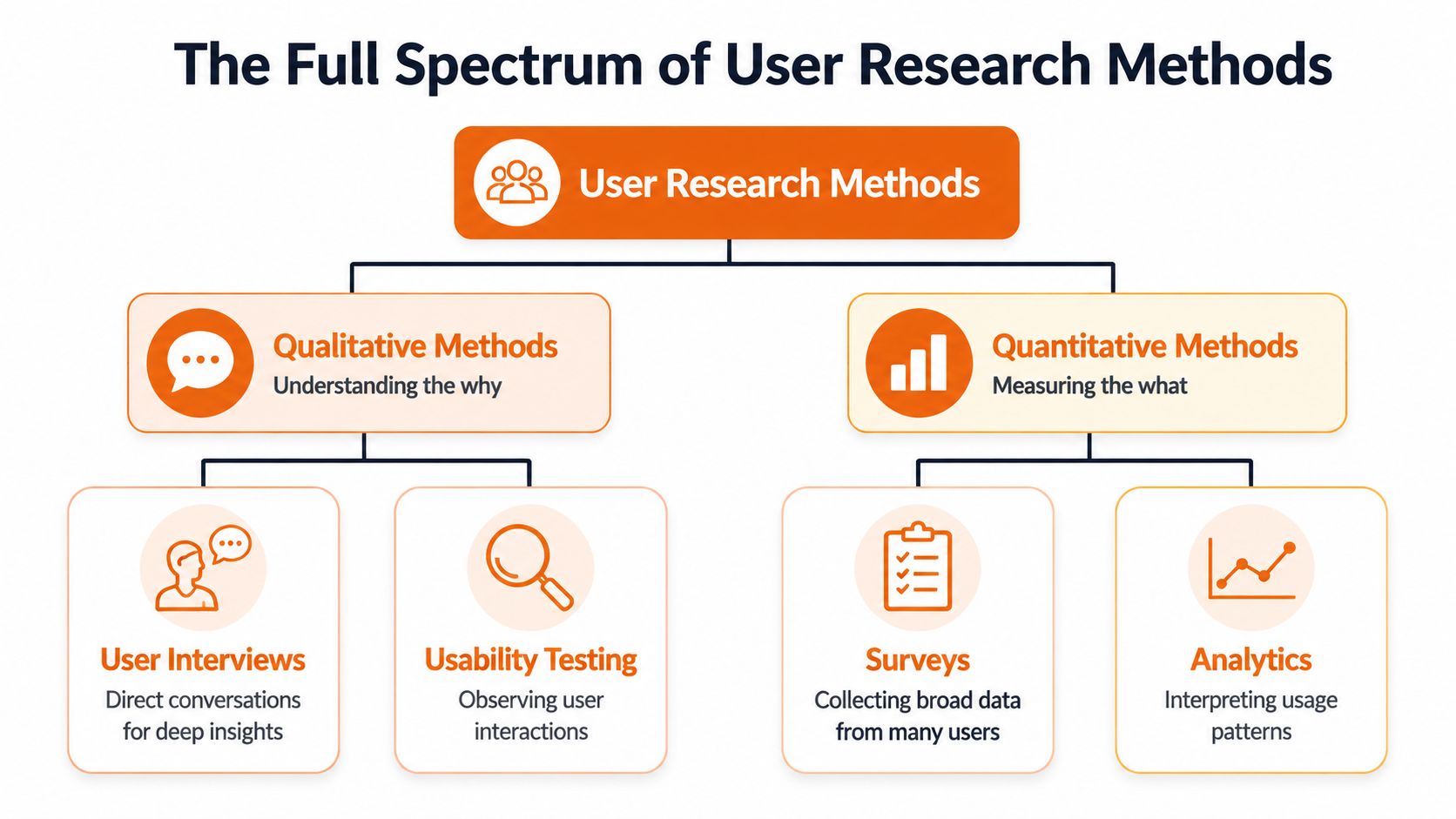
The easiest way to understand user research methods is to stop treating them as a random list. They're a toolkit. And like any serious toolkit, each item solves a different problem.
Use a simple 2×2 view. One axis is qualitative vs quantitative. The other is attitudinal vs behavioural. Once your team sees methods this way, method selection gets much easier.
Qualitative and quantitative answer different questions
Qualitative methods explain meaning. They help you understand motivation, frustration, context, and language. Quantitative methods measure scale. They help you understand prevalence, patterns, and confidence.
A simple way to think about it:
| Type | Best for | Typical methods |
|---|---|---|
| Qualitative | Understanding why something happens | Interviews, moderated usability testing |
| Quantitative | Measuring what happens and how often | Surveys, analytics, A/B testing |
If a team says, “Users don't get the onboarding,” that's too vague. Qualitative work can reveal where the confusion starts and how users describe it. Quantitative work can show how many users drop out and at which step.
Attitudinal and behavioural stop you from being fooled
This split matters even more.
- Attitudinal methods capture what people say, think, prefer, or believe.
- Behavioural methods capture what people do.
Those are not the same thing. Users may say a feature sounds valuable and still ignore it in the product. They may report that onboarding feels fine while session recordings show hesitation and repeated errors.
Interviews tell you the story users can articulate. Behavioural methods expose the friction they can't always explain.
That's why strong product teams combine perspectives instead of arguing about one “best” method.
The practical map most teams need
Here's the shortcut:
- Use interviews when you need depth, language, and unmet needs.
- Use usability testing when you need to observe task completion and friction.
- Use surveys when you want structured feedback across a broader audience.
- Use analytics when you need to inspect patterns in actual product usage.
If your team is also improving flows across the full product lifecycle, these strategic customer journey insights help connect isolated research findings to a wider customer experience view.
Product teams also benefit when research and interface decisions stay close together. That's why good research should feed directly into digital product design decisions, not sit in a slide deck no one uses.
Don't collect methods. Build a method stack.
Some teams overcorrect and try everything. Interviews, surveys, field studies, card sorting, A/B tests, heatmaps, diary studies. That looks mature and often creates noise.
A better move is to build a method stack around the decision in front of you. For example:
- Problem unclear. Start with interviews.
- Flow exists but feels weak. Run usability testing.
- Behaviour changed after release. Check analytics.
- Two versions compete. Run an experiment.
That's the core idea. User research methods aren't competing philosophies. They're complementary tools. Pick the one that gives your team the clearest next move.
Choosing the Right Method for Your MVP
Most advice on user research methods breaks down at the exact point where teams need it most. It explains what interviews are, what surveys are, what usability testing is, and then leaves you hanging when the key question appears: which method should we use right now, with this timeline, this budget, and this MVP risk?
That gap is real. Neutral guidance highlighted in this method selection discussion from Outset makes the point clearly. Teams should define what they need to learn and why, then choose methods that combine qualitative and quantitative evidence when it improves decision quality. It also makes the contrarian point many teams need to hear: more methods are not automatically better.
Start with the decision, not the method
The wrong question is, “Should we run interviews or a survey?”
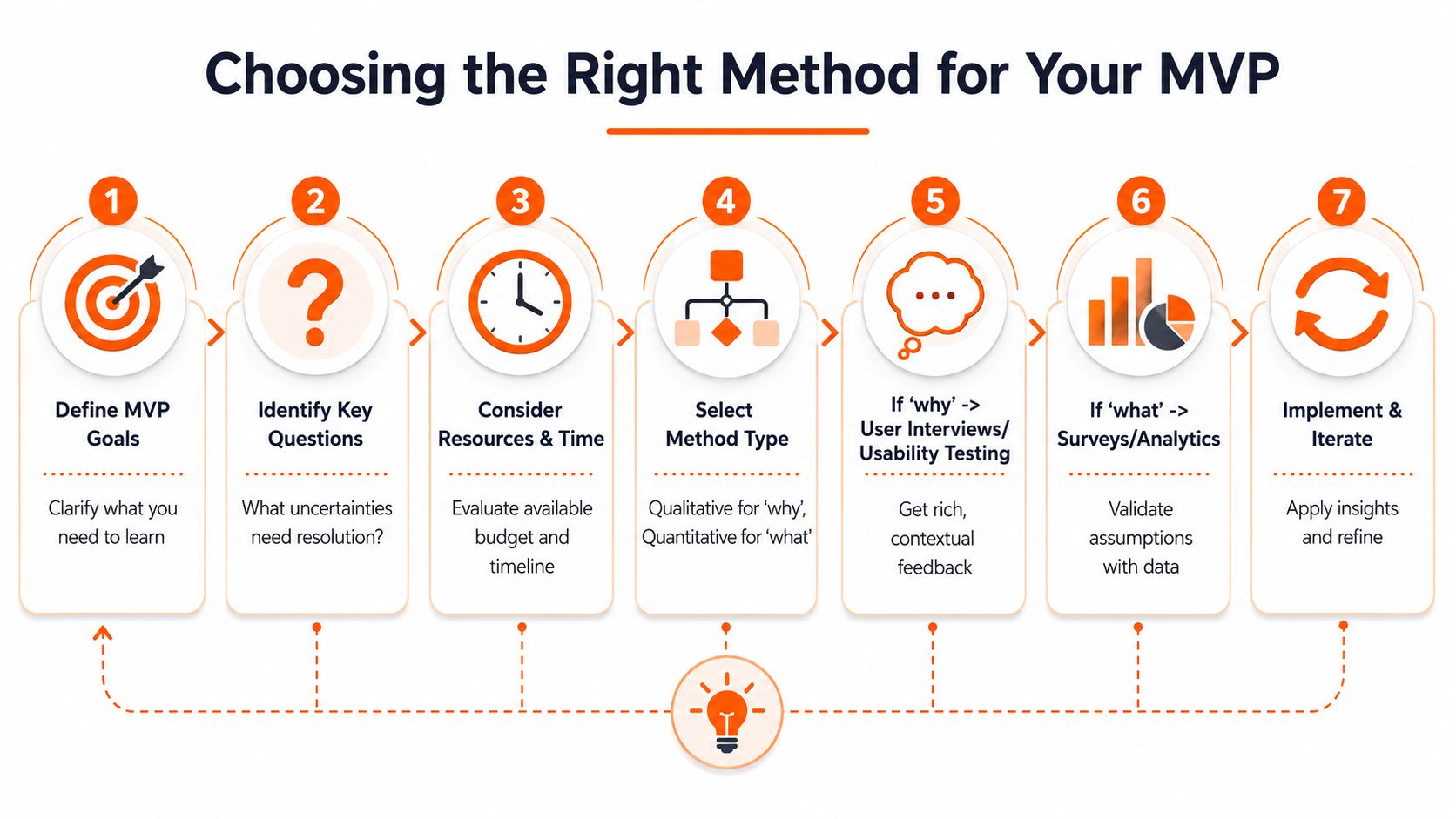
The right question is, “What decision are we trying to make before we spend more time building?”
That shifts the whole process. Your method should match your uncertainty.
Here's a practical decision grid for MVP teams:
| Product stage | Main question | Best-fit methods |
|---|---|---|
| Discovery | Is this problem worth solving? | Interviews, lightweight surveys |
| Validation | Can users understand and use the solution? | Usability testing, prototype feedback |
| Optimisation | Which version performs better in-market? | Analytics, A/B testing |
This is how teams stop using research as a ritual and start using it as a filter.
A lean rule for method selection
If you need why, start qualitative.
If you need what's happening at scale, go quantitative.
If you need to know whether users can complete a task, use behavioural methods.
If you need to compare alternatives in a live environment, experiment.
That gives product managers a clear sequence:
- Define the risk: What could make this MVP fail?
- Frame the question: Is it about desirability, usability, clarity, or performance?
- Choose the lightest method: Don't overinvest before you know enough.
- Time-box the work: Research should unblock delivery, not drift.
- Convert findings into backlog action: Delete, reprioritise, refine, or ship.
Match the method to the cost of being wrong
Some mistakes are cheap. A confusing tooltip can be fixed later. Some are expensive. Building the wrong workflow into your core product model can burn weeks of engineering effort and muddle your positioning.
That's why your research intensity should rise with decision risk.
- High strategic risk: Talk to users before building.
- Medium usability risk: Test the workflow before release.
- Live optimisation risk: Use analytics and experiments after launch.
If you're balancing MVP speed against product confidence, these MVP development strategies are useful because they frame product scope as a learning mechanism, not just a reduced feature set.
Prototype-led teams can also make this decision cycle much faster by pairing research with rapid prototyping techniques. A clickable prototype plus a few focused sessions often beats debating requirements in the abstract.
Decision lens: Don't ask which research method is best. Ask which one will give the team enough confidence to move without creating avoidable rework.
The key point is simple. MVP research should help you learn just enough to commit the next round of effort wisely. No more. No less.
Mastering Qualitative Methods to Uncover User Needs
Qualitative research is where product teams stop projecting and start listening. It's where you find out that users aren't struggling with the feature you obsessed over. They're struggling with the workflow around it, the language inside it, or the trust gap before they ever click.
For fast-moving SaaS teams, the two most useful qualitative user research methods are user interviews and usability testing. They work because one uncovers motivation and context, and the other exposes friction in real behaviour.

The business case is strong. A 2024 NCDI study found that UK SaaS products using user interviews and usability testing during the MVP phase saw 42% lower post-launch defect rates, and the same study tracked 1,200 UK-based software firms. It also reported a 35% faster time-to-market for B2B SaaS when attitudinal methods such as interviews were combined with behavioural methods such as usability testing, plus 28% higher user retention at 6 months post-launch for UK companies using mixed-method frameworks, with statistical significance, according to the verified NCDI data provided in the brief.
User interviews find the problem behind the request
Users rarely hand you the product strategy. They hand you fragments. Complaints, workarounds, hesitations, forced habits, and language patterns. Interviews help you connect those fragments.
Use interviews when you need to understand:
- Buying friction: Why prospects hesitate, delay, or reject.
- Workflow reality: What users are trying to get done.
- Feature pressure: Whether a request reflects a real need or just a local preference.
- Switching behaviour: Why teams stay with old tools even when they dislike them.
A simple interview structure works well:
- Context first: “Tell me how your team handles this today.”
- Pain second: “Where does the process break down?”
- Workarounds third: “What do you do when that happens?”
- Decision impact: “What slows you down or creates risk?”
- Reaction to concept: “What part of this feels useful, unclear, or unnecessary?”
Keep it conversational. Don't pitch. Don't defend the product. Don't ask people what features they want as if they're writing your roadmap.
Best use case: early discovery, feature prioritisation, ICP refinement, pricing conversations, and post-churn analysis.
Biggest weakness: interviews capture stated behaviour, not always actual behaviour.
Usability testing shows where the product breaks
Interviews tell you what users mean. Usability testing shows what they can do. That distinction matters because many product failures are not strategy failures. They're execution failures.
Ask a user to complete a realistic task with your prototype or product. Then watch.
Use prompts like:
- “Show me how you'd invite a teammate.”
- “Find where you'd update billing details.”
- “Set up the first report you'd need for Monday.”
- “Accept data consent settings and continue onboarding.”
Don't rescue too early. Silence is data. Repeated clicking is data. Going to the wrong menu is data. So is the sentence, “I'm not sure what this means.”
This walkthrough offers a useful visual example of user testing in practice:
A practical remote playbook
Nearshore and distributed teams don't need a lab. They need discipline.
| Method | What to prepare | What to capture |
|---|---|---|
| Interview | Discussion guide, participant context, recording consent | Quotes, themes, pain patterns |
| Usability test | Task script, prototype or live flow, observer notes | Task success, hesitation, error points |
For remote sessions:
- Use Zoom or Google Meet for moderated conversations.
- Use Figma prototypes when testing concepts before engineering starts.
- Use Miro or Notion to cluster observations fast after each session.
- Record sessions with permission so product and engineering can review exact moments of friction.
Users don't care about your feature taxonomy. They care whether they can finish the task that matters to them.
Copy-ready scripts your team can use
Interview opener
- “Thanks for joining. I'm not testing you. I'm trying to understand how you currently handle this problem and where the friction is.”
Usability opener
- “Please think aloud as you go. If something is confusing, that's useful for us to know.”
Follow-up probes
- “What were you expecting to happen there?”
- “What made that step unclear?”
- “How would you describe this in your own words?”
- “What would you do next if no one were here?”
Qualitative work becomes powerful when teams treat it as a source of product decisions, not anecdote collection. Done well, it cuts feature creep, lowers avoidable support demand, and gives product leaders language they can use in positioning, onboarding, and roadmap calls.
Driving Product Growth with Quantitative Research
Qualitative work gives you signal. Quantitative research tells you whether that signal matters at scale. This is how product teams move from “a few users struggled” to “this pattern affects a meaningful part of the product and we should act now.”
For SaaS, the most useful quantitative user research methods are A/B testing, surveys, and product analytics. They help you validate product choices, monitor real-world behaviour, and make changes with more confidence than instinct can provide.
A/B testing is for decisions, not curiosity
A/B testing matters when you have competing options and a clear success metric. Not before.
Good use cases include:
- comparing two onboarding flows
- testing a consent banner design
- evaluating pricing page messaging
- checking whether a new call to action improves progression
The point isn't to test everything. The point is to test what changes user behaviour in a commercially meaningful flow.
According to the UK's Office for Product Safety and Standards, in its 2025 Benchmark Report on Digital Product Compliance, UK SaaS platforms using A/B testing and analytics-driven user research achieved 37% higher compliance adherence with GDPR and the UK Data Protection Act 2018 than those relying on static survey methods. The same report analysed 850 UK software firms and found that behavioural data collection such as clickstream analytics and session recordings helped reduce data breach incidents by 29% within 12 months, based on the verified OPSS data provided in the brief.
That should change how teams think about experimentation. It's not only a growth tactic. It's also a compliance and clarity tool when user choices affect privacy, consent, and trust.
Surveys work when you already know what you're asking
Surveys are often misused. Teams send broad questionnaires because they want “feedback,” then get mushy responses they can't act on.
A survey becomes useful when you've already narrowed the problem. For example:
- validating which pain point is most common
- checking sentiment after a release
- comparing perceptions across user segments
- measuring satisfaction with a specific workflow
Good surveys are structured and blunt. Avoid open-ended overload. Use them to quantify themes you've already identified elsewhere.
A practical approach is to pair survey findings with targeted interviews. That combination gives you scale plus context, which is far more useful than either source alone in isolation.
Analytics reveals the product your users actually experience
Analytics is where hidden friction becomes visible. Funnel drop-off, dead clicks, rage clicks, abandoned flows, low feature adoption, and repeat behaviour all tell a story. They show the product that exists in use, not the product your team thinks it shipped.
If onboarding completion is weak, analytics helps isolate the stage where users stop. If a new feature isn't adopted, analytics can show whether users saw it, ignored it, or started and bailed.
Use analytics well by asking direct questions:
- Where do users abandon key flows?
- Which features are tried once and never revisited?
- Which paths correlate with successful activation?
- Where do privacy or consent interactions create hesitation?
What to watch: If a team cannot point to one metric tied to a product decision, they're collecting data, not learning from it.
Quantitative research protects margin, too
This isn't just about conversion improvement. It's also about avoiding waste.
The verified OPSS data in the brief states that UK-based SaaS teams using mixed-method frameworks reduced product rework costs by 44%, with statistical significance. That matters because rework is one of the quiet killers of product momentum. It drains engineering capacity, delays releases, and weakens confidence across leadership.
Quantitative research helps teams act earlier and with more precision. It gives founders cleaner reporting, product leaders a stronger prioritisation case, and engineering teams fewer expensive reversals.
Use qualitative methods to form the right hypotheses. Use quantitative methods to validate, prioritise, and monitor. That combination is how teams drive product growth without turning every roadmap choice into a political argument.
Embedding Research into Fast Nearshore Delivery
The biggest myth in product delivery is that research slows agile teams down. It doesn't. Slow decision-making slows teams down. Rework slows teams down. Shipping features that users don't understand slows teams down. Research, done properly, removes all three.
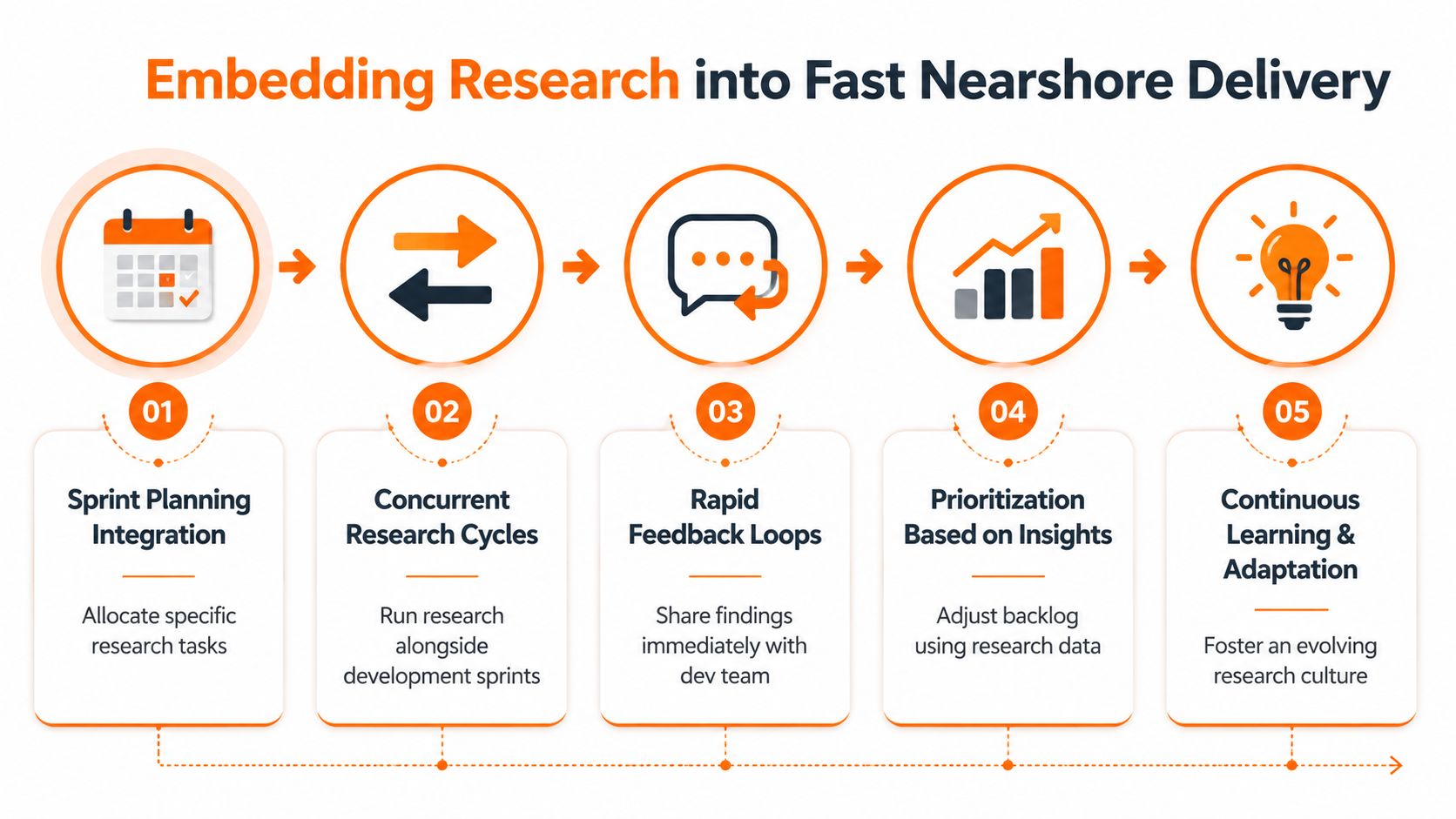
In fast nearshore environments, research should run inside delivery, not outside it. It belongs in sprint planning, backlog refinement, acceptance criteria, and release review. If your research process lives in a separate lane with separate timing, you've already created drag.
Build research into the sprint instead of around it
A fast operating model looks like this:
- Before the sprint: clarify the biggest product risk
- During the sprint: run focused interviews, prototype tests, or behaviour reviews
- Mid-sprint: share raw findings with product and engineering immediately
- End of sprint: turn evidence into backlog changes or release decisions
Distributed teams gain an advantage if they work with discipline. Researchers, product managers, designers, and engineers can review sessions asynchronously, comment inside tools like Figma, Notion, or Loom, and make decisions without waiting for a long readout.
Teams that want reliable speed should also design their delivery model around nearshore collaboration principles such as overlapping hours, direct communication, and shared planning rituals, which are central to a strong nearshore software delivery setup.
Use AI to shorten the learning loop
AI changes the economics of research execution. It doesn't replace judgement, but it absolutely removes admin.
The verified NCDI data in the brief states that UK SaaS teams integrating AI-driven analytics into user research workflows reduced research cycle time by 50%. That matters because cycle time is what determines whether research becomes a habit or a bottleneck.
Practical AI uses include:
| Research activity | AI-supported acceleration | Outcome |
|---|---|---|
| Interview review | Transcription and theme extraction | Faster synthesis |
| Session analysis | Pattern detection in recordings | Faster friction spotting |
| Feedback clustering | Sentiment and topic grouping | Faster prioritisation |
Good teams still validate conclusions manually. But they don't waste hours on tasks software can shrink to minutes.
Remote and asynchronous beats waiting for perfect logistics
Nearshore teams often support products across multiple markets, so participant coordination can get messy if the team overengineers it.
A better approach:
- Run moderated interviews for high-risk questions
- Use unmoderated testing for straightforward task validation
- Record and clip key moments for engineers
- Recruit across markets when language and compliance allow
- Keep studies narrow so findings stay actionable
This matters for pace. A team doesn't need a giant research programme every sprint. It needs a reliable learning habit.
Fast teams don't skip research. They shrink it to the smallest unit that improves the next decision.
Treat findings as delivery input, not documentation output
The worst research handoff is a polished report nobody uses. The best handoff is operational.
That means findings should end up as things like:
- rewritten onboarding copy
- a removed backlog item
- a changed acceptance criterion
- a revised consent flow
- a feature launch pause until a critical issue is fixed
When research gets embedded this way, it supports engineering velocity instead of competing with it. It helps distributed teams stay aligned, reduces opinion-driven churn, and keeps product decisions tied to what users need.
Take Extreme Ownership of Your Product Success
A lot of teams still act like user research belongs to someone else. The UX team. A contractor. A future hire. A later phase after launch. That mindset is one of the fastest ways to build the wrong thing with total confidence.
If you lead product, delivery, design, or engineering, research is your responsibility because outcomes are your responsibility. That's what Extreme Ownership looks like in practice. You don't just own output. You own whether the product works for the people it's meant to serve.
Stop hiding behind speed theatre
Shipping fast is useful only when you're moving in the right direction. Plenty of teams look busy. They run stand-ups, close tickets, push releases, and still create products that users ignore, misunderstand, or abandon.
That isn't speed. That's motion without evidence.
A stronger operating standard is simple:
- Challenge assumptions early
- Ask what decision needs evidence
- Use the lightest useful method
- Act on the result without delay
That applies whether you're building an MVP, refining onboarding, or trying to improve compliance-sensitive journeys. Research is not a brake on execution. It's what keeps execution from drifting.
The right partner challenges the brief
A weak delivery partner takes requirements and ships them. A strong one pushes back when the brief rests on guesswork. That's not resistance. That's ownership.
You want a team that asks:
- What problem are we solving?
- How do we know users need this?
- What is the fastest way to validate the risky part?
- What evidence would make us cut this from scope?
Those questions protect budget, time, and focus. They also create better products.
If nobody in your delivery process is accountable for learning, then everyone is accountable for rework.
Build a culture that listens before it scales
Research maturity doesn't come from adding more templates. It comes from changing team behaviour. Product leaders need to reward evidence over certainty. Engineers need access to user friction, not just tickets. Designers need to test language and flow, not only visuals. Founders need to stop letting seniority win roadmap arguments.
The teams that win don't wait until everything is perfect. They learn in motion. They use user research methods to cut noise, raise confidence, and ship with intent.
That's the standard. Stop guessing. Start listening. Then ship what the evidence supports.
If you want a delivery partner that treats research, product strategy, and engineering as one execution system, talk to Rite NRG. They help SaaS teams move fast with senior nearshore talent, product-first thinking, and AI-powered delivery that keeps speed high without losing control.