Your backlog keeps growing. Releases take too long. One brittle integration can derail a quarter's roadmap. Meanwhile, the business still expects faster launches, cleaner data, stronger security, and lower operating cost.
That's the actual shape of a legacy problem. It isn't old code sitting in a corner. It's a delivery constraint sitting in the middle of your growth plan.
Most CTOs already know the platform needs to change. The central challenge is choosing how to modernise without wrecking continuity, burning out the team, or funding a rewrite that never lands. The right answer isn't abstract architecture purity. It's a practical, business-led sequence of decisions that improves speed, control, and ROI.
That's the mindset behind Extreme Ownership. Treat modernization as a leadership responsibility, not an engineering side quest. Set the outcomes. Pick the right pattern. Build a delivery model that can execute. Then push value into production in controlled steps.
Your Legacy System Is a Handbrake on Growth
If you're leading technology in a scaling business, you've probably seen the same pattern. Product wants faster releases. Sales wants custom workflows. Operations wants fewer incidents. Finance wants predictability. Your legacy estate gives everyone the opposite.
The damage shows up in ordinary work. A simple feature request turns into an impact analysis across fragile dependencies. Developers avoid certain modules because nobody trusts the blast radius. Hiring gets harder because strong engineers don't want to spend their best years nursing opaque systems with weak documentation and slow feedback loops.

This is a business constraint, not a code problem
Treating legacy modernization as “technical debt cleanup” undersells the issue. This is about growth capacity. When the core platform resists change, every commercial initiative costs more and lands later.
The UK public sector gives a useful signal. The National Audit Office reported that government spends about £45 billion per year on digital and technology services, while a large share goes into maintaining existing systems rather than transforming them, as summarised in this review of UK modernization economics and technology spend. That matters because it reframes modernization as an economic decision. Leaders modernise to cut run-cost, reduce operational risk, and improve delivery speed.
You should think the same way.
Practical rule: If a core system slows product delivery, inflates operating cost, and raises change risk, it belongs on the business agenda, not just the engineering roadmap.
Stop framing modernization as a cost centre
A legacy platform can still run critical revenue operations. That doesn't make it healthy. Plenty of businesses mistake “still working” for “still fit”. Those are not the same thing.
Use a sharper lens. Ask whether the system helps you do these things well:
- Launch products faster: Can teams ship new capability without negotiating with fragile dependencies every sprint?
- Scale operations cleanly: Can the platform support more customers, more transactions, or more integrations without heroic effort?
- Control risk: Can you test, secure, and change the system without crossing your fingers on release day?
- Attract strong engineers: Can experienced people work productively in the stack, or will they spend months decoding historical complexity?
If the answer is no, the system isn't just old. It's actively suppressing business performance.
Extreme Ownership changes the outcome
Weak modernization programmes drift because nobody owns the result end to end. Architecture owns one piece. Product owns another. Operations inherits the risk. Vendors ship tasks, not outcomes. The programme turns into a sequence of disconnected motions.
Take ownership differently. Define the business outcomes first. Put one accountable leader over the programme. Force every technical decision to answer a commercial question: does this reduce cost, increase delivery speed, lower risk, or create future strategic flexibility?
That's when legacy system modernization strategies become valuable. Not when they appear advanced on a slide, but when they remove friction from the business.
Choosing Your Modernization Strategy and Pattern
Think of modernization like renovating a live commercial building. Sometimes you repaint and improve utilities while tenants stay inside. Sometimes you strip the structure back to the frame. Sometimes you build a new extension and move people over floor by floor. The mistake is assuming one approach fits every property.
That's why the best legacy system modernization strategies combine patterns. You don't need ideological purity. You need the right move for each capability.
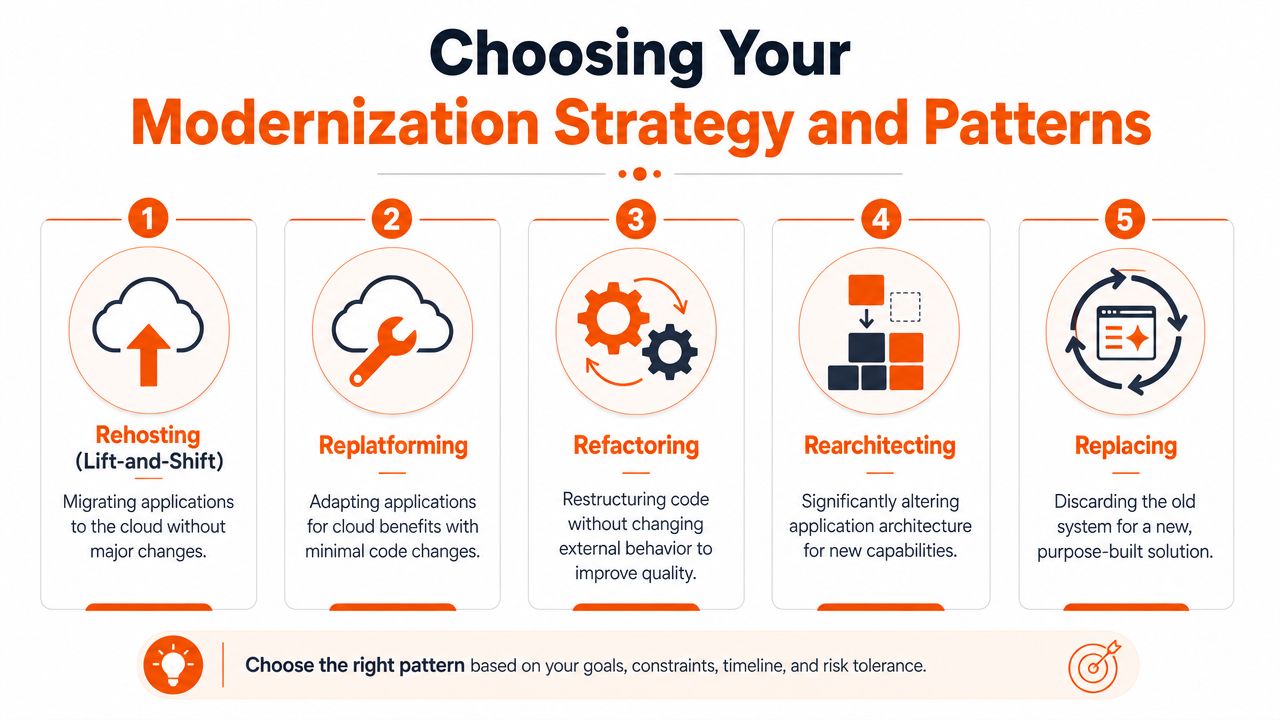
The five patterns that matter
Here's the practical view.
| Pattern | What it means | Best used when | Main trade-off |
|---|---|---|---|
| Rehosting | Move the application with minimal change | Infrastructure risk is the immediate problem | Fastest path, but it carries old design problems forward |
| Replatforming | Improve runtime, platform, or services with limited code change | You need better scalability or operations without full redesign | Gains are real, but architecture limits remain |
| Refactoring | Restructure code without changing external behaviour | Code quality and maintainability are blocking progress | Strong medium-term payoff, but needs discipline |
| Rearchitecting | Redesign core architecture for new capabilities | The current shape blocks growth, integration, or scale | High strategic value, higher complexity |
| Replacing | Retire the old system and adopt or build a new one | The legacy product no longer fits the business model | Cleanest reset, biggest change burden |
A lot of teams mix these. They rehost one peripheral app, refactor a revenue-critical service, and replace an obsolete internal tool. That's good strategy. Uniformity is overrated.
For a broader outside perspective, this guide to legacy system modernisation strategies is useful because it shows how different patterns fit different operational contexts.
Don't start with the database unless you enjoy pain
One of the worst sequencing decisions is jumping straight into database-first transformation. It feels foundational, so teams assume it's the right place to begin. In practice, it often locks you into risky, hard-to-reverse decisions too early.
A better route is to modularise business logic first. As outlined in this review of business-logic-first modernization, that approach usually delivers value faster and with less risk than starting with database rewrites. It also suits regulated or continuity-heavy environments where rollback and controlled iteration matter.
That recommendation is more than technical taste. It changes the blast radius of change.
- Business logic is easier to isolate: You can move capability by capability.
- API boundaries become clearer: Later integration and decomposition get easier.
- Rollback stays possible: That matters when continuity is essential.
- Teams learn faster: Early slices reveal hidden coupling before you touch the hardest layer.
Start where you can create control, not where the system looks most intimidating.
Use refactoring as a strategic lever
A lot of CTOs undervalue refactoring because it doesn't produce a shiny launch. That's short-sighted. Refactoring is often what makes later migration possible without chaos.
If your team needs a grounded explanation of where refactoring fits, this article on what code refactoring is is a useful primer for aligning engineering and product leaders. Refactoring isn't cosmetic. It's how you reduce change friction, isolate business rules, and prepare unstable code for safer migration.
Here's the decision logic I'd use:
- Rehost when the building is unsafe but still usable.
- Replatform when the foundations are acceptable and the utilities need upgrading.
- Refactor when your core logic still matters but the code shape is slowing everyone down.
- Rearchitect when your business model has changed and the old architecture can't support it.
- Replace when the legacy system no longer deserves preservation.
A short visual explainer can help align stakeholders before you commit to a path.
Pick for business impact, not technical elegance
The best pattern is the one that improves business performance with acceptable risk. That's it. Don't let architecture debates turn a commercial decision into a philosophical one.
If a targeted refactor enables faster releases in a critical revenue workflow, that may beat a grand rearchitecture. If replacing one back-office system removes months of manual work, do that before touching a core platform. Strong modernization leaders choose sequence based on value, not theatre.
Building a Business-Driven Modernization Roadmap
The roadmap is where good intentions usually go to die. Teams create a target architecture, carve out a giant programme, and call it strategy. Then reality arrives. Hidden dependencies surface. Business priorities move. Risk teams intervene. Delivery stalls.
A strong roadmap doesn't aim for drama. It aims for controlled momentum.
Build the roadmap around milestones the business can see
If your roadmap is written in platform abstractions only, don't expect executive support to last. Tie each phase to an operational or commercial outcome the business recognises.
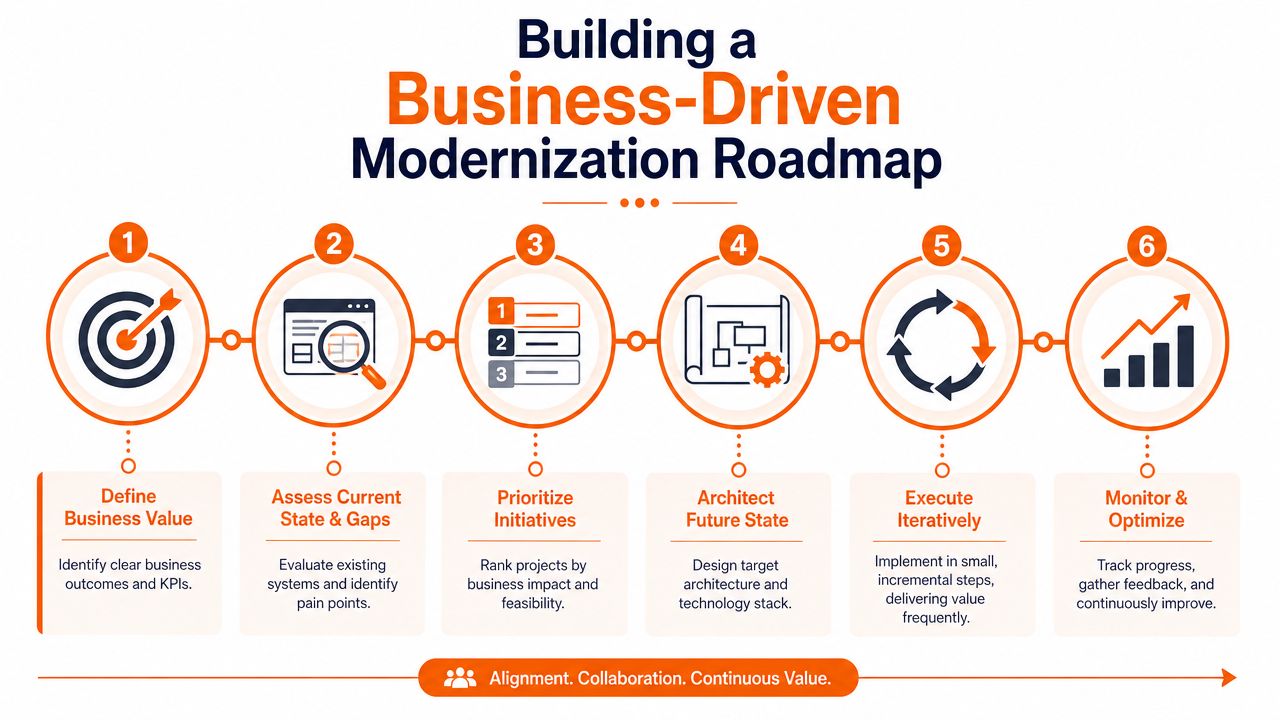
I'd structure the roadmap around six moves:
Define business value first
Pick the outcomes that matter now. Faster release cycles. Lower operating friction. Better integration capability. Fewer compliance headaches. Don't start with technologies.Map the current state accurately
Inventory systems, dependencies, ownership gaps, integration points, and fragile workflows. You're not drawing a pretty diagram. You're exposing what can break.Prioritise by value and feasibility
Choose work that can create visible progress without putting core operations at unreasonable risk.Design the future state selectively
Set architecture principles, not fantasy blueprints. Define where APIs, cloud services, modular boundaries, and data controls matter most.Execute in release trains
Push work through bounded increments. Each release should validate assumptions, reduce risk, and prove value.Measure and adjust
Don't protect the original plan. Protect the outcome.
Use gates, not vague confidence
The strongest modernization roadmaps break work into manageable phases with explicit performance, security, and compliance gates, as described in this guide to phased modernization planning and validation. That's the right model because it gives you evidence at every step instead of false reassurance.
Use a simple gate model like this:
| Gate | Question it answers | What you need before moving on |
|---|---|---|
| Performance gate | Does the modernised component behave fast enough under real workload? | Baseline comparison, test evidence, acceptable latency profile |
| Security gate | Have new controls and exposures been assessed? | Access model, encryption approach, remediation plan |
| Compliance gate | Can the change operate inside your regulatory obligations? | Audit trail, policy alignment, sign-off path |
| Operational gate | Can teams support this in production? | Monitoring, runbooks, ownership, rollback plan |
This is how you de-risk delivery without slowing it to a crawl.
The roadmap should prove progress in production, not merely progress in planning.
Choose quick wins that create strategic leverage
Not all quick wins are equal. A low-risk migration that teaches the team nothing is just a vanity exercise. Pick early work that both delivers value and improves your next move.
Good early candidates often include:
- A bounded integration layer: Useful for testing API strategy and observability.
- A painful internal workflow: Valuable because users feel the improvement quickly.
- A high-change module with contained dependencies: Ideal for proving your delivery model.
- A reporting or data access component: Helpful when better visibility supports later prioritisation.
Avoid starting with the most politically visible system if the team hasn't yet built muscle for phased migration. Early failure can poison the whole programme.
Governance must speed decisions up
A lot of organisations confuse governance with delay. That's poor governance. Good governance removes ambiguity, clarifies ownership, and speeds up calls that would otherwise bounce between architecture, security, product, and operations.
Run the programme with a small decision forum. Give it authority over sequencing, exceptions, funding trade-offs, and risk acceptance. Then insist on a single view of success. If one group is optimising for architectural modernity while another is protecting quarterly delivery at all costs, the roadmap will fracture.
Structuring Your High-Performance Delivery Team
Modernization doesn't fail because the pattern was wrong on paper. It fails because the team couldn't execute under pressure, across dependencies, while the business kept moving.
That's why team structure matters as much as architecture. You need a model built for phased change, live-system continuity, and constant decision-making. Anything less turns the programme into a stop-start negotiation.
Why old delivery models break down
A lot of companies still run modernization through fragmented ownership. Enterprise architecture defines the future. Internal developers keep the lights on. A systems integrator handles migration work. Product joins late. Operations inherits whatever lands.
That model creates handoffs, not progress.
The UK public sector has already moved towards incremental replacement rather than big-bang rewrites because legacy technology remains a major blocker to faster delivery, as highlighted in this summary of the UK shift toward phased modernization. That shift has one immediate implication. You need teams that can manage long-running, phased migration programmes without losing continuity.
The team shape that works
Use a structure built around business capabilities, not technical silos.
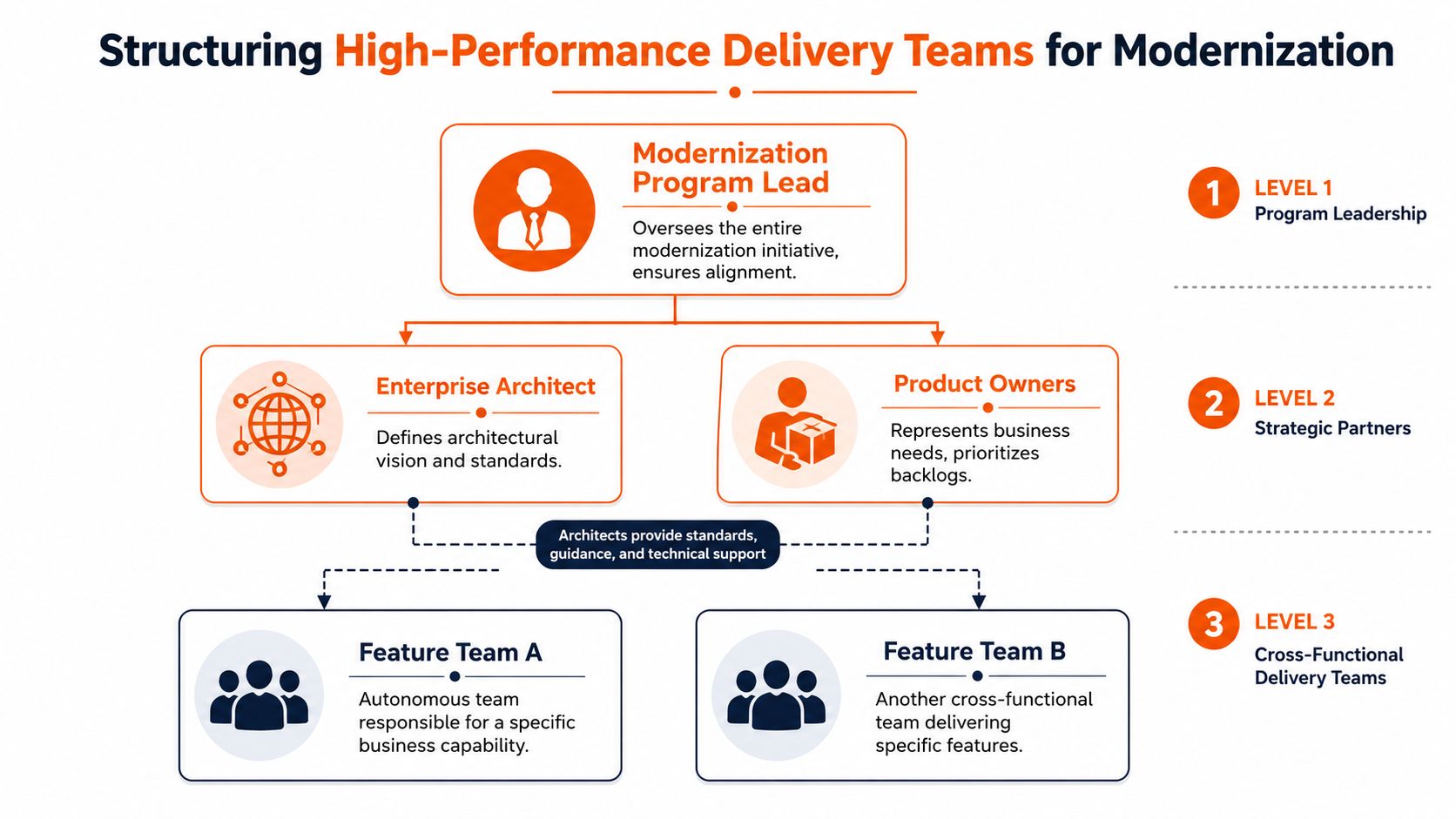
A practical setup looks like this:
- Modernization programme lead: One person owns outcomes, sequencing, trade-offs, and executive alignment.
- Enterprise architect: Sets architectural principles, integration standards, and platform guardrails.
- Product owners: Prioritise work by business value and make scope calls fast.
- Cross-functional feature teams: Engineers, QA, DevOps, and analysts aligned to a business capability, not scattered across functions.
- Platform and security support: Shared specialists who unblock teams without becoming bottlenecks.
Modernization is rarely a single-track build. Teams must maintain live operations, migrate bounded capabilities, harden release pipelines, and absorb stakeholder feedback all at once.
In-house, partner, or hybrid
Each model has trade-offs.
| Model | Strength | Weakness | Best fit |
|---|---|---|---|
| Fully in-house | Maximum control and internal context | Slow scaling, skill gaps, internal bandwidth limits | Stable organisations with strong senior bench |
| Traditional outsourcing | Extra capacity | Weak ownership, poor integration, handoff risk | Commodity work, not high-stakes modernization |
| Integrated dedicated team | Speed, specialist depth, tighter collaboration | Requires strong operating rhythm and clear leadership | Complex phased modernization |
| Build-Operate-Transfer | Long-term capability building with execution support | Needs deliberate planning and governance | Firms wanting to build a durable engineering centre |
For most CTOs, the winning model is hybrid. Keep strategy, product judgement, and critical architecture close. Add a senior integrated team that can absorb delivery load quickly and operate inside your processes. That's a very different proposition from tossing work over the wall.
If you're thinking about the people side more broadly, this piece on building high-performing teams is a useful reference for how accountability, clarity, and cadence affect delivery quality.
Strong modernization teams don't wait for perfect information. They surface risks early, make the next best decision, and keep moving.
What to insist on from any delivery partner
Don't buy a CV stack. Buy execution capability.
Ask for these signals:
- Senior engineering judgement: You need people who can untangle ambiguity, not just follow tickets.
- Product-first behaviour: Teams should understand user and business impact, not just technical tasks.
- Transparent operating rhythm: Weekly evidence, visible risks, and plain-language trade-offs.
- Knowledge transfer discipline: The team must leave your organisation stronger, not more dependent.
- Ownership under pressure: When a migration slice hits trouble, the team leans in instead of escalating excuses.
That's the difference between capacity and partnership. Capacity fills seats. Partnership changes outcomes.
Essential Tooling and Automation to Accelerate Delivery
Modernization without automation becomes a manually operated risk machine. Every deployment feels tense. Every test cycle takes too long. Every migration cutover depends on a few tired experts checking too many moving parts.
Tooling fixes that, but only if you treat it as delivery infrastructure instead of an afterthought.
Build a pipeline that enforces quality
Your CI/CD pipeline should do more than move code. It should stop bad change from reaching production and give teams rapid feedback while they're still able to act on it.
That means your pipeline needs to cover:
- Automated builds: Every change should produce a reproducible artefact.
- Static analysis and quality checks: Catch obvious issues before review becomes expensive.
- Environment consistency: Dev, test, and production shouldn't behave like different planets.
- Automated deployment controls: Promote changes through environments with repeatable rules.
If your environments are still hand-crafted and loosely documented, fix that early. Infrastructure definition belongs in code. This guide to infrastructure as code is a good reference point because it anchors the operational discipline needed for modern release pipelines.
Test the behaviour that matters
Legacy modernization often fails at the boundary between old and new. A component works in isolation, then breaks when real workflows, hidden integrations, or ugly data conditions hit it.
So don't rely on a thin test strategy.
Use multiple layers:
- Unit tests for isolated logic that changes frequently
- Integration tests for APIs, services, queues, and database interactions
- End-to-end tests for critical business journeys
- Regression suites for high-risk areas that cannot fail unnoticed
- Performance and security checks embedded into release flow, not bolted on at the end
The key is not maximal test volume. It's smart test coverage around business-critical behaviour and migration boundaries.
Make data migration boring
Most modernization pain comes from underestimating data. Teams focus on application code while data shape, quality, lineage, and cutover rules remain fuzzy. That's how ugly surprises land late.
Treat data migration as its own controlled workstream. Define mapping rules early. Build repeatable migration scripts. Validate outputs against business expectations, not just schema compliance. Run rehearsal migrations before any production move. Keep rollback logic explicit.
A few practical rules help:
- Separate migration logic from application logic so teams can test and rerun safely.
- Create comparison reports that business users can verify without engineering translation.
- Version every transformation rule because “temporary” mapping changes tend to become permanent.
- Instrument cutovers carefully so support teams can see what happened and respond fast.
Observability is part of modernization
You can't modernise what you can't see. Once components start moving, observability becomes imperative. Instrument services with logs, metrics, tracing, and alerting tied to user journeys, not just server health.
That gives you two advantages. First, teams catch regressions earlier. Second, business leaders get confidence because modernization becomes measurable in operation, not just in sprint reports.
Tooling won't rescue a weak strategy or a poor team. It will make a strong team faster, safer, and more predictable. That's the point.
Take Extreme Ownership of Your Modernization Journey
Legacy modernization becomes manageable when you stop treating it like one giant technology event. It works when you run it as a disciplined business transformation programme with hard choices, visible milestones, and accountable leadership.
That means dropping a few bad instincts.
Don't chase a heroic rewrite because it sounds cleaner. Don't default to lift-and-shift everywhere because it feels safer. Don't let architecture discussions drift away from commercial outcomes. And don't spread accountability so widely that no one owns the result.
The winning posture for CTOs
You need a posture that is direct, pragmatic, and relentless about value.
That looks like this:
- Own the commercial case: Modernization should reduce operational drag, improve delivery speed, and create strategic flexibility.
- Choose patterns selectively: Different systems deserve different treatment.
- Sequence for momentum: Early wins should create both business value and technical advantage.
- Back phased delivery: Release trains beat big-bang promises.
- Build a delivery engine: Team structure, governance, and tooling matter as much as architecture.
Many programmes either accelerate or collapse during this phase. CTOs who lead modernization well don't ask for abstract transformation. They ask for evidence. What got faster? What got safer? What got cheaper to change? What risk did we remove?
Modernization succeeds when every migration step earns the right to unlock the next one.
Prioritisation is the real leadership test
The hardest part usually isn't selecting a pattern. It's deciding where to start when budget is tight and risk tolerance is low.
That challenge is captured well in this discussion of low-risk modernization prioritisation. The critical decision is which systems to modernise first, how to sequence migrations, and how to define success when a full rewrite isn't realistic. That's a portfolio problem, not just an engineering one.
Use that lens aggressively.
Ask these questions at portfolio level:
| Question | Why it matters |
|---|---|
| Which systems create the most business drag today? | You want impact, not symbolic progress |
| Which systems carry unacceptable operational risk? | Some estates are expensive mainly because they're fragile |
| Which components can be isolated cleanly? | Modularity improves your odds of phased success |
| Where can one move unlock several others? | Good sequencing compounds value |
| What can we defer safely? | Not everything needs attention now |
A CTO with Extreme Ownership doesn't try to modernise everything at once. They pick the next right battles and force clarity on why those battles matter.
What success actually looks like
Success is not “the legacy programme is complete”. That's not how real organisations operate.
Success looks more like this:
- Teams release with less friction.
- Critical capabilities become easier to change.
- Operational support becomes less fragile.
- Security and compliance are handled with more confidence.
- Product and engineering stop negotiating with the platform every time they want progress.
That's why legacy system modernization strategies matter. They are not academic categories. They are decision tools that help you convert a constrained estate into a more responsive business.
The standard to hold
Set a high bar.
Don't accept endless discovery with no delivery. Don't accept vendors who measure activity instead of outcomes. Don't accept roadmaps that hide risk behind optimistic language. And don't accept internal drift where everyone agrees modernization matters but no one changes how decisions get made.
Modernization rewards leaders who take responsibility for the whole chain. Strategy. Sequencing. Team design. Delivery discipline. Operational follow-through.
That's the authentic version of Extreme Ownership. Not motivational language. Operational accountability.
If your platform is slowing growth, increasing delivery risk, or draining engineering focus, it's time to treat modernization like the business priority it is. Rite NRG helps CTOs and product-led companies execute complex technology change with senior dedicated teams, consulting support, and Build-Operate-Transfer delivery models that keep control high and momentum strong. If you want a partner that takes ownership, moves fast, and stays focused on outcomes, start the conversation.