Your roadmap is full. Your senior engineers are trapped in support issues. Product wants new features, sales wants enterprise commitments, and delivery keeps slipping. That's the point where most founders start searching for “IT and outsourcing” and immediately get pulled into the wrong conversation.
They compare hourly rates.
That's the mistake.
If you treat outsourcing like a procurement exercise, you'll buy capacity and inherit friction. If you treat it like a strategic delivery partnership, you can remove bottlenecks, protect your core team, and ship with more predictability. That's the difference between a vendor who waits for tickets and a partner who takes ownership of outcomes.
This matters in the UK because external delivery is already normal, not experimental. 34% of UK B2B organisations outsource IT support, making it the country's most commonly outsourced service, according to UK outsourcing statistics roundup. The mindset shift now is moving from basic support outsourcing to higher-value software, platform, and security work.
Stop Building, Start Accelerating
Most SaaS teams don't have a talent problem. They have a focus problem.
Your in-house team is handling too much at once. They're building product, fixing production issues, dealing with integration debt, supporting legacy decisions, and trying to hit roadmap dates that were optimistic from day one. Adding more tickets to the same team won't solve that. It usually makes delivery less predictable.
Why the old outsourcing model fails
Traditional IT and outsourcing thinking is built on one weak assumption. Someone outside your business can complete isolated tasks cheaply, and that alone creates value.
It doesn't.
Cheap execution without ownership creates handover gaps, weak architecture decisions, and constant management overhead. You save on rate cards and lose on speed, quality, and leadership attention. For a SaaS company, that's a bad trade.
Practical rule: If your outsourced team needs constant chasing, you haven't outsourced delivery. You've outsourced typing.
The better model is simple. Keep strategic control. Add a team that behaves like an extension of your delivery function, not a distant supplier. They should raise risks early, challenge weak assumptions, and help your people move faster.
What acceleration actually looks like
A strong partner should help you do three things well:
- Free your best people: Move non-core execution, stabilisation work, or specialist delivery to a partner so your senior internal team can focus on product-defining decisions.
- Increase delivery confidence: Build with a rhythm that includes planning discipline, transparent reporting, and clear accountability.
- Reduce management drag: Replace constant follow-up with proactive communication and owned outcomes.
Extreme Ownership matters. The right team doesn't wait for perfect briefs. They close gaps, ask harder questions, and keep momentum when requirements shift.
That's the #riteway in practice. High energy, proactive delivery, and accountability that starts before the first sprint.
Choosing Your Delivery Model Onshore, Offshore, and Nearshore
Your team finishes planning at 4 p.m. A blocker appears at 4:30. If the people building your product can respond in the same working day, momentum stays intact. If the answer lands tomorrow, the sprint slows, decisions stack up, and leadership starts managing delays instead of delivery.
That is why delivery model choice matters. It shapes feedback speed, escalation paths, compliance effort, and how quickly ideas become shipped software. For SaaS companies, this is not a staffing decision. It is a delivery design decision.
A simple comparison helps. Onshore gives you close access and easier coordination, with the highest cost. Offshore lowers day rates, but usually adds time-zone lag and more management overhead. Nearshore sits in the middle. You get meaningful overlap with better economics and fewer communication delays.
Here's the visual version.
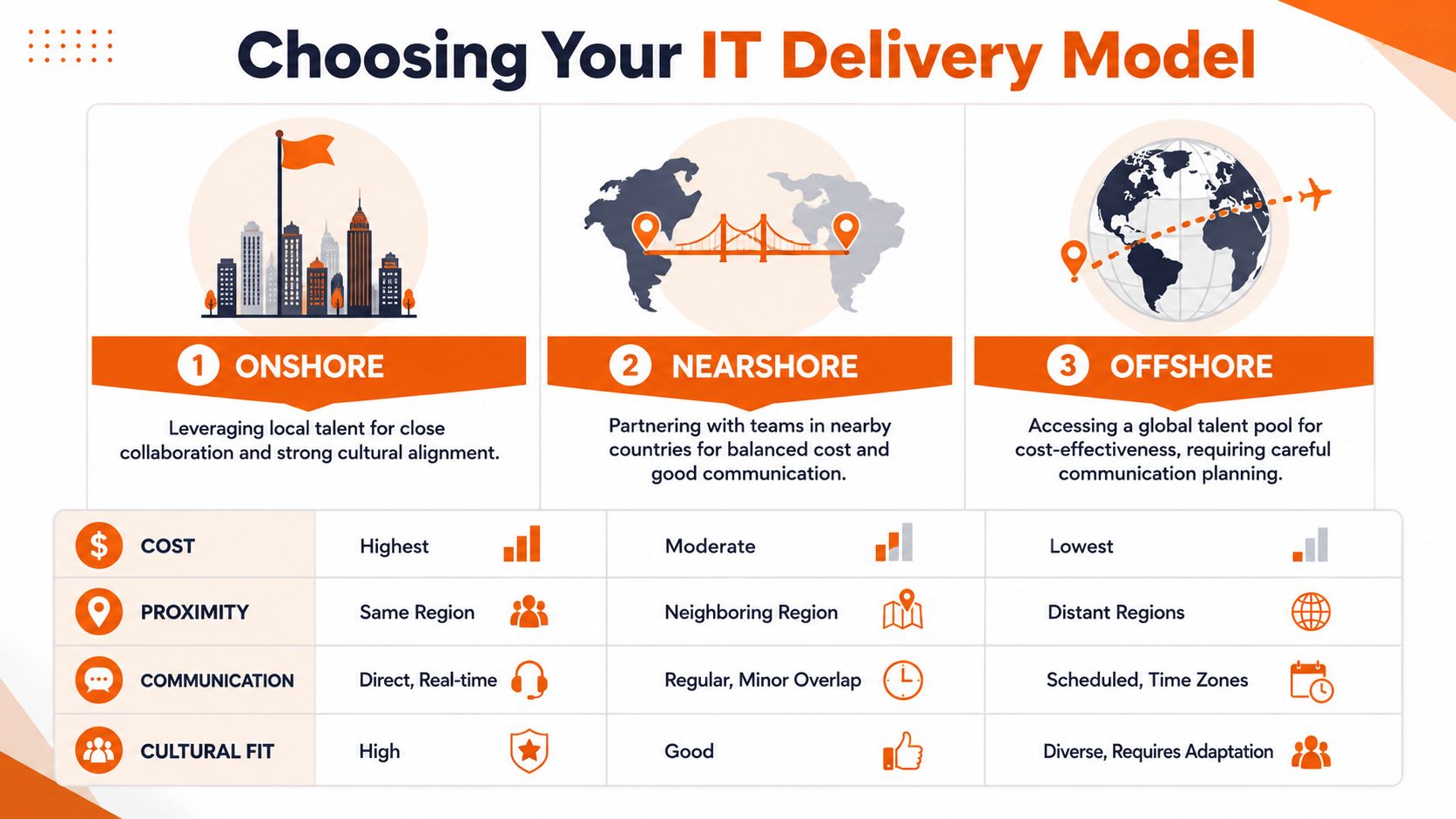
How the three models differ
| Model | Best for | Main strength | Main risk |
|---|---|---|---|
| Onshore | Sensitive, collaboration-heavy work | Real-time access and close business alignment | Premium cost |
| Nearshore | SaaS delivery that needs speed and control | Strong balance of cost, overlap, and execution rhythm | Quality still depends on partner selection |
| Offshore | Tightly defined, repeatable work | Lower day rates | Time-zone lag, slower decisions, heavier governance |
For UK SaaS teams, nearshore usually gives the best operating fit.
The reason is simple. SaaS products change fast. Priorities move. Bugs hit production. Customer feedback reshapes the backlog. You need engineers, product people, and delivery leads who can solve problems during your working day, not after a handoff across half the world.
Nearshore supports that rhythm. Stand-ups happen live. Refinement sessions do not require late-night calendars. Incident response stays faster because the right people are awake and available when the issue appears. That creates value far beyond the rate card.
If you want a practical side-by-side view, this comparison of nearshore vs offshore software development is useful because it frames the decision around delivery speed, collaboration, and control.
A short explainer can help your leadership team align on the basics before choosing a model.
My recommendation
Use onshore for executive-facing work, sensitive stakeholder environments, or tightly regulated delivery where proximity matters more than cost.
Use offshore for well-scoped execution with stable requirements, documented processes, and managers who already know how to run distributed delivery well.
Choose nearshore when you need a strategic delivery partner that can move at SaaS speed, work inside your business day, and take real ownership of outcomes.
For most UK SaaS companies, nearshore is the strongest default. It shifts the conversation away from cheap labour and toward faster decisions, better coordination, and more predictable delivery.
The Critical Decision When to Outsource Versus Build In-House
The biggest mistake in IT and outsourcing isn't choosing the wrong country. It's outsourcing the wrong work.
If you hand over your product brain, you'll regret it. If you protect the right things internally and partner on the rest, you'll scale faster without hollowing out your organisation.
Protect your core
Your core is the set of capabilities that creates real market advantage. Usually that includes product strategy, architecture ownership, customer insight, pricing logic, proprietary workflows, and the decisions that shape your roadmap.
Recent coverage argues that outsourcing core functions such as R&D can erode internal capability over time. That's why the line between strategic ownership and external execution has to be deliberate, as discussed in this analysis of hidden costs and capability trade-offs in offshoring and GCC decisions.
Keep these areas in-house:
- Product discovery: Customer problems, solution shaping, prioritisation.
- System direction: Architecture standards, major platform bets, security boundaries.
- Commercial logic: Anything linked tightly to your differentiation or margins.
Partner for context
Now the useful part. A lot of critical work matters significantly to the business without being your unique advantage. That's where partnership helps.
Examples include:
- MVP acceleration: You know what needs building but need a team that can execute cleanly and quickly.
- Legacy modernisation: Internal engineers shouldn't spend all quarter untangling old platform constraints.
- Specialist capability: Cloud operations, platform engineering, security implementation, data work, AI-enabled workflows.
- Feature expansion: You need a parallel stream without distracting your core product team.
Keep decision rights inside. Push execution capacity and specialist delivery outside.
That model lets your internal leaders stay accountable without becoming a bottleneck.
A simple decision filter
Ask four blunt questions before you outsource any workstream:
- Does this create differentiation? If yes, keep ownership close.
- Does it require scarce expertise right now? If yes, partner.
- Will delaying this block revenue, retention, or compliance? If yes, accelerate with external support.
- Can we define success clearly? If no, fix that before involving anyone.
For startup teams, this guide to outsourcing software development for startups is useful because it forces the fundamental question. Not “can someone else build this?” but “what should we never give away?”
My view is simple. Build internal strength around product judgement. Bring in external strength for velocity, coverage, and specialist execution.
How to Select a Partner The Rite Way
Most companies still buy external delivery the wrong way. They compare rates, ask for CVs, run a short technical screen, and assume procurement discipline will protect them.
It won't.
A low-cost partner can become an expensive problem very quickly. Industry analysis notes that outsourcing deals can end up costing at least 10% above the agreed figure once hidden overheads such as vendor selection, knowledge transfer, and ongoing relationship management are included, according to CIO's outsourcing analysis. That's why rate-card thinking is too narrow.
What to evaluate instead
Start with these criteria.
- Senior capability: Don't buy a bench of generalists if your product needs judgement. Ask who will do the work, who reviews architecture, and who owns delivery risk.
- Operational transparency: You should see progress in the same tools your own team uses. Jira, Linear, GitHub, Azure DevOps, Slack, Notion. No black box.
- Communication quality: Good partners don't hide behind account managers. Engineers, delivery leads, and product people should communicate directly and clearly.
- Commercial maturity: Strong teams ask why a feature matters, not just when it's due.
If you want a broader checklist for remote hiring and distributed team quality, this hiring remote developers playbook is a practical resource because it focuses on evaluation discipline instead of superficial screening.
Red flags I'd act on immediately
| Red flag | What it usually means |
|---|---|
| They promise anything in the sales call | Weak delivery governance |
| They avoid talking about risk | They expect you to manage the hard parts |
| They lead with low hourly rates | They're selling labour, not outcomes |
| They can't explain onboarding clearly | You'll pay for confusion later |
A partner who never pushes back will agree to your bad plan, bill for it, and leave you with the consequences.
What “The Rite Way” looks like
The #riteway is a delivery standard, not a slogan. It means ownership, pace, and clarity.
That includes proactive risk management, visible progress, senior engineering involvement, and a consulting mindset that connects delivery decisions to business outcomes. Models such as Build-Operate-Transfer can also make sense when you want external support at the start and long-term internal control later.
I'd rather pay for a partner who spots problems in week one than save money with one who documents failure in week twelve.
Ensuring Predictable Delivery with Smart Governance
Your product roadmap looks healthy on Monday. By Friday, a blocked release, an unanswered security question, and three conflicting status updates have turned it into noise. That is not a talent problem. It is a governance problem.
Good governance gives you predictable delivery. It defines who decides, what gets escalated, and how risks get handled before they hit customers. If you still have to chase updates or translate between teams, you do not have a delivery partner. You have rented capacity.
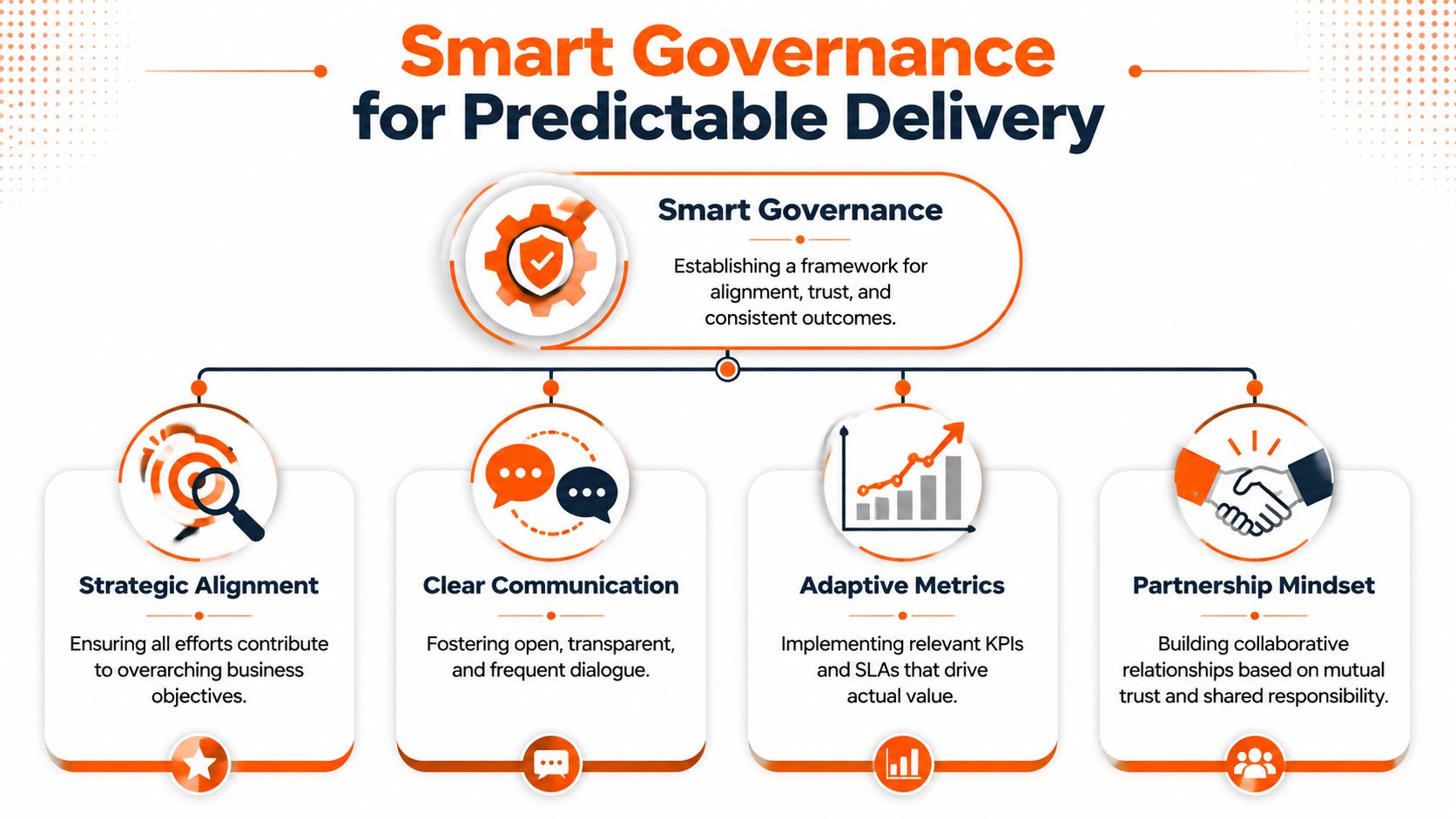
Build governance around decisions and risk
For UK organisations operating under UK GDPR, the client still owns accountability for lawful data processing, even when an external team does the work. That means governance has to cover delivery design, access, approvals, and incident handling from day one.
Set these control points early:
- Access discipline: Define who can reach production systems, customer data, logs, and admin tools.
- Decision ownership: Keep product, architecture, security, and risk decisions with named internal leaders.
- Escalation rules: Set clear triggers for delivery slippage, incidents, scope change, and dependency failure.
- IP clarity: Contracts must state who owns code, environments, assets, and documentation at every stage.
This is the shift that matters. Stop treating outsourcing as vendor management. Run it like a strategic delivery partnership with clear authority and shared accountability.
Measure delivery confidence, not just contract compliance
A green SLA can hide a weak delivery engine. Uptime and response times matter, but they do not tell you whether the team is helping you ship faster, reduce rework, or protect roadmap commitments.
Use governance to track the signals that change outcomes:
- Are releases getting easier to ship?
- Are risks raised early, with options attached?
- Is roadmap confidence improving each month?
- Are internal leaders spending less time chasing status?
- Is quality holding steady as output increases?
Strong partners bring these questions to the table themselves. High-ownership teams do not wait to be audited.
Use a simple operating cadence
Keep the rhythm tight and boring. Predictable delivery depends on repetition.
| Cadence | Focus |
|---|---|
| Daily | Blockers, risks, release movement |
| Weekly | Progress against commitments, pending decisions, cross-team dependencies |
| Monthly | Roadmap confidence, budget position, quality trends, team effectiveness |
| Quarterly | Partnership fit, capability gaps, structural changes, future capacity needs |
One more rule. Every meeting needs an owner, a decision log, and actions with dates. Without that discipline, governance turns into status theatre.
Governance should make delivery faster because decisions happen sooner, risks surface earlier, and accountability stays visible. That is how you get value acceleration instead of expensive supervision.
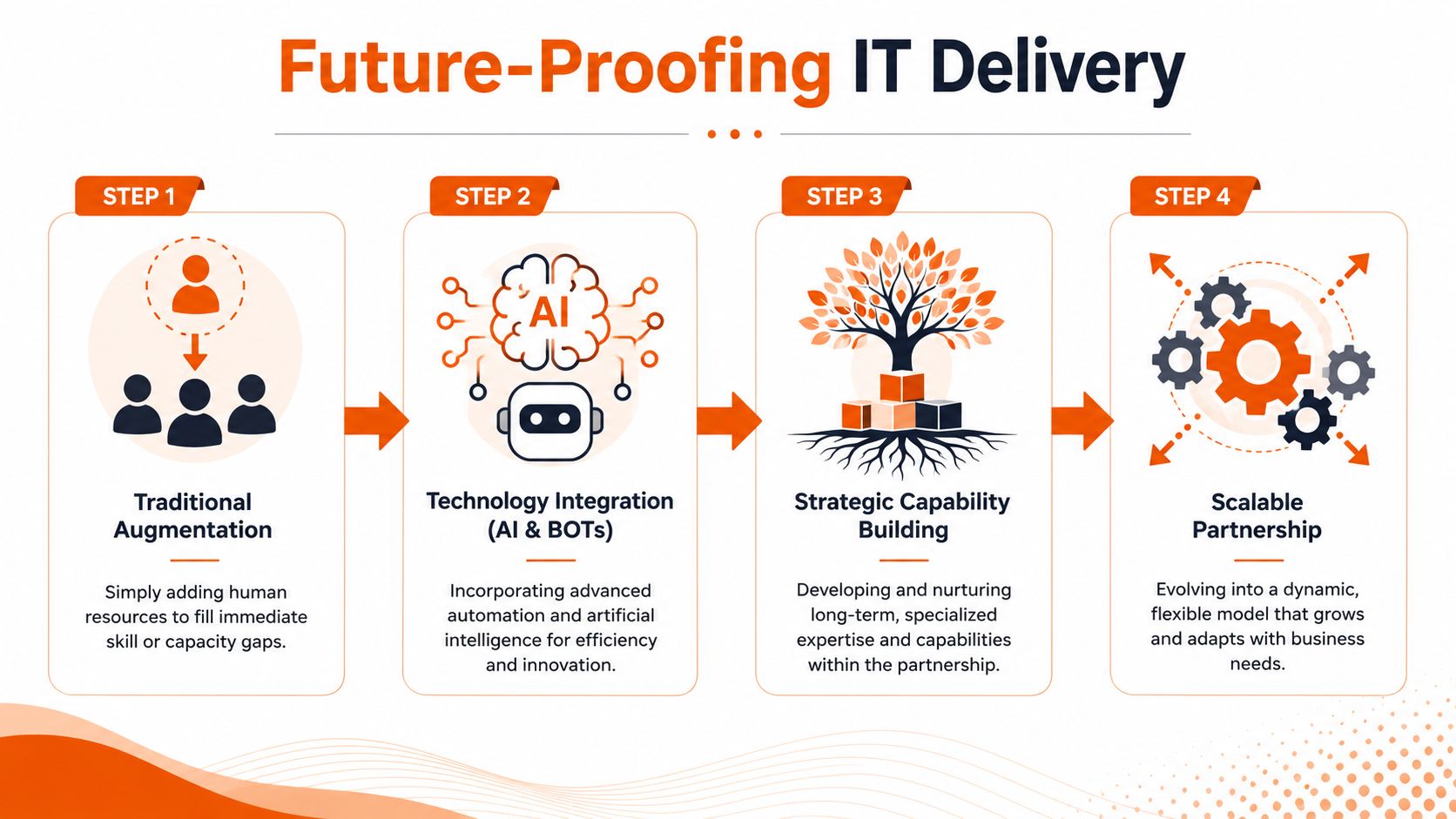
The Future of Delivery AI, BOT, and Senior Teams
The market has moved on from basic staff augmentation. That model fills seats. It rarely builds capability.
The stronger play is combining senior teams, AI-enabled delivery, and structures that let you scale without losing control. That's where modern IT and outsourcing becomes far more useful than the label suggests.
Why seniority matters more now
Deloitte's 2024 Global Outsourcing Survey found that 42% of executives cite access to specialised talent as the top reason for outsourcing, while 34% cite cost reduction, according to this summary of IT outsourcing statistics and Deloitte findings. That shift matters because modern delivery work isn't just coding. It includes cloud operations, cybersecurity, AI-enabled infrastructure management, and hybrid architecture orchestration.
That work punishes inexperience.
Senior teams make faster trade-offs, escalate earlier, and produce fewer downstream surprises. They don't need as much supervision, and that directly improves delivery confidence.
Where AI fits in delivery
AI shouldn't be treated like a marketing badge. Use it where it helps execution.
Useful applications include:
- Risk detection: Flagging delivery drift, dependency pressure, or testing gaps early.
- Recruitment support: Improving candidate screening and reducing noise in hiring funnels.
- Operational automation: Summarising delivery updates, organising documentation, and speeding repetitive workflows.
That's not about replacing judgement. It's about giving strong operators greater advantage.
BOT is the serious long-term option
If you know you need sustained capability, Build-Operate-Transfer is one of the most practical models available. A partner sets up the team and operating structure, runs it effectively, and then transfers the capability to you when the time is right.
That works especially well when you want:
- A dedicated product or R&D function
- Faster entry into a nearshore talent market
- Lower setup friction around hiring, compliance, and operations
- A path to ownership instead of permanent dependency
One example is Rite NRG, which offers dedicated teams, platform development, consulting, and BOT structures around nearshore delivery in Poland. That matters if you want an external launch engine now and internal control later.
The future belongs to companies that build delivery systems, not just teams.
Take Your First Step to Accelerated Delivery
You don't need more noise around IT and outsourcing. You need a cleaner operating model.
Choose the wrong partner and you'll add meetings, handovers, and rework. Choose the right one and you'll remove delivery drag, protect your core team, and create a stronger path from roadmap to release. That's the decision in front of you.
The practical guidance is straightforward:
- Don't buy on hourly rate alone
- Don't outsource your product brain
- Do choose a model that supports fast communication and control
- Do govern for outcomes, not theatre
- Do favour seniority and ownership over raw capacity
The right partnership should reduce the amount of management energy required to get good work done.
If you're a founder or CTO, act before the next missed milestone hardens into a pattern. Delivery issues compound when teams normalise them. Fix the model, and the roadmap usually becomes far more realistic.
Strategic delivery partnership is the better frame. It's more honest. It reflects what scaling SaaS companies need. Not cheaper coding. Better execution.
If you want a practical conversation about delivery bottlenecks, team design, nearshore options, or a Build-Operate-Transfer path, talk to Rite NRG. The useful first step is simple: map what must stay in-house, identify what's blocking delivery, and choose a model that gives you speed without giving away control.