Your roadmap looked clean three weeks ago. The MVP had a sharp release target, a sensible feature set, and a team that knew what mattered. Then sales promised a prospect a “small” add-on. Marketing asked for “just a wording tweak” that changed the workflow. A stakeholder dropped a Slack message that sounded harmless and created a brand-new acceptance path.
That's how scope creep enters a SaaS project. Not as a dramatic failure. As a string of reasonable requests nobody properly challenged.
We've seen this pattern enough times to call it early. Teams don't miss launch windows because they lack effort. They miss them because nobody owns the boundary between a good idea and the right idea for this release. Managing project scope creep isn't an admin exercise. It's a delivery discipline tied directly to time-to-market, cash burn, stakeholder confidence, and whether your MVP reaches customers before the market moves on.
Your MVP Is Drifting and You Know It
You can usually feel it before the dashboard confirms it.
Stand-ups get fuzzy. Tickets become broader than they were at sprint planning. Engineers ask clarifying questions that should have been settled before development started. QA starts testing scenarios nobody agreed to. Product discussions shift from outcomes to appeasement.
The first mistake is treating this as bad luck. It isn't. It's poor scope control.
Industry guidance used in the UK market highlights that scope creep usually starts with small unchecked additions that compound into schedule and cost overruns. A widely cited project-management statistic says 52% of projects experience scope creep according to project management guidance on scope creep. That number matters because it tells you this isn't rare. It's normal when the baseline is weak.
What drift looks like in a SaaS MVP
A drifting MVP usually shows up in a few predictable ways:
- Feature inflation: The core user journey gets crowded with “helpful” extras that belong in phase two.
- Hidden technical expansion: A simple front-end request triggers API changes, data model updates, migrations, and extra regression testing.
- Decision avoidance: Stakeholders keep adding instead of prioritising.
- Team confusion: Delivery stops asking “should we build this now?” and starts asking “how quickly can we squeeze this in?”
Scope creep rarely starts with one reckless decision. It starts when smart people keep saying yes in isolation.
That's why our operating view is blunt. If nobody owns the trade-offs, the project owns you.
The delivery stance that changes everything
At Rite NRG, our #riteway methodology is built on Extreme Ownership. That means the team doesn't just execute tickets. The team protects the outcome. If a request threatens the launch date, budget, or product focus, somebody has to say so immediately and with evidence.
That changes the conversation from “can we add this?” to:
- What business outcome does this support?
- What moves out if this moves in?
- Who approves the trade-off?
That's the mindset shift. You stop acting like scope drift is an unavoidable side effect of agile delivery. It isn't. It's a leadership failure that can be fixed with tighter decisions, stronger boundaries, and faster escalation.
Build Your Fortress Against Scope Creep
The real fight happens before sprint 1.
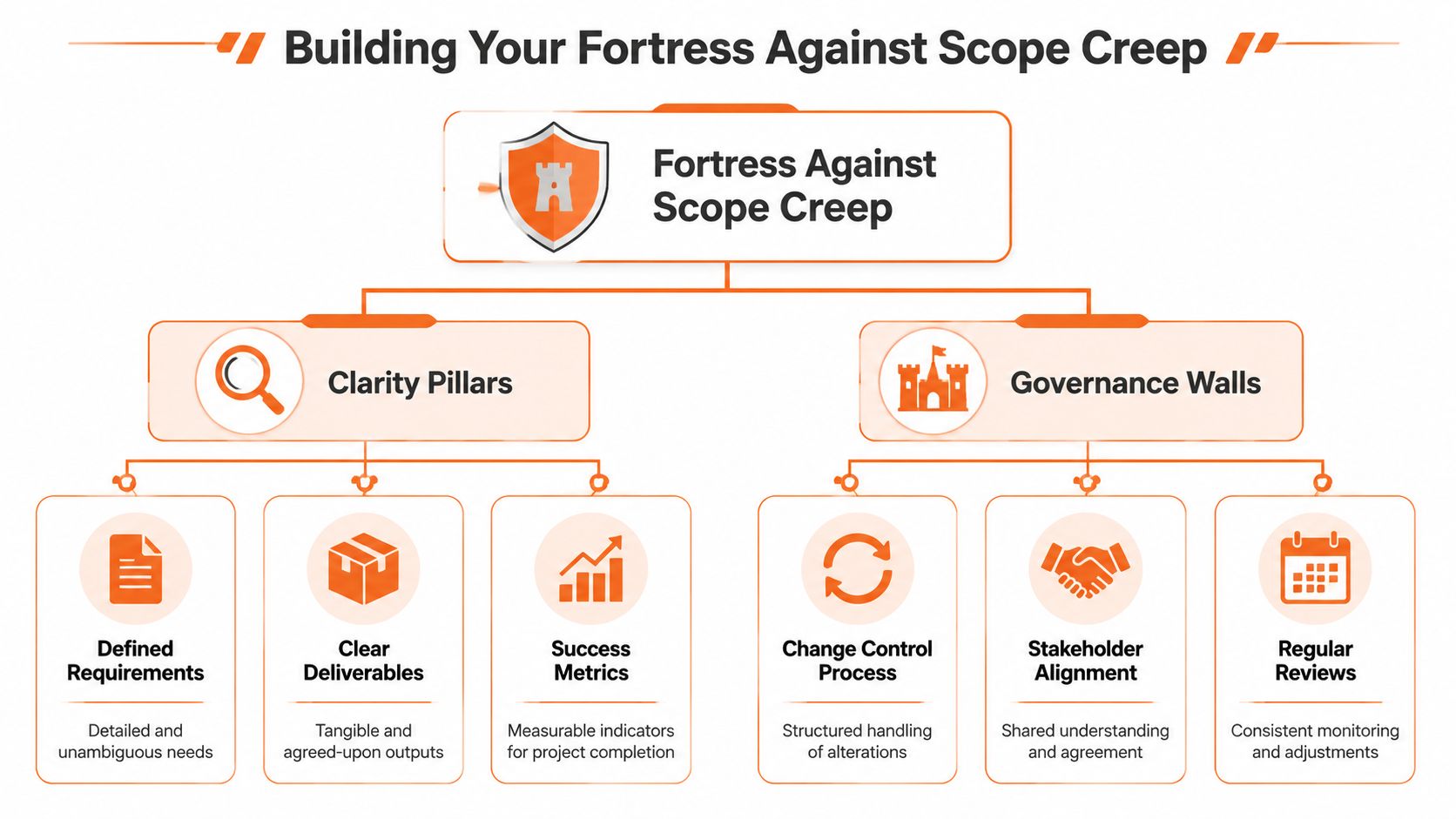
If your scope is vague, your backlog becomes a negotiation arena. If your governance is weak, every stakeholder request gains momentum by default. Teams that want predictable delivery need a structure that makes ambiguity hard and accountability obvious.
Strong UK Government project delivery guidance treats scope control as formal governance, not casual project admin. It requires a defined delivery approach, clear governance, a controlled change process, and regular reviews of scope against the baseline, as outlined in guidance referenced in this scope control article. That's the right model for SaaS delivery too.
Lock the baseline before code starts
If you can't explain the MVP in one page of plain language, it isn't ready.
Your baseline should include:
- Business outcome: The problem the MVP must solve now, not every problem it may solve later.
- Core deliverables: Named features, user flows, integrations, and environments.
- Assumptions: Dependencies, client inputs, third-party constraints, and technical boundaries.
- Exclusions: The features and requests that are explicitly not part of this release.
Many teams often become complacent. They document what they're building and ignore what they're refusing to build. That's how “we thought it was included” becomes your most expensive sentence.
Make readiness impossible to fake
A proper Definition of Ready stops weak work from entering the sprint. A proper Definition of Done stops vague work from being called complete.
Use them to force clarity:
| Control point | What it should answer |
|---|---|
| Definition of Ready | Is the ticket clear, testable, sized, and tied to a business outcome? |
| Acceptance criteria | What must be true for this item to be accepted without debate? |
| Definition of Done | Has the item been built, tested, reviewed, and matched to the agreed scope? |
Don't let generic ticket descriptions into delivery tools like Jira, Linear, or Azure DevOps. “Improve onboarding” is not a ticket. It's a workshop topic.
Practical rule: If a developer and a stakeholder would interpret a ticket differently, that ticket isn't ready.
Build governance that supports fast decisions
Good governance doesn't slow SaaS teams down. It stops them from spending speed on the wrong thing.
A useful MVP governance model has three layers:
- Product authority: One person owns priority and release intent.
- Delivery authority: One person owns execution reality, sequencing, and risk surfacing.
- Approval authority: A clear decision-maker signs off on changes with timeline or cost impact.
If those roles blur, scope expands through politeness. Nobody wants to block momentum, so everyone absorbs additional work.
The answer isn't more meetings. It's cleaner decision rights.
Use contracts and working agreements to protect focus
For client-facing builds, your statement of work and operating cadence should match. If the SOW says one thing and sprint behaviour says another, sprint behaviour wins.
Document these items upfront:
- Review windows: When stakeholders can request revisions.
- Approval gates: Which outputs need formal acceptance.
- Iteration limits: How many rounds are included.
- Change path: What happens when someone asks for more.
That's not bureaucracy. That's how you build a delivery system that can say “not now” without friction.
Use AI to Detect Scope Drift Early
Scope drift doesn't always show up in the backlog first. It leaks through language.
A product owner says, “while we're here”. A stakeholder asks, “could we also”. A ticket starts with one behaviour and ends with three. A stand-up update mentions work nobody saw in sprint planning. Those are early warnings.
Your team needs a detection habit before it needs a rescue plan.

Watch the human signals first
People reveal scope drift before reporting does.
Look for these patterns in Slack, Teams, Jira, Notion, and sprint ceremonies:
- Language drift: “Quick win”, “tiny tweak”, “should be easy”, “while we're doing this”.
- Ticket sprawl: Descriptions that keep growing after sprint start.
- Demo shock: Stakeholders react as if they expected something different from what was agreed.
- Silent engineering work: Refactoring or dependency work appears without a visible decision trail.
None of these signals prove a problem on their own. Together, they tell you the baseline is being negotiated in real time.
Create a weekly scope review rhythm
Fast teams need a short, disciplined cadence.
A weekly scope review should answer only a handful of questions:
- What changed since the last agreed baseline?
- Which requests are still informal?
- Where are tickets expanding beyond original acceptance criteria?
- What needs a decision now to protect the release?
Keep it tight. Keep the attendee list small. Product, delivery, and the person with approval authority are enough.
Let AI surface weak signals earlier
Humans miss patterns when the project gets noisy. That's where AI becomes useful.
Used properly, AI can scan ticket histories, commit messages, meeting notes, and delivery commentary to flag:
- requirement ambiguity
- repeated wording that suggests undeclared additions
- misalignment between sprint goals and actual work
- changes in implementation effort that don't match the original ticket shape
That doesn't replace delivery leadership. It gives delivery leadership better visibility.
For teams exploring this approach, AI-driven software development and testing shows how AI can support delivery workflows beyond pure code generation. In practice, the value comes from risk surfacing. The system catches weak signals early so the team can make a human decision before drift becomes delay.
If your first confirmation of scope creep is a missed milestone, your detection system is broken.
Keep one source of truth
AI only helps if your working data is organised.
Use one primary source for scope, one for tickets, and one for decisions. If scope lives partly in email, partly in Slack, and partly in somebody's head, no tool will save you. The goal is traceability. Every meaningful change should leave a visible trail.
The Change Control Playbook That Actually Works
Organizations often make one of two mistakes with change control. They either have no process, or they build a bloated process no SaaS team will use.
The answer is a lightweight system with hard edges.
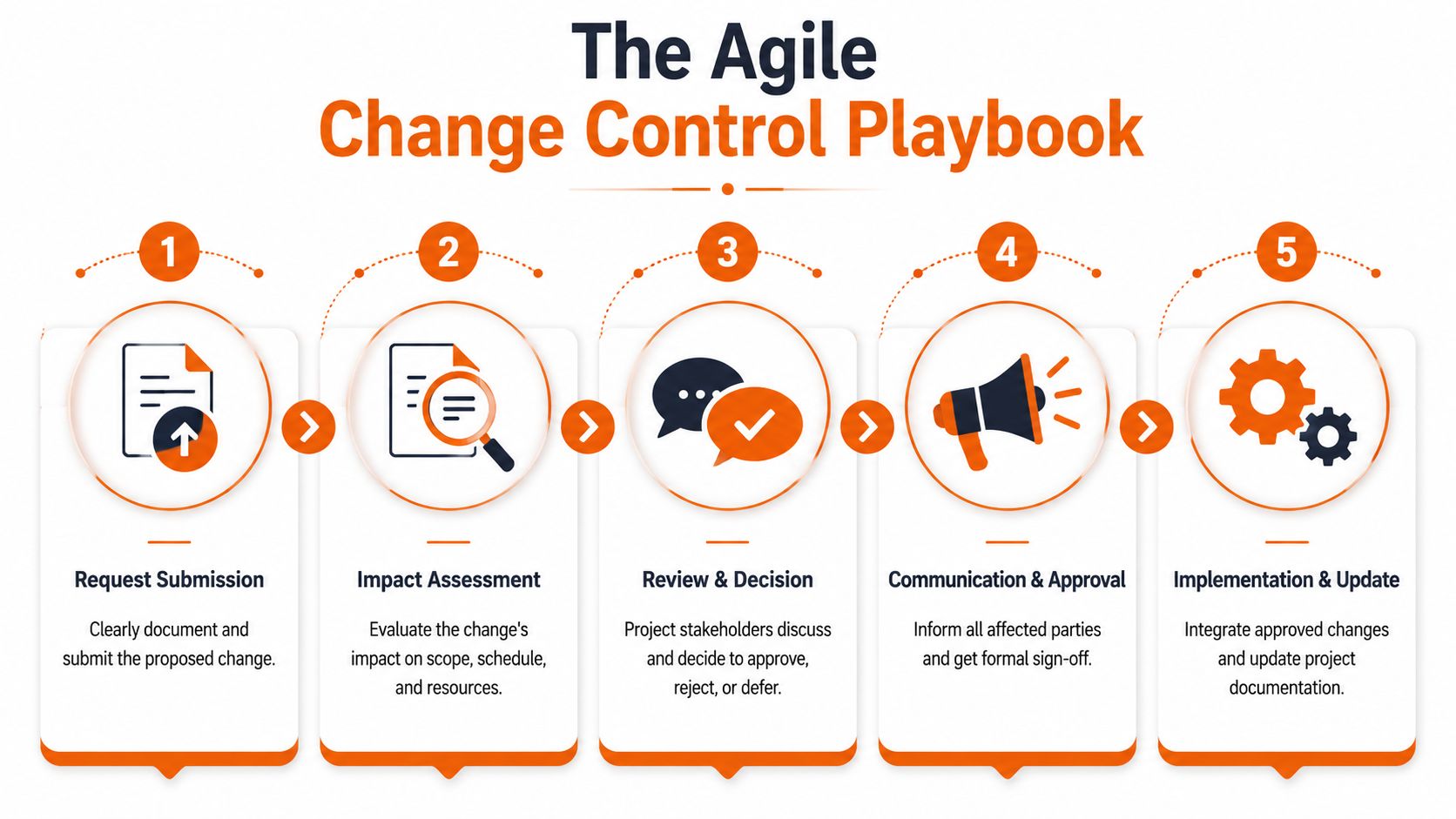
The practical method is straightforward. Baseline the scope, require a written change form for every request, estimate the impact on schedule and cost, get stakeholder approval, and then update the baseline, as outlined in this change control guide for project teams. The biggest failure point is still the same. Informal additions through email, chat, or verbal requests bypass proper analysis.
The five-step operating sequence
A workable change path for an MVP looks like this:
Capture the request
No verbal-only changes. No “we'll remember it”. Write it down immediately.Assess the impact
Check feature implications, technical effort, QA expansion, release risk, and dependency effects.Present the trade-off
Don't ask, “Do we want this?” Ask, “What moves if this enters now?”Decide clearly
Approve, reject, or defer. Those are the only honest options.Update the baseline
Refresh the backlog, sprint plan, documentation, and stakeholder view of the release.
This process should feel fast. If it takes days to analyse a small change, your governance is too heavy. If it takes minutes to approve a significant change, your governance is too weak.
Use a form that forces useful thinking
A solid change request form doesn't need legal language. It needs decision-quality information.
Here's a lightweight version you can start using today.
| Field | Description | Example |
|---|---|---|
| Request title | Short name for the proposed change | Add user invite flow |
| Requested by | Person or team initiating the request | Head of Sales |
| Business reason | Why this change matters now | Needed for pilot customer onboarding |
| Requested change | Plain-language description of the addition or alteration | Allow account owners to invite team members by email |
| Scope impact | What part of the agreed scope changes | New workflow added to account settings |
| Schedule impact | Expected effect on delivery timing | Requires timeline review |
| Cost or effort impact | Expected delivery effort or budget effect | Needs engineering and QA assessment |
| Dependencies | Systems, teams, or approvals affected | Email service integration, design update |
| Recommended decision | Delivery recommendation | Defer to post-MVP |
| Final decision | Approved, rejected, or deferred | Deferred |
Operational advice: If the form can't explain the business reason in plain English, the request probably isn't ready for approval.
Keep the discussion commercial, not emotional
Bad change control becomes a personality contest. Good change control is a trade-off discussion.
Use language like this in steering meetings and sprint reviews:
- If we include this now: what drops from the release?
- If we defer this: what business risk remains?
- If we approve it: who signs off on the impact?
- If we reject it: what alternative solves the immediate need?
That keeps the conversation grounded in outcomes instead of opinions.
For teams tightening the wider discipline around delivery risk, software project risk management is a useful companion topic because scope decisions and delivery risk are tightly connected.
A short explainer can also help align stakeholders before they hit your approval queue:
Ban the backdoor channels
If you want managing project scope creep to work in real life, ban one habit immediately. No developer should treat Slack messages, side calls, or hallway requests as approved scope.
Create one rule. If it changes the work, it enters the system.
That single habit removes most of the chaos.
Mastering Scope with a Nearshore Team
Founders sometimes assume nearshore delivery makes scope control harder. It doesn't. Weak operating models make scope control harder.
A nearshore team can protect scope better than an in-house team if the delivery culture is right. Distance doesn't create confusion by itself. Unclear ownership, fragmented communication, and poor decision hygiene create confusion.
Turn the team into scope guardians
A mature nearshore setup should never behave like a passive ticket factory.
Every engineer, QA specialist, product thinker, and delivery lead should know:
- what the MVP is meant to achieve
- what's explicitly outside the current release
- who can approve a change
- how to raise a risk without waiting for a crisis
That's where Extreme Ownership matters. If an engineer spots a ticket that leads to an unstated product expansion, they should challenge it. If QA sees acceptance criteria changing mid-sprint, they should escalate it. If delivery hears two stakeholders asking for different outcomes, the conflict should be surfaced immediately.
A strong nearshore team doesn't just deliver scope. It defends the release goal.
Build one operating system across locations
You don't need everyone in the same office. You need everyone using the same rules.
That means:
- One backlog: no shadow task lists in personal notes.
- One decision log: every approved change is visible.
- One communication rhythm: planning, review, demo, and escalation follow a shared cadence.
- One definition of ownership: teams raise risks early instead of waiting for permission.
When companies start hiring nearshore talent in LATAM or Europe, the strategic question isn't only where the talent sits. It's whether the partner can embed into the same decision model and protect business priorities under delivery pressure.
Use onboarding to prevent later drift
Most scope problems with distributed teams start during onboarding, not delivery.
Your onboarding checklist should include:
| Area | What to confirm |
|---|---|
| Product context | Why the MVP exists and which user problem it solves first |
| Scope boundaries | What is in, what is out, and what is deferred |
| Delivery process | How changes are raised, reviewed, and approved |
| Communication rules | Which channels are used for decisions, risks, and daily execution |
| Escalation path | Who steps in when priorities conflict |
A dedicated team model either works beautifully or fails noisily. If the team only receives tickets, they'll execute drift. If the team receives context and authority to challenge ambiguity, they'll stop drift before it spreads.
For companies evaluating a structured dedicated model, nearshore service delivery is worth reviewing because the operating framework matters as much as the location.
Replace vendor thinking with partner behaviour
The fastest route to blown scope is treating your external team like a pair of hands.
A proper partner asks hard questions. They push for business clarity. They refuse to hide delivery risk behind activity. That's what founders and product leaders need when the clock is running and investor expectations are real.
From Scope Creep to Scope Leadership
Teams frequently discuss controlling scope. Very few lead it.
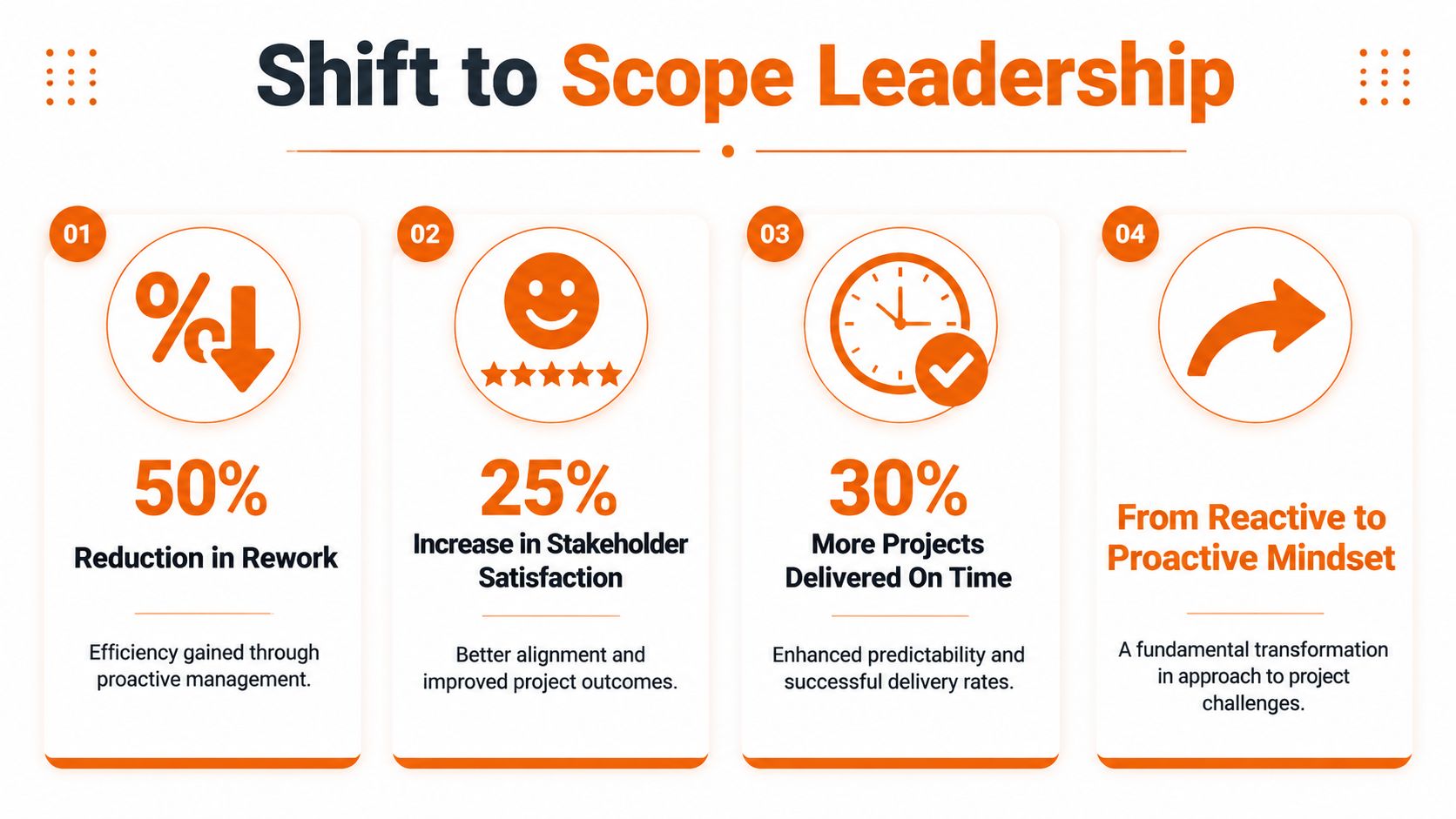
Control is defensive. Leadership is commercial. It means you use scope decisions to protect launch timing, focus spend on the highest-value work, and build trust with stakeholders who need predictability.
Track the signals that matter
You don't need a bloated PMO dashboard. You need a small set of metrics that show whether your release discipline is healthy.
Track these consistently:
- Change request volume: Are requests increasing as delivery progresses?
- Decision cycle time: How long does it take to approve, reject, or defer a request?
- Approved versus deferred changes: Are you protecting the MVP or diluting it?
- Budget versus actual: Is extra work entering the system without explicit trade-offs?
- Scope variance by sprint: Are teams delivering what was agreed, or taking on additional scope?
These KPIs work because they connect directly to business outcomes. If decision speed drops, release confidence drops. If approved changes rise without matching trade-offs, time-to-market slips. If budget and actual diverge without a visible decision trail, leadership has lost control.
Use scope data to build confidence
Investors, founders, and senior stakeholders don't just want progress updates. They want evidence that the product can move predictably.
A team that reports clearly on change volume, approval speed, and release trade-offs looks disciplined. A team that keeps saying “we hit some complexity” looks unprepared.
That difference matters. Predictable delivery earns trust. Trust buys you room to scale.
Lead the boundary, don't just document it
Managing project scope creep is ultimately a leadership choice.
You can let every stakeholder request compete for attention in real time. Or you can create a system where each idea is tested against the release goal, the budget reality, and the customer outcome that matters now.
Choose the second option. It's faster. It's cleaner. It gives your team room to execute properly.
Teams that lead scope well don't ship less value. They ship the right value at the right time.
If you want a delivery partner that treats scope as a business lever, not an admin afterthought, talk to Rite NRG. We help SaaS teams build with sharper ownership, clearer decision-making, and delivery systems designed to keep MVPs on time, on budget, and focused on outcomes.