Staff augmentation is one of those terms that gets thrown around a lot, but what does it actually mean for your business outcomes? Forget the stiff, corporate definitions for a second.
Think of it like this: you're building a world-class pit crew for a high-stakes race. You’ve got your core team, but you suddenly need a specialist—an expert in aerodynamics or a master engine tuner—to give you that winning edge, right now. Staff augmentation is your strategic move to bring that specialist directly into your garage, to work alongside your crew, using your tools, to deliver a specific, measurable win.
This is a strategic play, not just a hiring tactic. You're not just finding a contractor; you're embedding top-tier, proactive talent directly into your existing team to achieve a critical business goal.
What Staff Augmentation Really Means for Your Bottom Line
Let's cut through the jargon. At its heart, staff augmentation is about surgically injecting specialised skills—like a senior DevOps architect or a machine learning guru—right into the heart of your team to accelerate value delivery.
This isn’t about finding just another coder to fill a seat. It's about partnering with high-calibre talent who live and breathe a philosophy of Extreme Ownership. They aren’t there to just take orders; they are strategic partners there to solve your most pressing business problems, fast. This model gives you the agility to nail that aggressive product launch, meet a crucial investor deadline, or get a market-ready MVP out the door in record time—delivering tangible business value.
The best part? You keep total control over your project's vision and direction. It’s the ultimate lever for SaaS founders and CTOs who need to accelerate their roadmap without getting bogged down by the soul-crushing drag of traditional, months-long hiring cycles.
It’s About High-Impact Delivery, Not Just More People
One of the biggest mistakes I see is thinking of staff augmentation as just temporary hiring. That’s missing the point entirely. A genuine strategic partner sees it as a vehicle for delivering measurable business outcomes. The conversation shifts from "here's a CV" to "here's how our team will help you achieve your business goal."
The focus is on deploying proactive, high-energy problem-solvers who don't just blend in, but actively push your project forward with a consulting mindset.
This mindset is everything. The right partner won’t just sit back and wait for a ticket. They’ll offer strategic advice on your tech stack and delivery process, ensuring every action aligns with your commercial goals. It’s the difference between hiring a pair of hands and partnering with a strategic brain that is invested in your success.
This approach is no longer a "nice-to-have"—it's become a necessity, especially here in the UK. Facing a relentless talent shortage, UK organisations have made staff augmentation a core part of their workforce strategy. A recent Gartner survey found that a staggering 73% of UK Chief Information Officers plan to use augmentation to plug their tech talent gaps. It’s now one of the fastest-growing services in IT for a reason. With vacancies for senior developers and DevOps specialists jumping by 22% year-over-year, the old ways of hiring simply can't keep up. You can read the full research about these IT talent trends in the UK.
The Core Principles That Make It Work
So, what does this outcome-driven model actually look like on the ground? It all comes down to a few core principles that separate it from just filling a role.
- Seamless Integration: Your augmented team members should feel like part of the furniture. They adopt your tools, your workflows, and your communication style until you forget they aren't full-time staff.
- Proactive Problem-Solving: The goal is to bring in experts who see around corners. They don’t just execute tasks; they anticipate challenges and bring solutions to the table before a problem even arises.
- Accountability for Outcomes: Success isn't measured in hours billed. It’s measured in tangible business value—things like faster feature velocity, reduced time-to-market, and a better product that drives revenue.
Let's break down this mindset shift from a traditional headcount model to a modern, outcome-driven approach.
Core Principles of Outcome-Driven Staff Augmentation
This table shows the fundamental difference between simply buying time and investing in results.
| Principle | Traditional View (Headcount) | The #riteway Methodology (Business Outcome) |
|---|---|---|
| Focus | Filling a role, providing a resource. | Solving a business problem, delivering a specific outcome. |
| Accountability | The engineer is accountable for completing tasks. | We are accountable for the project’s success and business impact. |
| Engagement | Reactive. Waits for instructions and tickets. | Proactive. Suggests improvements, anticipates risks with high energy. |
| Integration | A separate contractor who logs hours. | A fully embedded team member, part of your daily stand-ups. |
| Value Metric | Billable hours. | Feature velocity, time-to-market, product quality, revenue impact. |
By focusing on these principles, staff augmentation becomes so much more than a buzzword.
It becomes a powerful, strategic tool for growth. It empowers you to scale your capabilities exactly when you need them most, ensuring your business stays agile, innovative, and way ahead of the competition.
Staff Augmentation vs Outsourcing: Choosing Your Model
When it's time to add more firepower to your engineering team, the path you take will massively shape your product, your culture, and ultimately, your bottom line. Picking between staff augmentation and outsourcing isn't just a simple tactical move; it's a strategic decision that determines who's really steering the ship toward your business goals. Let's break it down so the choice becomes crystal clear.
Think of it this way: imagine you need a complex, life-saving surgery.
With staff augmentation, you’re bringing a world-class specialist into your hospital. They join your team, work in your operating theatre, collaborate with your nurses, and use your tried-and-tested equipment. You have complete control over the entire procedure, and your own team gets to learn from the best in the business, right there on the job.
Now, consider outsourcing. This is like sending the patient to an entirely different hospital. You hand over the whole operation and just hope for a good result. You lose all direct oversight, their methods are not your own, and your internal team learns absolutely nothing from the experience.
This little story gets right to the heart of it: the fundamental difference is all about control and integration.
This chart neatly lays out the core decision so many leaders face when they need to scale up their teams.
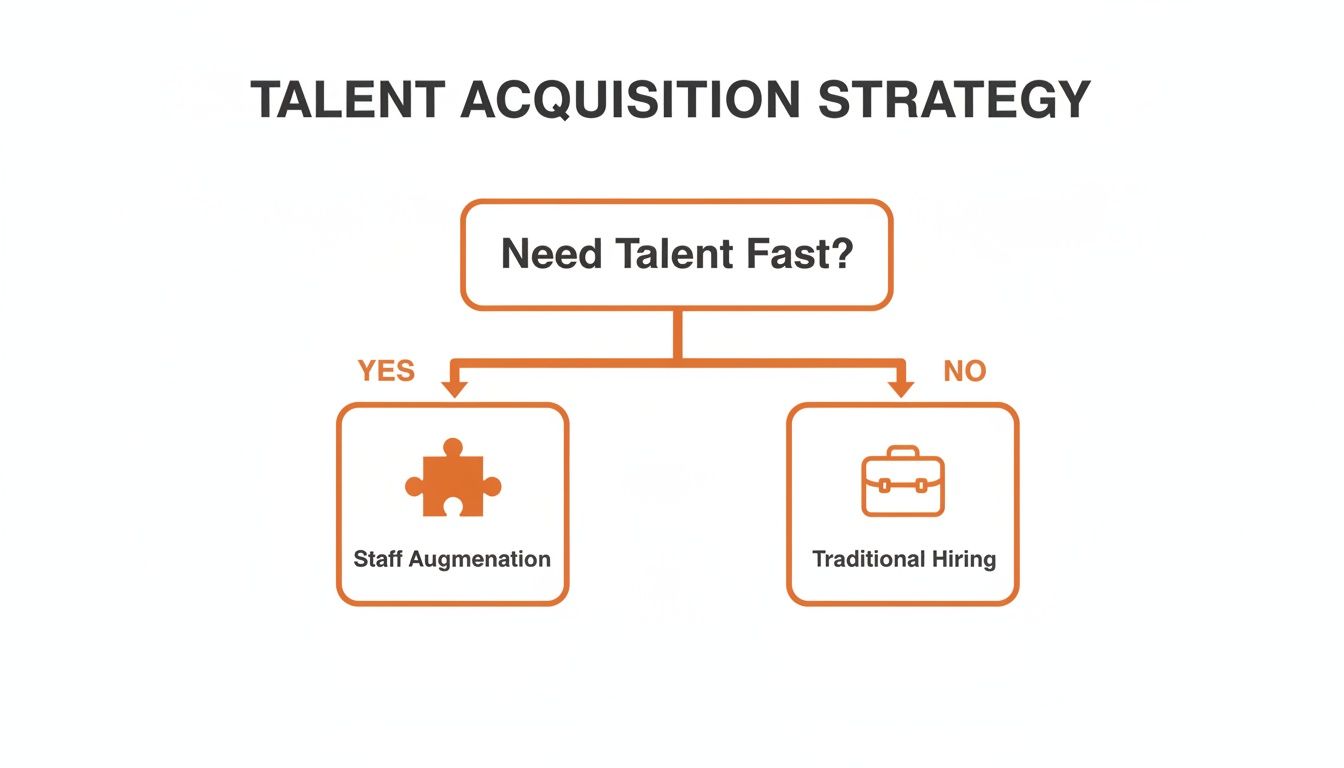
As you can see, when speed is what you absolutely need, staff augmentation is the way to go.
Control and Integration: The Real Deciding Factors
The biggest difference comes down to who calls the shots and how deeply the new talent becomes part of your existing crew.
With staff augmentation, you keep full managerial control. The developers you bring on board report directly to your project managers or tech leads. They slot right into your team, join your daily stand-ups, use your tools, and become part of your company culture.
With outsourcing, you give up project control. You hand over a specific piece of work to an outside company that manages its own team, its own processes, and its own delivery schedule. Your input is usually limited to high-level meetings, not the day-to-day grind.
This isn't just a minor detail—it has a direct impact on your product's quality and your company's long-term know-how. Having direct oversight means every single decision, from a small UI tweak to a major architectural shift, perfectly matches your product vision and demanding engineering standards.
The Impact on Knowledge and Culture
Another crucial point of difference is knowledge transfer. When you augment your team, your in-house engineers work side-by-side with senior specialists. They pick up new skills, best practices, and fresh ways of thinking, naturally levelling up your entire department. This builds real, lasting capability inside your company.
Outsourcing, on the other hand, often creates a knowledge black hole. The expertise is built up and kept within the vendor's team. As soon as the project is over, all that valuable knowledge walks right out the door, leaving your team no better off than before.
Choosing the right model is all about matching your immediate needs with your long-term goals. Is this just a one-off task, or is it a chance to make your core team even stronger for whatever comes next?
As strategic partners, we bring a consulting mindset to the table. We don't just supply engineers; we provide advisory on technology and delivery to help you answer that very question. We guide you towards the model that will best deliver your business goals, whether that’s crushing a short-term deadline or building the foundation for future growth. A great example is how we help clients put together a dedicated software development team, which you can read all about in our detailed guide. It's all about making sure your talent strategy is actively driving real business value.
Why Smart SaaS Leaders Choose Staff Augmentation
In the cut-throat world of SaaS, speed is everything. It's not just a nice-to-have; it's your primary weapon. The smartest leaders I know have figured out that the gap between a brilliant idea and a market-leading product is all about execution speed. This is exactly why staff augmentation has shifted from a simple hiring hack to a core strategy for explosive growth.
Forget just filling a seat. This is about a strategic injection of momentum, skill, and fresh energy right where you need it, right now. The question changes from, "Who can we hire?" to a much more powerful one: "What business outcome do we need to achieve, and who can get us there the fastest?"
Radical Speed to Market
Picture this: you get wind that your main competitor is about to drop a game-changing feature. The old way—job posts, screening calls, endless interview rounds, onboarding—drags on for months. By the time your new hire is finally up to speed, that market window might have slammed shut.
Staff augmentation flips that entire, sluggish process on its head.
Instead of waiting an entire quarter, you can have a senior developer or a specialist team plugged into your project in a matter of weeks. This is a game-changer, allowing you to:
- Launch MVPs in record time: Get your product into users' hands and start collecting real-world feedback while your rivals are still sifting through CVs.
- Beat competitors to the punch: Roll out new features and updates with blistering speed, locking in your market share and delighting your customers.
- Smash investor milestones: Hit those aggressive roadmap deadlines with confidence and cruise into your next funding round.
Unlocking Unbelievable Cost-Efficiency
Bringing on a full-time employee is a huge financial commitment. You're not just paying a salary; you're on the hook for recruitment agency fees, benefits, pensions, new hardware, and ongoing training. For a SaaS business, these fixed overheads can be a massive drain, especially when you only need a specific skill set for a single project.
Staff augmentation gives you a much smarter, more flexible way to manage costs. You pay for the precise expertise you need, for exactly how long you need it. No long-term baggage. This approach is a lifesaver when you're modernising an old system or tackling a tricky migration on a tight budget. Every single pound you spend is tied directly to a business outcome.
Staff augmentation is about transforming your cost base from a fixed liability into a flexible asset. You gain access to elite talent without the long-term financial burden, allowing you to invest your capital where it matters most: in growth and innovation.
The Power of Extreme Ownership
But here's the secret: the real magic of a great partner goes way beyond just providing bodies. The number one reason staff augmentation fails is when it's treated like a transactional body shop. A true partner works from a place of Extreme Ownership. And no, that's not just a buzzword; it's a fundamental mindset.
It means the engineers who join your team don't just sit around waiting for tickets to be assigned. They hunt for risks. They challenge assumptions. They hold themselves personally accountable for the business outcome of their work. They bring a high-energy, can-do attitude, asking "why" before they even think about writing a line of code to ensure every ounce of effort pushes your commercial goals forward. This is what turns a simple line-item cost into a high-return investment.
This proactive, consulting-led approach delivers real, tangible results. For UK businesses, a flexible workforce isn't just a convenience; it's a productivity rocket ship. Tapping into an augmented team can help companies raise productivity by roughly two times. You also gain the agility to scale your team up or down based on what the project demands, without any long-term ties. This is gold for SaaS founders who need to get their MVP out the door, fast.
You can dive deeper into the data on workforce flexibility on Verified Market Research.
Real-World Scenarios: Putting Staff Augmentation to Work
Alright, let's move past the theory. Knowing what staff augmentation is is one thing, but seeing it solve urgent, real-world business problems? That’s where the magic happens. This isn't just about plugging a few holes in your team; it's a powerful strategy for nailing critical goals when everything is on the line.
We’re about to jump into some real-life scenarios that founders, CTOs, and business leaders run into all the time. These examples show exactly how bringing in the right people—backed by a philosophy of Extreme Ownership—leads directly to big business wins.

For the Founder Who Needs an MVP in 90 Days
The Problem: You’re a founder with a fantastic, VC-backed idea. The seed money is in the bank, but the clock is ticking—loudly. Your small in-house team is great, but you don't have the specialised front-end skills to build a polished Minimum Viable Product (MVP) in the 90-day window your board is demanding.
The Solution: You skip the painfully slow traditional hiring process. Instead, you augment your team with two senior React developers and a UI/UX designer from a nearshore partner. They aren't just contractors; they are strategic partners who slot right into your squad, joining your daily stand-ups and working in your project management tools from day one.
The Business Outcome: You absolutely crush your 90-day deadline. The MVP you deliver is top-notch, validating your idea with early users and, just as importantly, impressing your investors. This helps you lock in your next funding round. You gained critical market momentum without taking on the long-term cost of full-time hires, saving your cash for the next stage of growth.
For the CTO Facing a Nasty Skills Gap
The Problem: You’re the CTO, and your mission is to transform a clunky, monolithic platform into a modern, scalable microservices architecture using Python. Your team is sharp, but they've never done this exact type of project before. The local market for senior Python engineers with this specific experience is completely dry, and every day you wait, your competitors pull further ahead.
The Solution: You partner with a firm that provides a dedicated "pod" of three augmented specialists: a Senior Python Developer, a DevOps pro who knows Kubernetes inside and out, and a Solutions Architect. This pod doesn't just work in a silo; they embed with your core team with a consulting mindset. They get on with building the new services while simultaneously mentoring your engineers and establishing best practices. Effective resource planning for projects is key here, as it helps you blend new and existing talent to maximise your team’s output.
The Business Outcome: The crucial microservices project gets done on schedule and to an incredibly high standard, making your platform more stable and performant. But the real win? Your internal team’s skills have been massively upgraded through genuine knowledge transfer. You've built a lasting capability that stays with you long after the augmented pros have wrapped up. You solved a huge business problem and upskilled your people at the same time.
"True staff augmentation is about capability injection, not just capacity. It’s adding the specific expertise that not only solves an immediate problem but also elevates the entire team's ability to deliver value in the future."
For the Enterprise Leader Tackling a Cloud Migration
The Problem: You're a leader in a large organisation, and you’re in charge of moving a critical legacy application from on-premise servers to the cloud. It’s a project with massive potential business rewards but equally massive risks. Your internal IT team is already flat out with day-to-day work and simply doesn't have the specialised cloud engineering skills to pull this off without causing a major headache for the business.
The Solution: You augment your infrastructure team with a certified AWS or Azure Cloud Architect and a couple of Cloud Engineers. This specialist crew takes full ownership of the migration plan and its execution, working hand-in-glove with your internal staff to ensure everything goes off without a hitch. This laser-focused approach means your core team can keep the lights on without being pulled in a dozen different directions. Once you’re in the cloud, having a plan for maintenance and support services is a smart move to protect your new cloud investment.
The Business Outcome: The migration is a total success—finished on time, under budget, and with virtually no disruption to the business. The company immediately starts seeing the benefits: better scalability, tighter security, and lower operating costs. By strategically bringing in experts, you dodged the colossal cost and risk of a botched migration and set the company up for a future of innovation.
How to Select a High-Impact Nearshore Partner
Choosing your nearshore partner is, without a doubt, one of the most critical decisions you'll make. Get it right, and you'll smash your roadmap and accelerate your business goals like never before. Get it wrong? You'll be drowning in project delays, budget blowouts, and a mountain of technical debt that will haunt you for years.
The secret is to look past the flashy tech jargon and focus on what actually drives business success.
A great partner doesn't just sell you a list of skills; they sell you outcomes. They aren’t passive order-takers waiting for the next ticket to land in their queue. They are proactive, high-energy problem-solvers who take Extreme Ownership over your success. This is the heart of the #riteway methodology, a framework we built on proactivity and a can-do attitude. Honestly, it should be the gold standard you demand from anyone you consider working with.

Go Beyond the CV and Vet for Mindset
Let's be real: anyone can send you a CV stuffed with acronyms. But a true strategic partner brings a powerful consulting mindset to the table. They don’t just ask what to build; they dig in and ask why. Your entire vetting process should be laser-focused on uncovering this crucial difference.
Here are the tough questions you absolutely must ask to separate a simple vendor from a strategic ally:
- Roadblock Response: "Tell me about a time a project was heading off-track. What steps did you take, and how did you communicate the issue to the client?" A fantastic answer will centre on proactive solutions and crystal-clear communication, not on pointing fingers.
- Integration Strategy: "How do you make sure your engineers become a seamless part of our existing team and culture?" You’re looking for detailed plans covering onboarding, communication protocols, and active participation in ceremonies like daily stand-ups and retros.
- Proactivity Proof: "Can you give me an example of how one of your engineers spotted a risk or suggested an improvement that wasn't in the original scope?" This question reveals whether they operate with a forward-thinking, problem-solving mindset or just follow instructions.
The Strategic Partner Selection Checklist
Finding the right partner is about more than just ticking boxes on a technical skills sheet. It's about finding a team whose culture, communication, and commitment align with your own. This checklist is designed to help you evaluate potential partners on the criteria that truly drive business outcomes.
| Evaluation Criterion | What to Look For | Red Flags to Avoid |
|---|---|---|
| Consulting Mindset | They ask "why" before "what." They challenge assumptions and suggest better alternatives to deliver more value. | They act as passive order-takers. They agree to everything without question and never push back. |
| Extreme Ownership | They take responsibility for outcomes, not just tasks. They openly discuss challenges and bring solutions to the table. | They blame others or external factors when things go wrong. Lack of accountability is a huge warning sign. |
| Communication Framework | Proactive, transparent, and regular updates. Clear protocols for stand-ups, reporting, and issue escalation. | Communication is reactive or happens only when you ask. You feel like you're working in a black box. |
| Cultural & Time Zone Fit | Strong alignment with your company values and high-energy work ethic. Minimal time zone friction ensures seamless collaboration. | Significant cultural clashes or a large time zone gap that hinders real-time communication and team bonding. |
| Onboarding & Integration | A structured plan to embed their engineers into your team, tools, and processes from day one. | A "plug-and-play" approach with no defined onboarding process. Their engineers feel like outsiders. |
| Commercial Focus | They understand your business goals and connect their technical work directly to commercial impact. | They are purely focused on technical tasks and seem disconnected from the business objectives behind them. |
Use this as your guide during the vetting process. A partner who scores well across these areas is far more likely to become an invaluable extension of your team, not just a temporary resource.
Evaluate Communication and Transparency Frameworks
Flawless code is completely useless if it’s being built in a black box. A truly high-impact partner champions radical transparency. They make delivery predictable by giving you constant, unvarnished visibility into progress, roadblocks, and wins.
Your partner’s communication framework is just as important as their tech stack. Without clear, proactive, and honest dialogue, even the most talented engineers will fail to deliver the business value you need.
The global IT staff augmentation market is absolutely booming, and this incredible growth is fuelled by the demand for more flexible, outcome-focused models. The market, valued at over US$1,037 million, is on track to hit US$1,462 million by 2031. This trend highlights a massive shift towards partners who blend onshore project management with nearshore engineering to dramatically speed up time-to-market. Discover more insights about these market trends on reports.valuates.com.
Seek a Partner Genuinely Invested in Your Success
At the end of the day, the best partner is one who acts like a stakeholder in your business. Their success is directly tied to yours. They offer advisory on technology and delivery, they challenge your assumptions, and they are relentlessly focused on the commercial impact of their work. They bring a "can-do" energy that lifts your entire team.
This approach ensures you're not just buying hours, but investing in a capability that drives tangible results. It's a core reason why some partners, like us at Rite NRG, champion models that go far beyond simple staff augmentation. For instance, understanding the Build-Operate-Transfer model can reveal a partner's commitment to building your long-term, sustainable capabilities, not just fulfilling a short-term contract. Choose a partner who wants to build with you for the long haul.
Measuring Success with the Right KPIs
Let's get real for a moment and cut through all the jargon. When you bring in augmented staff, how do you actually know if it's delivering value? It’s not about just picking a pricing model; it’s about defining what winning looks like for your business.
For years, people have relied on vanity metrics like "lines of code" or "hours billed." Frankly, that's a one-way ticket to failure. Those numbers tell you nothing about the actual business value you're getting.
A proper strategic partner—one that lives and breathes a philosophy of Extreme Ownership—changes the conversation entirely. Success isn't about activity; it's about achievement. It's time to stop tracking technical output and start measuring tangible outcomes that directly impact your bottom line. This is where business-focused Key Performance Indicators (KPIs) become your guiding light, making sure everyone is rowing in the same direction.
This isn’t just about keeping people accountable. It’s about building a partnership so transparent and predictable that the invoice you receive perfectly mirrors the value you got, not just the hours someone clocked.
Moving Beyond Vanity Metrics
First thing's first: tear up the old playbook. Forget about metrics that are easy to count but impossible to value. We need to zero in on KPIs that tell you the real story about the health and speed of your product development. These are the numbers that matter to your customers, your investors, and your board.
Here are a few outcome-driven KPIs that actually mean something:
- Feature Delivery Velocity: How fast can your blended team get an idea from a whiteboard sketch into the hands of a paying customer? This is the ultimate test of your team’s ability to execute and deliver market value.
- Reduced Cycle Time: When a bug pops up, how long does it take to crush it and deploy the fix? Shrinking this time means your team is becoming more agile, efficient, and better at keeping your product top-notch.
- Impact on User Engagement: Are the features you're shipping actually making a difference? Tracking things like user adoption, time spent in the app, or conversion rates ties your development work directly to business growth.
When you measure what matters, you get what matters. Focusing on business outcomes ensures that your augmented team is not just building software, but actively building your business.
Structuring for Shared Success
Once you’ve got the right KPIs nailed down, you can build contracts and pricing models that get everyone excited about the same goals. This transforms the whole dynamic from a basic client-vendor transaction into a genuine partnership.
To really get a grip on the impact of your investment, you need solid metrics. Learning how to measure training ROI can provide a fantastic framework for evaluating the return you're getting from any external talent.
This outcome-driven mindset turns every sprint and every feature launch into a measurable win. It fosters a high-energy culture where your in-house team and your new partners are all laser-focused on a single mission: delivering incredible value, fast.
Got Questions About Staff Augmentation? We've Got Answers.
We've covered the what, why, and how of staff augmentation. But I get it, you probably still have some specific questions buzzing around. Let's get straight to the point and tackle the most common ones we hear from SaaS founders and CTOs.
How Fast Can I Really Get New People On Board?
This is where staff augmentation truly shines. Forget the months-long slog of traditional recruitment. With a partner who's on the ball, like Rite NRG, you can have senior, fully vetted engineers ready to contribute in as little as 1–2 weeks.
That kind of speed is a game-changer. It means you can pounce on market opportunities or crush unexpected project demands without missing a beat. We've built our entire process around this need for speed, using smart recruitment tech and maintaining a pool of top-tier talent so you get the right skills, right now.
Will They Actually Fit In With Our Team's Vibe?
This is a huge, and perfectly valid, concern. The last thing you want is a brilliant coder who disrupts your team's flow. A true delivery partner understands that cultural fit is just as crucial as technical prowess.
At Rite NRG, this is non-negotiable. We don't just find you a developer; we find you a team member who genuinely aligns with your company's values and ways of working. We're big on a mindset we call Extreme Ownership. This means our people don't just show up – they dive in with a proactive, high-energy attitude. They'll be on your Slack, in your Jira boards, and actively contributing to your daily stand-ups and retros. The goal is simple: to become an indistinguishable, high-impact part of your crew.
The secret to great staff augmentation isn't just about adding headcount. It's about seamless integration. The right partner ensures their people don’t just work for you—they become part of your team, sharing your goals and owning the outcomes right alongside you.
How Do I Keep Control of Everything?
Easily! In fact, staff augmentation gives you more control, not less. This isn't like traditional outsourcing where you hand over the keys to the entire project and hope for the best. With this model, the augmented team members report directly to you. You're the one setting the priorities, managing the backlog, and steering the ship.
A good partner will amplify that control with total transparency. We make sure you're never in the dark, using shared dashboards and constant communication to keep you looped in. Think of us as your strategic advisors—we'll offer insights and ideas, but you always have the final say. You're in the driver's seat, always.
Ready to inject some serious energy and proactive talent into your team and finally accelerate that roadmap? Rite NRG builds elite engineering teams that deliver real business outcomes. Book a call with us today and see how we can help you ship up to 50% faster.