Feeling swamped by the sheer number of product development software options out there? You’re not alone. The secret isn't just about picking another tool; it’s about building a strategic engine that actually smashes your business goals. This guide reframes your software stack as a direct route to faster market entry and a healthier ROI, shifting the focus from technical output to genuine, measurable business outcomes.
Move Beyond Tools to Accelerate Your Market Entry
Let’s be honest. As a CTO or product leader, you know choosing software isn't just an IT task—it's a critical business decision. The choice you make directly impacts your speed, efficiency, and your ability to outmanoeuvre the competition. Every moment spent hesitating is a delay in revenue and a free pass for your rivals to get ahead.
The right software isn’t a silver bullet, but it’s an incredible amplifier for your team's efforts. It’s the connective tissue between your big-picture strategy and the day-to-day execution, ensuring every single action drives a real business result. So, the real question is: how do you stop juggling a random collection of apps and start building a high-performance delivery machine?
The Partnership Mindset
This is where a change in perspective is absolutely key. Stop thinking about your software stack in a vacuum and start seeing it as the bedrock of a delivery partnership. A genuine partner doesn't just tick boxes on a to-do list; they buy into your vision and take real ownership of your goals.
This very philosophy is the heart of our #riteway methodology, a unique framework built on a high-energy, proactive approach:
- Extreme Ownership: We make your product goals our own. Every decision, every deadline, and every deliverable is met with proactive responsibility. This completely gets rid of the blame game and keeps everyone focused on one thing: delivering business value.
- High Energy & Proactivity: We believe a great team is more than just a list of skills. It's an energetic, can-do force that spots challenges before they become problems, communicates with total transparency, and keeps your project humming with forward momentum.
The end game here is simple: make delivery predictable. Your software stack should bring clarity and control, allowing your teams to ship features with confidence and consistency. It’s what turns an ambitious roadmap into a market reality that drives revenue.
From Software to Strategy
Picking a vendor is a transaction. Choosing a strategic partner is a game-changer. With our consulting mindset, we don't just point you to tools. We offer strategic advisory on technology and delivery, showing you exactly how to fuse the right software with a dedicated nearshore team to build an undeniable competitive advantage.
Our clients ship up to 50% faster without compromising on quality because we look at the entire ecosystem—the tools, the processes, and the people. It’s about building an engine for growth, not just managing another project. To see how this thinking can solve your most pressing challenges, you can learn more about our approach to delivering a powerful MVP in just two weeks. Now, let's dive into how you can apply this mindset to your own product journey.
Right, let's get into the weeds of product development software. It can feel like you’re trying to decipher a secret code with all the acronyms flying around – ALM, PLM, CI/CD – it's a real alphabet soup.
But here’s the thing: you don’t need one single, magical tool that does everything. Think of it more like building a high-performance race car. You wouldn't use a spanner to change a tyre; you’d use a wheel gun. It’s all about having a specialised toolkit where every piece of software has a very specific job in getting your idea from a sketch on a napkin to a product your customers can't live without.
Let's ditch the dry, textbook definitions. Each tool is a lever you pull to get a specific business outcome – whether that's shipping faster, increasing customer adoption, or just making sure you're building the right thing. Getting your head around this landscape is the first crucial step to creating a powerhouse delivery engine.
The Architect and The Master Plan: ALM and PLM
Before you lay a single brick, you need a blueprint. At the highest level, you have tools that act as this master plan for your entire product, making sure every single decision ties back to the big-picture business goals.
Application Lifecycle Management (ALM): Think of ALM as the architect's grand design for a new skyscraper. It covers the whole nine yards, from the first spark of an idea and gathering requirements all the way through development, testing, and eventually, pulling the plug. ALM software is the single source of truth that keeps everyone—from business analysts to developers and QA testers—singing from the same hymn sheet. The real business outcome here is governance and traceability, giving you a complete audit trail and ensuring quality is baked in from day one.
Product Lifecycle Management (PLM): PLM is a bit broader, like a property developer overseeing an entire neighbourhood, not just one building. It traditionally manages the entire life of a physical product, juggling things like supply chains and manufacturing. In the digital world, it overlaps with ALM but puts a bigger spotlight on managing the product as a business asset throughout its entire journey in the market.
This kind of strategic oversight is absolutely essential. It’s a perspective we live and breathe. We don't just churn out code; as your strategic partner, we ensure technology is always serving the bigger business vision.
Key Software Categories and Their Business Impact
To make this crystal clear, let's break down how each software category translates into real-world business value. This table cuts through the jargon and shows you exactly what business outcome you're buying.
| Software Category | Primary Role (Analogy) | Core Business Outcome |
|---|---|---|
| ALM / PLM | The Master Blueprint | Governance, traceability, and strategic alignment. |
| Project Management | The Foreman's Schedule | Predictability, team coordination, and clear communication. |
| Design & Prototyping | The Interior Designer's Mock-up | Reduced rework, better user adoption, and market validation. |
| CI/CD | The Automated Assembly Line | Speed, release consistency, and improved developer morale. |
| Monitoring & Analytics | The Live Dashboard | Data-driven decisions, proactive issue resolution, and user insight. |
Seeing it laid out like this really drives home the point: each tool has a distinct, powerful role to play in your product's success. It’s about creating a system where the whole is far greater than the sum of its parts.
The Foreman and The Assembly Line: Project Management and CI/CD
Okay, with the master plan sorted, it's time to get our hands dirty and actually build the thing. This is where tools that manage the daily grind and automate the heavy lifting come into play. They’re your site foreman and your automated production line, all rolled into one.
Project Management Software: This is the foreman’s clipboard and walkie-talkie. Tools like Jira or Asana are brilliant for tracking tasks, managing deadlines, and making sure everyone knows who’s doing what, and when. Their main gift to your business? Predictability and transparency. You can finally say goodbye to chaos and hello to reliable delivery timelines that your board can count on.
Continuous Integration/Continuous Delivery (CI/CD): Picture a fully automated, state-of-the-art car factory. That's CI/CD. Instead of a developer manually compiling code, running tests, and pushing it to a server (a process riddled with potential for human error), CI/CD tools automate the whole show. The moment a developer checks in their code, it’s automatically built, tested, and prepped for release. This gives you two massive business advantages: blistering speed and rock-solid reliability.
The magic really happens when these systems talk to each other. A developer marks a task as 'done' in Jira, which should instantly kick off the CI/CD pipeline. That's how you create a frictionless path from idea to deployment, accelerating value delivery.
The Visionary and The Prototyper: Design Tools
Last but definitely not least, you need tools that can bring your vision to life before you’ve even written a single line of code. It’s all about the user experience.
- Design & Prototyping Software: This is where your designers work their magic, like an interior designer creating stunning 3D renders of a new flat. Tools like Figma or Sketch let you build clickable prototypes and mock-ups. You can test user journeys and get real feedback early on, making sure you’re building something people will actually want to use. The business outcome is huge: you dramatically reduce wasted development effort and massively increase your odds of a successful launch that drives user adoption.
This entire ecosystem is booming. The UK software development market, a major hub for this kind of innovation, is on track to hit a staggering £63.6 billion by 2030. This growth is being supercharged by cloud-based tools, which are expected to grab 65% of the market by 2025, giving businesses of all sizes access to incredible power that slashes their time-to-market. You can dive deeper into these figures with these UK software development statistics and trends on Netguru.com. This is exactly where we come in—helping you harness these tools as a strategic partner to get exceptional results up to 50% faster, without ever cutting corners on quality.
Essential Features That Guarantee Predictable Delivery
Forget the flashy, never-ending list of features some vendors will throw at you. When you’re choosing product development software, there’s really only one question that matters: does this tool help my team deliver predictably and with high quality? It’s all about empowering your people to ship on time, every time, with zero drama. This isn’t just a nice technical perk; it’s the absolute heartbeat of a winning business strategy.
The real value is found in features that create forward momentum. We’re talking about capabilities that smash down silos, give you crystal-clear insights at a glance, and automate the grunt work so your senior talent can focus on actual innovation. This is the core of what we call the #riteway methodology – using technology to amplify human expertise and drive results you can actually measure.
This workflow shows you exactly how different software types—from the initial ALM blueprint to the CI/CD assembly line—should lock together to create a seamless delivery machine.
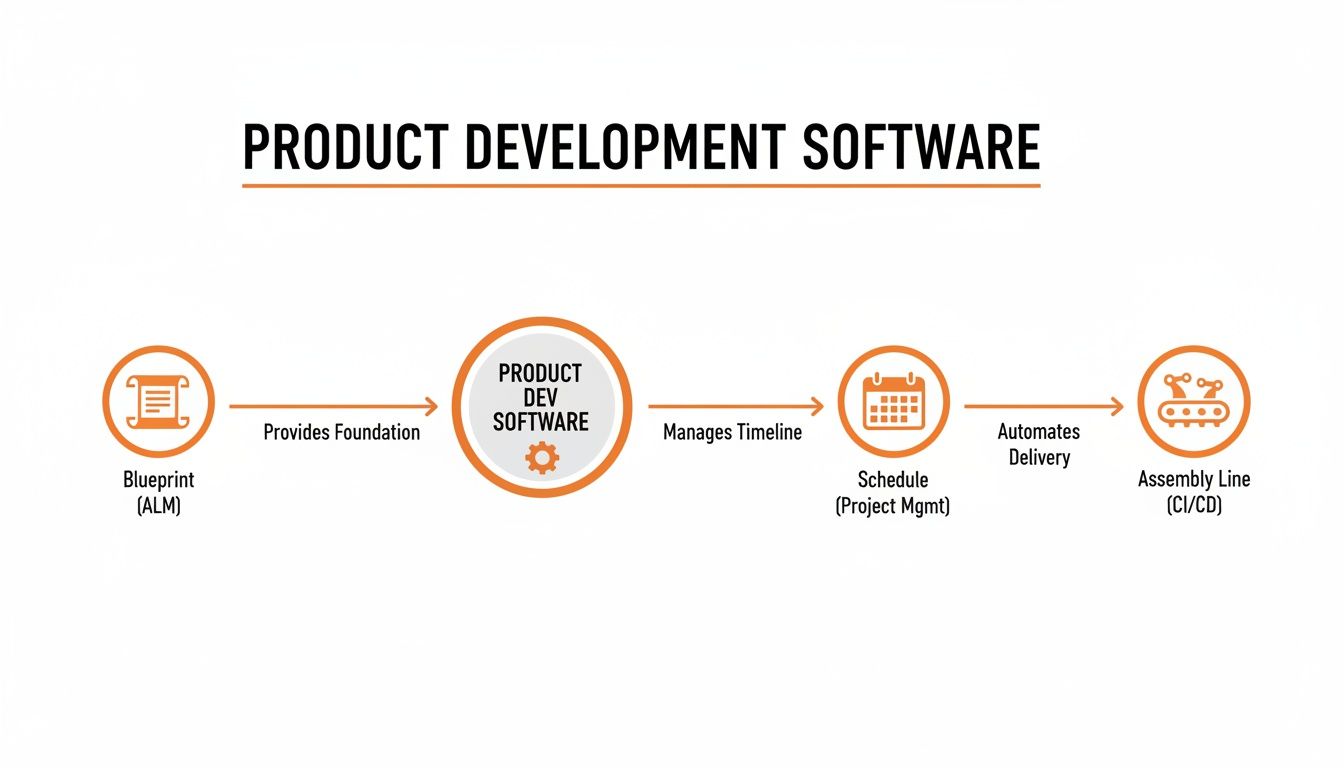
The key takeaway? A successful product journey depends on interconnected systems, not a patchwork of isolated tools. It’s the only way to ensure a smooth flow from a brilliant concept all the way to a happy customer and positive business outcome.
Seamless Integration and APIs
Honestly, the most powerful feature any piece of software can have is its ability to play nicely with others. A tool that works in a vacuum is just a future bottleneck. That’s why a robust, well-documented API isn't a "nice-to-have"—it's an absolute must-have for building a high-energy, proactive development cycle.
Think it through. When a designer hits ‘final’ on a prototype in Figma, that should instantly create a new story in Jira. When a developer pushes their code, it should automatically kick off a build in your CI/CD pipeline and update the task status. This level of automation kills manual handoffs, which are breeding grounds for mistakes and delays.
At Rite NRG, we live and breathe this principle. Our AI-powered processes are built on top of seamless tool integration. This lets us automate workflows and flag risks before they become problems, freeing up our senior engineers to solve complex challenges instead of getting bogged down in admin.
Real-Time Collaboration and Transparency
Your product development software needs to be the central hub, the digital town square where everyone converges—from your in-house leadership to your nearshore partners. Features that enable real-time collaboration are absolutely essential for keeping everyone aligned and moving forward with a high-energy, can-do attitude.
Make sure you're looking for tools that provide:
- Shared Workspaces: A single source of truth for every project asset, conversation, and decision. It’s the simplest way to make sure everyone is working from the latest information and to kill confusion at the source.
- Contextual Comments and @Mentions: The power to have conversations directly on designs, code commits, or tasks keeps communication tied to the work itself. It makes everything easy to find and trace back later.
- Live Dashboards: Visual, real-time reports that give every single stakeholder, from the CEO down to the junior developer, a clear, honest view of progress. This kind of transparency builds trust and fosters a culture of Extreme Ownership.
These features aren't just about making life more convenient. They're about creating a unified, high-energy environment where information flows freely and everyone feels connected to the mission of delivering value.
Advanced Analytics and Reporting
Let's be blunt: you can't improve what you don't measure. Gut feelings are great for brainstorming, but data is what drives predictable delivery. Your software stack has to provide you with robust analytics that answer critical business questions, not just technical ones.
Forget vanity metrics like "lines of code written." You need to focus on features that track business-centric KPIs. For example, powerful reporting should help you track cycle time (how long it takes from starting a task to getting it deployed) and deployment frequency. These metrics are a direct reflection of your team’s ability to deliver value to customers, fast.
This data-first approach is fundamental to how we operate. As your strategic partner, we help you configure your product development software to track the metrics that actually matter, turning your tools from simple task managers into strategic engines for growth. When you connect every feature to a measurable business outcome, you can finally stop hoping for predictable delivery and start guaranteeing it.
How to Choose Your Software Stack for Business Growth
Let's be blunt: choosing your product development software is one of the most critical decisions you'll make for your business. This isn't just about ticking boxes on an IT procurement list; it's a strategic move that can either supercharge your growth or sink you in technical debt and operational quicksand. Get it wrong, and you're looking at hidden costs, demoralised teams, and watching competitors race past you.
The secret to getting it right is to completely reframe the question. Stop thinking, "What cool features does this tool have?" and start asking, "What concrete business results will this tool help us smash?" This is exactly where our consulting mindset comes in—we help you build a tech stack that’s an engine for your ambition, not an anchor.
The Vendor vs. Partner Test
Here’s the single most important filter you can apply: are you dealing with a vendor or a partner? A vendor sells you a licence and wishes you luck. A partner rolls up their sleeves and gets invested in your success.
Think about it. A vendor sells you a tool; a partner helps you assemble a high-octane delivery machine focused on business outcomes.
A vendor will talk your ear off about features and uptime stats. A partner, on the other hand, wants to know about your time-to-market goals, your user adoption targets, and how their solution helps you nail that next funding round. It’s a completely different conversation, one built on shared goals and what we call Extreme Ownership.
This distinction isn't just semantics—it's everything. When the inevitable hiccup happens, a vendor sends you a link to a help doc. A partner jumps on a call and works with you to crush the problem, bringing the kind of high-energy, "we've got this" attitude that defines a winning team.
Your Business-First Evaluation Checklist
To cut through the marketing fluff and sales jargon, you need to go into every conversation armed with the right questions. These questions are designed to reveal a provider's true DNA. Here's a practical checklist to keep in your back pocket:
- Scalability and Future-Proofing: Can this architecture handle your growth from 100 users to 100,000 without needing a complete, painful rebuild? Don't accept vague promises. Ask for real-world case studies of companies they've helped scale.
- Total Cost of Ownership (TCO): Look way beyond that initial subscription fee. What's the real cost when you factor in integration, team training, essential plugins, and ongoing maintenance? A cheap entry price can be a trojan horse for a crippling TCO later on.
- Integration and Ecosystem: How smoothly does this tool plug into the software you already use and love? A powerful, well-documented API isn't a "nice-to-have"; it's a non-negotiable for building the seamless workflows you need to move fast.
- Support and Partnership Model: What does support actually look like in practice? Will you have a dedicated success manager who knows your business, or will you be just another ticket in a queue? Dig into their process for handling emergencies and how they approach proactive communication.
As you evaluate your options, it's also smart to understand the wider landscape, including specific cross-platform app development tools. This gives you the context to make sharp decisions that serve you today and set you up for success tomorrow.
As a strategic partner offering advisory on technology, we are designed to answer these exact questions. We don’t just recommend software. We help you architect a complete solution—the right tools, streamlined processes, and empowered people—all aligned to deliver your MVP at speed. If you need a clear roadmap for building a solid foundation, check out our insights on software development for startups.
Ultimately, when you choose your software stack through this business-first lens, it stops being an expense and becomes a powerful catalyst for predictable delivery and unstoppable growth.
Power Up Your Workflow with AI and Nearshore Talent
So, you’ve picked out your product development software stack. That’s a great start, but the tools are only half the story. The real magic happens when you figure out how to squeeze every last drop of potential out of them. It's about turning your software from a simple utility into a genuine competitive advantage that drives business value.
Just imagine this for a second: a CI/CD pipeline that doesn't just build code but uses AI to predict integration failures before they even happen. Or a project management tool that automatically flags delivery risks based on subtle shifts in team velocity and code complexity. This isn't some far-off fantasy; it's what high-performance delivery looks like right now.
The secret sauce is combining best-in-class tools with an AI-augmented team that is wired for proactive problem-solving. You're aiming for a workflow so smart and efficient it practically runs itself, freeing up your team to do what they do best: innovate and deliver incredible value.
The AI Advantage in Product Development
AI is no longer just a buzzword. It’s a genuine force multiplier for your entire development lifecycle. When you properly weave it into your product development software, it takes care of the grunt work, predicts the unpredictable, and surfaces insights that a human team could easily miss. The knock-on effect for your business is huge.
If you really want to get ahead, it's worth understanding why use AI in app development for faster results and a quicker path to market.
Here’s a taste of what an AI-powered process brings to the table:
- Predictive Analytics: AI can chew through historical data from your project management tools to forecast sprint completion rates with unnerving accuracy. This lets you make proactive tweaks to your roadmap.
- Intelligent Code Completion: AI assistants can suggest entire blocks of code, speeding up development and easing the mental load on your engineers.
- Automated Testing and Bug Detection: AI algorithms can write test cases, spot bugs in real-time, and even suggest fixes. This dramatically shrinks your QA cycle and boosts code quality.
This isn't a niche trend, either. Low-code platforms are already shaking things up in the UK, with 60% of businesses expected to be using them by 2025. When you layer AI on top, the gains are even more impressive. Think 30% faster development with automated code completion, a 40% reduction in manual documentation work, and 25% less downtime thanks to predictive analytics.
Fusing AI with Elite Nearshore Talent
Now, let's bring in the human element. Because let’s be honest, technology alone is never enough. The real fireworks happen when you pair this AI-driven intelligence with an elite nearshore team—a crew of senior engineers who live and breathe our #riteway methodology.
This is where we come in. We don’t just send you a list of CVs. We provide a high-energy, proactive team, augmented by AI-powered processes, that acts as a unified delivery engine plugged directly into your in-house leadership.
A dedicated Rite NRG team becomes a natural extension of your own. We integrate directly into your tools and workflows, but with one crucial difference: we bring a culture of Extreme Ownership. We take full responsibility for your outcomes, communicate with radical transparency, and use our AI-augmented insights to stay several steps ahead. It’s the difference between a vendor that just ticks off tasks and a true partner that actively drives your business forward.
For a real-world example of how we apply this thinking to deliver massive efficiency gains, check out our case study on the AI revolution in construction, cutting weeks of work down to minutes.
This powerful combination ensures your product development software isn't just a passive system for tracking work. Instead, it becomes a dynamic, intelligent, and proactive engine for predictable delivery and accelerated growth.
The Rite NRG Way: From Software Selection to Smashing Your Market Goals
Choosing the world's best product development software is a brilliant first step, but let's be honest—it's just that. A first step. The most incredible tool on the planet is only as good as the team and the process behind it. True market success isn't about the name on the software box; it's about how you weave that tech into a high-performance delivery engine that relentlessly drives your business forward.
This is where all the threads we've discussed finally come together. The real magic happens on the journey from picking the right tools to embedding them in a seamless, powerful workflow. It’s here that a strategic delivery partner can turn your potential into cold, hard results. Think of it as the difference between having a garage full of high-end car parts and a finely tuned F1 machine, ready to take pole position.
Beyond Code: Focusing on What Actually Matters
For too long, the software world has been hung up on vanity metrics—lines of code, features shipped, tickets closed. These are activities, not outcomes. With our energetic, can-do attitude, we flip the script and focus the entire conversation on what truly matters: measurable business value.
We help you define and track success in the language your board and investors genuinely understand:
- Rocket-Fuelled Time-to-Market: How much faster are you really getting your MVP and new features into the hands of paying customers?
- Skyrocketing User Adoption: Are your new features actually making an impact? We dig into engagement metrics to prove what you’re building solves real problems.
- Rock-Solid Delivery Predictability: Can you confidently commit to a roadmap and know you'll hit your deadlines? We build systems that turn delivery into a science, not a guessing game.
This obsession with outcomes is a core pillar of our #riteway methodology. We believe our job isn't done until your software is actively fuelling your bottom line.
Your Invitation to a New Standard of Delivery
This guide has given you a tour of the product development software landscape, from the nitty-gritty of selection to building advanced workflows. Now, it's time to put that knowledge into practice with a partner who matches your ambition with execution that’s second to none.
We are that partner. We bring an explosive combination of high energy, proactive communication, and an unwavering belief in Extreme Ownership. We don’t just tick off tasks; we adopt your business goals as our own. Your success is our mission.
Choosing Rite NRG means you're not just hiring another vendor; you're bringing on a strategic ally who is fully committed to making your vision a reality. We seamlessly blend our senior, AI-augmented teams with your chosen tools to create an unstoppable delivery powerhouse. We hunt down risks before they become roadblocks and communicate with the kind of transparency that lets you lead with complete confidence.
With the right tools and the right partner, accelerated delivery isn't just some far-off goal. It’s your new standard operating procedure.
Frequently Asked Questions
What Is the Most Important Factor When Choosing Product Development Software?
It's easy to get mesmerised by a long list of flashy features, but that’s rarely where the real value is. The single most important thing to look for is how well the software aligns with the business outcome you’re trying to achieve.
Forget the feature-by-feature comparison for a moment and ask the real questions. “Will this tool genuinely help us get our MVP out the door faster?” or “Does it give me the clarity I need to manage our hybrid team without everything grinding to a halt?” That's the stuff that matters.
A tool is only as good as its ability to push your strategic goals forward. A strategic partner with a consulting mindset, like Rite NRG, helps you cut through the noise and evaluate your options based on the business value they’ll deliver, not just their technical specs.
How Can We Integrate New Software Without Disrupting Our Current Workflow?
The secret is to avoid the "big bang" approach where everything changes overnight. That's a recipe for chaos. Instead, think in phases and aim for a quick, impactful win to get everyone on board.
Start by pinpointing the single biggest bottleneck in your current process. Is it communication? Is it deployment? Find a tool that solves that one specific problem, introduce it, and prove its value. This builds momentum and makes the team eager for the next improvement, rather than resistant to change.
At Rite NRG, we live and breathe this approach. Our senior teams slot right into your existing setup, and we introduce and fine-tune tools incrementally. We’re here to enhance your flow, not tear it down. Our commitment to Extreme Ownership means we make the transition so smooth that you’ll see faster delivery from day one.
Can Product Development Software Replace the Need for a Skilled Team?
Not a chance. Software is an incredible force multiplier, but it can't replicate pure talent, passion, and ownership. The best tools in the world will only ever get you average results if the team using them isn't up to scratch.
The real magic happens when you pair a top-tier software stack with a high-energy, senior engineering team. The tools handle the grunt work and provide the data, which frees up your best people to do what they do best: innovate and solve the really tough problems. This synergy is the core of our #riteway methodology—we combine elite talent with smart, AI-driven processes to deliver outstanding business outcomes.
Ready to turn your software stack into a high-performance engine for growth? Partner with Rite NRG to build and scale your vision with a team that brings unmatched energy and a rock-solid commitment to your success. Let's build your next big thing, together.
Made with Outrank app