In the UK, 34% of adults had used an AI chatbot in the past month, yet only 4% of UK businesses were using chatbots specifically, according to the UK chatbot adoption analysis. That gap defines the opportunity. Customers already understand conversational interfaces, while many companies still haven't connected them to the workflows that create value.
The right chatbot development services partner won't start with a model, a widget, or a polished demo. They'll start with a business constraint, such as support capacity, slow lead qualification, fragmented internal knowledge, or repetitive case handling, then design an accountable system around the outcome. The #riteway methodology matters here: Extreme Ownership, high energy, and proactive delivery must shape the engagement from discovery through optimisation.
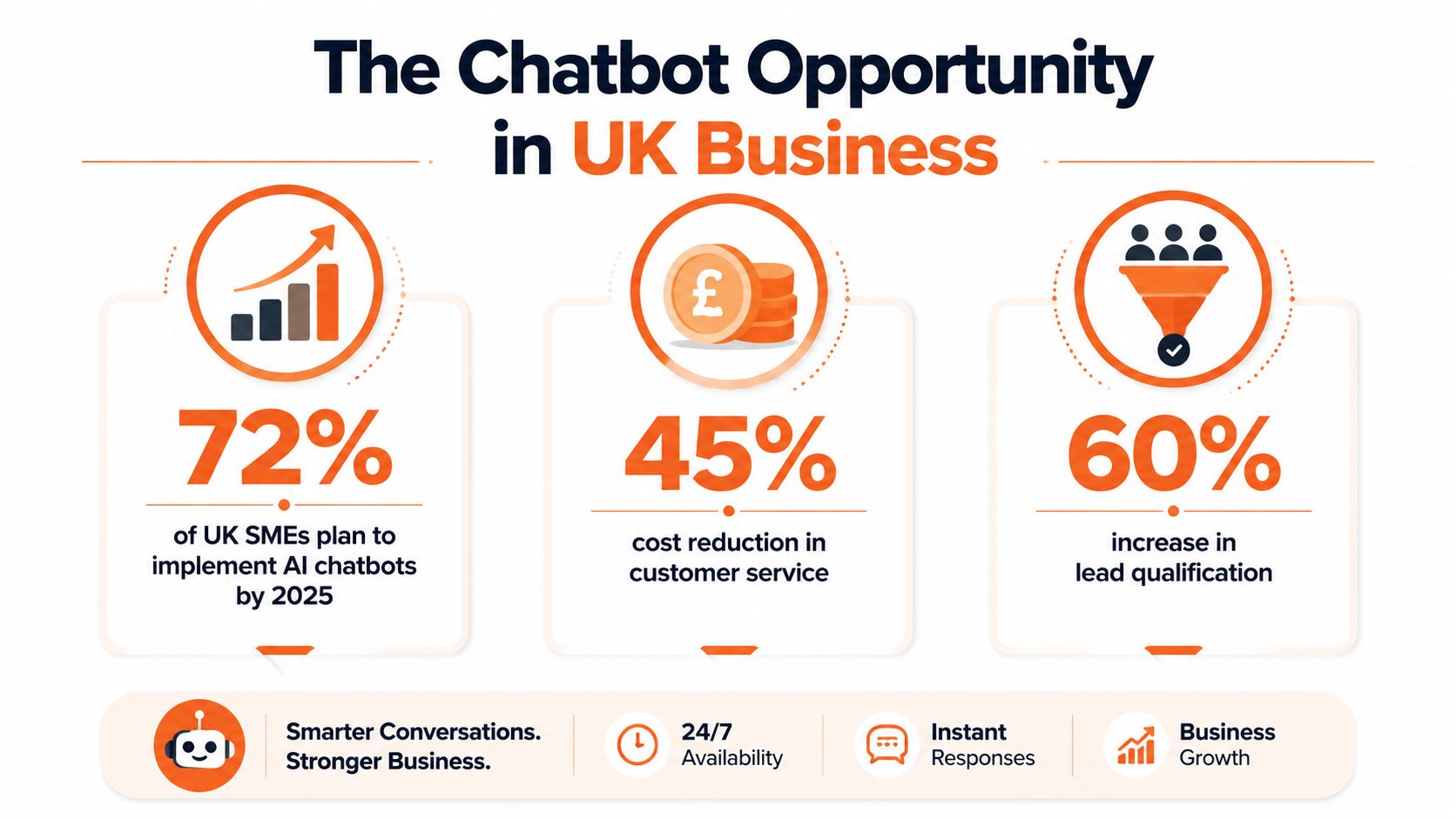
The Chatbot Opportunity in UK Business
UK buyers should treat chatbot investment as an operating-model decision, not a software purchase. The Office for National Statistics chatbot adoption reference shows that business use of chatbots still trails broader interest in AI, while consumers already use conversational tools for help and information. The implication is clear: demand is forming before many companies have prepared the workflows needed to serve it well.
Familiarity doesn't equal readiness
Customer familiarity raises the service standard. People expect natural language, relevant answers, and a quick route to resolution. A bot that repeats static FAQs, loses context, or blocks access to a person can make the experience worse.
Deloitte's UK reporting indicates broad awareness and use of generative AI, as summarised in this UK chatbot development services overview. That awareness changes what buyers should demand from a deployment. Responses need grounding in approved knowledge, safeguards must cover sensitive requests, and the system needs a reliable handoff to a human adviser when confidence or authority runs out.
Readiness depends on more than customer demand. Before approving development, confirm that the business owns the relevant knowledge, can provide controlled access to operational systems, and has people responsible for escalation, monitoring, and content updates. Poor ownership turns a promising assistant into an unmanaged source of incorrect answers.
The strategic gap
The opportunity is to select a narrow workflow where automation can improve service capacity, response quality, or employee productivity without weakening trust. Support triage, an internal policy guide, and sales qualification may all use conversational AI, but they require different data, integrations, controls, and measures.
A hybrid design is usually the safer starting point. Let the assistant handle predictable questions, information retrieval, and structured intake. Give human advisers the cases involving judgement, exceptions, emotional customers, or commercial risk. Measure the handoffs as carefully as the automated resolutions, because an escalation path that frustrates users defeats the project.
Practical rule: Fund the workflow, not the chatbot. If the business problem cannot be measured before development starts, the project is not ready.
For a broader view of service automation, AI-powered customer service strategy offers useful context. The buying decision should follow the same test: define the outcome, verify implementation readiness, then choose the technology and delivery partner that can support it.
What Modern Chatbot Development Services Actually Include
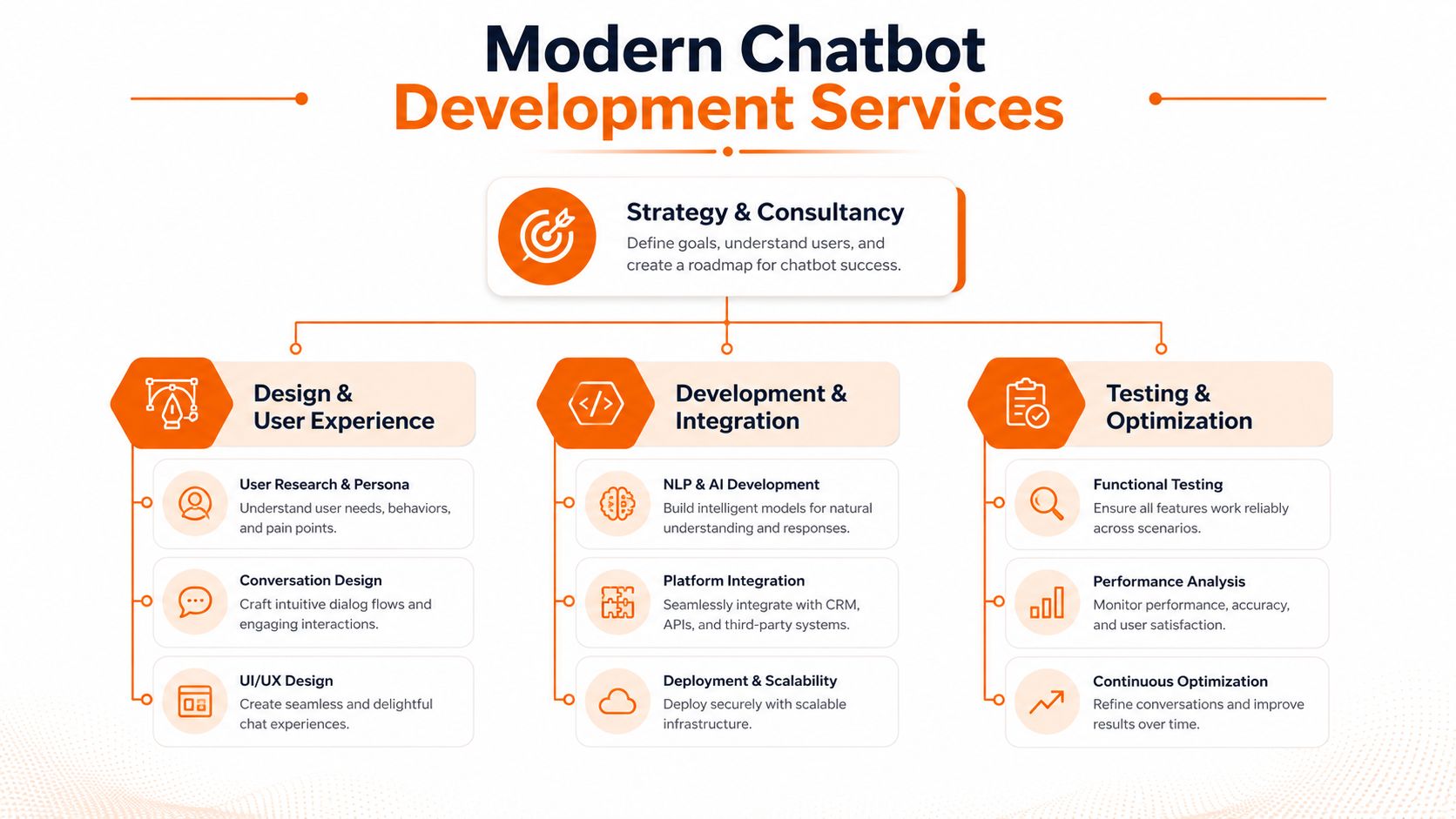
Professional chatbot development services cover far more than conversation scripting. The work begins with discovery and outcome definition, then moves through experience design, architecture, integration, testing, launch, and operational improvement. A vendor that only presents a bot builder is offering a component, not a delivery capability.
Start with strategy and consultancy
The first deliverable should be a clear use-case decision. That means identifying who will use the system, which questions or tasks recur, what data the assistant needs, and where a human must take over. The team should also define baseline measures, such as handling time, resolution quality, escalation volume, lead response speed, or employee time spent searching for answers.
This phase exposes weak ideas early. A company may think it needs a customer-facing assistant when the stronger first use case is internal support, where the data is more controlled and the operational risk is lower.
Design the experience, not just the prompts
Conversation design maps the user journey across successful paths, ambiguity, frustration, unsupported requests, authentication, and handoff. It also establishes tone, consent language, accessibility expectations, and the point at which the bot should stop asking questions.
A useful service will test real language from support tickets, chat logs, sales enquiries, or internal requests. Designers should create interaction patterns that move users towards resolution rather than maximising conversation length. A short, decisive exchange is often more valuable than a fluent but unfocused one.
Build the system around enterprise reality
Development includes model selection, retrieval, orchestration, APIs, permissions, and observability. A retrieval-augmented generation approach can ground answers in approved company information, while workflow integrations allow the assistant to check status, create cases, qualify leads, or surface relevant records.
Integration depth determines business value. A bot disconnected from the CRM, helpdesk, knowledge base, or case-management platform can answer questions, but it can't reliably advance work.
Test, launch, and improve
Testing should include conversation quality, integration behaviour, access control, failure handling, latency, regression coverage, and user acceptance. After launch, monitoring must capture unanswered questions, low-confidence responses, failed actions, escalations, and changes in source content.
The service should include governance, ownership, review routines, and an improvement backlog. The modern chatbot development services process reinforces the point that delivery continues after the initial build.
Choosing the Right Architecture for Your Use Case
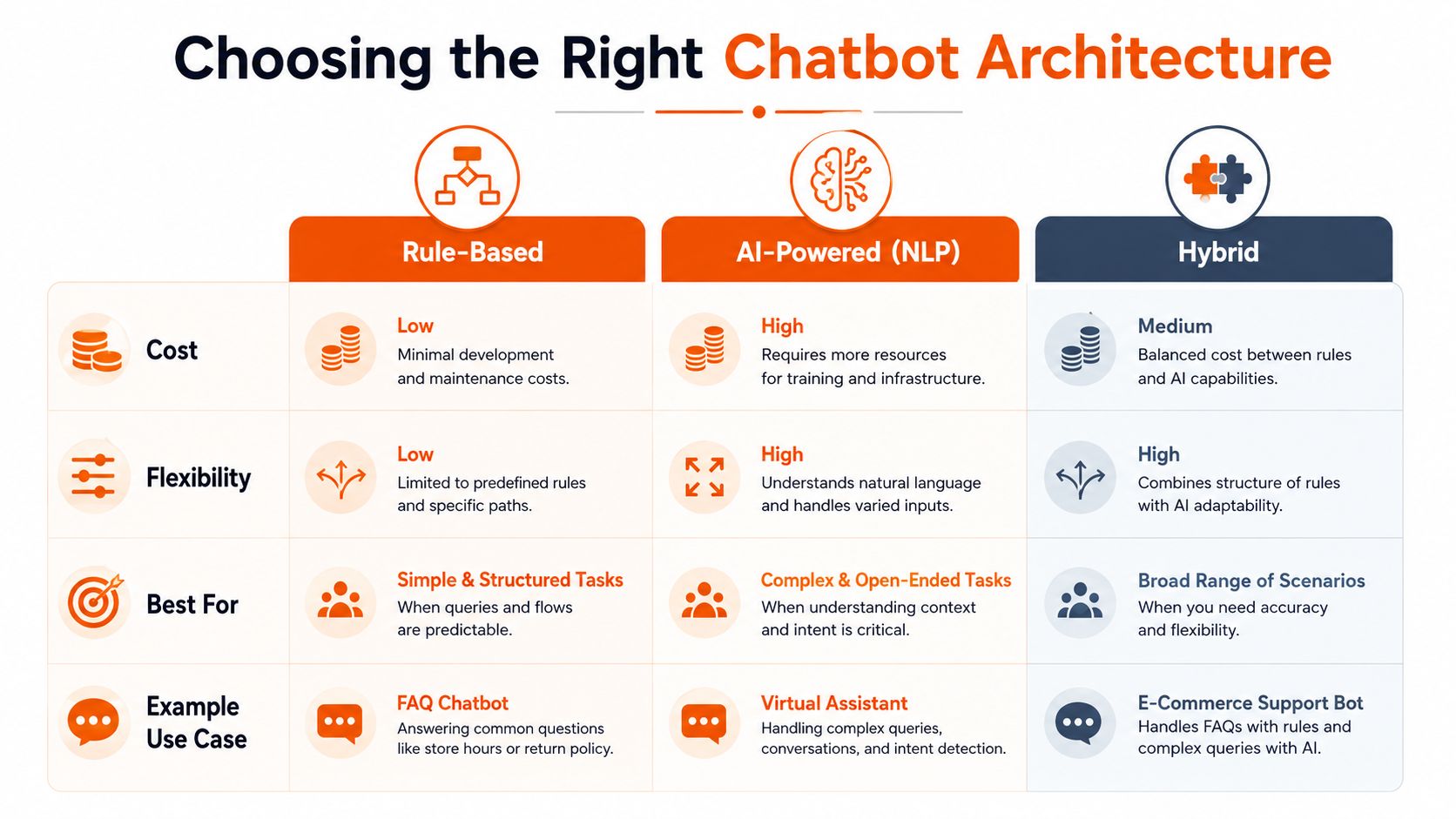
Architecture should follow the workflow. A rule-based system can be the right choice when the process is narrow, predictable, and sensitive to variation. A generative system can offer a better experience for open-ended questions, but it needs stronger controls. In most serious business environments, hybrid architecture is the practical default.
Rule-based systems
Rule-based bots use fixed routes, buttons, intents, and decision trees. They work well for password guidance, appointment routing, simple eligibility checks, and tightly controlled navigation. Their behaviour is easier to test and explain, and their scope is straightforward to govern.
Their weakness is brittleness. Users don't follow scripts neatly, and a system that can't recognise variation quickly sends people into loops. Rule-based design also becomes expensive to maintain when business policies and journeys change frequently.
AI-powered systems
Natural-language systems interpret broader phrasing and can retrieve or generate responses across a wider knowledge domain. They're useful for internal questions, product discovery, and support requests that don't fit a small set of predefined intents.
The risk is uncontrolled confidence. A fluent answer can still be wrong, incomplete, or inappropriate. Production systems need grounding, response evaluation, data permissions, fallback behaviour, and human review for sensitive actions.
Hybrid systems
Hybrid designs combine deterministic controls with AI flexibility. The system can use rules for authentication, payments, eligibility, and workflow boundaries, while using retrieval and language understanding for discovery, explanation, and less predictable questions.
The best chatbot isn't the one that answers everything. It's the one that knows what it can answer, what it can do, and when to bring in the right person.
Use a decision matrix based on data sensitivity, task complexity, language variation, integration needs, and the cost of an incorrect answer. For practical conversation patterns and interaction principles, Chatgrow's chatbot design guide offers useful design context.
Human handoff must be designed as part of the architecture, not added after a failed launch. Transfer should preserve the conversation context, identify the reason for escalation, and give the agent the relevant data. That protects the customer's time and helps the human resolve the issue instead of restarting discovery.
Engagement Models and ROI Expectations
The commercial model should match the uncertainty and ownership required by the project. A fixed-scope build suits a contained use case with stable requirements. A dedicated team works better when the assistant will evolve alongside a SaaS product, support operation, or internal platform. A build-operate-transfer model can fit companies that want to establish long-term capability while initially relying on an experienced delivery partner.
Avoid contracts that reward completed screens or integrations without tying work to operational outcomes. A vendor can deliver every technical milestone and still leave the business with an assistant nobody trusts.
Compare the options
| Engagement Model | Typical Timeline | Best For | Cost Range | Key Considerations |
|---|---|---|---|---|
| Fixed-scope project | Defined project window | A focused pilot or bounded workflow | Scope-dependent | Clear requirements, change control, explicit acceptance criteria |
| Dedicated team | Ongoing | Product teams building and improving a conversational capability | Team and scope-dependent | Strong collaboration, shared ownership, continuous prioritisation |
| Build-operate-transfer | Phased engagement | Businesses creating internal delivery capability | Programme-dependent | Knowledge transfer, hiring, governance, operational continuity |
| Advisory plus implementation | Discovery followed by delivery | Buyers needing architecture and delivery direction | Scope-dependent | Independent prioritisation, risk reduction, better investment sequencing |
The table intentionally avoids invented price bands. Costs vary with data readiness, security needs, integrations, channels, testing depth, and post-launch support. A serious proposal should itemise those drivers rather than hide them inside a single attractive figure.
Measure value where it appears
For customer service, track resolution quality, handling time, escalation quality, and the volume of repetitive work removed from agents. For sales, measure the quality and speed of qualification, not merely the number of conversations. For internal operations, measure time saved on repeatable research and the quality of completed tasks.
UK evidence supports this productivity-first approach. Government research reports that 75% of businesses using AI saw improved workforce productivity, 57% developed new or improved processes or operations, and 10% reported no impact so far; most had not yet seen a revenue change, according to the UK Government AI adoption research summary. The first business case should therefore focus on service capacity and process improvement, not speculative revenue claims.
Hidden costs include knowledge-base maintenance, evaluation, monitoring, security reviews, integration changes, training, and operational ownership. Put each item into the plan before approval.
Vendor Selection Criteria That Actually Matter
A vendor's slide deck doesn't prove production readiness. Ask how the team handles incomplete data, failed integrations, sensitive requests, ambiguous language, model changes, and the first difficult month after launch.
Evaluate evidence, not adjectives
Look for proof across five areas:
- Proven industry experience: Ask for live examples relevant to your workflow, not just a generic demo.
- Transparent development process: Require visible discovery outputs, decision logs, test evidence, and a prioritised backlog.
- Post-launch support and SLA: Confirm who monitors quality, responds to incidents, updates content, and owns improvement.
- Integration capability: Test whether the team understands your CRM, helpdesk, identity layer, knowledge systems, and internal APIs.
- Scalability architecture: Examine permissions, observability, testing, retrieval quality, and the path from pilot to wider adoption.
Run a demanding evaluation
Give shortlisted partners a realistic scenario with conflicting requirements. Ask them to explain the architecture, handoff rules, data boundaries, measurement plan, and likely failure modes. The strongest team will ask difficult questions before proposing a solution.
Nearshore delivery can work well when the partner offers time-zone overlap, cultural compatibility, senior engineers, and direct communication. It doesn't work when “nearshore” is used to disguise fragmented ownership or an offshore chain of intermediaries.
Watch for these warning signs:
- Demo-first selling: The vendor avoids baseline measures and jumps straight to features.
- Platform dependency: The team can name tools but can't explain orchestration, retrieval, security, or testing.
- No failure strategy: Nobody can describe what happens when the system doesn't know.
- Launch-only support: The proposal ends at deployment without monitoring or improvement.
- Unclear accountability: Problems are passed between product, engineering, and the client.
Extreme Ownership is visible in the uncomfortable moments. A partner should surface risks early, propose options, and stay accountable for the result rather than wait for perfect instructions.
Use a short paid discovery or pilot to test working behaviour. During that phase, assess communication speed, decision quality, technical transparency, and whether the team challenges weak assumptions. For a wider view of partner capabilities, artificial intelligence software development company guidance provides useful selection context.
Real Implementation Patterns and Lessons Learned
A customer-service assistant should absorb repetitive front-door requests while giving agents the context needed for complex cases. A UK-focused industry analysis reports that AI implementation can reduce customer-service costs by 30% to 45%, while 85% of CX leaders are implementing customer-facing generative AI for always-on support, triage, and agent assistance, according to the KPMG UK customer experience report. The practical lesson is clear: combine retrieval, intent detection, case integration, and escalation. Do not design for total replacement.
Internal operations follow a different pattern. Parliament reported a pilot in which the Scout tool achieved 83% adoption in its first month and saved an average of 26 minutes per day, as covered in the UK customer support preference report. That result supports a narrow, task-based assistant with a defined audience and a measurable time-saving goal.
What these patterns have in common
Successful projects begin with a workflow, not a chatbot brand. They set an automation boundary, retain human judgement where it matters, and measure operational improvement rather than conversation volume.
A sales assistant should qualify prospects against agreed criteria and record useful information in the CRM. An internal assistant should retrieve approved policy or product information and make uncertainty visible. A recruitment assistant should answer repetitive candidate questions while protecting the human relationship, as shown by recruitment chatbot implementation patterns.
Customer preference sets a clear design constraint. Public reporting indicates that 83% of consumers preferred speaking to a real person, while 4% preferred a virtual agent or chatbot. Forced automation, weak handoffs, and vague bot boundaries damage trust, even when the underlying technology works.
Give customers an obvious escape route. Preserve context during transfer, restrict the assistant to tasks it can perform reliably, and assign an owner to review failures and correct recurring problems. Implementation readiness determines whether the pattern produces savings or creates another support queue.
Your Strategic Path Forward
Start with four decisions:
- Choose the outcome: Reduce repetitive service work, accelerate qualification, improve internal access to knowledge, or support a defined operational task.
- Check readiness: Confirm data quality, system access, ownership, privacy controls, and the people who'll monitor performance.
- Select the delivery path: Use a platform for a narrow workflow, a specialist partner for complex integration, or a dedicated team when the capability will become part of the product.
- Set the first proof point: Agree on a baseline, a controlled pilot, quality thresholds, handoff rules, and a review date before development begins.
UK technology adopters were associated with 19% higher turnover per worker, after controls for management practices and firm characteristics, according to UK Government AI adoption research. That supports a firm recommendation: treat chatbot development as a business-system investment, with measurable operating targets and accountable delivery.
Rite NRG provides strategic consulting, senior nearshore engineering teams, end-to-end platform delivery, and Build-Operate-Transfer support for chatbot initiatives that need dependable integration and ownership. Visit Rite NRG to discuss your use case, define the right architecture, and turn a chatbot idea into a measurable delivery plan.