You're staring at a queue that keeps growing, the sales team wants faster onboarding, support is copying the same details into three systems, and engineering is stuck firefighting handoffs instead of shipping features. That's the state of process automation for most SaaS and enterprise teams right now. The companies that win aren't the ones with the most tools, they're the ones that treat automation as a delivery discipline, with extreme ownership, clear outcomes, and a partner who will challenge weak assumptions early.
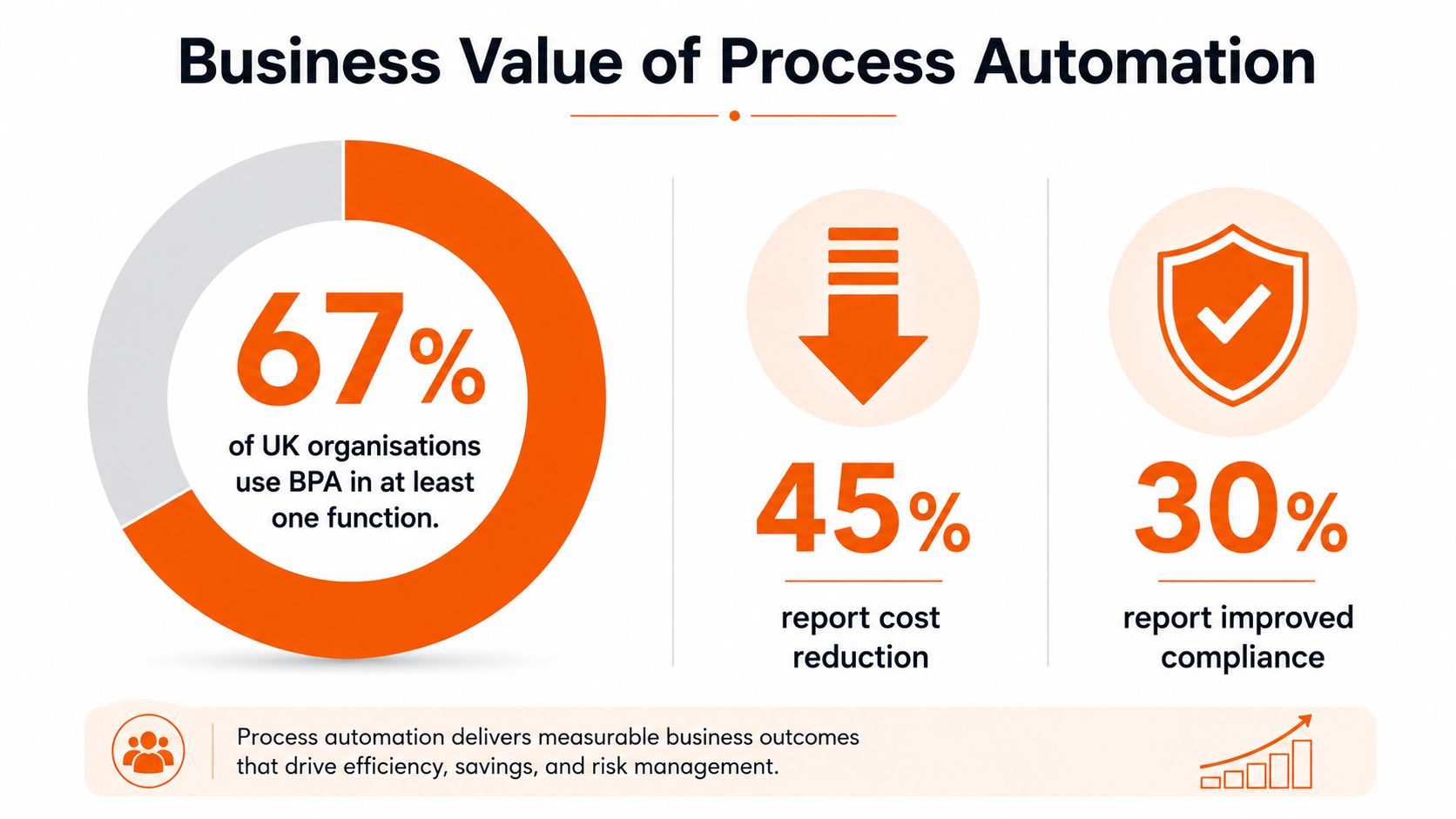
The market has already moved past experiments. UK-focused reporting says 67% of organisations worldwide now use business process automation in at least one function, 31% have fully automated at least one function, and the average enterprise now uses 7.5 automation tools, up from 4.2 in 2022. That shift matters because automation is no longer a side project, it's part of the operating model, especially in regulated, workflow-heavy UK environments. For a practical overview of the basics, the what is process automation guide is a useful starting point before you go deeper into implementation.
A serious delivery partner doesn't sell shiny tooling and disappear. A serious partner asks where the bottleneck is, what metric proves value, and what breaks if the workflow touches legacy systems or compliance gates. That's the #riteway mindset, high energy, proactive ownership, and a refusal to confuse activity with progress. If you want automation that improves time-to-market and predictability, not just technical output, you need that kind of stance from day one. For a broader delivery strategy lens, see Rite NRG's SaaS efficiency guide.
Why Process Automation Matters Now
A SaaS founder usually feels the pain first in the quiet places. On Monday morning, the onboarding backlog is full, finance is waiting on approvals, and customer success is chasing updates that were supposed to be automatic. Meanwhile, engineering is glued to brittle integrations because the “temporary” manual workaround never went away.
That's where process automation stops being a back-office improvement and starts becoming a growth lever. In UK markets, the pressure is sharper because teams are dealing with workflow standardisation, compliance expectations, and digital transformation programmes across finance, professional services, and public-facing operations. The point isn't to automate for vanity. It's to remove friction that blocks revenue, slows service, and makes every release harder than it should be.
Practical rule: if a process keeps reappearing in status meetings, it's probably a candidate for automation or redesign.
Rite NRG's #riteway approach fits here because it starts with accountability, not tooling. Extreme ownership means the team owns the business result, not just the build ticket. High energy and proactivity matter because automation work dies quickly when the delivery team waits for perfect clarity instead of moving the process forward with evidence. That consulting mindset is the difference between shipping a bot and improving the service.
The bigger shift is structural. Industry reporting tied to the UK market notes that the average enterprise now uses multiple automation tools instead of one-off pilots, which tells you how far this has moved into core operations. That's why teams need a partner that can think across delivery, governance, and legacy constraints, not a vendor list that only knows one product category. If you're only measuring task completion, you'll miss the prize, which is cleaner delivery, lower rework, and a more predictable operating rhythm.
Understanding Process Automation and Its Taxonomy
Think of process automation like installing smart conveyors in a factory. You're not hiring more people to carry parts from one end of the floor to the other. You're designing the flow so work moves with less friction, fewer handoffs, and more control.
RPA for structured screen work
Robotic process automation, or RPA, is the conveyor for rule-based screen tasks. It's best when the inputs are structured, the steps don't change much, and the systems don't expose clean APIs. A SaaS operations team might use it to move data from an inbox into a CRM when the format is consistent and the exception rate is low.
Osher Digital's automation expertise is a helpful example of how RPA is usually positioned in the world, as a narrow tool for repeatable work rather than a universal fix. That's the correct mental model. If the process depends on judgement, negotiation, or exceptions, RPA alone will become fragile fast.
Workflow automation for multi-step handoffs
Workflow automation handles the chain of approvals, notifications, and system updates that sit between teams. It's the better fit when the work spans several roles, but the logic still stays mostly deterministic. A classic SaaS example is onboarding, where sales, implementation, support, and finance all need different actions triggered by the same event.
Many teams overcomplicate a simple problem or under-scope a complex one. If the workflow is mainly a matter of moving data and triggering the next step, workflow automation is enough. If you need humans to approve, reject, or review edge cases, the design must account for that from the start.
Intelligent automation for pattern-heavy work
Intelligent automation layers machine learning or other AI techniques onto the process. It belongs where the work has patterns, but not fixed rules. Think of routing support tickets based on content, classifying documents, or flagging risk in a compliance queue.
The key is not to treat AI like magic. Use it where it improves the decision surface, then keep humans responsible for the final call when the outcome matters. That's the difference between automation that helps and automation that creates confusion.
Business Value and ROI of Process Automation
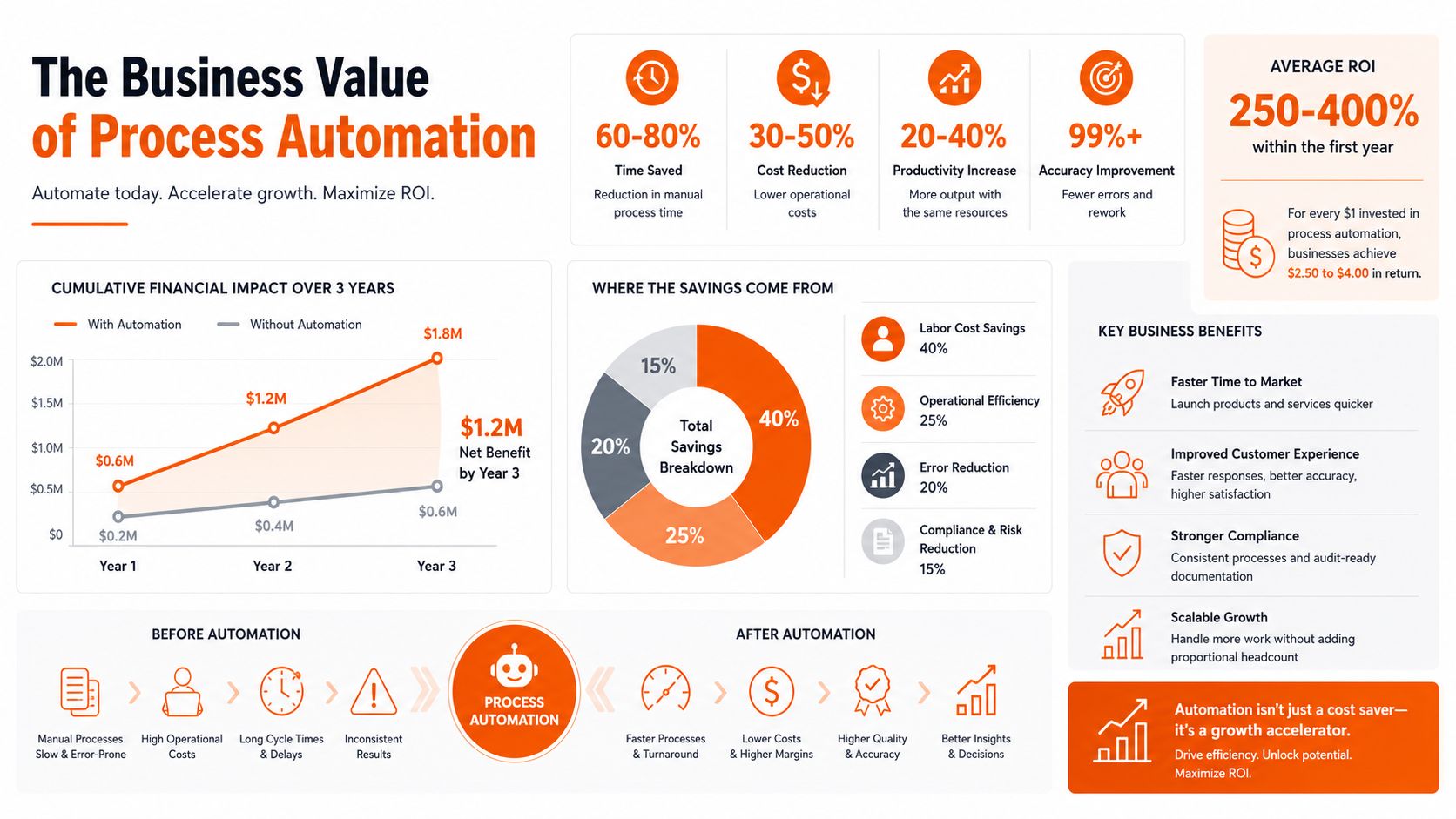
The business case only becomes real when you tie automation to operational outcomes. UK-focused reporting says 67% of organisations worldwide now use business process automation in at least one function, and a 2026 estimate puts the market at $19.6 billion, up from $8 billion in 2020. Those figures tell you this isn't a niche efficiency play anymore, it's mainstream management infrastructure.
ROI starts with the right measurement
The UK Government Digital Service guidance, as summarised in the cited material, is blunt, automation should reduce effort only when the step is reliable, and teams should measure whether the service improved by tracking outcomes like reduced handling time, fewer errors, or lower cost-to-serve. That framing is the right one. Technical output doesn't pay the bills, outcomes do.
So if your board asks whether the investment worked, don't talk about bot counts or workflow diagrams. Talk about whether the process moved faster, whether the error rate fell, and whether the service team spent less time on repetitive handling. Those are the metrics that survive scrutiny in a real business review.
Selective automation beats wholesale replacement
McKinsey's automation research is useful because it cuts through the fantasy that entire jobs disappear overnight. It says fewer than 5% of occupations can be fully automated with current technology, while about 60% of occupations could have 30% or more of their activities automated. That's the right strategic lens for leaders in the UK, automate activities inside jobs, don't try to delete the job and hope the process survives.
That approach is also safer in regulated environments. You keep humans on the decisions that need judgement, and you automate the repetitive steps that create delay, cost, and inconsistency. In practice, the ROI usually shows up as less rework, faster cycle times, and a service model that scales without constant headcount growth.
The best automation programme doesn't try to prove how clever the tooling is. It proves the business got easier to run.
SaaS and Legacy Modernisation Use Cases
The most valuable automation work rarely sits in a clean greenfield system. It sits in a brownfield estate where the business still depends on older tools, awkward handoffs, and manual checks that no one has been brave enough to remove. That's where process automation earns its keep, because it lets you modernise flow without ripping out everything underneath.

A finance team might use automation to route compliance reporting through structured approvals, then retain a clear audit trail for every action. A SaaS company might automate customer onboarding across sales, implementation, and external service partners so the customer doesn't have to repeat information at every step. Those are not back-office toys, they're revenue and trust systems.
The gap is bigger than many teams realise. A 2025 survey cited in the brief found only 17% of UK organisations said AI was widely embedded in their business, while 42% said it was limited to specific departments or functions and 35% were piloting or experimenting. That tells you most companies are still early in the operating-model shift, especially when automation crosses organisational boundaries or customer-facing journeys. The opportunity is not just internal efficiency, it's building service experiences that don't collapse under handoffs.
For a more technical legacy lens, Rite NRG's legacy modernisation strategies are relevant because modernisation usually starts with the seams, not a full replacement. Automate data moves first. Automate approval chains next. Then decide what still deserves a human checkpoint because of risk, regulation, or customer impact.
In brownfield systems, the win is not “we automated a task.” The win is that fewer tickets bounce between departments, customers get answers faster, and the legacy stack stops dictating the pace of delivery. That's how modernisation becomes practical instead of theatrical.
Implementation Roadmap with Pragmatic KPIs
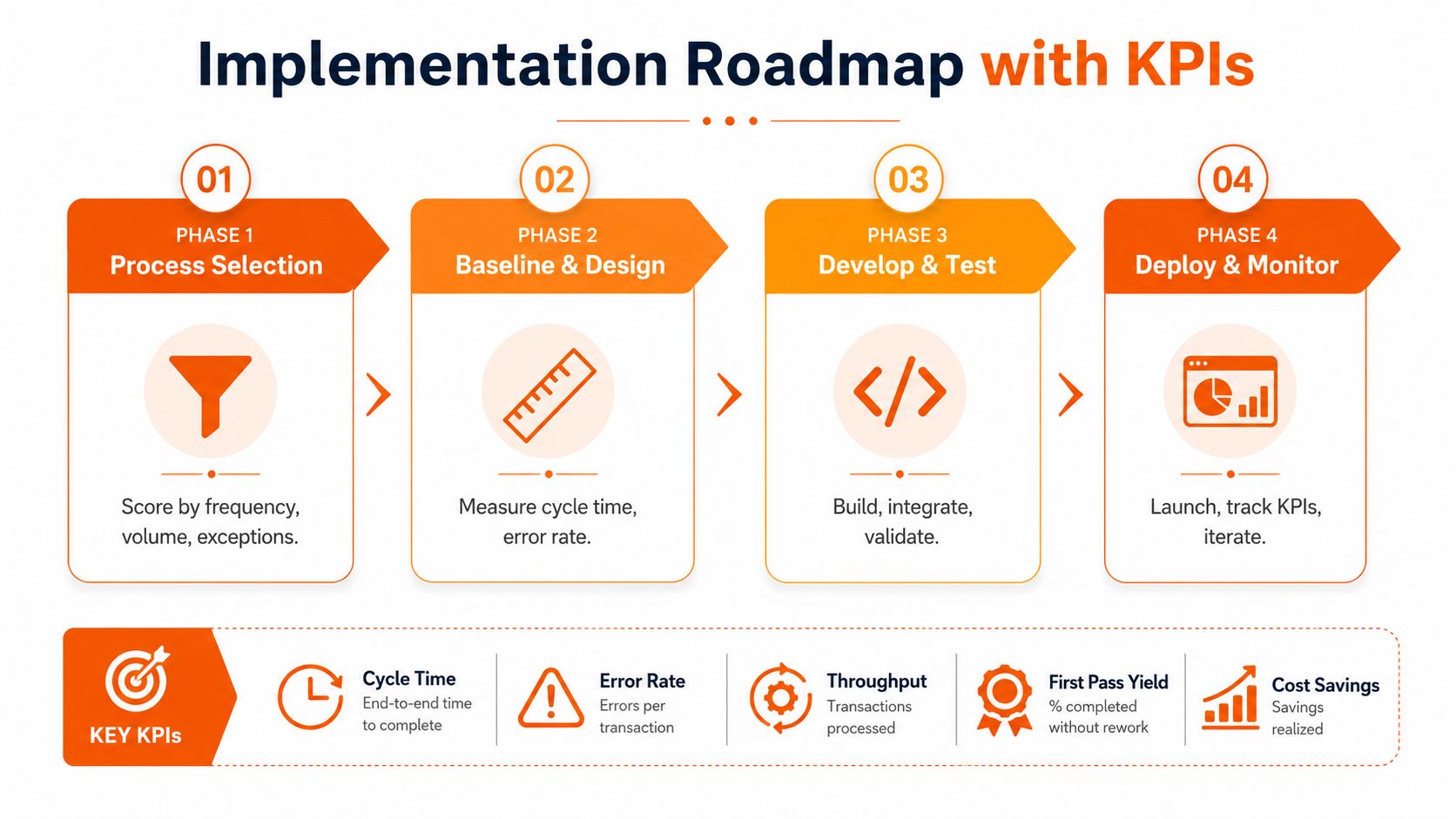
A roadmap keeps automation honest. Without one, teams tend to automate the loudest process in the room instead of the one with the clearest business value. The better way is to score candidates on process frequency, transaction volume, time per transaction, system complexity, data reliability, and exception rate, because those variables are tied to both feasibility and ROI.
Start with baselines, not assumptions
Before anything goes live, capture cycle time, error rate, SLA breaches, and cost per transaction. Then repeat the same measurement after a 60 to 90 day stabilization window so you can tell the difference between real improvement and short-term noise. That discipline is important in regulated UK environments because auditability matters as much as speed.
If you don't instrument the workflow, you won't know whether the automation helped or just hid the problem in a different place. Make latency, throughput, backlog, and exception queue size visible from day one. When something fails, the system should tell you where, not force the team to guess.
Use a phased delivery sequence
- Process selection. Filter hard. If the process is low volume, full of exceptions, or politically sensitive, park it.
- Baseline and design. Map the current path, define the metrics, and decide where human approval stays in the loop.
- Develop and test. Build the workflow, integrate the systems, and run a short parallel trial with real users and masked test data.
- Deploy and monitor. Launch with explicit SLA thresholds, watch the KPI trends, and iterate based on evidence.
Practical rule: if you can't explain how success will be measured before go-live, you're not ready to automate that process.
For leaders who want to keep delivery disciplined, Rite NRG's software delivery metrics guide aligns well with this approach because automation only matters when the metrics are visible and trusted. The partner you choose should push for that clarity, not let weak measurement slip through because the demo looked good.
Common Pitfalls and Risk Mitigation
The biggest mistake in automation is assuming repetition equals readiness. A process can be repetitive and still be a terrible candidate if it crosses too many systems, depends on tacit judgement, or sits under heavy regulation. In brownfield environments, that assumption burns budget fast.
Recent research on operational complexity says automation stalls when workflows span at least three systems, require handoffs across at least three roles or organisations, contain tacit decision points, must satisfy hard regulatory or contractual constraints, or run on entrenched legacy tools that teams won't replace wholesale. That's exactly why generic “automate everything” advice fails in the UK market. The central question is how to automate without breaking compliance, accountability, or existing systems.
The mitigation is straightforward, but it has to be designed in. Use orchestration for multi-step flow, human-gated approvals where judgement matters, structured audit traces for accountability, and brownfield integration when the legacy estate has to stay in place. If the workflow needs rollback, logging, or credential handling, treat those as part of the design, not a later cleanup task.
For teams trying to reduce delivery risk, a useful comparison is the cloud modernization failure rate conversation, because the same pattern shows up again and again. Teams don't fail because automation is impossible. They fail because they automate a broken process, ignore exception handling, and then blame the tool when the mess gets faster.
If the process can't survive a bad day, it can't survive automation.
The better move is to stop early when the red flags are obvious. If the process is undocumented, changes every week, or depends on a single person's tribal knowledge, fix the process first. That's not conservatism, it's delivery discipline.
Selecting a Nearshore Partner and Accelerating Delivery
The right partner doesn't just build the workflow, they help you choose which workflow deserves the investment. That matters because McKinsey's finding that fewer than 5% of occupations can be fully automated but about 60% can automate 30% or more of their activities is a direct argument for selective redesign, not blanket replacement. You want a team that can separate the automatable slice from the human judgement that should stay intact.
A strong nearshore partner should bring senior delivery people who can challenge weak assumptions, keep collaboration transparent, and scale quickly when the work gets real. Rite NRG's model fits that shape because it combines product-first thinking, AI embedded across recruitment, delivery, and operations, and the ability to scale teams within 1 to 2 weeks. The value is not just speed. It's predictability.
Look for these criteria when you choose who builds with you:
- Senior ownership. The people in the room should be able to design, not just execute tickets.
- Cultural fit. If the team won't challenge you or speak plainly about risk, you'll pay for it later.
- Cross-system fluency. Automation work lives and dies on integration, not on isolated code quality.
- Delivery flexibility. Build-Operate-Transfer options in Poland matter when you want a long-term operating model, not a one-off project.
- Outcome discipline. Every sprint should point back to a measurable business result.
The best automation programmes feel calm because the partner owns the hard parts early. That's the #riteway mindset in practice, extreme ownership, high energy, and proactive delivery that keeps the business moving. If you want process automation to become a competitive edge instead of a science project, choose a partner who thinks like an operator and ships like a strategist.
If you're ready to turn manual handoffs, legacy friction, and compliance-heavy workflows into measurable delivery gains, talk to Rite NRG. They build senior nearshore teams, modernise SaaS and enterprise systems, and bring the ownership needed to make automation stick. Visit Rite NRG and start with a conversation about the process that's slowing your business down today.