You've got a strong SaaS idea. You can explain the problem, sketch the workflow, maybe even list the first ten features. But the gap between “this should exist” and “customers will pay for it” is where most products get punished.
Founders usually don't fail because they care too little. They fail because they move too fast on the wrong assumptions, hire people who wait for instructions, and treat delivery like a coding exercise instead of a business system. That's the mistake.
A good product development process isn't paperwork. It's a machine for reducing risk, compressing feedback loops, and getting to revenue with fewer wrong turns. If you want predictable delivery in 2026, you need a process that combines sharp discovery, senior execution, AI acceleration, and a team that acts with Extreme Ownership instead of passive compliance.
Your Idea Is Not Enough
A lot of founders start in the same place. You've spoken to a few prospects, the pain feels obvious, and you're tempted to start building before someone else beats you to it. That urgency is real. It's also dangerous.
In the UK, approximately 80% of new product launches fail because flawed processes don't converge on viable, market-ready solutions before production, according to Kaizen's analysis of UK launch failure. That number should change how you think. Your product isn't competing against other ideas. It's competing against bad process, false confidence, and expensive rework.
Process beats enthusiasm
Founders often describe process as bureaucracy. I don't buy that. A weak process gives you chaotic roadmaps, slow decisions, and a backlog packed with features nobody asked for. A strong product development process gives you clarity on what matters now, what can wait, and what shouldn't be built at all.
That's where the #riteway methodology matters. It's built on Extreme Ownership, high energy, and proactivity. In practice, that means your team doesn't hide behind tickets. They surface risks early, challenge bad assumptions, and stay focused on the business result. The right team doesn't ask, “What did the spec say?” They ask, “Will this move adoption, retention, or revenue?”
Practical rule: If your team can only describe output, not outcome, your product development process is already off track.
Stop mistaking motion for validation
Early momentum feels good. Figma screens feel good. A backlog feels good. None of that proves demand.
Before you build, pressure-test the problem with a sharper lens. A resource like Proven SaaS business idea validation is useful because it forces the uncomfortable questions early, before engineering time turns into sunk cost. You also need a crisp value proposition, not a vague promise. This is exactly why a tool like the Value Proposition Canvas helps founders cut through wishful thinking and connect features to actual customer pain.
Here's the blunt truth. Customers don't buy ideas. They buy outcomes. Faster reporting. Lower manual effort. Better compliance visibility. Fewer missed renewals. If you can't name the business change your product creates, your roadmap is guesswork.
What a serious founder does next
A disciplined product development process starts with a few absolute requirements:
- Define the business pain clearly so a buyer can recognise it in seconds.
- Separate assumptions from evidence before your team writes production code.
- Force prioritisation early because every extra feature delays learning.
- Build with ownership so blockers, risks, and bad decisions don't sit hidden for weeks.
That's the shift. Your idea gets you into the game. Process is what keeps you alive long enough to win.
The Foundation From Discovery to a Bulletproof MVP
Most MVPs are too big, too vague, and too late. Founders call something an MVP when it's really version one of a bloated product. That's not discipline. That's avoidance.
The strongest signal of real demand is finding 20+ potential customers who describe the problem unprompted, and the realistic path from validated idea to paying customers is 5–9 months, not 6 weeks, according to Seven Solvers' SaaS development guide. That should reset your expectations immediately.
Start with evidence, not preferences
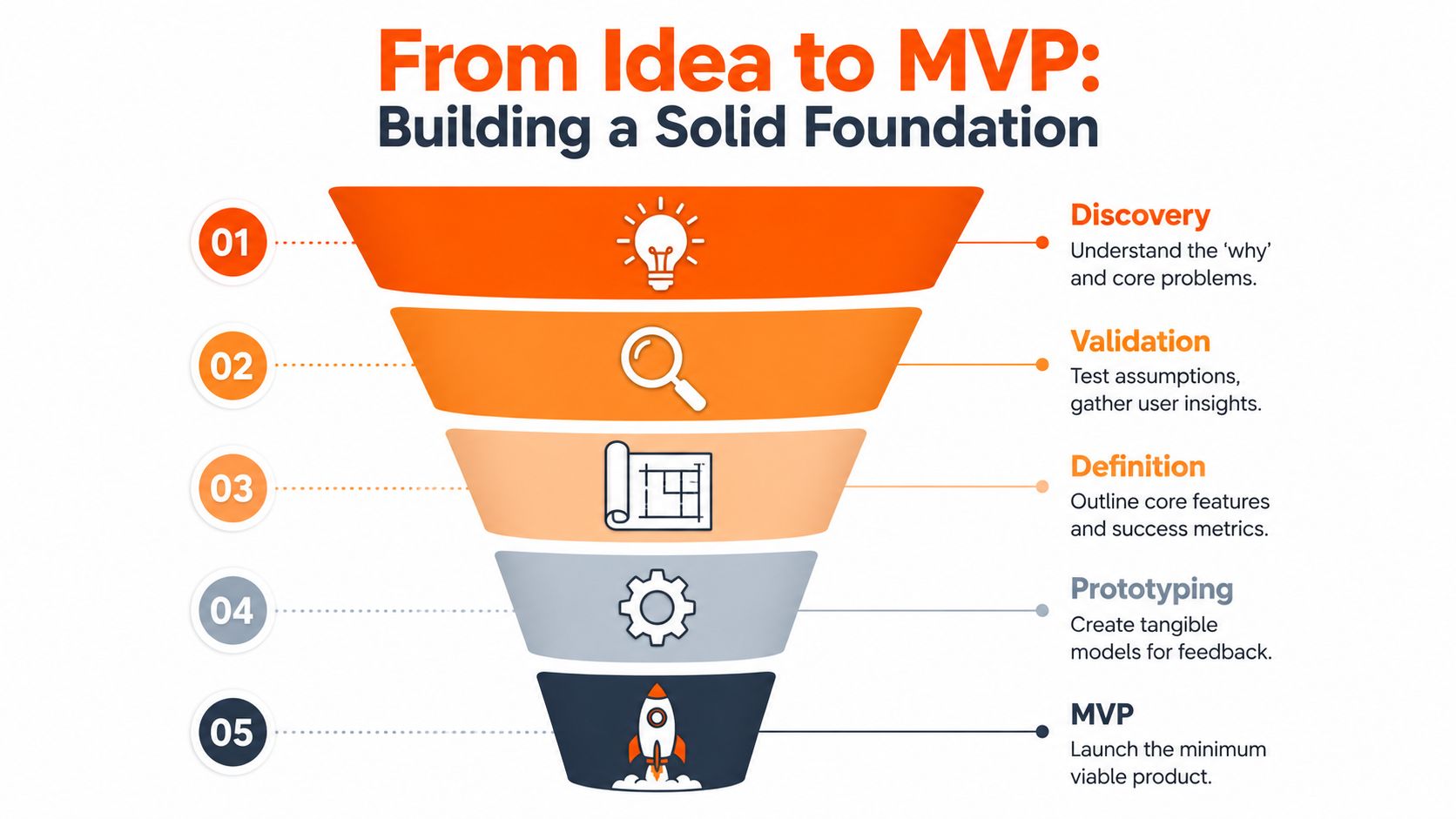
Discovery isn't a warm-up. It's where you decide whether the problem is sharp enough, urgent enough, and expensive enough to deserve a product.
Use this sequence:
Interview the right people
Don't ask friends if the idea is good. Speak to people who live with the problem and already spend time or money on workarounds.Listen for unprompted language
If prospects only agree after you explain the pain, that's weak evidence. You want them to describe the problem in their own words.Map the current workaround
Spreadsheets, Slack, Notion, email chains, manual exports. Workarounds reveal urgency and budget.Define the first measurable win
Your MVP needs one job. Not five. One. Make it easy to understand and easy to buy.
What belongs in a real MVP
A real MVP solves one painful problem exceptionally well. It doesn't try to impress investors with breadth. It gives early customers a reason to adopt, return, and pay.
Use this filter when deciding scope:
| Decision area | Keep it in the MVP when | Cut it when |
|---|---|---|
| Core workflow | It directly solves the primary pain | It only makes the product feel more complete |
| Reporting | It helps the user prove value quickly | It exists for internal vanity |
| Integrations | It removes a major adoption blocker | It serves a hypothetical future segment |
| Admin features | It's necessary for basic control | It belongs in later operational polish |
Feature creep usually starts with reasonable language. “We might need this.” “Sales will ask for it.” “It's small.” That thinking kills speed.
Build the smallest product that can create a meaningful business result for a specific customer.
Don't confuse proof of concept, prototype, and MVP
Founders waste time because they treat these as interchangeable. They aren't. If your team is muddling them, this guide to AI project artifacts is useful for clarifying what each deliverable should prove and when.
A simple way to understand it is:
- Proof of concept checks technical feasibility.
- Prototype tests flow, usability, and comprehension.
- MVP tests market behaviour and willingness to adopt or pay.
If you skip that discipline, you'll present a polished prototype to prospects, get polite feedback, and mistake courtesy for demand. That's expensive self-deception.
For teams that need sharper thinking before delivery starts, a solid proof of concept documentation approach helps force better decisions around assumptions, scope, and risk.
The front end decides the back end
Most delivery pain starts before engineering begins. Weak discovery creates moving targets. Moving targets create rework. Rework destroys confidence, budget, and speed.
Your front-end process should produce four outputs before serious build work begins:
- A problem statement customers recognise immediately
- A narrow MVP scope tied to one business outcome
- Success metrics that tell you whether adoption is real
- Clear exclusion decisions so the team knows what not to build
If you can't explain why each MVP feature exists, your scope is too wide. Tighten it. Customers reward clarity. So do delivery teams.
Assembling Your A-Team for Extreme Ownership
The wrong team can make a strong idea look weak. The right team can sharpen a rough idea into a commercial product. That's why team design matters as much as product design.
For UK software product development, the most critical success factors are top management support, a dedicated cross-functional team, and a clear strategic direction, while the most common pitfall is failing to meet customer needs, according to research on software product development success factors. That lines up with what I've seen repeatedly. Delivery breaks when leadership is vague and teams work in silos.
Skills matter. Ownership matters more.
A passive vendor waits for requirements, delivers tickets, and tells you what went wrong after the sprint. That's not a partner. That's outsourced inertia.
A serious product team behaves differently:
- Product people protect the problem definition instead of inflating the roadmap.
- Designers challenge ambiguity and make hard trade-offs visible early.
- Engineers think commercially and raise delivery risks before they become delays.
- Leadership removes friction so the team can make fast, aligned decisions.
That's what Extreme Ownership looks like in a product development process. Nobody shrugs and points elsewhere. Everyone owns the outcome.
Cross-functional means shared accountability
Don't build a team where strategy lives with founders, design lives in isolation, and engineering gets handed specs like a factory line. That setup creates lag, defensiveness, and local optimisation.
A better model is simple:
| Team element | What good looks like |
|---|---|
| Leadership | Clear direction and fast decisions |
| Product | Ruthless prioritisation tied to business outcomes |
| Design | Rapid testing of assumptions before build |
| Engineering | Technical choices that support speed and maintainability |
This is also why nearshore teams work best when they're treated as part of the core product unit, not an external add-on. Senior nearshore engineers should join planning, challenge assumptions, and contribute to product decisions. If they only receive tasks, you're wasting the strategic value you hired.
A strong reference point for this is building high-performing teams. The core lesson is simple. Performance isn't a recruitment slogan. It's the result of alignment, trust, and consistent ownership.
The best delivery teams don't just complete work. They reduce uncertainty for the founder.
What to look for when hiring your product team
If you're assembling a team for a new SaaS product, screen for these signals:
- Commercial awareness instead of pure technical fluency
- Bias for action instead of dependency on heavy supervision
- Comfort with ambiguity because early-stage products change
- Communication habits that surface blockers early
- Respect for scope discipline because speed depends on it
You don't need the biggest team. You need the most aligned one.
The Delivery Engine Cadence Tooling and AI Workflows
A product development process either creates momentum or drains it. There isn't much middle ground. When delivery slows, it's usually because the operating cadence is weak, tooling is fragmented, or the team still treats AI like a novelty instead of an execution advantage.
UK SaaS teams should work in 1–2 week short, focused sprints, prioritise ruthlessly at the start of each sprint, deploy continuously, and use brief daily standups to remove blockers, as outlined in this SaaS product development guidance. That cadence works because it forces clarity, exposes friction quickly, and keeps decision-making close to the work.
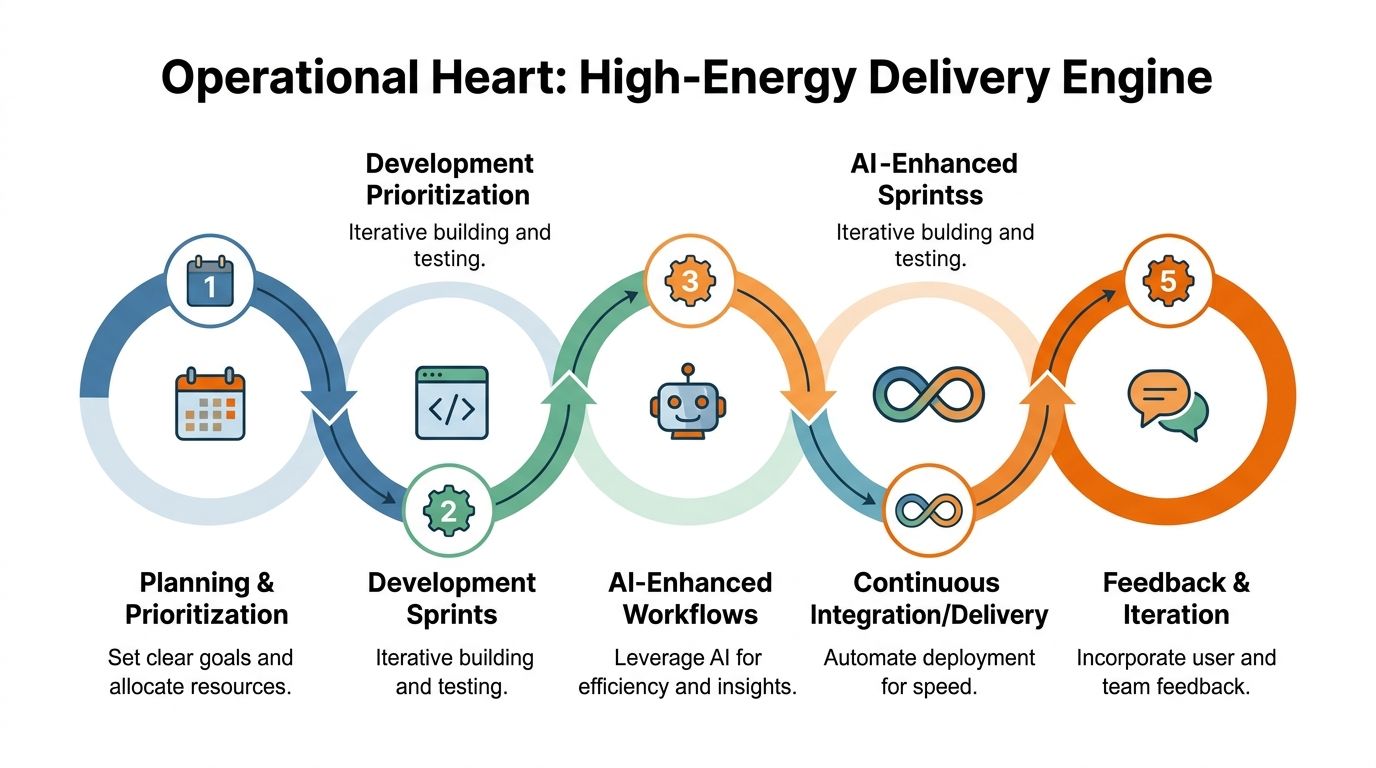
A high-energy delivery engine looks like this:
Cadence first, then tooling
Tools don't fix a weak rhythm. If your backlog is vague, your priorities change daily, and releases happen in stressful batches, buying another platform won't save you.
A better operating model has five moving parts:
Sprint planning with teeth
Pick fewer items. Define what “done” means. Kill anything that doesn't support the current outcome.Daily blocker removal
Standups should expose issues fast. Not recite status updates.Continuous integration and deployment
Ship in small increments so risk stays visible and reversible.Fast feedback loops
Pull in usage signals, customer comments, and delivery data while the work is still fresh.Retrospectives that change behaviour
If the same problem appears every sprint, the team isn't learning.
Where AI actually helps
Here's the practical shift. AI belongs inside the workflow, not outside it as a gimmick.
UK startups can ship up to 50% faster by integrating AI-powered risk surfacing and automated workflows, and AI tools can reduce the risks and assumptions phase by 30–40%, according to Evangelist Software's guide for UK tech entrepreneurs. That matters most in the messy early stages, where unclear assumptions create the biggest delays.
Use AI where it improves delivery discipline:
- Risk surfacing to flag unclear requirements, missing dependencies, and likely delivery bottlenecks
- Documentation support to tighten specs, acceptance criteria, and release notes
- Quality workflows to strengthen test coverage and spot edge cases earlier
- Recruitment and staffing operations to speed up team assembly and reduce hiring drag
Here's a useful framing. AI should reduce waiting, not replace thinking.
This short video gives a practical lens on modern product delivery and why operating rhythm matters as much as raw engineering skill:
Build a visible system
Founders lose confidence when delivery becomes opaque. The fix isn't more meetings. It's a transparent system where everyone can see status, risk, and next steps.
Your tooling stack should support that visibility across:
- Product planning with clear priorities and ownership
- Design collaboration so decisions don't disappear in screenshots and comments
- Code review and CI/CD for faster, safer releases
- Observability and incident response so production issues don't linger in the dark
You don't need a fashionable stack. You need a coherent one. Jira, Linear, GitHub, GitLab, Figma, Slack, Notion, and modern CI/CD pipelines all work when the team uses them with discipline. The point isn't the badge on the tool. The point is whether the system supports predictable delivery.
Good cadence creates speed. Good tooling protects it. AI multiplies it.
Navigating Risk and Ensuring Predictable Delivery
Most founders say they manage risk. What they often mean is they react to problems after the roadmap has already slipped. That's not risk management. That's expensive recovery.
A serious product development process handles risk early, visibly, and continuously. Especially in UK SaaS, where legal, operational, and scaling risks can hit long before product-market fit is secure.
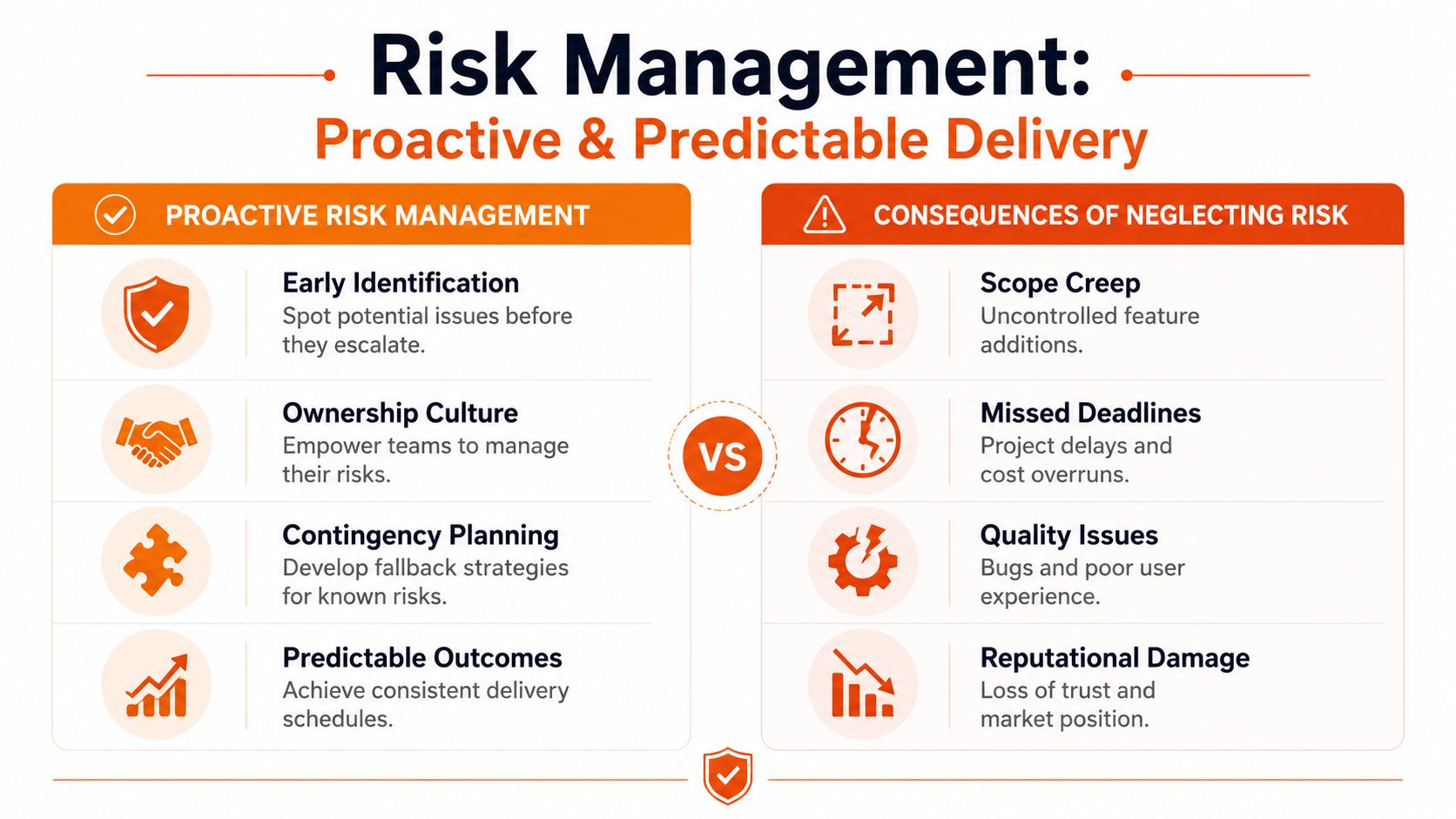
The passive model fails founders
One of the costliest mistakes is treating compliance as something to “sort later”. A significant percentage of UK MVPs fail because of unpredictable GDPR and compliance costs, and that risk can be mitigated through strategic structuring such as a Build-Operate-Transfer model with an R&D centre in Poland, according to Shopify's UK product development strategy guide.
That point matters because risk isn't just technical. It sits in hiring, governance, legal exposure, and delivery continuity.
Here's where founders get trapped:
- Scope risk grows when nobody says no decisively.
- Compliance risk grows when product decisions ignore data handling realities.
- Team risk grows when critical knowledge sits with a few individuals.
- Scaling risk grows when recruitment and operations are improvised.
Proactive risk management is a leadership choice
If you want predictable delivery, act on risk before it turns into delay. That means making risk review part of delivery, not a side conversation when things go wrong.
Use a simple operating checklist:
| Risk area | Proactive response |
|---|---|
| Product scope | Lock the outcome, then challenge every feature against it |
| Compliance | Review data flows and obligations before implementation hardens |
| Team continuity | Build shared ownership across product, design, and engineering |
| Delivery capacity | Create a staffing model that can scale without chaos |
The Build-Operate-Transfer model is especially useful when you need more than contractor capacity. It gives you a path to build a dedicated R&D centre with operational structure, talent access, and long-term control. For founders scaling under pressure, that's not an outsourcing trick. It's a strategic hedge against hiring volatility and operational fragility.
If a risk can derail delivery, it belongs in weekly decision-making, not quarterly review slides.
Predictability comes from structure
Founders often think flexibility means leaving everything open. It doesn't. Predictable delivery comes from clear ownership, short escalation paths, and early visibility into legal, staffing, and product risks.
The strongest teams don't pretend risk can be eliminated. They design a system that catches it early, contains the blast radius, and keeps progress moving.
Measuring What Matters KPIs Beyond Code Commits
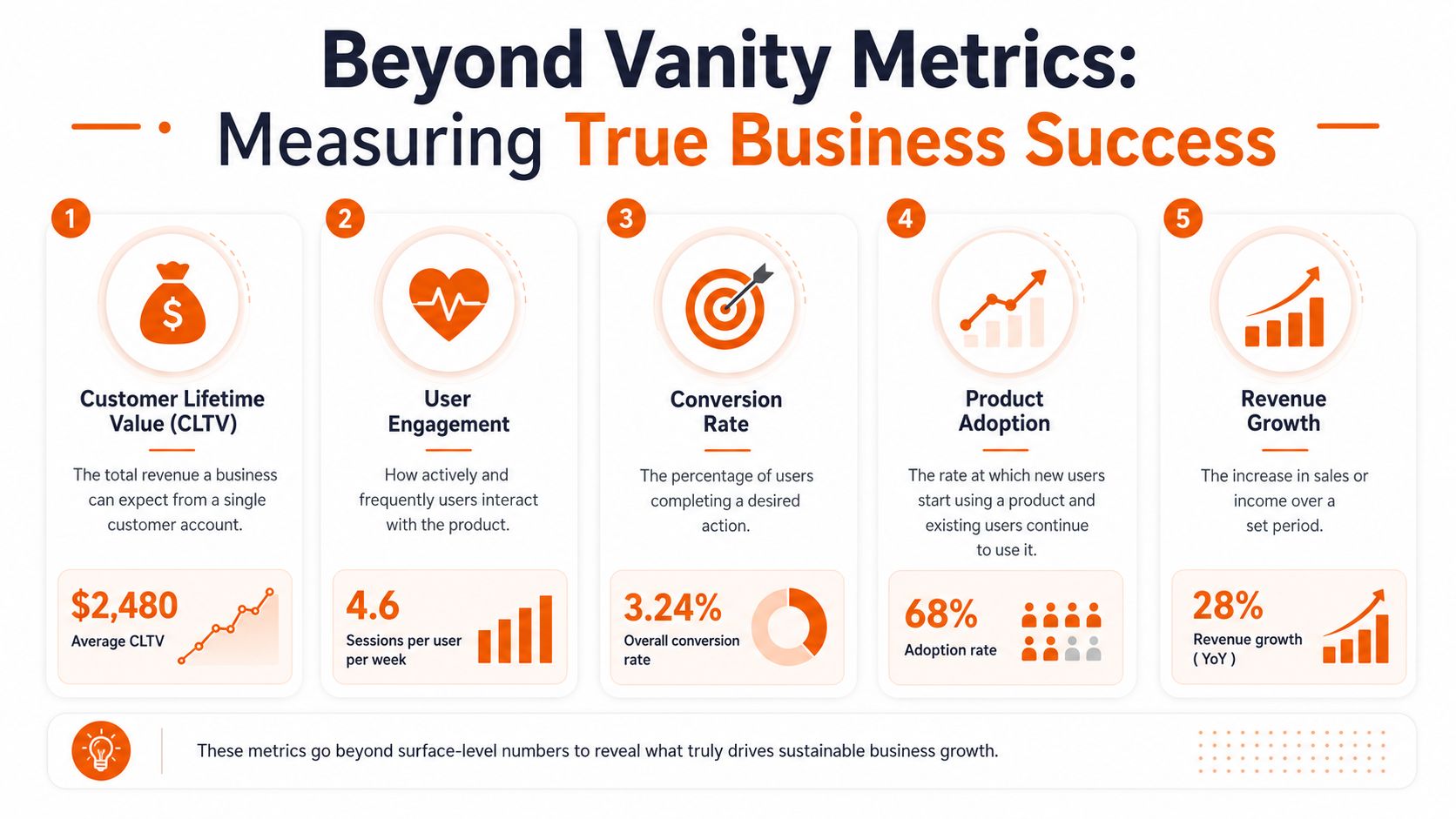
If your team celebrates velocity while adoption stalls, you're measuring the wrong thing. Code commits, story points, and hours logged might help internal coordination, but they don't tell you whether the product is winning.
A business-first product development process measures customer and commercial impact. That's the level founders, product leaders, and investors care about.
Output metrics mislead
Teams love output metrics because they're easy to count. That doesn't make them useful. A busy sprint can still move the business nowhere.
Use this distinction:
- Output metrics tell you work happened.
- Outcome metrics tell you whether the work mattered.
That shift changes better decisions than any backlog grooming session.
The KPIs worth watching
Track metrics that reveal whether the product is becoming easier to sell, easier to adopt, and more valuable to customers over time.
| KPI | Why it matters |
|---|---|
| Time-to-market | Shows how quickly your team can turn validated ideas into customer-facing value |
| Customer acquisition cost | Reveals whether your product and go-to-market motion are efficient enough to scale |
| Churn rate | Exposes whether the product keeps delivering value after initial adoption |
| Customer lifetime value | Indicates how much commercial value each customer relationship generates |
| Product adoption and engagement | Shows whether users are getting to value and returning consistently |
None of these metrics sit outside delivery. Product decisions shape all of them. Poor onboarding hurts adoption. Weak prioritisation delays time-to-market. Fragile releases damage retention. Confusing positioning raises acquisition cost because sales and marketing have to work harder to explain the value.
Ask better questions in every sprint
Instead of asking “How much did we ship?”, ask:
- Did this reduce friction for the user?
- Did this improve activation or retention?
- Did this make the product easier to buy or easier to expand?
- Did this shorten the path from idea to measurable value?
That's the conversation mature teams have. Not because code doesn't matter, but because code is only useful when it changes the business outcome.
Launch Iterate and Own the Outcome
Launch day matters. It just isn't the finish line.
Too many teams treat launch as the moment the pressure ends. In reality, launch is where the hard truth arrives. Real users behave differently from test users. Messaging gets exposed. Onboarding weaknesses surface fast. Features you thought were essential get ignored, while smaller details become deal-breakers.
That's why the product development process has to stay alive after release. The best teams launch, measure, learn, and adapt without drama. They don't cling to the original roadmap for emotional reasons. They follow evidence.
What strong teams do after launch
Once the product is live, ownership becomes even more important. You need a team that treats post-launch signals as operating data, not criticism.
Focus on four things:
Watch adoption closely
Look for where users hesitate, drop off, or bypass the intended workflow.Collect direct customer language
Support tickets, onboarding calls, demos, and churn conversations all sharpen the roadmap.Prioritise with discipline
Don't let every piece of feedback become a feature request. Find patterns.Keep shipping
Small, confident improvements beat occasional heroic releases.
Launch gives you exposure. Iteration gives you leverage.
Distribution matters too
A strong product still needs visibility. Once your MVP is live and your positioning is clear, distribution channels become part of the growth system. Founder directories, launch platforms, niche communities, and curated listings can all help early traction when used deliberately.
If you're exploring lightweight ways to increase exposure, the benefits of StartupSubmit are worth a look because they align with a simple principle: once your product is ready, discovery should be systematic, not improvised.
Ownership is the real differentiator
Frameworks help. AI helps. Nearshore scale helps. None of them rescue a team that avoids accountability.
The teams that win operate differently. They take the brief seriously, but they don't hide behind it. They challenge weak assumptions. They raise risks before they hurt delivery. They keep energy high when priorities shift. They stay focused on business outcomes, not just shipping activity.
That's the heart of #riteway. Extreme Ownership isn't a slogan. It's the standard. When a team behaves that way, speed becomes safer, iteration becomes smarter, and delivery becomes predictable.
If you're building a SaaS product in 2026, don't settle for a process that only produces code. Build one that produces traction, clarity, and repeatable progress.
If you want a delivery partner that thinks like an advisor, moves with urgency, and builds with senior nearshore teams that own outcomes from discovery to scale-up, talk to Rite NRG.