You've got the idea. Maybe you've got a pitch deck, a few investor conversations, and a backlog that's already too long. What you probably don't have is unlimited time, unlimited budget, or room for a six-month detour into building the wrong thing.
That's why the MVP development process matters. Not as a software ritual. Not as a watered-down first version. As a business validation system.
Most founders still approach MVPs like a smaller product. That's the wrong frame. A good MVP is built to answer a hard commercial question fast: will real users care enough to activate, return, and move towards paying? If the answer is unclear, more code won't rescue you. Better decisions will.
Beyond the Code Your MVP Is a Business Validation Tool
The fastest way to waste money is to treat an MVP like a mini product roadmap. Teams pile in features, polish edge cases, and celebrate shipping. Then nobody uses it in a way that proves the business works.
A real MVP does one job. It tests whether a specific customer problem is painful enough, urgent enough, and frequent enough to justify a focused solution. That means every decision in the MVP development process must connect to a measurable outcome. User activation. Retention. Revenue signal. Something commercial.
Stop buying output and start buying clarity
If you hire a team to “build what's in the spec”, you're buying output. If you work with a team that challenges the spec, cuts weak assumptions, and ties scope to a business result, you're buying clarity.
That difference is massive. UK startups adopting a consulting mindset can cut MVP development costs by 30% and accelerate growth by prioritising one core problem solved better than anyone else, using frameworks like RICE to rank features objectively, ensuring every pound spent supports the single key outcome (SaaS Fractional CPO on MVP development).
That's the mindset we use with founders. We don't ask, “What do you want us to build?” We ask, “What has to be true in the market for this company to win?”
Practical rule: If a feature doesn't help you validate the business, it doesn't belong in version one.
The #riteway mindset changes the build
The #riteway approach starts with Extreme Ownership. That means the delivery team owns outcomes, not excuses. If scope is fuzzy, we sharpen it. If assumptions are weak, we test them. If the plan creates delivery risk, we say so early.
That's what a strategic partner does. A vendor waits for instructions. A high-ownership team protects your budget by reducing unnecessary work before it starts.
If your understanding of an MVP is still “the simplest thing we can launch”, reset it. The better definition is “the smallest testable product that can produce a business decision”. For a deeper breakdown of that distinction, this guide on what an MVP is in software development is worth reading.
What success actually looks like
A successful MVP isn't judged by how much got built. It's judged by what became clear.
You should finish the first release able to answer questions like:
- Problem strength: Do users care enough to change behaviour?
- Value clarity: Can they understand the benefit quickly?
- Usage signal: Do they come back without being pushed?
- Commercial direction: Is there a believable path to monetisation?
That's the standard. Build a learning machine, not a feature list.
From Big Idea to Sharpest Problem
Most MVPs go wrong in discovery, not development. Founders start with a broad idea, hear polite encouragement from a few people, and then treat that as proof. It isn't.
Your first job is to narrow the idea until it hurts. You need one user type, one painful problem, and one clear moment where your product creates relief.
Start broad, then cut aggressively
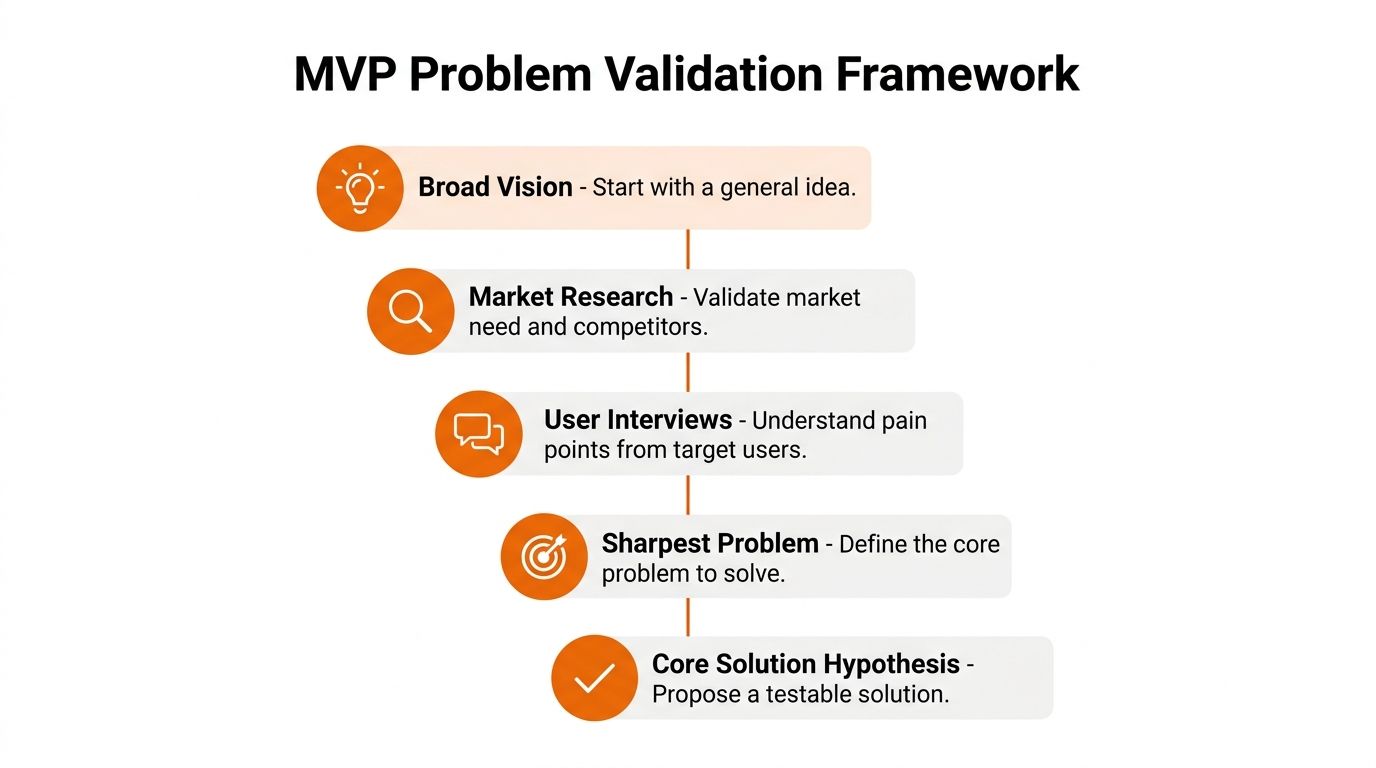
Discovery should move through five levels:
Broad vision
Start with the space you want to play in. Don't pretend this is the product yet.Market research
Look at competitors, substitute behaviours, and buyer habits. You're checking whether the problem already gets solved, ignored, or worked around badly.User interviews
Talk to target users about current behaviour, not opinions about your idea. Ask what they do today, what breaks, what they pay for, and what they've already tried.Sharpest problem
Pull the recurring pain into one sentence. If you can't state it clearly, you haven't earned the right to build.Core solution hypothesis
Define the smallest solution that could change the user's current behaviour.
Don't collect feedback. Collect decision-making evidence
A weak interview sounds like this: “Would you use an app that does X?” People will say yes to almost anything if it sounds useful.
A strong interview gets into friction, urgency, and existing workarounds. Ask:
- Recent behaviour: “When did this happen last?”
- Current workaround: “How are you solving it today?”
- Cost of the problem: “What does this delay, break, or waste?”
- Buying signal: “Have you paid for anything to address it?”
- Priority check: “Where does this sit against your other problems?”
That last point matters because interest is cheap. Priority is what drives adoption.
The point of discovery isn't to confirm your idea. It's to give your idea a chance to fail before your budget does.
Turn qualitative interviews into scope cuts
At a critical stage, many development groups lose their rigor. They acknowledge valuable input yet maintain their initial backlog. This behavior results in bloated MVPs.
In reality, 68% of UK startups that conduct discovery interviews end up cutting more than half their initial must-have features within 2 weeks of feedback, yet this ‘feature attrition rate' is rarely quantified in mainstream content (Square Root on the MVP build process).
That should change how you run the MVP development process.
Use a simple evidence filter after interviews:
| Input | What to ask | What to do |
|---|---|---|
| Repeated pain | Did multiple users describe the same problem in similar language? | Keep it in scope |
| Weak urgency | Did users call it nice-to-have or future interest? | Cut it |
| Existing workaround | Are users already hacking around the problem? | Prioritise solving that friction |
| No behaviour signal | Did nobody show action, budget, or urgency? | Remove it from MVP |
| Edge case request | Was it raised by one user in a niche scenario? | Push to post-MVP backlog |
Own the truth, even when it's inconvenient
Extreme Ownership in discovery means challenging your own favourite features. If interviews tell you users don't care, cut them. If a different pain point keeps showing up, pivot the scope.
Founders hate that moment because it feels like losing progress. It isn't. It's saving the build.
A sharp MVP starts when the idea gets smaller and stronger at the same time.
Architecting a Lean MVP That Delivers Value
Once the problem is clear, teams frequently immediately make the same mistake. They expand the solution. They turn one validated need into a platform, dashboard, workflow engine, admin panel, analytics suite, and settings page before they've proved anyone wants the core experience.
You need a lean architecture, not a wish list.
Pick one metric that matters
A disciplined MVP has a single success metric before build starts. Not five. Not a dashboard full of vanity numbers. One metric that tells you whether the business hypothesis is getting warmer or colder.
The right metric depends on the model:
- Activation if the question is whether users reach first value quickly
- Retention if the question is whether the problem is important enough to bring them back
- Revenue if the question is whether the market will pay now
- Qualified usage if the product has a longer commercial cycle
Investors don't fund code; they fund evidence. Investors and clients in the UK market now demand MVPs that demonstrate measurable business outcomes, specifically visible user activation, retention, and a clear monetisation path, rather than just technical features, with 40% of successful SaaS MVPs validated by 100+ real users before seed funding (Deployflow on SaaS MVP delivery).
Use MoSCoW like you mean it
Organizations often state they use MoSCoW. Very few do it properly. They label almost everything “must-have” because nobody wants to make hard calls.
Real MVP scoping is harsher:
- Must-have means the product fails without it
- Should-have means useful, but validation still works without it
- Could-have means not now
- Won't-have means intentionally excluded
If your must-have list needs a workshop to defend itself, it's too big.
Decision test: If removing a feature still lets you test the core hypothesis, remove it.
Match scope to actual delivery reality
In the UK for 2026, a standard MVP development project typically costs between £25,000 and £80,000 and takes 10 to 20 weeks, driven by a four-person senior team operating at about £8,000 per week in contractor rates, with total day-rate expenditure reaching £96,000 over a 12-week cycle before internal efficiencies reduce agency pricing into the £60,000 to £80,000 range (Red Eagle on UK MVP development costs).
That should force discipline. If your first version needs more time, more people, and more money than that kind of delivery envelope can sustain, it probably isn't an MVP.
For planning alternatives, additional UK data shows mid-complexity MVPs take 8 to 14 weeks and cost £30,000 to £70,000, while simple MVPs take 4 to 8 weeks and cost £5,000 to £10,000. The same source notes senior developer day rates ranging from £500 to £1,200 and milestone-based payment structures that usually require 30 to 40% upfront, 30 to 40% at mid-development, and 20 to 30% on delivery (Sigli on MVP services and pricing in the UK).
Key MVP metrics across the lifecycle
| Metric Category | Example Metric | Business Question It Answers |
|---|---|---|
| Acquisition | Sign-ups from a target segment | Are we attracting the right users? |
| Activation | User reaches first meaningful outcome | Do people get value quickly? |
| Engagement | Repeat usage of the core workflow | Is the product part of real behaviour? |
| Retention | Return usage over time | Is the problem painful enough to keep solving? |
| Monetisation | Trial-to-paid or first revenue event | Will the market pay for this? |
| Delivery | Time from backlog item to production | Is the team shipping predictably? |
If you want to tighten the planning side before development starts, these rapid prototyping techniques are useful for pressure-testing scope before engineers commit to build.
Assembling Your Nearshore Team for Speed and Ownership
The team model shapes the result more than most founders admit. A weak team can turn a good idea into a slow, expensive guessing exercise. A strong team will cut noise, expose risk early, and keep the MVP development process pointed at commercial outcomes.
That's why I prefer small, senior, product-minded squads over larger delivery setups built around handoffs.

What the right MVP team actually does
A good MVP squad doesn't just execute tickets. It translates business uncertainty into delivery decisions.
You want people who can do all of this without drama:
- Product leadership: clarify the hypothesis, challenge weak scope, define the success metric
- Design: reduce friction in the core user journey, not decorate secondary screens
- Engineering: choose practical architecture, ship fast, avoid rebuilding the world
- QA mindset: catch risk early and protect the learning loop
- Delivery ownership: surface blockers before they become delays
This is why nearshore can be a strategic advantage when it's done properly. The value isn't just cost. It's access to senior people who can work in your timezone rhythm, communicate directly, and take ownership beyond task completion.
Avoid the vendor trap
Hourly contracts often create the wrong behaviour. More changes mean more hours. More hours mean less incentive to challenge bad scope. That's how founders lose control of the build while still feeling busy.
The #riteway Methodology's emphasis on “Extreme Ownership” aligns with UK best practice requiring fixed-scope, accountable MVP proposals with a single success metric defined before build starts, avoiding hourly contracts that lead to uncontrolled scope expansion (Mantar on MVP development in the UK).
That's the operating model I'd recommend every time. Fixed scope. Clear objective. Accountable team. No hiding behind billable ambiguity.
Hire people who are willing to tell you what not to build. That's where the real savings are.
What to look for in a nearshore partner
Not all nearshore setups are equal. The strongest ones behave like an extension of your leadership team, not a remote labour pool.
Use these criteria:
- Commercial understanding: Can they talk about activation, retention, and monetisation, or only frameworks and velocity?
- Delivery sharpness: Do they propose a focused first release, or mirror your oversized backlog back to you?
- Communication style: Are they direct about risks and trade-offs?
- Cultural fit: Do they take initiative, or wait for permission?
- Team continuity: Will the people who scope it also help deliver it?
For founders comparing models, this breakdown of nearshore software delivery services gives a practical view of how to structure the partnership.
I'd also include one straightforward option in the market. Rite NRG provides nearshore software delivery with senior engineering teams, product-first consulting, and MVP-focused delivery for SaaS companies. That model is useful when you need strategic delivery support, not just extra hands.
Shipping Fast and Learning Faster
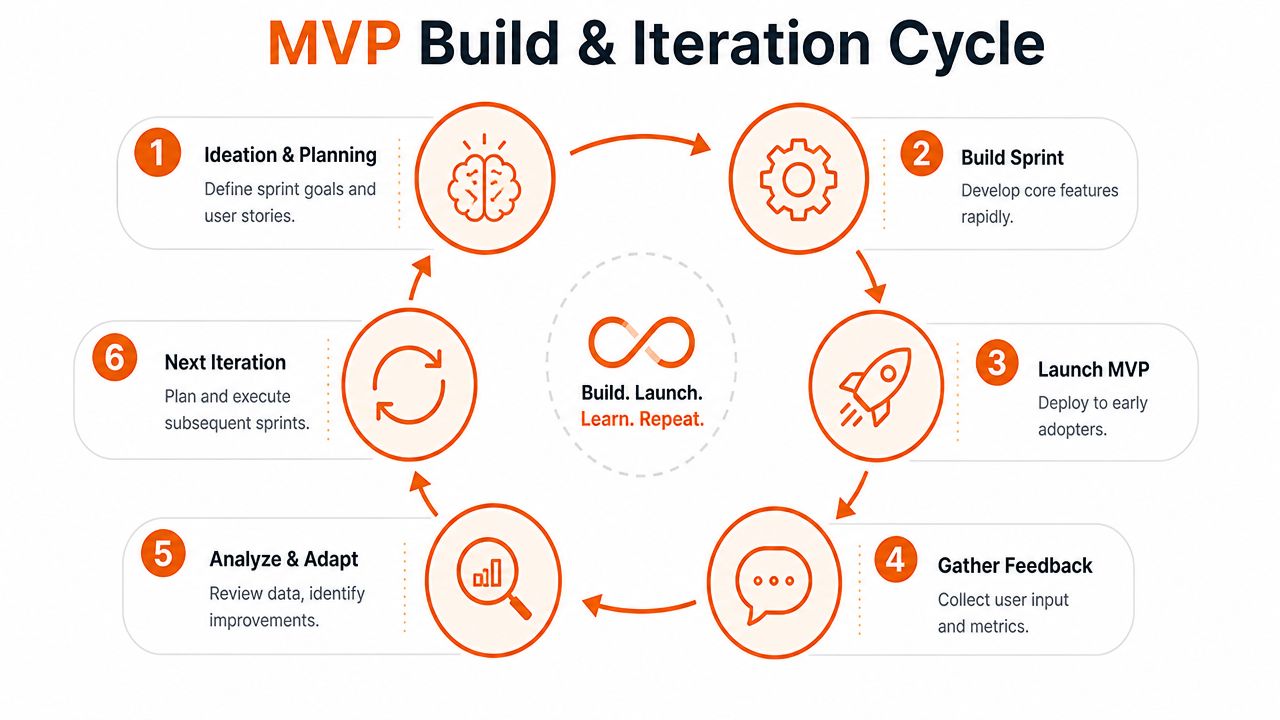
Build speed matters. Learning speed matters more. If your team ships quickly but can't tell you what changed in user behaviour, you've only accelerated uncertainty.
A strong MVP build runs in short loops. Define the sprint goal. Ship the smallest usable increment. Measure what users do. Adjust while the signal is still fresh.
Build the feedback loop into the product
Telemetry isn't a post-launch add-on. It belongs in the first sprint. If you care about activation, instrument the key actions that define activation. If retention matters, track return behaviour from day one.
That means your squad should release with:
- Event tracking on the core user journey
- Clear definitions for key actions and drop-off points
- QA coverage for the main conversion path
- Feedback capture inside or around the product
- Release visibility so everyone knows what changed and why
If security and release quality are part of your risk profile, it's worth reviewing how secure devops pipelines support faster, safer iteration without slowing down delivery.
Use accelerators, but stay outcome-led
Teams don't win points for writing boilerplate manually. They win by getting to usable learning faster.
With an energetic “can-do” attitude reflecting that the right team exceeds a skill list, UK MVP teams now deliver 60% of boilerplate code via low-code/no-code accelerators, achieving 8–16 week timelines and 15–25% cost savings without sacrificing quality (K Soft Technologies on SaaS MVP development in the UK).
That doesn't mean every MVP should be no-code. It means mature teams use accelerators where they remove waste. Authentication flows, admin panels, standard CRUD patterns, workflow scaffolding. Fine. Save your custom engineering effort for the part users will value.
This short video gives a useful perspective on keeping the loop tight in practice.
Launch small, then learn hard
A smart MVP launch is controlled. You don't need a big reveal. You need a clean environment for learning.
A practical launch sequence looks like this:
Private beta
Start with a narrow user group that closely matches the problem you validated.Observe behaviour
Watch where users complete the core task, hesitate, or abandon the flow.Run short feedback cycles
Combine usage data with direct conversations. Don't let either one dominate.Adapt backlog weekly
Promote what strengthens the core value. Kill what distracts from it.Prepare the next iteration
Every sprint should answer a business question, not just clear tickets.
That's how you keep momentum without losing discipline.
Your MVP Is the First Step Not the Last
An MVP isn't the finish line. It's the point where your idea finally meets reality.
Done properly, the MVP development process gives you something more valuable than software. It gives you evidence. Evidence about who cares, what they care about, where the friction sits, and whether the business has a credible path forward. That's what lowers risk. That's what sharpens strategy. That's what earns the right to build more.
What founders should carry forward
The strongest MVPs all follow the same logic:
- They validate a business outcome, not a feature list
- They cut scope harder than feels comfortable
- They use one clear success metric
- They rely on teams that own delivery, risk, and decision quality
- They launch to learn, not to celebrate
That's the #riteway lens. High energy. Clear accountability. No hiding behind process. The team owns the result, and the result has to mean something commercially.
Your first release should create clarity. If it doesn't, it was too big, too vague, or aimed at the wrong question.
The next move is simple
Stop trying to perfect the idea in isolation. Put the smallest credible version into the hands of the right users. Instrument it properly. Watch behaviour. Cut fast. Double down where the signal is strong.
That's how SaaS products get traction without burning months on assumptions.
If you need a partner that can challenge scope, define the right success metric, and help you ship an outcome-focused MVP with real delivery ownership, talk to Rite NRG.