
You're probably here because the situation is already uncomfortable.
You need to hire a web developer, product work is piling up, release pressure is rising, and every path looks risky. Hire too slowly and roadmap promises slip. Hire the wrong person and your team spends months cleaning up architecture, missed edge cases, and vague communication. Hire purely on cost and you usually buy delay.
I'll be direct. Hiring a web developer isn't an HR task first. It's a delivery decision. If you treat it like a job ad and a stack of CVs, you'll optimise for activity. If you treat it like a business-critical delivery move, you'll optimise for speed, quality, ownership, and commercial outcomes.
That's the difference behind the #riteway mindset. Extreme Ownership. High energy. Clear accountability. You're not looking for someone to “help with code”. You're looking for someone who can move the product forward without creating drag around them.
Define the Mission Not Just the Role
Most founders start in the wrong place. They write “need a React developer” or “need full-stack support” and assume the rest will sort itself out.
It won't.
A technology label describes a toolset. It doesn't define the result you need. If you want to hire a web developer who improves delivery, start with the mission. What must change in the business because this person joined?
Start with the business problem
Your developer hire should connect to one of a few real outcomes:
- Ship an MVP faster: You need a builder who can work across UI, API, deployment, and product ambiguity.
- Stabilise a shaky platform: You need someone who can reduce defects, tighten architecture, and improve release confidence.
- Increase product throughput: You need a developer who can remove bottlenecks, not add another dependency chain.
- Support growth after launch: You need continuity, documentation, and someone who won't disappear when the first version goes live.
That framing changes everything. The brief becomes sharper. Interviews improve. The shortlist gets better because you stop attracting people who only want to close tickets.
Write a scorecard, not a shopping list
A weak brief looks like this:
- React
- Node
- TypeScript
- AWS
- 5+ years
- startup experience
That's not a hiring strategy. That's keyword collecting.
A better scorecard has four parts:
| Area | What to define |
|---|---|
| Outcome | The business result this hire must contribute to |
| Scope | What they own directly in the first months |
| Constraints | Time, budget, legacy systems, team size, compliance, handover needs |
| Signals | What evidence proves they can deliver in your environment |
For example, instead of “hire a front-end developer”, define something closer to this:
Mission: Improve onboarding flow quality and help the team ship the next product release with fewer handoff delays.
Now you can evaluate real fit. Can they work from rough product requirements? Can they challenge a poor UX assumption? Can they coordinate with product and back-end people without waiting to be told what to do?
Decide what ownership looks like
A common source of hiring mistakes is that founders say they want senior people, but they screen mainly for syntax knowledge.
A senior web developer should do more than code. They should:
- Clarify ambiguity early instead of proceeding to build the wrong thing.
- Raise delivery risks before they become deadline problems.
- Document decisions so knowledge doesn't vanish into Slack threads.
- Think commercially and understand why a feature matters.
Practical rule: If your brief can't explain what success looks like after the hire lands, you're not ready to hire yet.
The #riteway starts with accountability before recruitment. Define the mission, define the decisions this person must own, and define the behaviours that protect delivery. Then hire against that. Everything else gets easier.
Find Smart Talent Beyond Job Boards
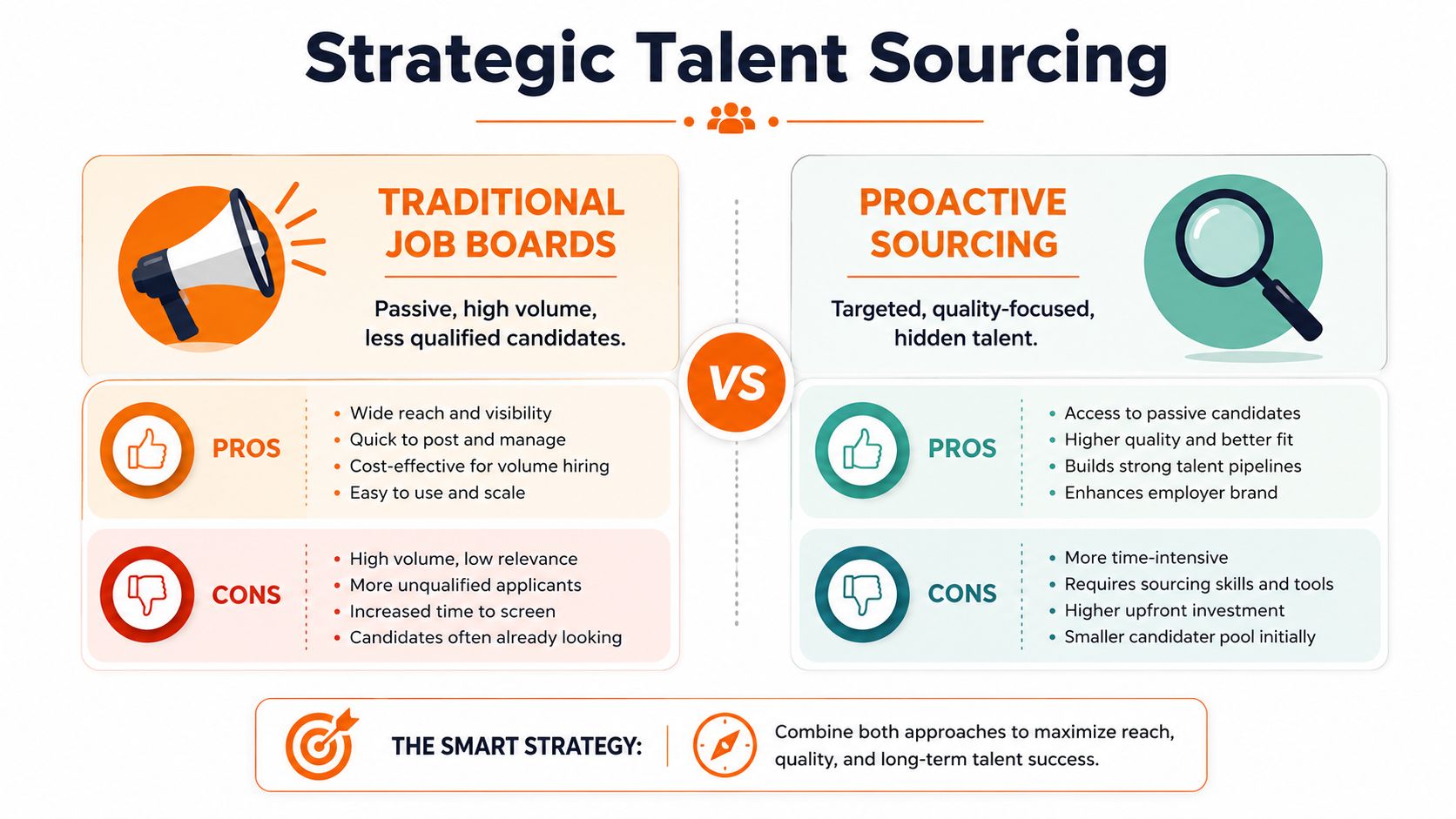
If you rely only on job boards, you'll get volume. You won't necessarily get momentum.
That matters in the UK because technical hiring is happening inside a constrained market. The Office for National Statistics reports 1.73 million ICT specialists in 2024 and 166,000 vacancies in ICT occupations across the UK, which signals sustained competition for technical talent rather than a one-off spike, especially for teams trying to move quickly on product work, as outlined in this UK web developer hiring market guide.
Compare the hiring model before the sourcing channel
Most founders ask, “Where do I find a developer?”
The stronger question is, “What hiring model gives me the most reliable delivery?”
Here's the key trade-off:
| Model | Where it works | Where it breaks |
|---|---|---|
| In-house hire | Strong for long-term internal capability and culture building | Slow recruitment, high overhead, heavy management load |
| Freelancer | Useful for contained tasks or short-term specialist input | Risky when product continuity, support, or shared knowledge matter |
| Agency | Can work for defined projects with clear boundaries | Often creates a black box between your product decisions and their execution |
| Dedicated team | Strong when you need continuity, control, and predictable delivery | Requires a partner with real integration discipline |
A lot of founders choose a freelancer because it feels fast and cheap. Then the product launches, change requests arrive, bugs appear, and no one owns the bigger system. If you're weighing that route, this breakdown of freelancer hiring trade-offs is worth reviewing before you commit.
Why proactive sourcing wins
Job boards are passive. You post, wait, and filter noise.
Proactive sourcing flips that. You define the mission, target the profile, and engage people who match the level of ownership you need. That's how you find candidates who aren't spending all day applying. They're busy delivering.
This is also why many SaaS teams use nearshore hiring as a strategic shortcut to launch faster. Not because geography is trendy, but because access, continuity, and speed matter more than postcode loyalty when the roadmap is under pressure.
Cheap access to labour isn't the goal. Reliable access to accountable delivery is.
My recommendation for SaaS teams
If you need one person for a tightly scoped task, use a freelancer with a narrow brief.
If you need product continuity, release rhythm, collaboration with product stakeholders, and support after launch, move past transactional hiring. A dedicated nearshore team is usually the more sensible operating model because it gives you continuity without forcing you to build an entire hiring, compliance, and operational machine yourself.
This is one place where Rite NRG is a practical option. It provides dedicated teams, platform development, consulting, and Build-Operate-Transfer support for SaaS companies that need senior engineering capacity integrated into their workflows rather than isolated outsourced execution.
Don't default to the channel that feels familiar. Pick the model that protects delivery.
Interview for Ownership and Impact
A polished CV can hide a passive operator.
You don't hire a web developer to recite framework trivia. You hire them to make decisions under uncertainty, communicate clearly, and move work forward when requirements are incomplete. That's what interviews should test.

Ask questions from real delivery pressure
Drop the puzzle-first interview process. It overweights performance theatre and underweights execution.
Instead, ask questions that expose how the candidate thinks when things get messy:
- Ambiguous brief: “You receive a ticket with missing acceptance criteria and a deadline. What do you do in the first hour?”
- Risk handling: “Tell me about a time you realised a requested solution would create future problems. How did you handle it?”
- Cross-functional judgement: “When product, design, and engineering disagree, how do you push the work forward?”
- Quality ownership: “What do you check before saying a feature is ready for release?”
- Handover discipline: “How do you make sure another developer can safely work on what you built?”
These questions surface behaviour, not rehearsed theory.
Score ownership, not charm
A good interview needs a scorecard. Otherwise the loudest candidate wins.
Use a simple rubric across these areas:
| Capability | What good looks like |
|---|---|
| Ownership | Takes responsibility for outcomes, not just assigned tasks |
| Communication | Explains trade-offs clearly and raises issues early |
| Judgement | Knows when to simplify, when to escalate, and when to challenge |
| Collaboration | Works well with product, design, QA, and business stakeholders |
| Execution | Ships work with structure, testing discipline, and documentation |
If you want more detail on building a stronger team around this principle, this guide on how to hire a dedicated developer adds useful context on fit beyond raw technical skill.
The strongest candidate usually asks better questions, spots hidden risk, and gives you a clearer plan than weaker candidates do.
Test for AI-era delivery maturity
This is now part of the job. A developer who ignores AI-assisted workflows is missing a real part of modern delivery.
Current hiring guidance makes the point well: in an AI-augmented environment, the question isn't just whether someone can code. It's whether they can use AI to ship faster, document clearly, and proactively manage risks without creating rework, as discussed in this AI-era hiring perspective for web developers.
That doesn't mean you should hire someone because they name-drop tools. It means you should probe how they work:
- Ask for a real example of using AI in implementation, debugging, or documentation.
- Ask where they don't trust it and how they validate output.
- Ask how they prevent AI-generated shortcuts from damaging maintainability.
- Ask how they communicate uncertainty when using accelerated workflows.
The right answer isn't “I use AI for everything”. The right answer shows speed plus judgement.
Validate Delivery with a Paid Test Project
A portfolio shows what someone wants you to see. A paid test shows how they work when the brief is yours.
That's why I treat the paid test as indispensable. After the initial interview stages, use a small paid test project. Expert hiring guidance recommends exactly that sequence: define requirements first, review similar work, then use a paid trial based on real project tasks, and only after that lock scope, deliverables, and timelines into the contract, as explained in this web developer hiring workflow guide.
What the test should look like
Keep it small. Keep it real. Keep it paid.
A good test project mirrors the kind of work the developer would do in your team. Examples include:
- A feature slice from your product with a clear boundary
- A bug-fix and improvement task on an existing code sample
- A front-end implementation from a design file with realistic edge cases
- A back-end endpoint task with validation and documentation expectations
Don't ask for generic coding puzzles if your real work involves product ambiguity, cross-functional decisions, and release discipline.
What you're actually evaluating
The output matters, but the process matters more.
Watch for these signals:
- Question quality: Do they clarify assumptions early?
- Scope control: Do they avoid overengineering?
- Communication: Do they explain trade-offs and blockers?
- Code judgement: Is the solution maintainable, not just functional?
- Documentation: Can someone else pick up their work without a detective story?
Pay for signal. Don't ask candidates to do free production work and call it assessment.
How the #riteway uses test projects
The reason this works is simple. Ownership shows up fast when someone handles real constraints.
A weak candidate rushes to code, fills gaps with assumptions, and leaves you to interpret the result. A strong candidate narrows risk, asks sharp questions, communicates as they go, and hands over something another engineer could extend safely.
That's what predicts delivery. Not a polished CV. Not confidence on a call. Not a GitHub profile with no context.
Calculate the True Cost of Your Developer
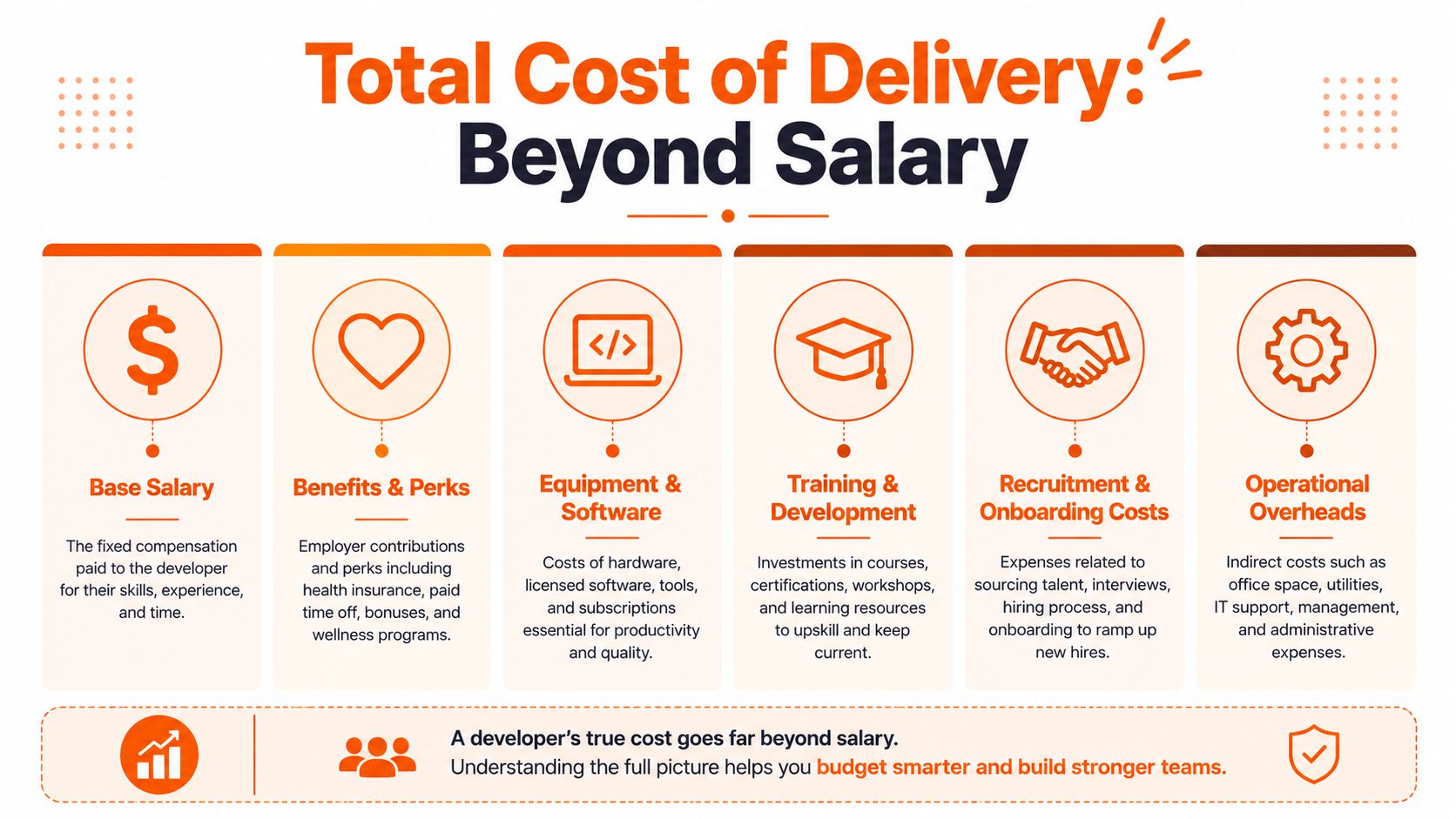
Most founder spreadsheets lie because they stop at salary.
That's not cost. That's one line item.
In the UK, the National Careers Service salary range for web developers is cited as £25,000 to £50,000, with more experienced developers earning up to £70,000 or more, depending on skills, location, and employer type. The important point is that this base pay sits inside a broader cost picture that includes recruitment, benefits, and management overhead, as outlined in this UK web developer salary and hiring cost overview.
The salary number is the easy part
Founders usually compare options like this:
- Employee salary
- Contractor day rate
- Agency quote
- Dedicated team monthly cost
That comparison misses the operational burden attached to each model.
The cost of hiring a web developer often includes:
- Recruitment effort: writing briefs, screening CVs, interviews, follow-ups
- Employer obligations: benefits, payroll administration, compliance
- Equipment and tooling: laptop, licences, access management
- Onboarding time: your senior team spending energy on setup and context transfer
- Delivery drag: slower progress while the new person gets productive
- Management overhead: planning, reviews, and coordination load
If you're trying to understand how expensive the wrong decision can become, this piece on understanding bad hire expenses is a useful complement to the salary discussion.
Compare by total cost of delivery
A cleaner way to evaluate options is this table:
| Question | In-house | Freelancer | Agency | Dedicated team |
|---|---|---|---|---|
| Who owns recruitment? | You | You | Agency | Partner |
| Who carries continuity risk? | You | Mostly you | Shared, often unclear | Shared in a structured way |
| Who manages team integration? | You | You | Mixed | Shared |
| How predictable is monthly cost? | Medium | Low to medium | Medium | High |
| How much knowledge stays with the product? | High if retained | Often fragile | Variable | High if integrated well |
If you're comparing nearshore arrangements specifically, this breakdown of nearshore vs offshore software delivery models helps frame the operational differences more clearly.
My blunt advice
Don't optimise for the cheapest visible number.
Optimise for the hiring model that gives you the most predictable output with the least avoidable management friction. If a lower-cost option forces you to rebuild context, chase updates, or replace missing ownership later, it wasn't cheaper. It was deferred cost with extra pain attached.
Onboard for Velocity and Integration
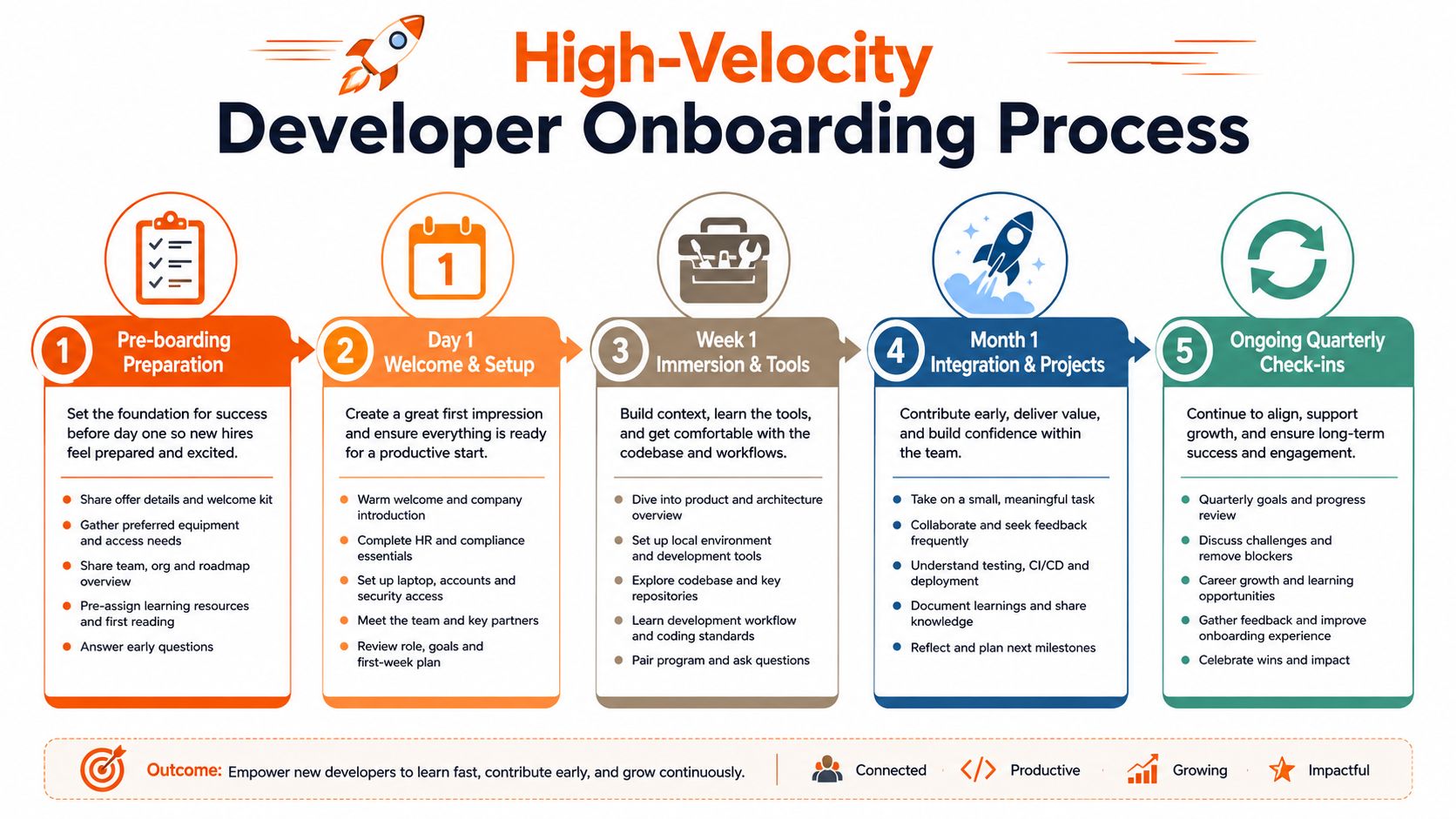
A good hire can still fail if your onboarding is chaotic.
Many companies sabotage themselves. They spend weeks hiring, finally get someone in, then leave them waiting for access, missing product context, and guessing what “done” means. That's not onboarding. That's waste.
Set the first week up before day one
The first days should feel organised, not improvised.
Before the developer starts, prepare:
- Access and tools: repositories, project boards, communication channels, design files, staging environment
- Product context: user problem, current roadmap, known technical constraints, priorities
- Delivery expectations: communication cadence, ownership boundaries, review process, definition of done
- Key people: who owns product decisions, who reviews code, who unblocks environment issues
If those basics aren't ready, your new hire spends energy on logistics instead of delivery.
Give them a real first win
The first task matters. Don't dump a giant legacy rebuild on them. Don't give them meaningless admin work either.
Pick something small but real:
| First-task type | Why it works |
|---|---|
| Contained bug with customer impact | Teaches product context and release flow |
| Small feature improvement | Shows how design, product, and engineering interact |
| Documentation cleanup plus code change | Tests clarity and system understanding |
| Observability or testing improvement | Builds confidence in safe delivery |
A well-run kickoff helps a lot here. If you want a practical agenda, Orsane's project kickoff guide is a good template for aligning stakeholders without wasting the first meeting.
Here's a useful walkthrough to support stronger team onboarding and collaboration:
Build integration, not just access
A productive developer needs more than credentials. They need rhythm.
Use simple operating habits:
- Daily contact early on: short check-ins to remove blockers quickly.
- Visible work tracking: no hidden tasks, no mystery status.
- Fast feedback loops: review quickly and explain decisions.
- Clear escalation paths: the developer should know exactly where to take risk, ambiguity, or stakeholder conflict.
Onboarding succeeds when the developer understands the mission, the product, the people, and the pace.
If you do this well, new hires contribute sooner and your existing team doesn't burn time compensating for confusion.
Your Partner in Predictable Delivery
If you came here wanting to hire a web developer, the bigger truth is this. You don't want a developer.
You want progress. You want product momentum. You want releases to happen without drama. You want your roadmap to move because the people building it take ownership of outcomes, not just tickets.
That's the standard I'd hold.
What strong hiring really changes
When you hire well, a few things start happening fast:
- product decisions become easier to execute
- your team spends less time translating and re-explaining
- risk gets surfaced earlier
- releases become more predictable
- knowledge stays inside the delivery system
That's why the #riteway matters. Extreme Ownership isn't a slogan. It's an operating expectation. The developer, team, or partner you bring in should behave like someone responsible for the result, not someone renting out effort by the hour.
The bar should be higher
Don't settle for someone who can follow instructions. That's too low a bar for SaaS delivery.
You need people who can challenge vague requirements, protect delivery quality, communicate risk clearly, and keep moving when the roadmap gets messy. That's what turns hiring from a cost centre into a competitive advantage.
The right hire doesn't reduce your workload only by coding. They reduce it by thinking, clarifying, structuring, and owning.
My final recommendation
If the work is narrow and temporary, hire narrowly.
If the work touches your product core, roadmap speed, customer experience, and post-launch continuity, hire for ownership and delivery structure. That may mean an employee. It may mean a dedicated team. It may mean a delivery partner. The right answer is the one that gives you control, continuity, and predictable execution.
Choose the model that helps you ship.
If you want a team that treats hiring as a delivery strategy rather than a resourcing task, talk to Rite NRG. They help SaaS companies build and scale senior engineering teams with product-first thinking, transparent collaboration, and AI-powered processes, so you can move faster without losing control.