Your backlog is moving. Your release train isn't. Features get built, but revenue impact stays fuzzy. Deadlines slip because decisions sit in Slack threads, QA becomes a bottleneck, and your current partner keeps telling you what happened instead of what they're doing next.
That isn't a technology problem. It's an ownership problem.
If you're buying software development services in the UK, you're operating in a serious market. The UK information and communication sector contributed about £186 billion in gross value added in 2023, and London accounted for 59% of all UK tech investment value in 2024, according to Mordor Intelligence's UK software development market analysis. In a market like that, slow delivery gets punished. Passive partners get exposed fast.
Is Your Tech Partner a Roadblock or a Rocket Ship?
A weak partner waits for tickets. A strong partner drives outcomes.
You know the roadblock pattern. The team says they're “on track” until the week the milestone misses. Engineers raise risks late. Product assumptions go unchallenged. Nobody owns release readiness across design, architecture, testing, and deployment. You're left stitching the whole thing together yourself.
That setup fails because the commercial goal and the delivery engine are disconnected.
What bad partnership looks like
Most delivery issues start long before a bug appears in production. They start when a partner behaves like rented hands instead of a delivery owner.
Common signs:
- Reactive communication means you hear about blockers after they've already damaged the plan.
- Feature-first thinking means the team measures success by shipped tickets, not adoption, retention, or launch readiness.
- Narrow accountability means design blames engineering, engineering blames QA, and everyone blames requirements.
- No challenge function means bad ideas get built quickly instead of corrected early.
Practical rule: If your partner never pushes back, they're not protecting your product. They're protecting their timesheet.
What a rocket ship partner does differently
The right partner doesn't just write code. They spot delivery risk early, force clarity into vague requirements, and make the uncomfortable calls before delays turn into budget damage.
That's the standard behind the #riteway mindset. Extreme Ownership isn't a slogan. It's how software development services should operate when the work matters. The team owns throughput, quality, communication, escalation, and commercial context. If something drifts, they bring a fix. Fast.
For a SaaS founder, that changes everything:
- You get fewer surprises.
- You make better trade-offs.
- You launch with more confidence.
- Your internal team spends less time managing the vendor and more time steering the business.
A partner should feel like force multiplication. If they feel like another layer to manage, they're slowing you down.
Beyond Code What Software Development Services Actually Mean
Most founders buy software development services as if they're buying coding hours. That's the wrong frame.
You're not buying output. You're buying the capability to move from idea to validated product, from fragile stack to scalable platform, from release chaos to predictable delivery. If your provider can't connect technical choices to business outcomes, they're not offering a full service. They're offering labour.
The service stack that actually matters
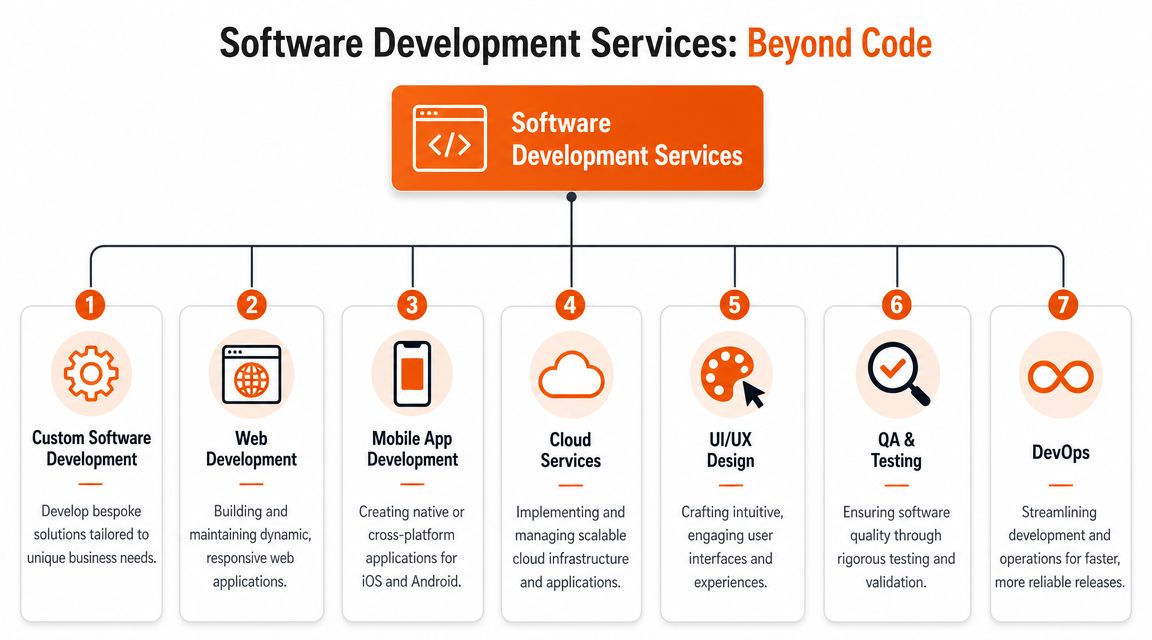
A serious delivery partner combines several disciplines into one operating system.
- Product and discovery work turns fuzzy founder ideas into priorities, acceptance criteria, and a release path.
- UI and UX design reduces friction before engineering bakes the wrong assumptions into the product.
- Engineering builds the application, but senior engineers also shape architecture, data flow, and maintainability.
- QA and testing protect release confidence through automation and structured validation.
- DevOps and platform work make shipping repeatable, observable, and safe.
- Technical leadership keeps trade-offs aligned with commercial reality.
If one of those layers is missing, you usually pay for it later in rework.
Why cloud capability now matters more than generalist coding
The market has already moved. The global software development market is projected to grow from USD 0.57 trillion in 2025 to USD 1.11 trillion by 2031, with cloud deployment as the dominant model, according to Techreviewer's analysis of software development market trends. That's why generic build teams struggle. Buyers need partners who can design for cloud-native delivery, not just produce bespoke code.
That shows up in practical decisions:
| Service area | Business outcome it should drive |
|---|---|
| Product discovery | Faster validation and fewer wasted builds |
| Architecture | Scale without repeated rewrites |
| QA automation | Safer releases and less regression pain |
| DevOps | Shorter path from commit to production |
| UX design | Better onboarding and lower user friction |
If your current provider treats DevOps as an afterthought, fix that. Strong release engineering is a business function. If you want a useful outside perspective on that shift, CloudCops DevOps consulting gives a good overview of how delivery improves when infrastructure, automation, and release discipline are designed together.
Good software development services shorten the distance between a business decision and a production outcome.
What to ask for instead of “developers”
Ask for a delivery system.
Ask who owns architecture. Ask how testing is automated. Ask what happens when scope changes. Ask how the team handles release readiness, incident response, backlog shaping, and technical debt. That's how you find out whether you're buying code or buying momentum.
Choosing Your Engagement Model for Maximum Impact
The wrong engagement model creates drag even if the engineers are good. The right one gives you speed, control, and a cleaner path to business value.
You don't need every model. You need the one that matches your current constraint.
Engagement Model Decision Matrix
| Model | Best For | Control Level | Speed to Start |
|---|---|---|---|
| Dedicated Team | Extending an existing product or platform team | High | Fast |
| End-to-End Platform Development | Building a new product, MVP, or major rebuild | Medium | Medium |
| Strategic Consulting | Solving architecture, delivery, or scaling problems | High | Fast |
| Build-Operate-Transfer | Creating a long-term captive delivery function | Very high | Slower |
Dedicated Team works when you need capacity without losing ownership
If you already have product leadership, a roadmap, and internal standards, a dedicated team is usually the cleanest option. You plug senior engineers, QA, DevOps, or product support into your workflow and keep decision-making close to home.
This model is ideal when:
- Your roadmap is clear but your hiring pipeline can't keep up.
- You need specialised capability in areas like cloud migration, platform engineering, or frontend rebuilds.
- You want continuity without handing off the entire product.
A lot of founders confuse this with simple staff augmentation. The key difference is operating maturity. A good partner supplies people who integrate into delivery, not passengers who wait for instructions. If you're weighing that distinction, this breakdown of staff augmentation definition is useful.
End-to-end platform development fits when speed matters more than internal management
If you're launching a product, rebuilding a legacy platform, or trying to hit a market window with limited internal bandwidth, this model makes sense. One partner owns design, engineering, QA, DevOps, and delivery management.
The upside is coherence. The trade-off is that you need tight governance and a partner you trust to challenge assumptions.
Use it when:
- You need an MVP built with commercial urgency.
- Your internal team is lean or non-technical.
- You want one accountable owner across the delivery stream.
The fastest projects aren't the ones with the most developers. They're the ones with the fewest handoff failures.
Strategic consulting is for high-cost uncertainty
Sometimes the smartest spend isn't more build capacity. It's better decisions.
If your team is stuck on scaling problems, release issues, cloud architecture, engineering process, or vendor transition, strategic consulting can facilitate progress quickly. You bring in senior people to assess, redesign, and de-risk before you commit to a bigger build.
This is also where process tooling matters. If you're tightening governance across planning, development, testing, and release, this guide to application lifecycle management software is a practical reference point.
Build-Operate-Transfer is the long game
BOT works when you want your own delivery centre without doing every part of setup yourself. A partner builds the team, runs operations, handles early execution, then transfers the capability to you once it's stable.
This model suits businesses that want strategic control over time but need speed and operational support upfront. It's heavier than the others, but for the right company it creates a durable asset instead of a long-term dependency.
Choose the model that removes your current bottleneck. Not the one that sounds most impressive in a board slide.
The Nearshore Advantage Why Poland Delivers Predictability
UK firms don't struggle because demand is weak. They struggle because senior delivery capacity is hard to secure and harder to retain. That's why nearshore software development services have moved from optional to strategic.
The UK had 55,000 unfilled ICT vacancies in 2024, according to the ONS figure cited in Blackthorn Vision's overview of software development service models. If you're trying to hire senior backend engineers, DevOps specialists, or platform people locally, you already feel that shortage. It slows hiring, inflates risk, and pushes product plans into compromise mode.
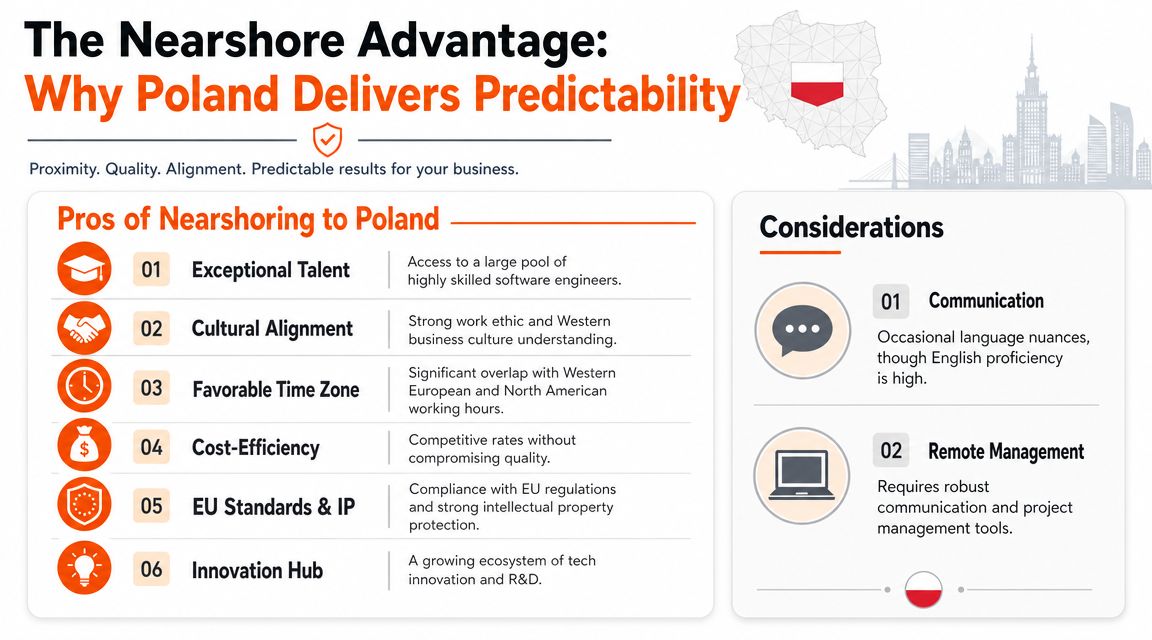
Why Poland solves a delivery problem, not just a hiring problem
The true win isn't cheaper labour. It's predictability.
Nearshore teams in Poland usually fit UK delivery rhythms better than far-off offshore models. Working hours overlap. Agile ceremonies don't need awkward scheduling. Product managers, designers, and engineers can resolve blockers in the same business day. That matters when you're trying to keep momentum through fast release cycles.
Use nearshore when you need:
- Senior talent access without waiting on a slow domestic hiring market
- Better collaboration across product, engineering, and QA
- Fewer communication gaps during planning, refinement, and release
- Delivery resilience when internal recruitment stalls
If you're exploring the operating model in more depth, this guide to nearshore service delivery breaks down what strong nearshore collaboration should look like in practice.
Why Poland fits high-ownership delivery
Poland works well for SaaS teams because the strongest engineers there don't just execute tasks. They engage with product logic, architecture, release quality, and long-term maintainability. That's the difference between adding capacity and improving overall effectiveness.
Here's a closer look at the model in action:
The strongest nearshore partnerships also integrate cleanly into modern engineering patterns. Cross-functional squads, clear API boundaries, test automation, and strong CI/CD practices matter even more when talent is distributed. When those pieces are in place, nearshore stops feeling “remote” and starts feeling like an extension of your core product function.
Nearshoring works when the team shares ownership, not just a calendar.
If you're still viewing Poland as a compromise, you're using an outdated lens. For many UK SaaS companies, it's the more reliable route to senior talent and consistent delivery.
Mitigate Risk with Proactive Partnership and AI
Most software risk isn't dramatic. It's cumulative.
A missed clarification in discovery becomes a wrong build. A weak test strategy becomes release hesitation. A security review left until the end becomes rework, delay, and executive frustration. That's why proactive partnership matters more than polished status reports.
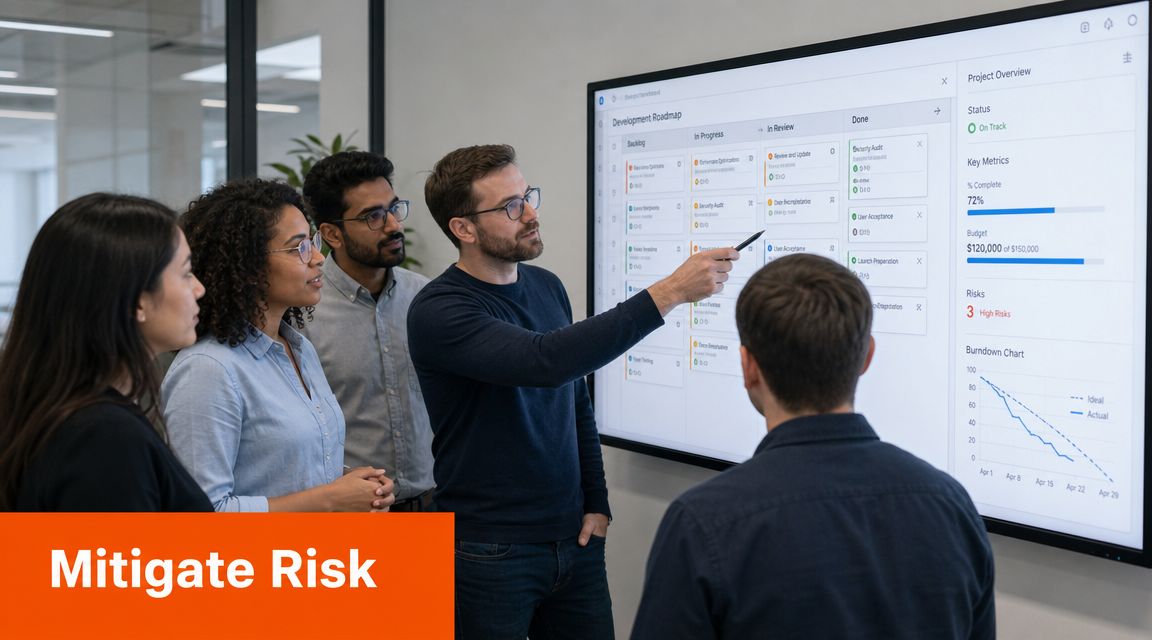
Risk drops when ownership starts early
In the UK, compliance is not optional. Under the UK GDPR regime and the UK Data Protection Act 2018, teams handling personal data need privacy-by-design controls such as data minimisation, role-based access control, audit logging, and documented retention and deletion policies. The NCSC also recommends secure development practices including dependency management, secure build pipelines, vulnerability scanning, and rapid patching. AltexSoft's discussion of software delivery documentation and process discipline captures why those concerns have to be embedded from the start.
That has a direct implication. Security and compliance shouldn't sit at the end of the plan. They should shape architecture, user roles, environments, testing, and release workflows from day one.
Where AI actually helps delivery
AI is useful when it sharpens execution, not when it replaces judgement.
Used properly, AI can help teams surface ambiguous requirements, speed up test creation, improve documentation quality, flag anomalies in delivery data, and reduce repetitive coordination work. That makes senior people more effective. It doesn't remove the need for them.
Good use cases include:
- Backlog refinement support that exposes gaps before stories enter build
- Test acceleration that strengthens regression coverage
- Operational monitoring that highlights delivery drift early
- Documentation assistance that keeps decisions visible across the team
If you want a grounded view of secure automation in the pipeline, this guide to CI/CD security automation is worth reviewing.
The operating model matters more than the toolset
AI won't rescue a passive team. It amplifies whatever operating discipline already exists.
That's why I favour partners who use AI inside a clear ownership model. For example, Rite NRG applies AI across delivery workflows, testing support, and operations while keeping human oversight close to architecture, product judgement, and release decisions. That's the right balance. If you want to see how that model works in more depth, their piece on AI-driven software development and testing is relevant.
The safest delivery teams don't avoid hard conversations. They force them early, while change is still cheap.
The Right Partner Checklist Questions for Your RFP
Most RFPs are too shallow. They ask about frameworks, rates, and capacity. Then leaders act surprised when the selected vendor misses context, under-communicates, and ships features that don't move the business.
Ask sharper questions.
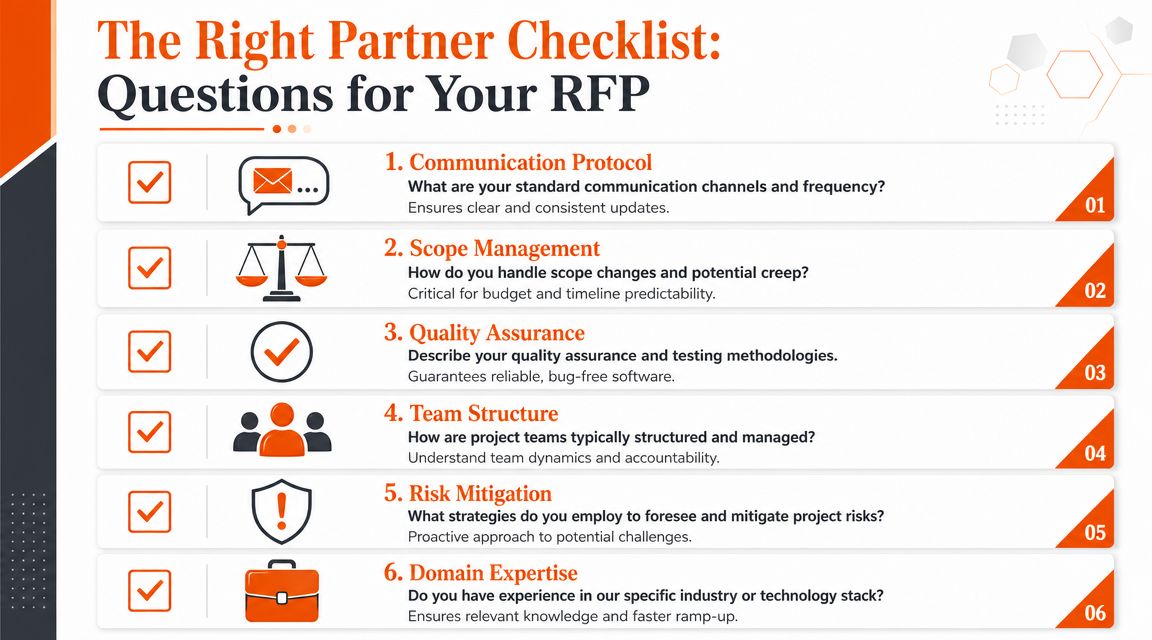
Questions that reveal ownership
Use questions that force the partner to show how they think, not just what tools they know.
How do you handle a milestone that's slipping right now?
You want specifics on escalation, replanning, stakeholder communication, and trade-off management.How do you challenge product assumptions before development starts?
Good partners don't blindly convert tickets into code. They test logic, edge cases, and delivery risk early.What does your release process look like from code complete to production?
This exposes whether they understand QA, DevOps, rollback planning, and operational readiness.How do you keep business goals visible to engineers?
If they can't answer this, expect disconnected execution.
Questions that expose delivery maturity
The next group tells you whether the partner can run complex work.
| RFP question | What you're really testing |
|---|---|
| How do you manage scope change? | Commercial control and planning discipline |
| How is the team structured? | Accountability across product, engineering, QA, and DevOps |
| What risks do you watch early? | Proactive thinking and experience |
| How do you onboard into an existing platform? | Adaptability and technical due diligence |
What strong answers sound like
Strong partners talk about actions. Weak partners talk about intentions.
Look for answers that mention things like discovery workshops, architecture review, automated testing, API contracts, incident response, decision logs, release checklists, and explicit ownership. That language signals lived delivery experience.
Avoid partners who hide behind vague promises such as “we adapt”, “we're flexible”, or “we can work your way”. Flexibility matters. But without a clear operating model, flexibility turns into drift.
A good RFP should help you find a team that takes responsibility before you ask. That's the standard.
Your Next Move for High-Energy Delivery
If your current partner needs managing at every step, replace the model. You don't need more status meetings. You need software development services built around ownership, speed, and commercial clarity.
The strongest partnerships share a few traits. They understand your product goal, not just your backlog. They bring structure across design, engineering, QA, DevOps, and release. They use nearshore access and AI support to improve throughput without weakening judgement. Above all, they act before problems harden into delays.
What to do next
Don't start with a beauty parade of vendors. Start with your bottleneck.
- If hiring is your problem, look for a dedicated nearshore team with senior capability.
- If delivery coherence is your problem, choose an end-to-end partner who can own the stack and the release path.
- If risk and uncertainty are the problem, bring in senior consulting before you commit to a bigger build.
- If long-term control matters most, explore a BOT model and build durable capability.
The standard to hold
Set a higher bar in every partner conversation:
- They must understand the business outcome
- They must own delivery risk early
- They must communicate with clarity
- They must improve your operating cadence, not just add hands
That's what the #riteway comes down to. High energy. Clear accountability. No hiding behind process. No shrugging at blockers. No passive execution.
You're not buying code. You're choosing the team that will either accelerate your business or slow it down.
If you're ready for a delivery partner that treats your roadmap like a business commitment, talk to Rite NRG. Bring the product challenge, the hiring constraint, or the delivery mess. The right team should help you solve it, not just estimate it.