
Your product is live. Customers are buying. The roadmap is full. Yet every release feels slower than the last.
A small pricing change touches three services. A simple dashboard update triggers a bug in billing. Your strongest engineers spend their week untangling side effects instead of shipping the next thing that matters. From the outside, it looks like an execution problem. Usually, it isn't.
It's a codebase problem. More specifically, it's a structural problem inside the codebase. That's where code refactoring stops being a developer clean-up task and starts becoming a business decision.
The Hidden Anchor Slowing Down Your SaaS Growth
A founder I often picture in this situation has already done the hard part. They found traction. The MVP worked. Customers asked for more. The team moved fast, made trade-offs, and got the product into market.
Then growth exposed the bill for that speed.
Features that once took days now take weeks. Engineers hesitate before touching core workflows. New joiners need far too long to become effective because nobody can quickly explain how the system really works. Product starts hearing “it's more complex than it looks” on every planning call.
Fast MVPs create predictable mess
That's normal. Early-stage software is built for learning, not elegance. You optimise for speed, clarity of demand, and customer feedback. You should.
But if you keep layering on top of rushed foundations, the codebase becomes an anchor. It drags on every sprint. It raises the cost of every decision. It slows delivery at exactly the point when the business needs more speed, not less.
If you want a broader executive view of how this drag accumulates, this guide for data and AI leaders frames technical debt in a way non-technical leaders can use.
Practical rule: If your team is afraid to change code they wrote six months ago, the problem isn't effort. It's structure.
Refactoring is how you release the anchor
So, what is code refactoring in business terms?
It's the disciplined work of improving the internal design of your software so your team can change it faster, safer, and more predictably. You're not paying for code to look prettier. You're investing in delivery capacity.
That matters because software value isn't just what the product does today. It's how quickly and safely your team can evolve it tomorrow.
A codebase that resists change hurts speed, cost, and quality at the same time. A codebase that supports change becomes a growth asset. Refactoring is how leaders make that shift on purpose instead of waiting for a crisis to force it.
Defining Code Refactoring Without The Jargon
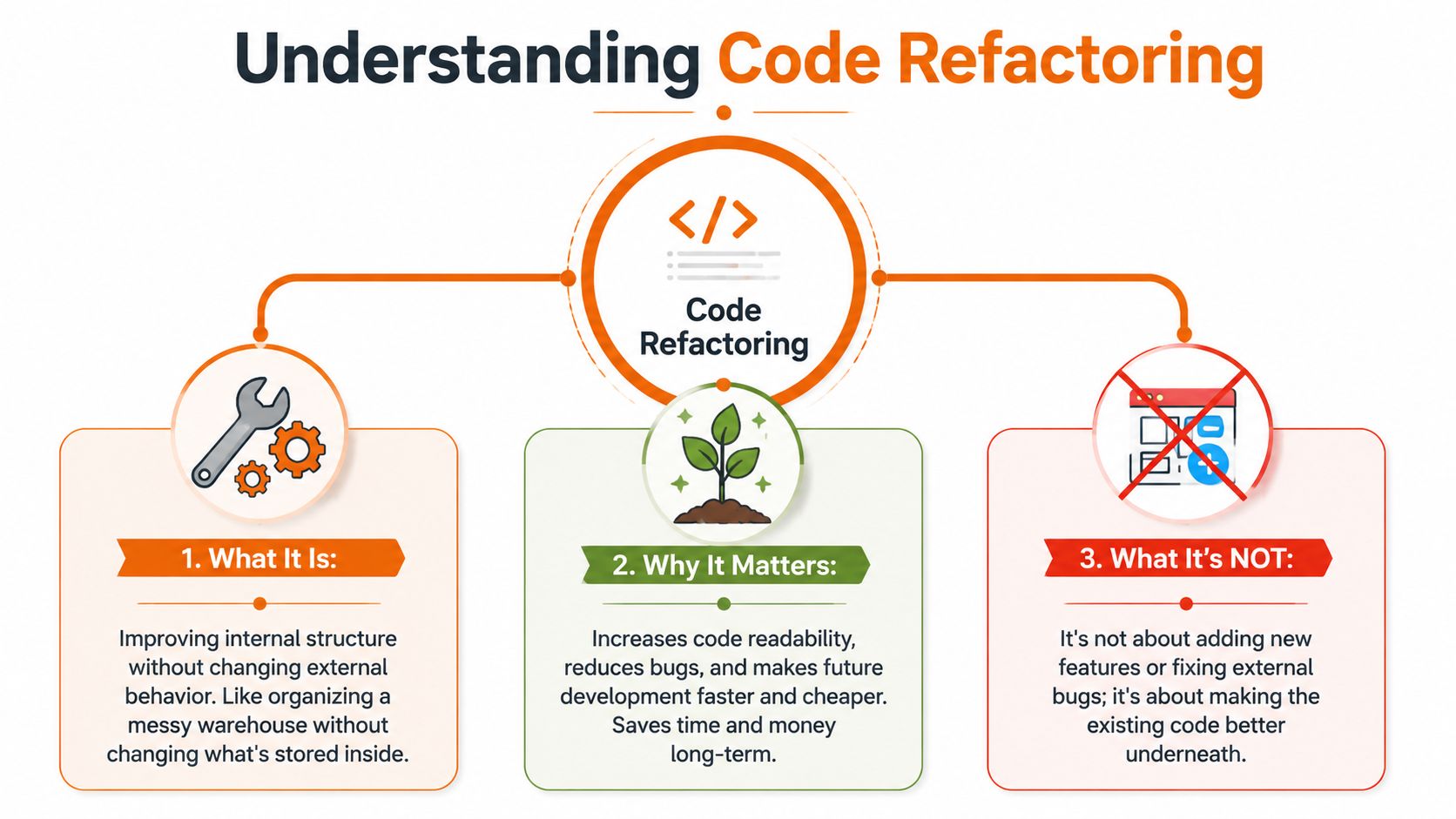
What is code refactoring? It's improving the internal structure of software without changing its external behaviour.
That last part matters. Customers shouldn't see a new feature because of refactoring alone. They should experience the same behaviour, but your team should have a cleaner, safer, easier-to-change system underneath.
The best non-technical analogy is a warehouse.
The warehouse analogy that actually works
Think of your software as a warehouse full of inventory. Refactoring doesn't change what's stored there. It changes how the warehouse is organised.
You relabel shelves. You move items into sensible aisles. You clear blocked paths. You stop keeping the same item in five different corners. The warehouse still serves the same goods. But now your staff can find things faster, make fewer mistakes, and add new stock without chaos.
That's refactoring.
What refactoring is not
Leaders get tripped up here because teams often bundle several kinds of technical work into one conversation. Separate them.
- It isn't a rewrite. A rewrite replaces major parts of the system or starts again from scratch.
- It isn't bug-fixing. A bug fix changes behaviour because something is broken.
- It isn't feature delivery. A new feature adds capability users didn't have before.
Refactoring sits underneath all three. It improves the structure that supports them.
Here's the simplest way to discuss it with your team:
| Activity | Goal | Impact on Features | Risk Level |
|---|---|---|---|
| Refactoring | Improve internal structure without changing behaviour | No new features | Moderate if done without tests, controlled if done incrementally |
| Rewriting | Replace part or all of a system with a new implementation | May delay feature delivery while rebuilding | High |
| Bug-Fixing | Correct behaviour that is wrong in production or test scenarios | No new features, but user-visible behaviour changes | Varies based on system criticality |
Why this matters in real teams
A 2021 survey of software developers found that 40.6% refactor code almost every day and 36.9% do it every week. That tells you something important. Refactoring isn't niche craftsmanship. It's routine professional work in serious software teams.
In plain English, teams refactor because living systems need maintenance to stay fast. The same way finance teams clean up reporting structures and operations teams standardise workflows, engineering teams reorganise code so future work costs less.
Refactoring is not “doing work twice”. It's reducing the cost of doing the next piece of work.
What this looks like in practice
A few simple examples make it concrete:
- Renaming vague variables so engineers instantly understand intent
- Extracting repeated logic into one shared method instead of copying it across the codebase
- Breaking long conditional chains into smaller, clearer rules
- Splitting oversized classes that do too many jobs into focused components
None of that changes the customer promise. It changes the team's ability to deliver on that promise again and again without friction.
Why Refactoring Is A Strategic Business Imperative
If your codebase slows delivery, refactoring is not optional overhead. It's operational advantage.
Leaders often classify refactoring as “engineering improvement work” and push it below feature demand. That's backwards. A slow, fragile codebase makes every feature more expensive. It also makes delivery less predictable, which is far worse than being slow.

The business cost shows up in four places
First, it hits delivery speed. Teams spend more time understanding old code, tracing side effects, and working around brittle dependencies.
Second, it raises maintenance cost. A 2023 UK Tech Nation report cited here found that disciplined code refactoring can reduce long-term maintenance costs on SaaS platforms by up to 40%. That's not cosmetic. That's margin.
Third, it harms quality. The same source cites a University of Bristol study linking unrefactored long methods to a 3x higher bug rate. That means code structure isn't just an engineering preference. It affects customer experience, support load, and trust.
Fourth, it weakens scalability. As the platform grows, messy internal structure turns every migration, integration, and new product line into a harder bet.
Refactoring protects your delivery engine
If you care about predictable release cycles, refactoring belongs next to testing, deployment automation, and architecture governance. It's part of the operating model.
Teams that pair refactoring with strong release discipline usually perform better because they remove friction before it compounds. If your leadership team is tightening engineering operations, these essential DevOps and CI/CD practices complement refactoring by making cleaner code easier to ship safely.
A lot of founders only confront this when delivery starts slipping and support costs rise. That's late. Better leaders treat code quality as a live operational concern, much like software maintenance management rather than an occasional rescue exercise.
Leadership lens: Refactoring is one of the few technical activities that improves speed, quality, and cost control at the same time.
This video gives a useful technical grounding if you want to understand how engineers think about the practice in day-to-day work.
The valuation angle leaders miss
Investors, buyers, and senior hires don't just assess your product. They assess whether your organisation can keep improving it without chaos.
A codebase that only the original team can safely change is a business risk. A codebase that supports repeatable delivery is an asset. Refactoring is how you protect that asset before the market forces the issue.
Key Refactoring Patterns Your Team Should Use
Founders don't need to memorise design patterns. They do need to recognise the problems those patterns solve.
The right question isn't “which refactoring technique sounds advanced?” It's “what recurring delivery pain are we paying for, and which structural fix removes it?”
When the same logic lives everywhere
One of the most expensive smells in a SaaS codebase is duplication. The same pricing rule appears in checkout, invoicing, admin tools, and a background job. A rule changes, and the team now has to hunt down every copy.
That's where Extract Method and related consolidation work matter. Your engineers pull repeated logic into one reliable place.
Business outcome:
- Change becomes cheaper because one update replaces many
- Risk drops because you stop missing hidden copies
- Knowledge transfer improves because there's a clear source of truth
If one business rule exists in multiple places, your team doesn't have one system. It has several slightly different versions of the truth.
When conditionals become a decision jungle
Some code starts simple and ends up unreadable. You see chains of if/else logic handling customer type, plan level, region, legacy exceptions, promotional rules, and temporary edge cases no one removed.
That slows everybody down. Engineers need too much time to reason about the impact of one change. Testing gets harder because nobody is fully confident they've covered the paths that matter.
Patterns such as Simplify Conditionals, guard clauses, and Replace Conditional with Polymorphism can turn that jungle into smaller, more understandable rules. For leaders, the signal is simple. If estimating a small logic change always triggers a long technical debate, the issue is probably structure, not effort.
When one class does everything
Every growing platform eventually produces a “god class”. One oversized component knows too much and does too much. It handles validation, business rules, orchestration, persistence, notifications, and perhaps half the product's history.
That's a serious business issue because it creates a bottleneck. Few engineers want to touch it. Fewer still can do it safely.

Breaking these components into smaller, single-purpose parts aligns directly with stronger software architecture and system design thinking. The point isn't elegance. The point is that engineers can understand, test, and change the system without fear.
A leader's translation guide
Use this when talking to your engineering team:
| What you notice in the business | What your team may be seeing in code | Refactoring pattern that usually helps |
|---|---|---|
| One change creates bugs in several places | Duplicated logic | Extract Method or shared service extraction |
| Tiny rule changes take too long to estimate | Complex nested conditionals | Simplify Conditionals or Replace Conditional with Polymorphism |
| New engineers ramp slowly on one module | Oversized god classes | Split by responsibility |
| Teams avoid touching certain files | High coupling and unclear ownership | Modularisation and responsibility separation |
What to ask in planning
You don't need to prescribe the implementation. You do need to ask sharper questions.
- Where is this logic duplicated today? If the answer is “in a few places”, push for consolidation.
- What part of this flow is hardest to change safely? That often identifies the right refactoring target.
- If a new engineer joined tomorrow, could they modify this confidently? If not, your speed problem is structural.
- Are we reducing complexity while building this feature, or adding to it? Good teams can answer clearly.
The strongest product and engineering leaders treat refactoring patterns as business tools. They know that clean structure isn't vanity. It's how teams avoid rework and keep shipping with confidence.
Building a Proactive Refactoring Workflow
Refactoring fails when teams treat it like a giant annual clean-up. That approach creates delay, risk, and endless debate about timing.
The better model is continuous refactoring. Small changes. Frequent decisions. Clear ownership. That's how disciplined teams protect speed without turning quality into a side project.
Build it into the sprint, not beside it
The simplest operating rule is the Boy Scout Rule. Leave the code cleaner than you found it.
That doesn't mean pausing delivery for broad, abstract tidy-ups. It means any engineer touching a part of the system should improve naming, remove duplication, simplify logic, or isolate responsibilities while they're already in that area. Done properly, this keeps quality moving forward without creating a separate programme that competes with product work.

A strong default workflow looks like this:
- Write or update a test first so the expected behaviour is explicit.
- Make the change pass with the simplest correct implementation.
- Refactor immediately after while the context is fresh.
- Review for structure, not just correctness in pull requests.
- Track recurring hotspots so repeated pain gets addressed intentionally.
Use Red-Green-Refactor with discipline
The Red-Green-Refactor cycle works because it removes guesswork.
Red means the test fails because the new expectation isn't met. Green means the code now works. Refactor means you improve the structure while keeping behaviour stable. This sequence stops teams from “cleaning up” code blindly and gives leaders a more reliable way to approve quality work.
If your organisation needs a sharper view on test quality, these key principles for software testing are useful because they reinforce behaviour-focused testing rather than brittle implementation checks.
Operating principle: Refactor in small steps that preserve behaviour. Large heroic clean-ups create unnecessary risk.
Don't let AI speed up the wrong thing
AI coding tools can help teams move faster. They can also flood a codebase with low-context, duplicated, weakly structured code if nobody is governing the output.
That risk is no longer theoretical. GitClear's 2024 analysis found that as AI assistant use rose, the volume of refactored code dropped from 25% to under 10%, while copy-pasted code increased. That signals a long-term quality problem if leaders reward output volume without reviewing structure.
So use AI, but set rules:
- Use AI for acceleration, not abdication. Let it propose improvements, not define architecture.
- Require human review of structural changes. Senior engineers should approve anything that affects boundaries or core workflows.
- Measure maintainability alongside velocity. Fast output that creates future drag isn't a win.
- Tie refactoring to non-functional expectations. Performance, reliability, observability, and maintainability all matter, especially when you define non-functional requirements in software delivery.
What extreme ownership looks like in practice
The best teams don't say, “the ticket didn't ask for cleanup”. They say, “we own the health of the system we're changing”.
That mindset changes delivery. Engineers stop passing structural mess downstream. Tech leads stop approving avoidable complexity because it's faster today. Product leaders stop treating code quality as invisible internal preference and start seeing it as delivery infrastructure.
Refactoring works when ownership is active, not performative. Small improvements, every sprint, backed by tests and reinforced by review. That's how teams stay fast without becoming fragile.
Your Partner In Delivering Predictable SaaS Value
Code refactoring is not a side concern for engineers with high standards. It's a core discipline for any SaaS business that wants predictable delivery, lower maintenance drag, and a platform that keeps compounding in value.
If your team ignores refactoring, you won't just get messier code. You'll get slower releases, shakier quality, harder onboarding, and less confidence in every strategic change. Leaders feel that in roadmap slippage, hiring pressure, and customer frustration.
There's also a talent and productivity angle that matters at scale. A 2025 Imperial College London analysis of UK scale-ups, cited here, found that refactoring god classes into single-responsibility components reduced engineer onboarding time and boosted team productivity by up to 45%. That's what disciplined structure buys you. Faster contribution from more people, with less cognitive overload.
Good software teams don't just ship features. They protect the conditions that make future shipping fast.
That is the fundamental answer to what is code refactoring. It's a management decision expressed through engineering practice. It says your company won't borrow speed from the future without a plan to pay it back. It says quality is part of delivery, not an optional afterthought. It says the codebase must support growth instead of resisting it.
If you lead a SaaS product, treat refactoring like revenue infrastructure. Because once your platform reaches scale, it is.
If you want a delivery partner that treats code quality with extreme ownership and builds SaaS platforms for speed, resilience, and long-term value, talk to Rite NRG. They help product teams ship faster without losing control of the codebase that powers the business.