Security in the software development life cycle (SDLC) isn't a final gatekeeper—it's a high-energy, proactive strategy for delivering business value. It's a total mindset shift, weaving security into every stage of development, from the first sketch to launch. This isn't just about defence; it's about building a superior product that wins customer trust and accelerates your path to market. It's security as a business enabler, not a technical checklist.
Why Weaving Security into Your SDLC is a Business Multiplier
Let's be blunt. For too long, security has been treated as a final, painful hurdle before launch—a dreaded bottleneck that kills momentum and delays revenue. Too many SaaS leaders see it as a cost centre, a frustrating delay standing between their brilliant idea and paying customers.
It's time to flip that script. This isn't a dusty manual; it's a strategic playbook for founders and CTOs who are ready to build resilient, market-leading products. As a strategic partner, we're here to show you that embedding security deep into your development process is about so much more than stopping hackers. It's your secret weapon for building fierce customer loyalty, hitting launch dates with confidence, and shipping a far superior product, faster.
From Afterthought to Accelerator
This proactive stance is the difference between firefighting and future-proofing. It’s about catching a potential problem on day one—when it's cheap to fix—not getting a panicked call six months after launch that puts your reputation and revenue on the line.
At Rite NRG, we live by our #riteway methodology, which is built on a foundation of "Extreme Ownership." This applies directly to security. When you own security from the start, it stops being a roadblock and becomes a powerful accelerator for innovation and sustainable growth. This isn't just a nice idea; it's a business necessity. Consider this: in the UK alone, third-party involvement in security breaches has doubled, and supply chain attacks have skyrocketed by an almost unbelievable 633%. A reactive, "we'll fix it later" attitude is no longer just risky; it's a direct threat to your company's survival and valuation.
Let's look at the old way versus the new way.
The Old Way vs The #riteway: A Mindset Shift
| Security Approach | Traditional (Reactive) | The #riteway (Proactive & Integrated) |
|---|---|---|
| When it Happens | At the end, just before release. | Throughout the entire SDLC, from day one. |
| Who Owns It? | A separate, isolated security team. | Everyone. Developers, QA, Ops—it's a shared responsibility driven by Extreme Ownership. |
| The Goal | Find vulnerabilities before launch (a "gatekeeper"). | Build secure software that delivers business value (an "enabler"). |
| The Cost | High. Finding and fixing late is expensive and slow. | Low. Early fixes are 100x cheaper and faster. |
| The Outcome | Delayed releases, team friction, and constant fire-fighting. | Faster delivery, higher quality, and confident innovation. |
This isn't just about defence; it's about playing offence. When security is baked into your DNA, it becomes a massive part of your value proposition. It empowers your business to:
- Launch Faster and More Predictably: Finding and squashing a bug in the design phase is infinitely cheaper and quicker than patching a live production system. This turns unpredictable delivery schedules into a reliable revenue engine.
- Build Unshakeable Customer Trust: In a world of constant data breach headlines, proving your commitment to security is one of the most powerful sales and retention tools you have. Customers and partners flock to products they know are safe, boosting acquisition and reducing churn.
- Innovate Without Fear: When your team isn't constantly putting out security fires, they can pour all that energy into building the amazing features that will conquer your market.
By taking extreme ownership of security, you transform what many see as a cost centre into a powerful engine for growth. To learn more about building these solid foundations, check out our guide on software development for startups.
Embedding Security Controls Across Every SDLC Stage
Let's get practical about how security weaves seamlessly into your development workflow, delivering value, not friction. Imagine your SDLC is a high-speed vehicle assembly line. You’d never wait until the car is on the showroom floor to check if the brakes work. The cost of a recall would be astronomical, and the damage to your brand would be catastrophic.
It’s the same story with security in the software development life cycle. It’s all about building in critical safety checks at every step, not as a panicked afterthought. The goal isn’t to add friction; it's to build smarter so you can move faster and with far more confidence, delivering a product that customers trust.
This infographic brilliantly illustrates the shift from the old, painful "roadblock" model of security to the modern, high-speed "superhighway" approach we live and breathe.
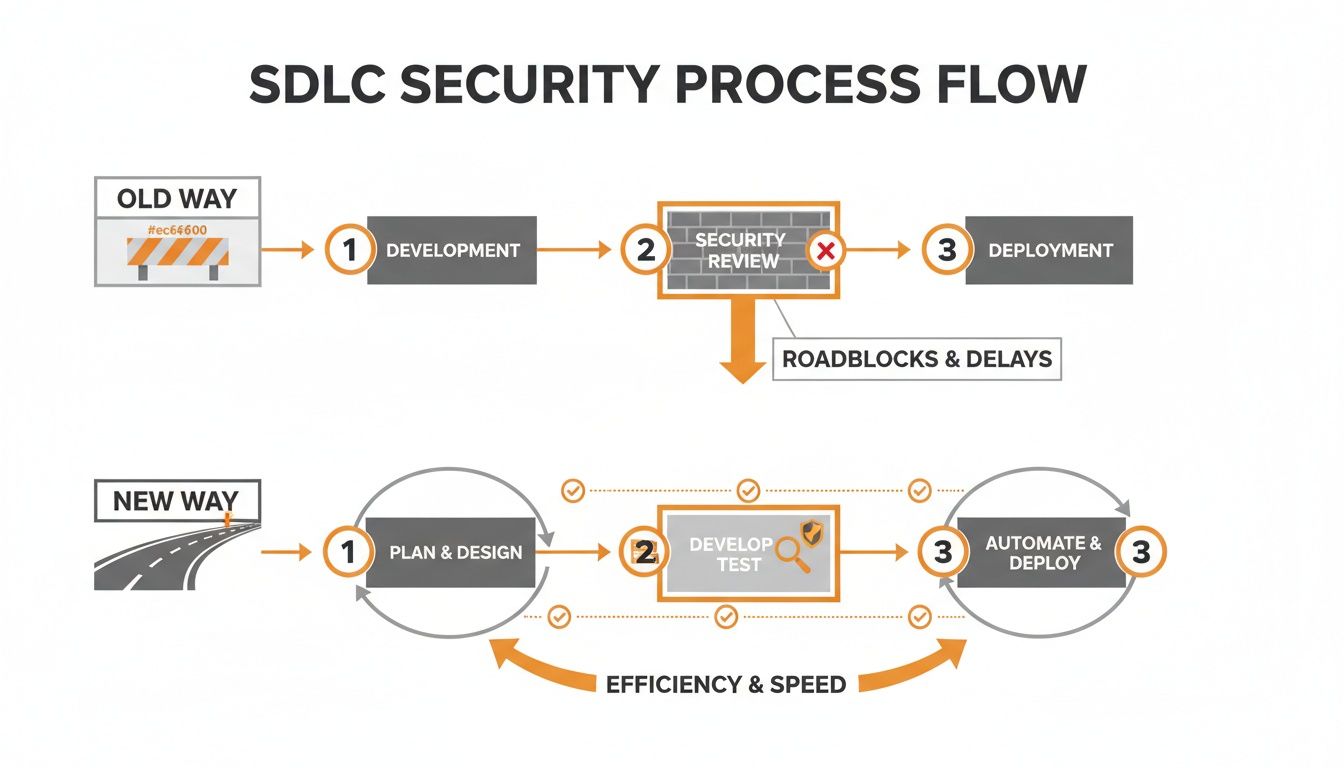
The business outcome is crystal clear: security isn't some final gate you have to pass. It’s a parallel track that actually enables faster, more reliable delivery by crushing expensive rework and killing nasty late-stage surprises that threaten your launch date.
Requirements And Design: A Blueprint For Resilience
Great security starts before anyone writes a single line of code. It begins here, in the design phase, where we lay the foundation for a resilient product. This is where we apply Extreme Ownership to potential risks and save a world of pain—and money—down the line.
One of the most powerful activities at this stage is Threat Modelling. Instead of just building something and hoping for the best, our high-energy teams proactively put on their attacker hats. We map out the application's architecture and ask the crucial question: "If I wanted to break this and steal customer data, how would I do it?" This collaborative exercise uncovers fundamental design flaws that would be a nightmare to fix later. Integrating robust Privacy by Design principles from day one is also a non-negotiable part of delivering a trustworthy product.
"A flaw fixed in the design phase is 100 times cheaper to fix than a flaw found after release. Proactive threat modelling isn't just a security practice; it's a powerful business efficiency strategy that protects your budget and your timeline."
This early-stage focus is everything. If you want to go deeper on creating systems that are built to last, we’ve laid out some core strategies in our guide on how to design great software architecture.
Development And Testing: Empowering Engineers for Speed and Safety
Once coding kicks off, the game shifts to empowering your developers to be the first line of defence. This isn’t about turning them into security gurus overnight. It's about giving them the right tools and automated feedback loops to write secure code from the get-go, turning security into a seamless part of their high-energy workflow.
- Static Application Security Testing (SAST): Think of this as a super-smart spellchecker for code that’s obsessed with security. SAST tools plug directly into the developer's coding environment, scanning for vulnerabilities as they type. This provides immediate, actionable feedback, letting them fix issues on the spot. The business outcome? Faster cycles and drastically lower remediation costs.
- Software Composition Analysis (SCA): Modern applications are built on countless open-source libraries. SCA tools are your automated defence against supply chain attacks, constantly scanning these dependencies for known vulnerabilities. The business outcome? Protecting your company from headline-making breaches caused by third-party code.
Deployment And Maintenance: Continuous Vigilance for Continuous Value
As we gear up for deployment, automation becomes our best friend. Security checks get baked right into the Continuous Integration/Continuous Deployment (CI/CD) pipeline, acting as an automated guard that ensures no insecure code ever makes it to production.
This is where we run automated Dynamic Application Security Testing (DAST) tools, which actively probe the running application for weaknesses, mimicking how a real attacker would. But security doesn't stop at launch. Continuous monitoring and diligent patching ensure your application stays secure against emerging threats, protecting your customers and your revenue streams long-term. It’s a continuous loop that makes your security posture stronger with every release.
The Modern Toolkit For Building Secure Software
Let's be honest, picking the right security tools can feel like navigating a maze blindfolded. The market is flooded with complex acronyms and wildly expensive promises, making it nearly impossible to figure out where to even start.
Here’s the secret from a strategic partner: building a secure product isn't about buying every flashy tool. It’s about making smart, targeted investments that deliver real business outcomes. It’s about giving your team a high-energy, proactive toolkit that turns your development process into a self-correcting system that accelerates delivery.
This isn't just theory. The demand for great tooling is exploding because the cost of insecure software is painfully high. The UK Cyber Security Software Development industry is on track to hit £1.4 billion in revenue by 2025, a direct response to the fact that a staggering 43% of UK businesses were hit by breaches. This surge is about one thing: embedding security right into the development workflow to protect business value.
That’s where a consulting mindset, laser-focused on value, cuts through the noise. We'll break down the essential tools—what they are, why they matter, and exactly where they fit—to bulletproof your product and accelerate your delivery.
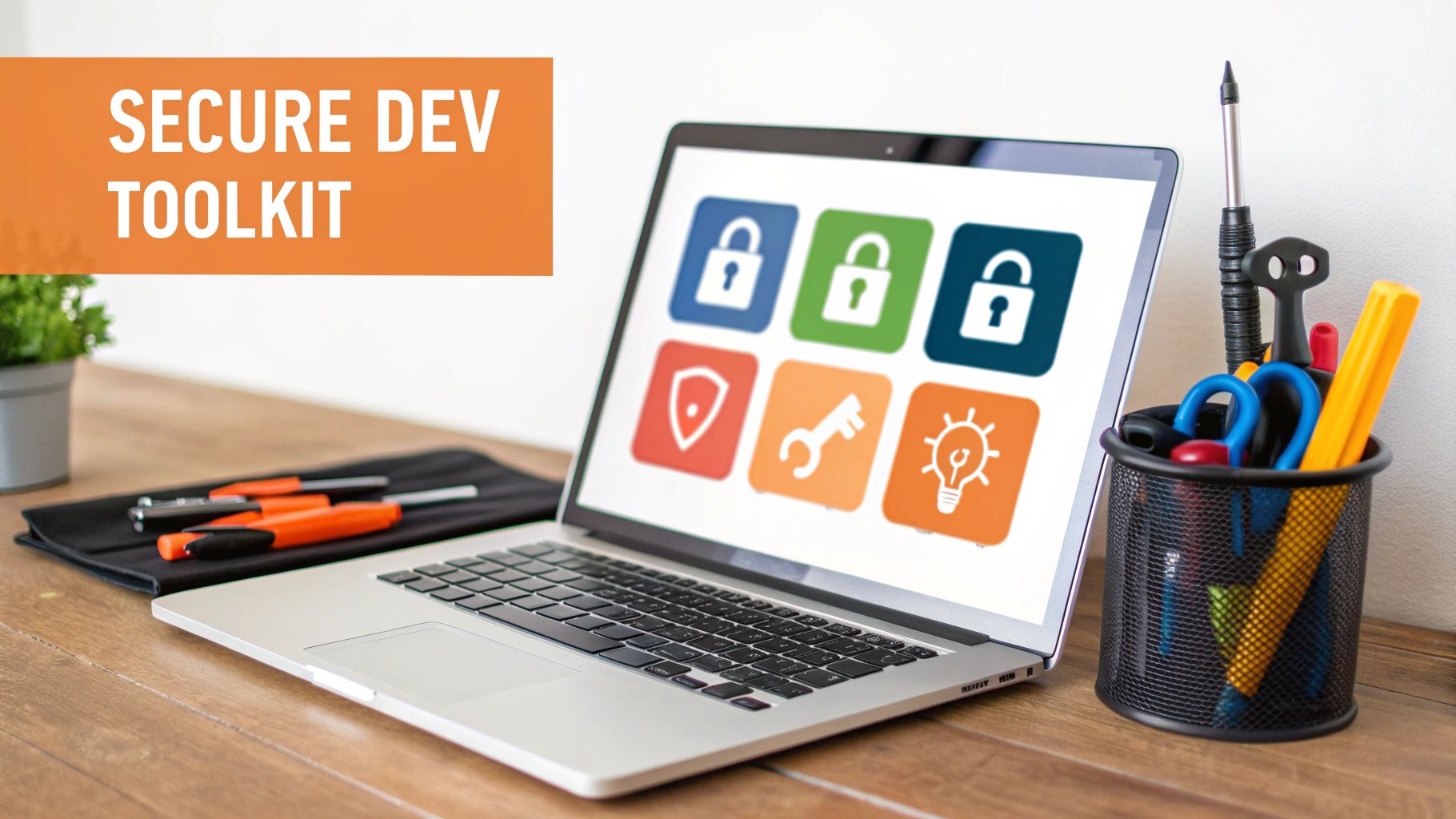
To make things even clearer, here's a quick cheat sheet breaking down the core tools you'll need in your arsenal.
Essential Security Tooling Cheat Sheet
| Tool Type | What It Does | Best Fit SDLC Stage | Business Outcome |
|---|---|---|---|
| SAST (Static Analysis) | Scans raw source code for bugs and vulnerabilities before it runs. | Development | Catches flaws early, slashing remediation costs and time. |
| DAST (Dynamic Analysis) | Tests the live, running application for vulnerabilities from an attacker's view. | Testing / Staging | Finds runtime-specific issues that static analysis can't see, preventing live breaches. |
| SCA (Dependency Scanning) | Identifies known vulnerabilities in third-party libraries and components. | Development & CI/CD | Protects against supply chain attacks and ensures compliance, safeguarding brand reputation. |
| Secrets Management | Securely stores and manages API keys, passwords, and other credentials. | Across the SDLC | Prevents credential leaks, a leading cause of major breaches that destroy customer trust. |
This table gives you a bird's-eye view, but let's dive into what makes these tools so powerful.
Automated Code Analysis: SAST and DAST
Think of these tools as your first line of automated defence—your tireless, 24/7 security analysts who provide instant feedback right when it's needed most.
- Static Application Security Testing (SAST): This is like having a security-obsessed proofreader looking over your developer's shoulder. SAST scans your raw source code before it’s even compiled, hunting for common coding errors. When plugged straight into the developer's environment, they get immediate feedback and can fix issues on the spot. The business outcome is crystal clear: dramatically reduced remediation costs and faster development cycles.
- Dynamic Application Security Testing (DAST): If SAST is the proofreader, DAST is the real-world crash test. It probes your running application from the outside, mimicking how an attacker would. This is an essential check in your testing environments, ensuring your code is secure in practice, not just in theory. The business outcome? Catching critical vulnerabilities before they can be exploited by real attackers.
By combining these two, you get a powerful inside-out and outside-in view of your application's security posture, baked directly into your CI/CD pipeline.
Supply Chain and Secrets Management
Modern software is rarely built from scratch. It’s assembled from hundreds of open-source libraries. This creates a massive supply chain that must be secured. At the same time, your application needs credentials—API keys, database passwords—to function. Leaving these "secrets" in your code is like leaving your house keys under the doormat for the world to find.
Taking extreme ownership of your software supply chain is non-negotiable. A single vulnerable library can compromise your entire application. Automated dependency scanning is your first and most critical line of defence.
Here’s how you lock down these two critical areas:
- Software Composition Analysis (SCA): These tools are your automated inventory managers. They scan all third-party libraries in your project against a massive database of known vulnerabilities. When a flaw is found, the tool alerts you and often suggests the exact version to update to, making fixes quick and painless. The business outcome? A secure supply chain that builds trust with enterprise customers.
- Secrets Management: Stop storing credentials in config files or source code—immediately. A dedicated secrets management tool, like HashiCorp Vault or AWS Secrets Manager, acts as a centralised, encrypted safe. Your applications fetch credentials at runtime, ensuring they are never exposed. The business outcome? Dramatically reducing the risk of a catastrophic data breach.
Integrating these tools is a cornerstone of a resilient development process. To learn more about the technologies that power great products, check out our guide on modern product development software. Ultimately, this modern toolkit isn't just about defence; it's about enabling speed and confidence, reflecting the Rite NRG commitment to delivering exceptional business value.
Fostering a Culture of Extreme Ownership in Security
You can have the best security tools on the planet, but they’re only half the story. The most advanced scanner is useless if your team treats security as “someone else’s problem.” To build truly bulletproof software, you need to ignite a cultural fire—a mindset where every single person on your team takes Extreme Ownership for the security of the product. This is a core pillar of the #riteway methodology.
This means moving away from the old, siloed world of finger-pointing and embracing a unified, proactive defence. Security isn't some dark art practiced by specialists; it's a team sport. When product managers, developers, and QA engineers all see themselves as guardians of the system, you create something exponentially stronger than the sum of its parts.
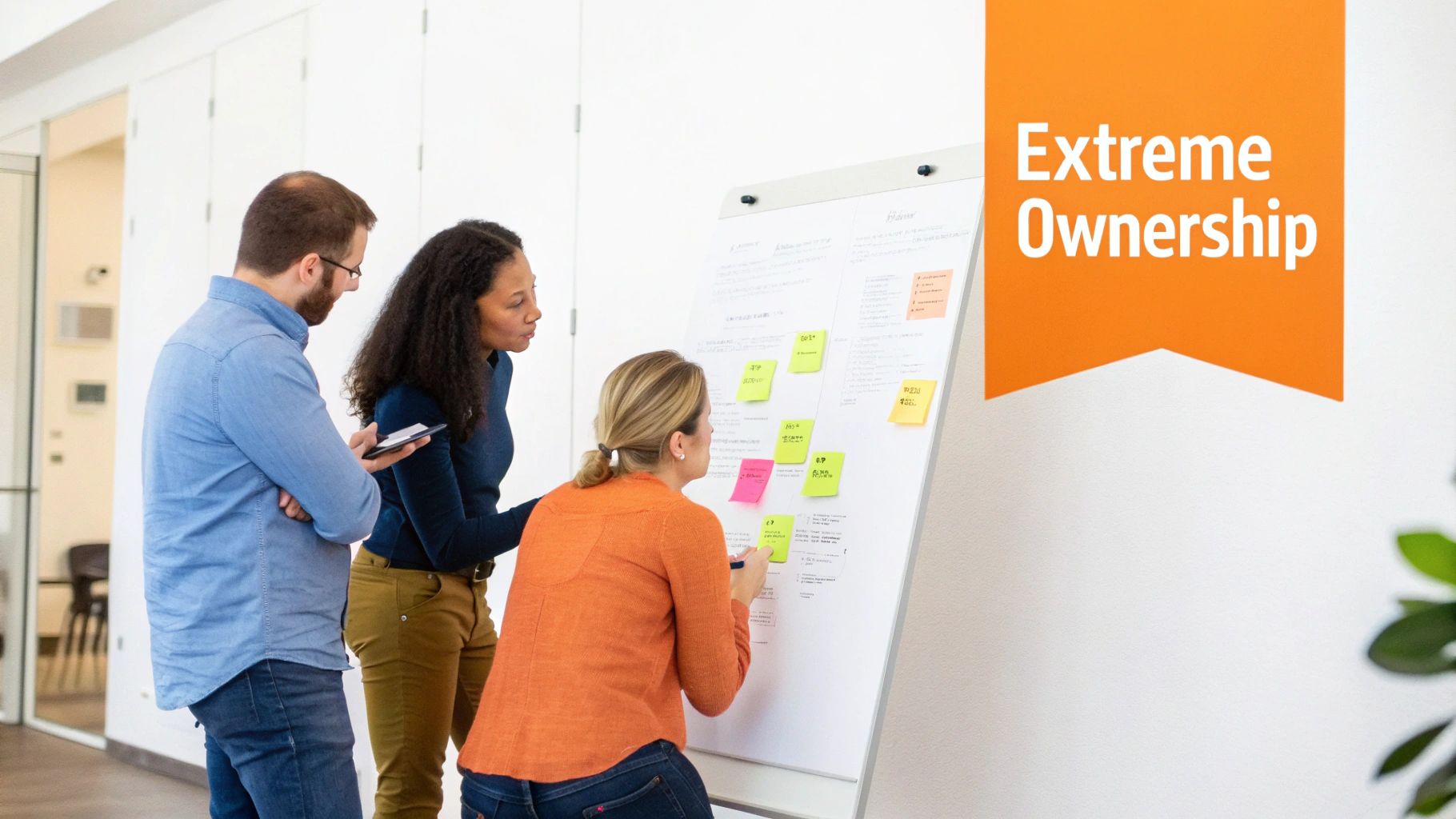
Of course, a shift this big doesn't just happen. It has to be built. Laying the groundwork with comprehensive cybersecurity training for employees is non-negotiable, as it’s the first step in transforming your team into a powerful 'human firewall'.
Clarifying Roles and Responsibilities
Extreme Ownership begins with crystal-clear expectations. Everyone on the team needs to know exactly what their part is in defending the application. This isn't about piling on extra work; it’s about weaving a security-first mindset into the fabric of their daily roles.
- Product Managers: They own the "what" and "why." This means security requirements are defined right alongside feature requirements. They prioritise security stories and ask from day one, "What are the security implications of this feature for our customers and our business?"
- Developers: As the builders, they own the "how." They're responsible for writing clean, secure code. This means actively using SAST tools for instant feedback and tackling vulnerabilities with a sense of urgency.
- QA Engineers: These are your expert "breakers." Their role goes beyond just checking if a feature works. They think like an attacker, running DAST scans and actively hunting for ways to exploit the application.
- DevOps/Platform Engineers: They own the fortress. Their domain is the infrastructure, and their mission is to harden the CI/CD pipeline, manage secrets, and ensure the production environment is hostile to any would-be attacker.
When everyone knows their post, there are no cracks for vulnerabilities to slip through. It creates a seamless, proactive environment where security becomes a natural part of the workflow.
Moving Beyond Vanity Metrics to Business Outcomes
A culture of ownership is fuelled by measuring what actually matters. For too long, security teams have been judged on vanity metrics like the "number of vulnerabilities found." That number tells you nothing about your real-world risk or business performance. It’s just technical output.
To show you’re making a real difference, you have to stop counting problems and start measuring the speed and efficiency of your solutions. This is how you prove that your security programme isn't just a cost centre—it's a powerful engine for creating value.
The #riteway approach is all about tracking metrics that plug directly into business performance. These are the numbers that prove your security investment is paying off by making your delivery more predictable and your product more resilient.
Here are the metrics that genuinely drive business value:
- Mean Time to Remediate (MTTR): This is the king of all agility metrics. It measures the average time it takes your high-energy team to crush a vulnerability from the second it’s found. A low MTTR is the hallmark of a proactive team that neutralises threats before they can cause business harm.
- Security-Related Bug Density: This tracks the number of security bugs per thousand lines of code. Seeing this number trend downwards over time is your proof that secure coding practices and developer training are hitting the mark and improving product quality.
- Cost of Remediation by SDLC Stage: This is a killer ROI metric. It puts a real number on the incredible savings you get from catching issues early. A flaw fixed in design might cost a few pounds, but that same flaw found in production could cost tens of thousands to fix, impacting your bottom line.
By tracking and celebrating these powerful, outcome-focused metrics, you pour fuel on the fire of Extreme Ownership. You show the entire team how their individual efforts directly build a faster, stronger, and more profitable business.
How to Weave Security into Your Nearshore Team's DNA
Bringing a nearshore partner into the fold is a massive boost for talent and speed, but how do you ensure your security stays rock-solid? The secret isn't more red tape; it's about forging a genuine partnership built on transparency, shared goals, and what we live by: Extreme Ownership.
This is our playbook for making security a natural, energetic part of how you build software together. We don’t create a separate "security team" over there and a "dev team" over here. Our goal is to create one cohesive unit, where your nearshore crew feels like a true extension of your own, all obsessed with shipping a secure, brilliant product. And it all kicks off by being incredibly clear from day one.
Lock in Total Alignment Before a Single Line of Code is Written
The success of any nearshore relationship hangs on everyone being on the same page. Before development starts, we get crystal clear on the security requirements. This isn't just a technical checklist; it's a strategic conversation about your business risks and the trust you have with your customers.
We make this a huge part of our kickoff. Everyone—and I mean everyone—needs to understand the security standards, any compliance hoops we need to jump through, and the specific threats we're guarding against. Getting this sorted early kills any confusion and empowers every engineer, whether in your office or ours, to make smart, security-first decisions autonomously.
A partnership runs on clarity. When security expectations are part of the statement of work and are talked about in daily stand-ups, they stop being a source of friction and become a shared mission. That's what proactive, high-energy collaboration really looks like.
Building Secure Workflows and Shared Pipelines
Once that foundation is solid, we get into the nitty-gritty of secure collaboration. This is where you need more than just coders; you need partners with a consulting mindset who help you build a secure development environment from the ground up.
A few practices are absolutely non-negotiable:
- Airtight Access Controls: We live by the principle of least privilege. Team members get access only to the systems and data they absolutely need to do their jobs. This dramatically shrinks the potential attack surface.
- Security Baked into the CI/CD Pipeline: We’re huge advocates for plugging automated security tools (SAST, SCA, you name it) directly into the CI/CD pipelines you share. This creates an automated safety net that checks every piece of code against the same tough standards, no matter who wrote it.
- Open and Honest Communication: With shared channels for talking about potential vulnerabilities in real-time, risks get spotted and squashed immediately. This kind of open dialogue is central to the Rite NRG "can-do" spirit—we turn potential problems into challenges we solve together.
This screenshot from our Clutch profile really shows what happens when you commit to this kind of deep, partnership-first way of working.
Those consistent 5-star ratings aren't just about technical chops. They speak to the immense business value of having a partner who takes Extreme Ownership over quality, communication, and—most critically—security. This feedback is a direct result of building high-trust relationships where getting security right is a win for everyone. Our product-first mentality means every decision we make is viewed through the lens of what will create the most secure, valuable, and successful product for your business.
The Rite NRG Approach: Where Secure Meets Speed
Let’s get real. All the security theory in the world doesn't mean a thing if it can't keep up with the pace of your business. Delivering secure software, fast, isn't about ticking boxes. It’s a total mindset shift. This is the core of the #riteway methodology—a philosophy built on high energy, Extreme Ownership, and an obsessive focus on real business outcomes, not just lines of code.
We’ve ripped up the old playbook where security is the angry gatekeeper at the end of the line. Instead, we weave it into the very fabric of how we build. This isn't a trade-off. It’s a smarter way of working that helps our partners ship features up to 50% faster without cutting a single corner on quality. We don’t just find problems; we build systems that stop them from ever happening in the first place.
AI-Powered Processes and a Can-Do Culture
Our secret sauce isn’t just about having great people; it's about amplifying their talent with smart automation. We embed AI-driven processes into our daily workflows to handle the grunt work of routine security scans. These systems are relentless—they hunt for vulnerabilities and flag potential risks long before they can blow up a sprint or jeopardize a launch.
But this isn't just about catching bugs. It's about freeing up your best people. When automation handles the repetitive checks, your senior engineers can stop being code janitors and start being the innovators you hired them to be. Their brainpower goes into solving the tough problems and building the amazing features that your customers are waiting for.
Security isn't a department; it's a culture. When you combine transparent collaboration with a proactive, 'can-do' attitude, security discussions shift from being confrontational to constructive. That's the Rite NRG difference.
Making Your Delivery Predictable and Secure by Design
At the end of the day, our mission is simple: make your delivery schedule solid as a rock and your product virtually unbreakable. We get there by building a culture where security is everyone’s job, all driven by a consulting mindset that ties every technical choice directly back to business value.
Here’s what that actually looks like:
- Proactive Risk-Spotting: Our entire process is wired to surface potential issues early and often. Security becomes a continuous, open conversation, not a last-minute panic.
- Constructive Teamwork: We create an atmosphere where developers and security pros are on the same team, with the same goal. It's about solving problems together, not pointing fingers.
- A Passion for Excellence: We're obsessed with getting it right the first time. This eliminates the soul-crushing, budget-draining rework that plagues so many other projects.
This energetic drive for excellence is what transforms security from a chore into a massive competitive advantage. When you partner with Rite NRG, you're not just hiring a set of skills; you’re getting a dedicated team that is all-in on making your product a runaway success.
Frequently Asked Questions
Jumping into security within the software development life cycle can feel daunting. We get it. Here are some straight-talking answers from a strategic partner to the questions we hear most often from founders and tech leaders.
Won't Adding Security Checks Slow Down Our MVP Delivery?
This is probably the biggest myth out there! It's a fair question, but our experience shows the opposite is true. When you build security in from the start—what we call a ‘shift-left’ approach—you actually speed things up. You’re catching tiny issues early before they balloon into massive, soul-crushing problems that derail your launch.
Think of it this way: automated tools plugged into your CI/CD pipeline give your developers feedback in minutes, not weeks. The #riteway model is all about making these checks lightweight and frictionless, turning security into a catalyst for speed. That small investment of time up front pays for itself a hundred times over by preventing those nightmare scenarios of last-minute panics and emergency patches.
Taking Extreme Ownership of security from day one means you're building a faster, more reliable delivery engine, not adding a bottleneck. It's about building it right the first time to accelerate your path to market.
Our Developers Are Not Security Experts. How Can We Do This?
And they don't need to be! You're not trying to turn every developer into a security guru. The real magic happens when you empower your team with the right tools and create a culture where everyone feels responsible for security. It's about making security a natural, integrated part of their craft.
As your strategic partner, we kick things off by integrating simple, user-friendly SAST tools right into their development environment. This gives them instant, easy-to-understand feedback as they code. From there, we focus training on real-world risks, like the OWASP Top 10 vulnerabilities. Our "can-do" attitude means we embed security champions in your team, making it a collaborative effort instead of a chore handed down from on high.
What Is The Single Best First Step To Take?
Easy. Start with automated dependency scanning. It’s the highest-impact, lowest-effort move you can make, period. So much of today's software is assembled from open-source libraries, which means a huge chunk of your risk is hiding in code you didn't even write.
Hooking up a tool like Snyk or Dependabot to your source code repository is an absolute game-changer. It automatically sniffs out known vulnerabilities in all those third-party components and often raises pull requests to fix them for you. This one step gives your security posture an immediate and massive boost by tackling supply chain risk head-on.
Ready to transform security from a roadblock into a superhighway for innovation? The team at Rite NRG is obsessed with helping you build and scale secure SaaS products faster and more predictably. Let's talk about building your secure MVP.